 A GUIDE TO PREAMBLES IN ETC
  A GUIDE TO PREAMBLES IN ETC
 This Guide to the Preambles in the Encyclopedia of Triangle Centers (ETC) exists for this purpose: to be searched. Instead of searching ETC's Parts one at a time, you can search the Guide, which covers all 37 Parts. For example, you can search for names, terms, sources, years, etc.
Try searching these names of contributors of triangle centers: Dao, Hatzipolakis, Hutson, Lozada, Moses, Pavlov, Warren, and many others.
Then try some of these:
Centers X(74), X(98)-X(112). Points on the circumcircle; mappings Λ and Ψ
Centers X(113)-X(139) (Points on the nine-point circle)
Centers X(140)-X(170) (Centers of central triangles)
Centers X(191)-X(236) (Ceva conjugates)
Centers X(237)-X(248) (Line conjugates)
Centers X(249)-X(297) (isogonal conjugates of prevously listed centers)
Centers X(298)-X(350) (isotomic conjugates of prevously listed centers)
Centers X(401)-X(475), on the Euler line
Centers X(485)-X(495), triangle centers associated with squares
Isoscelizer points: X(503)-X(510)
Centers on the lines at infinity: X(511)-X(526)
Centers X(527)-X(565). Jan 1 2001. Among these, X(527)-X(545) are of the form "direction of vector AX+BY+CX for selected triangle centers X. Points X(546)-X(551) are midpoints.
Centers X(566)-X(584) (includes definitions of these words as nouns: orthogonal, harmonic, orthoharmonic.)
Centers X(616)-X(642), contributed by Bernard Gibert, March 2, 2001.
Trilinears for points in this section were found by Joe Goggins, Oct. 19, 2005.
Centers X(1166)-X(1208), February 14, 2003. Saragossa points (1st, 2nd, 3rd), contributed by Darij Grinberg
Centers X(1286)-X(1311), Collings Transforms
Centers X(1354)-X(1367), Brisse Transforms
Centers X(1393)-X(1477), Beth Conjugates
Centers X(1512)-X(1568), Orthojoins
Centers X(1601)-X(1634), TCC Perspectors. Suppose P is a point. As noted in TCCT, p. 201, the tangential triangle is perspective to the circumcevian triangle of P. (The tangential triangle is also perspector to the circum-anticevian triangle of P, with the same perspector as for the circumcevian triangle of P.) In August 2003, Jean-Pierre Ehrmann gave barycentrics for the perspector, called the TCC-perspector of P. For further properties of TCC perpsectors, published some 14 years after their introduction here, see I. Minevich and P. Morton, International Journal of Geometry 2017, "Synthetic foundations of cevian geometry, IV"
Centers X(1635)-X(1651), Tripolar Centroids, contributed by Darij Grinberg, August 24, 2003.
Centers X(1662)-X(1706), Circle-related points, contributed by Peter Moses during August, 2003.
Centers X(1707)-X(1788), Mimosa transforms and inverse Mimosa tranforms, contributed by Clark Kimberling, September 16, 2003. Let g(P,X) denote the P-gimel conjugate of X. The Mimosa transform M(X) arises in connection with the equation g(P,X) = X.
Centers X(1824)-X(1907), Zozma transforms (isogonal conjugates of inverse Mimosa transforms)
Centers X(1908)-X(1982), Centers from bicentric pairs. Suppose P and U are a bicentric pair. Many operations on P and U result in triangle
centers. Among these are trilinear and barycentric product, bicentric sum, bicentric difference, crosssum, and crossdifference.
Centers X(1992)-X(2006), Orthocorrespondents. Suppose that P is a point in the plane of triangle ABC. The perpendiculars through P to the lines AP, BP, CP meet the lines BC, CA, AB, respectively, in collinear points. Let L denote their line. The trilinear pole of L is the orthocorrespondent of P. This definition was introduced by Bernard Gibert.
Centers X(2007)-X(2040). Gallatly circle (pedal cicle of the 1st and 2nd Brocard points).
Centers X(2041)-X(2046), Euler-Vecten-Gibert Points. On August 13, 2003, Bernard Gibert contributed six centers that lie on the Euler line and are related to the Vecten points.
Centers X(2055)-X(2046), Orion transforms, contributed by Jean-Peirre Ehramann, September 24, 2003.
Centers X(2070)-X(2080), Inverses in circumcircle, contributed by Peter Moses.
Centers X(2081)-X(2088), PK and NK Transforms, contributed by Bernard Gibert, October 1, 2003. Let X -1 denote the isogonal conjugate of X. Then PK(X) is the point of intersection of the trilinear polar of X and the trilinear polar of X -1, and NK(P) is the pole of the line XX-1 with respect to the conic that passes through points A, B, C, X, and X -1. Also, PK(X) is the crossdifference, and NK(X) the crosssum, of X and X -1.
Centers X(2093)-X(2105), Reflections, contributed by Peter Moses.
Centers X(2106)-X(2119), points on the 2nd equal-areas cubic, EAC2. For any point P on EAC2, the X(2)-isoconjugate of P is also on EAC2. Contributed by Clark Kimberling.
Centers X(2120)-X(2143),, Eigencenters and eigentransforms. Contributed by Clark Kimberling, October, 2003.
Centers X(2365)-X2384), More points on the circumcircle, October 20, 2003, revised January 20, 2015 following suggestions by Viktor Kataysky. Notations: CIR(U)
Centers X(2394)-X2419), Gibert-Simson Transforms. On October 19, 2003, Bernard Gibert contributed points that lie on the Simson cubic. Indeed, this cubic is the image of the circumcircle under a mapping here named the Gibert-Simson transform.
Centers X(2446)-X(2573), (Mostly) circle-related points, contributed by Peter J. C. Moses, October-November, 2003. See the notes just before X(1662) for an introduction and notation. Included in this section are centers of similitude of several pairs of circles.
Centers X(2594) - X(2670), related to bicentric pairs.
Centers X(2677)-X(2770), Rigby-Simson points and Simson-Rigby points.
Centers X(2855)-X(2868), Simson-Moses points, defined by changing "isogonal" to "isotomic" in the definition of Simson-Ribgy
points (X(2687)-X(2770).
Centers X(2883)-X(2962), Isogonal Conjugates with respect to Special Triangles (e.g,, medial, orthic, excentral, tangential). The term "complementary conjugate" already in use at the time of this writing (November 11, 2004) is a synonym for "medial isogonal conjugate", as is "anticomplementary conjugate" for "anticomplementary isogonal conjugate"; accordingly, the earlier terms will be used in the sequel. Also, "excentral isogonal conjugate" is "X(188)-aleph conjugate" and "orthic isogonal conjugate" is "X(4)-Ceva conjugate"; in these cases, the new terminology will be used.
Centers X(2967)-X2973), Points lying on the MacBeath inconic, contributed by Peter Moses, November 12, 2004,
Centers X(2979)-X(), Dual triangles: DC points and CD points, contributed by Clark Kimberling. Suppose DEF is a triangle in the plane of triangle ABC. Let D' be the isogonal conjugate of the point of intersection of line EF and the line
at infinity. Define E' and F' cyclically. The triangle D'E'F' is here
named the dual of DEF. The vertices of D'E'F' lie on the
circumcircle, and D'E'F' is similar to DEF. The duality is between the
sidelines EF, FD, DE and the points D', E', F', respectively. For
example, if E and F remain fixed and D varies, then D' remains fixed,
while E'F' varies. Actually D'E'F' is the dual of any triangle
homothetic to DEF. Indeed, DEF need not be a triangle but can be the
union of three concurrent lines. Suppose U is a point having cevian triangle DEF and dual triangle D'E'F'. Then there exists a point DC(U) whose circum-anticevian
triangle (TCCT, p. 201) is D'E'F'. To construct DC(U) from U, let A' = AD'∩BC, and let A" be the {B,C}-harmonic conjugate of A'. Define B" and C" cyclically. The lines
AA", BB", CC" concur in DC(U). Also, DC(U) = U-isoconjugate of the
crosssum of U and X(6).
Centers X(3000)-X(3019), Intersections of Central Lines.
gX = isogonal conjugate of X
tX = isotomic conjugate of X
tgX = isotomic conjugate of gX
gtX = isogonal conjugate of tX
Gt = intersection of lines X(tX) and (gX)(gtX)
Tg = intersection of lines X(gX) and (tX)(tgX)
Then the points A, B, C, gX, tX, Tg, Gt are on a conic. As a circumconic, it is the image under the isogonal conjugate mapping of line X(gtX). It is also the image under the isotomic conjugate mapping of line X(tgX).
A3 = BB2∩CC2, B3 = CC2∩AA2, C3 = AA2∩BB2.
Eric Danneels proves in "A Simple Perspectivity," Forum Geometricorum 6 (2006) 199-203, that the triangles A3B3C3 and ABC are perspective. If X = x : y : z (barycentrics), then the Danneels perspector P(X) is given by
P(X) = x(y - z)2 : y(z - x)2 : z(x - y)2.H(X; M, t) = bc[(1 + t)ax + (1 - t)by + (1 - t)cz] : ca[(1 - t)ax + (1 + t)by + (1 - t)cz] : ab[(1 - t)ax + (1 - t)by + (1 + t)cz],
with inverse given by
H-1(X; M, t) = bc[(1 - t)(by + cz) - 2ax] : ca[(1 - t)(cz + ax) - 2by : ab[(1 - t)(ax + by) - 2cz].
César E. Lozada contributed several such triangle centers (March 21, 2011).
It is well known that if X=X(1), the incenter, then the three aforementioned Euler lines concur in the Schiffler point, X(21). If their parallels, the lines LA, LB, LC concur, the point of concurrence is the Kirikami-Schiffler point of the triangle A'B'C', denoted by KS(A'B'C'). Seiichi Kirikami (February 1, 2011) found that those lines concur if A'B'C' is the reference triangle ABC and also concur if A'B'C' is the medial triangle. Peter Moses found additional cases and properties..
a(a - b)(a - c)yz + b(b - c)(b - a)zx + c(c - a)(c - b)xy = 0.
This hyperbola has perspector X(100), center X(5375), meets the circumcircle in X(898) and the Steiner circumellipse in X(666), and is the isogonal conjugate of the line X(244)X(665). If X = x : y : z (barycentrics) is a point on the circumcircle, then the point H(X) = x/(a(b - c)) : y/(b(c - a)) : z/(c(a - b)) is on the Hutson-Moses hyperbola.
If P = p : q : r (trilinears), then the perspector is P* = a(b + c - a)p2 : b(a + c - b)q2 : c(a + b - c)r2.
F1 = X(13), the 1st Fermat point
F2 = X(14), the 2nd Fermat point
F3 = inverse of F1 in the circumcircle
F4 = inverse of F2 in the circumcircle
F5 = inverse of F1 in the nine-point circle
F6 = inverse of F2 in the nine-point circle
Dao Thanh Oai noted that these points are concyclic, Telv Cohl gave a proof, and Peter Moses discovered properties described in this preamble. The center of the Dao-Moses-Telv circle is X(1637). (Francisco Javier García Capitán, November 3, 2014)
The Dao-Moses-Telv circle is orthogonal to the circumcircle, the nine-point circle, and all the other circles in their coaxal family. The circle passes through X(5000) and X(5001), these being the Walsmith point and its inverse in the circumcircle. (Peter Moses, November 6, 2014)
x(S2Cy2 - S2Bz2) + y(S2Az2 - S2Cx2) + z(S2Ax2 - S2Ay2) = 0.
The subject of symbolic substitution was introduced in C. Kimberling, "Symbolic substitutions in the transfigured plane of a triangle," Aequationes Mathematicae 73 (2007) 156-171.
Trilinear image:
Let P be a point with trilinears x : y : z wrt T1. Then the T1-to-T2 trilinear image of P is the point P′ with trilinears x : y : z wrt T2. This is a non-affine collineation, preserving collinearities, but not ratios of distances between collinear points. Parallel lines do not remain parallel under this mapping, so that points on the line at infinity map to finite points. Circumconics of T1 map to circumconics of T2 and inconics of T1 map to inconics of T2.
Barycentric image:
Let P be a point with barycentrics x : y : z wrt T1. Then the T1-to-T2 barycentric image of P is the point P′ with barycentrics x : y : z wrt T2. This is an affine collineation, preserving collinearities as well as ratios of distances between collinear points. Parallel lines remain parallel under this mapping, so that the line at infinity maps to itself. Conics map to conics of the same type (ellipses, including circles, map to ellipses, parabolas to parabolas, hyperbolas to hyperbolas). Circumconics of T1 map to circumconics of T2 and inconics of T1 map to inconics of T2.
Functional image:
Let the sidelengths of T1 be denoted a1, b1, c1 and the sidelengths of T2 be denoted a2, b2, c2. Let P be a point with coordinates f(a1,b1,c1) : g(b1,c1,a1) : h(c1,a1,b1) with respect to T1, where f, g, h either have the same degree of homogeneity, or else one is the zero function and the other two have the same degree of homogeneity. (If P is a center of T1, then f = g = h.) Then the T1-to-T2-functional image of P is the point P′ with coordinates f(a2,b2,c2) : g(b2,c2,a2) : h(c2,a2,b2) with respect to T2. Coordinates here can be trilinears or barycentrics, as long as the same system is used for T1 and T2. P′ serves the same 'function' wrt T2 (e.g., centroid, circumcenter, 1st Brocard point, A-vertex of orthic triangle, etc.) as P serves wrt T1. For example, the orthic-to-excentral functional image of X(5) = X(40), since X(5) and X(40) are the respective circumcenters of the orthic and excentral triangles. This is a non-affine collineation, preserving collinearities, but not ratios of distances between collinear points (except where these distance ratios define the point, such as midpoints, reflections, etc.). Parallel lines remain parallel under this mapping, so that the line at infinity maps to itself. Circles map to circles. Other conics map to conics, but not necessarily of the same type (e.g., the MacBeath circumconic of T1 may be an ellipse, but maps to the MacBeath circumconic of T2, which may be a hyperbola.) Circumconics of T1 map to circumconics of T2 and inconics of T1 map to inconics of T2.
César Lozada (June 10, 2015) found that if P = p : q : r (trilinears), then the homothetic center of MAMBMC and ABC is the point given by
HL(P) = [(a2 + b2 + c2)p + 2abq + 2acr]/((a2 - b2 - c2) : : = (Sωp + abq + acr)/SA : :
If P is on the infinity line, then HL(P) = P, and if P lies on the Euler line of ABC, then Euler-line-of-MAMBMC = Euler-line-of-ABC.
Centers X(7755)-X(7999), Centers associated with mixtilinear triangles: César Lozada (July 6, 2015) introduced the 2nd-to-6th mixtilinear triangles and contributes associated triangle centers.
Centers X(8002)-X(8021), Centers associated with the Stammler triangle. César Lozada (July 22, 2015) introduced centers associated with the Stammler triangle. A'B'C', an equilateral triangle whose vertices are the centers of the Stammler circles; see MathWorld: Stammler Circles.
Centers X(8012) -X(8042), Danneels points. Danneels points are introduced at X(3078). The definition is restated here for a point U = u : v : w (barycentrics): D(U) = u2(v + w) : v2(w + u) : w2(u + v). It is proved at X(3078) that if U is on the Euler line of a triangle ABC, then D(U) is also on the Euler line.
Centers X(8075)-X(8104), Points associated with tangential-midarc triangles. This section was contributed by César Eliud Lozada, August 18, 2015. Let ABC be a triangle with incenter I. Let D' and D'' be the points in which the line AI meets the incircle, where D′ is the closer of the two points to A. Define E' and F' cyclically, and defined E'' and F'' cyclically. Let A'B'C' be the triangle whose sidelines are the tangents to the incircle at D', E', F'. The triangle A'B'C' has been called the tangential-midarc triangle of ABC (e.g., MathWorld), but here it is the 1st tangential-midarc triangle of ABC. Let A''B''C'' be the triangle whose sidelines are the tangents to the incircle at D'', E'', F''. Triangle A''B''C'' is here introduced as the 2nd tangential-midarc triangle of ABC.
Centers X(8117)-X(8140), Endo-homothetic centers. This section was contributed by César Eliud Lozada, September 7, 2015.
Centers X(8141)-X(8159), Centers of central circles. This section was contributed by César Eliud Lozada, September 22, 2015. There are more than sixty central circles included at MathWorld. Triangles centers
X(8141)-X(8155) are centers of such circles that are not among the points X(i) for i < 8141.
Centers X(8162)-X(8171), Similicenters of pairs of circles, contributed by Peter Moses, October 5, 2015.
Centers X(8176)-X(8182), Centers associated with Van Lamoen circles, contributed by César Eliud Lozada, October 10, 2015.
Let A′B′C′ be the medial triangle of ABC, and let G = X(2), the centroid of ABC (and of A'B'C'). It is well known that the circumcenters of triangles GBC', GCA', GAB', GCB', GAC', GBA' lie on a circle, called the van Lamoen circle of ABC. See van Lamoen Circle at MathWorld. More generally, let U be any triangle perspective to ABC with perspector P such that the six circumcenters all lie on a circle. That circle is introduced here as the U-van Lamoen circle.
Centers X(8185)-X(8253), Centers associated with homothetic pairs of triangles. contributed by César Eliud Lozada, October 13, 2015.
Centers X(8254)-X(8263), Midpoints associated with pedal and antipedal triangles, contributed by Peter Moses, October 17, 2015.
In TCCT, pp. 187-188, it is noted that if ABC is a triangle and P is a point not on a sideline of ABC, then the pedal triangle of P is homothetic to the antipedal triangle of the isogonal conjugate, P', of P, and also that the product of the areas of the two triangles is the square of the area of ABC. Moreover, the vertices of the pedal triangles of P and P' are concyclic, and the center of the circle is the midpoint of P and P'. The following table shows examples of P, P', and their midpoint.
Centers X(8268)-X(8272), Centers of apedal conics, contributed by Clark Kimberling and Peter Moses, October 19, 2015. Suppose that ABC is a triangle and P is a point not on a sideline of ABC. Let P' denote the isogonal conjugate of P. The vertices of the antipedal triangles of P and P' lie on a conic, here denoted by apedal(P). The following table shows examples of P, P', and the center of apedal(P'). Conjecture: For every ABC and P, the conic apedal(P) is a hyperbola.
Centers X(8273)-X(8350), Perspectors, contributed by César Eliud Lozada, Oct. 21, 2015. Perspectors are given for pairs of triangles Many of these triangles were introduced in connection with specific triangle centers in ETC.
Centers X(8372)-X(8424), Perspectors of pairs of triangles, contributed by César Eliud Lozada, November 2, 2015.
Central triangles A'B'C' and A''B''C'' are perspective if the lines A'A'', B'B'', C'C'' concur. The point of concurrence is their perspector (or center of perspective). If A'B'C' and A''B''C'' are not only perspective, but homothetic, their perspector is their homothetic center.
Centers X(8431)-X(8533), X(30)-Ceva conjugates., contributed by Peter Moses, November 4, 2015. These points on the Neuberg cubic, K001 in Bernard Gibert's Cubics in the Triangle Plane. Each of these centers is the perspector of two triangles from a list of 25 triangles found in Table 19.1.
Centers X(8537)-X(8550), Centers associated with Ehrmann circles,contributed by César Eliud Lozada, November 9, 2015.
In Hyacinthos #6098), December 2, 2002, Jean-Pierre Ehrmann defines a circle as follows. Let P be a point in the plane of ABC and not on the lines BC, CA, AB. Let AB the the point of intersection of the circle {{P,B,C}} and the line AB. Define AC symmetrically, and define BC, BA, CA, CB cyclically. These six points of intersection are on a circle if and only if P = X(6). This circle is here named the Ehrmann circle. The circles {{X(6),B,C}}, {{X(6),C,A}}, {{X(6),A,B,}} are the A-Ehrmann circle, B-Ehrmann circle, C-Ehrmann circle, respectively.
Centers X(8551)-X(8579), Coefficient Points of Circles, contributed by César Eliud Lozada, November 15, 2015. Every circle has a trilinear equation of the following form:
(Lα + Mβ + Nγ)⋅(aα + bβ + cγ) + K⋅(aβγ + bγα + cαβ) = 0 (1)
and conversely, if K ≠ 0 then the equation (1) represents a circle.
A circle Λ is a central circle if L : M : N is a triangle center and K is a homogeneous symmetric function of (a,b,c); see TCCT, pp 219-226 and CircleFunction at MathWorld). In such a case, L : M : N is called the coefficient point of the circle Λ. (The coefficients L, M, N, K are homogeneous in a,b,c, so that L : M : N is unambiguously defined. In other words, there is no loss in assuming that K = 1 in equation (1).)
Centers X(8580)-X(8583), Perspectors associated with the Atik triangle,, contributed by Clark Kimberling and Peter Moses, November 22, 2015. Suppose that V is a point outside a circle (U,u). Let (V,v) be the circle with center V that is orthogonal to (U,u), so that v2 = |UV|2 - u2 = power of V with respect to (U,u). Let UV,A be the circle (V,w) obtained from (U,r) = A-excircle and V = incenter, and let LA be the radical axis of UV,A and the A-excircle. Define LB and LC cyclically. Let A' = LB∩LC, B' = LC∩LA, C' = LA∩LB. The triangle A'B'C' is here named the Atik triangle (Atik being the name of a star). The Atik triangle is perspective to ABC at X(3062).
Centers X(8601)-X(8614), Points associated with orthocevian triangles, contributed by Clark Kimberling and Peter Moses, November 22, 2015. Let (O,R) be the circumcircle, and let A′B′C′ be the cevian triangle of a point X. Let
(OA,rA) be the circle through B′ and C′ and orthogonal to (O,R). That is, (OA,rA) is the circle that passes through the points B' and C' and also their inverses in (O,R). Define (OB,rB) and (OC,rC) cyclically.
The triangle T(X) = OAOBOC is here named the orthocevian triangle of X.
Centers X(8616)-X(8665), Gibert circumtangential conjugates, contributed by Peter Moses, November 26, 2015, based on notes from Bernard Gibert, November 2, 2015, in connection with the cubic K024.
The Gibert circumtangential conjugate of a point U = u : v : w (barycentrics) is defined as the point
a^2 (a^2 b^2 c^2 u v - b^2 c^4 u v + a^4 c^2 v^2 - a^2 c^4 v^2 + a^2 b^2 c^2 u w - b^4 c^2 u w - 3 a^2 b^2 c^2 v w + a^4 b^2 w^2 - a^2 b^4 w^2) : :
A related point is the circumtangential-isogonal conjugate of U, defined by
a^2 (a^2 c^2 u v - c^4 u v + a^2 c^2 v^2 - c^4 v^2 + a^2 b^2 u w - b^4 u w + a^4 v w - a^2 b^2 v w - a^2 c^2 v w - 2 b^2 c^2 v w + a^2 b^2 w^2 - b^4 w^2) : :
If U is on the circumcircle, then its Gibert circumtangential conjugate, denoted by M1(U), is on the Lemoine axis, X(187)X(237), and the circumtangential-isogonal conjugate, denoted by M2(U), is on the line at infinity, X(30)X(511). Thus, if U is on X(187)X(237), then M1(U) is on the circumcircle, and if U is on X(30)X(511), then M2(U) is on the circumcircle. For a selection of circumtangential-isogonal conjugates, see X(8666)-X(8714).
Centers X(8666)-X(8714), Circumtangential-isogonal conjugates, contributed by Peter Moses, November 26, 2015, based on notes from Bernard Gibert, November 2, 2015, in connection with the cubic K024.
The circumtangential-isogonal conjugate of U, denoted by M2(U), is defined by
a^2 (a^2 c^2 u v - c^4 u v + a^2 c^2 v^2 - c^4 v^2 + a^2 b^2 u w - b^4 u w + a^4 v w - a^2 b^2 v w - a^2 c^2 v w - 2 b^2 c^2 v w + a^2 b^2 w^2 - b^4 w^2) : :
If U is on the circumcircle, then M2(U), is on the line at infinity, X(30)X(511), so that if U is on X(30)X(511), then M2(U) is on the circumcircle. Related conjugates are M1(U) defined in the preamble to X(8616) and the circumnormal-isogonal conjugate M3(U) defined in the preamble to X(8715).
Centers X(8715)-X(8725), Circumnormal-isogonal conjugates, contributed by Peter Moses, November 28, 2015, based on notes from Bernard Gibert, November 28, 2015, as a sequel to the preceding section on circumtangential-isogonal conjugates.
Centers X(8726)-X(8734), Perspectors involving the Ascella triangle, contributed by Clark Kimberling and Peter Moses, December 3, 2015. Let A' = incircle-inverse of A, and define B' and C' cyclically. Let OA be the circle {{B,C,B',C'}}, and define OB and OC cyclically. The circles OA, OB, OC are orthogonal to the incircle. Let VA be the center of OA, and define VB and VC cyclically. The triangle VAVBVC is here named the Ascella triangle. The Ascella triangle is also the mid-triangle of the excentral triangle and the intouch triangle.
Centers X(8735)-X(8756), Points associated with orthoanticevian triangles, contributed by Clark Kimberling, Peter Moses, and Randy Hutson, November 9, 2015. Let (O,R) be the circumcircle, and let A′B′C′ be the anticevian triangle of a point X. Let
(OA,rA) be the circle through B′ and C′ and orthogonal to (O,R). That is, (OA,rA) is the circle that passes through the points B' and C' and also their inverses in (O,R). Define (OB,rB) and (OC,rC) cyclically.
The triangle T(X) = OAOBOC is here named the orthoanticevian triangle of X. If P = p : q : r (barycentrics) and T(P) is perspective to ABC, then the perspector is barycentric product of P and the orthocenter;
Centers X(8782)-X(8855), Centers associated with Ehramann circles, contributed by César Eliud Lozada, December 11, 2015.
Let ABC be a triangle and let P1 = p1 : q1 : r1, P2 = p2 : q2 : r2, P3 = p3 : q3 : r3 (barycentrics) be three non-collinear points, none on a sideline of ABC. The locus of a point M such that the cevian triangle of M and the triangle T = P1P2P3 are perspective, with perspector denoted by Z(M), is given by
F(x,y,z) = δ11(r1y-q1z)x2+δ22(p2z-r2x)y2+ δ33(q3x-p3y)z2+(p2q3r1-p3q1r2)xyz = 0 (1)
where δij is the (i, j)-minor of the vertex matrix of the triangle T.
If T and ABC are perspective, then p2q3r1 - p3q1r2 = 0 and, if the equation (1) is non-degenerate, it represents a pivotal cubic with pole Ω(T) and pivot P(T) given by:
Ω(T) = δ22δ33p2p3 : δ33δ11p3q1 : δ11δ22p2r1
P(T) = δ22δ33p3r2 : δ33δ11p3r1 : δ11δ22p2r1
This section deals with the poles and pivots of these cubics and the perspectors Z(M) for most of the centers M lying on them.
Centers X(8856)-X(8950), Loci associated with selected triangles (2), contributed by César Eliud Lozada, December 11, 2015.
Let ABC be a triangle and let P1 = p1 : q1 : r1, P2 = p2 : q2 : r2, P3 = p3 : q3 : r3 (barycentrics) be three non-collinear points, none on a sideline of ABC. The locus of a point M such that the anticevian triangle of M and the triangle T = P1P2P3 are perspective, with perspector denoted by Z(M), is given by
F(x,y,z) = (r3δ32y2-δ23q2z2)x+(δ31r3x2-δ13p1z2)y+(δ21q2x2-δ12p1y2)z+(p2q3r1-p3q1r2)xyz = 0 (1)
where δij is the (i, j)-minor of the vertex matrix of the triangle T.
If T and ABC are perspective, then p2q3r1 - p3q1r2 = 0 and, if the equation (1) is non-degenerate, it represents a pivotal cubic with pole Ω(T) and pivot P(T) given by:
Ω(T) = p1δ12δ13 : q2δ21δ13 : r3δ31δ12
P(T) = δ13δ32 : -δ13δ31 : δ31δ12
This section deals with the poles and pivots of these cubics and the perspectors Z(M) for most of the centers M lying on them.
Centers X(8953)-X(8998),
Centers associated with quadsquare triangles, contributed by César Eliud Lozada, December 21, 2015. "In every quadrilateral may be inscribed at least one square having a vertex on each of the four sides. If there is more than one such square in a given quadrilateral, there is an infinite number". Reference: Hebbert, C. M., Annals of Mathematics, Second Series, Vol. 16, No. 1/4 (1914 - 1915), pp. 38-42.
Let P be a point in the plane Π of ABC and let ϒA = ACA'BA'CAB be a square inscribed in the quadrilateral ABPC, with AC on line AB, A'B on BP, A'C on PC, and AB on CA. It is easy to prove, using homogeneous coordinates, that ϒA is unique if P does not lie on the conic κA given by the trilinear equation
Sa2u2 + bc(a2 + S)vw + ca(b2 + S)wu + ab(c2 + S)uv = 0
Note that B and C lie on κA. Define κB and κC cyclically. If
P ∈ Π - κA∪κB∪κC (1),
then there exist unique squares ϒA, ϒB, ϒC inscribed in the quadrilaterals ABPC, BCPA, CAPB, respectively. If P = u : v : w (trilinears) satisfies (1), then the vertices of ϒA are as shown here:
AB = (au + bv + cw)uS + (abv + SCu)cw : 0 : bvwS + (bcv + SAw)au
AC = (au + bv + cw)uS + (acw + SBu)bv : cvwS + (bcw + SAv)au : 0
A'B = u(auS + bSBv) : (S + SA)auv + abcuw + (S + SC)cvw : w(auS + bSBv)
A'C = u(auS + cSCw) : v(auS + cSCw) : abcuv + (S + SA)auw + (S + SB)bvw
If P lies on the side BC of ABC then ϒA is the A-inner-inscribed square of ABC, as defined at Mathworld: Inner Inscribed Squares Triangle. The square ϒA is here named here the A-quadsquare triangle of P. The sidelength of ϒA is given by
LA = S*Sqrt(abc(2uvw(aSAu+S(bv + cw)) + bc(v^2 w^2 + u^2 w^2 + u^2 v^2)a))/|(au + cw)(au + bv)S + (avw + buw + cuv)abc|
Let OA, OB, OC be the centers of the squares ϒA, ϒB, ϒC, respectively. The triangle OAOBOC is here named the P-quadsquares triangle. The vertex OA are given by
OA = a(bcvw + 2Su^2) + (S + SB)buv + (S + SC)cuw : abcuw + (S + SA)auv + (S + SC)cvw : abcuv + (S + SA)auw + (S + SB)bvw,
and cyclically for OB and OC.
The P-quadsquares triangle is perspective to ABC for all P satisyfing (1). The perspector is given by
Z(P) = u((S + SB)bv + (S+SC)cw) + abcvw : :
The transformation P → Z(P) maps lines onto conics. For P on the Euler line, the locus of Z(P) is the conic through X(6), X(485) and the vertices of the three inner-inscribed-squares triangle.
Centers X(8999)-X(9111), Crossdifferences involving X(6), contributed by Peter J. C. Moses, December 28-31, 2015.
Suppose that P = p : q : r and U = u : v : w (barycentrics) are points. It is well known that the trilinear pole of the line PU, given by barycentrics 1/(rv - qw) : 1/(pw - ru) : 1/(qu - sv) , lies on the circumconic with perspector P and on the circumconic with perspector U (e.g., the trilinear pole of X(2)U is the point 1/(v - w) : 1/(w - u) : 1/(u - v), on the Steiner circumellpse. If P lies on the circumcircle, then P is the trilinear pole of the line X(6)Q, where Q = crossdifference of X(6) and the isogonal conjugate of P; e.g., X(99) = trilinear pole of X(6)X(524), where X(524) = crossdifference of X(6) and X(512).
Centers X(9114)-X(9117), Orthologic centers, contributed by César Eliud Lozada, January 5, 2016.
Let Li and Gc be the triangles T' and T", respectively, defined at X(9112), i.e., Li is the equilateral triangle with least area inscribed in ABC and Gc is the equilateral triangle with greatest area circumscribed to ABC. Let Gi and Lc be the triangles T' and T", respectively, defined at X(9113), i.e., Gi is the equilateral triangle with greatest area inscribed in ABC and Lc is the equilateral triangle with least area circumscribed to ABC.
Centers X(9118)-X(9122), Loud centers, contributed by César Eliud Lozada, January 8, 2016. In 1891, Frank Herbert Loud published the following theorem:
Let P1, P2, P3, Q1, Q2, Q3, R1, R2, R3 be nine distinct points on a cubic Ψ such that:
(1) P1, P2, P3 are collinear on a line, LP;
(2) P1, Q1, R1 are collinear on a line, L1;
(3) P2, Q2, R2 are collinear on a line, L2;
(4) P3, Q3, R3 are collinear on a line, L3.
Define S1, S2, S3 and T1, T2, T3 as follows:
(i) S1 = Q2R3∩Q1R1 and T1 = Q2R3∩Ψ - {Q2, R3}
(ii) S2 = Q3R1∩Q2R2 and T2 = Q3R1∩Ψ - {Q3, R1}
(iii) S3 = Q1R2∩Q3R3 and T3 = Q1R2∩Ψ - {Q1, R2}
Then (a) the points S1, S2 and S3 are collinear (on a line LS ); (b) the points T1, T2 and T3 are collinear (on a line LT ); and
(c) the lines LP, LS and LT concur.
Reference: Loud F.H. "A theorem in plane cubics", Annals of Mathematics, Vol. 6, No. 1 (Jun., 1891), pp. 5-6
Centers X(9123)-X(9214), Parry triangles and associated centers, contributed by Randy Hutson, January 15, 2016.
Let A1 be the intersection, other than X(111), of the Parry circle and the line AX(111), and define B1 and C1 are cyclically. The triangle A1B1C1, here named the 1st Parry triangle, is similar to ABC and orthogonal to ABC, with similitude center X(110).
Let A2 be the intersection, other than X(110), of the Parry circle and line AX(110), and define B2 and C2 cyclically. The triangle A2B2C2, here named the 2nd Parry triangle, is similar to ABC and orthogonal to ABC, with similitude center X(111).
On the Parry circle, A1B1C1 and A2B2C2 are antipodes. The Euler line of A1B1C1 is the Euler line of A2B2C2, and the Brocard axis of A1B1C1 is the Brocard axis of A2B2C2. The Brocard axis of A1B1C1, and also of A2B2C2, is the Lemoine axis of ABC.
Let A3 be the intersection, other than X(2), of the Parry circle and the A-median, and define B3 and C3 cyclically. The triangle A3B3C3, here named the 3rd Parry triangle, is similar to the 4th Brocard triangle, with similitude center the intersection, other than X(2), of the Parry circle and the orthocentroidal circle. Also, A3B3C3 is the reflection of the circumsymmedial triangle of A2B2C2 in the common Brocard axis of A1B1C1 (which is also the Brocard axis of A2B2C2 and A3B3C3). The triangles A2B2C2 and A3B3C3 are perspective at X(647). Let A'B'C' be the reflection of the circumsymmedial triangle in the Brocard axis. Then A3B3C3 is similar to A'B'C', with similitude center X(111).
Centers X(9217)-X(9461), Centers related to bicentric pairs, contributed by César Eliud Lozada - January 17, 2016 and January 19, 2016
Centers X(9517)-X(9582), Midpoints on the infinity line, contributed by Peter Moses, February 11, 2016. Suppose that P = p : q : r and U = u : v : w (barycentrics) are distinct points on the line L at infinity; that is, p + q + r = 0 and u + v + w = 0. As in the definition of orthopoint (copied below from Glossary), P may be regarded as a "direction" in the plane of the reference triangle ABC, and all the (parallel) lines in this direction meet in P, and likewise for U. Let L(P) be any line that meets L in P, and let L(U) be any line that meets L in U. Let W1 and W2 be the angle bisectors of the angles between L(P) and L(U) at L(P)∩L(U). The midpoints of P and U are here defined as W1∩L and W2∩L. Since L(P) and L(U) are perpendicular lines, the two midpoints are a pair of orthopoints, defined in the Glossary of ETC.
Centers X(9534)-X(9715), Centers of similitude, contributed by César Eliud Lozada, February 27, 2016. The appearance of (Φ2, i, j) in the following lists means that the insimilcenter and the exsimilcenter of the circles Φ1 and Φ2 are X(i) and X(j), respectively. (Followed by lists.)
Centers X(9718)-X(9721), Centers related to Dou circle, contributed by César Eliud Lozada, March 10, 2016.
The Dou circle is defined in MathWorld as the circle cutting the sidelines of the reference triangle ABC at A', A", B', B", C', C" so that angle(A'AA") = angle(B'BB") = angle(C'CC") = 90º. The center of the Dou circle is X(155).
Let f(a,b,c) = (a^2)[SA*(2*R^2-SA) and g(a,b,c) = bc(S^2+SB*SC-2*(SB+SC)*R^2). A trilinear equation for the Dou circle is then
f(a,b,c)x^2 + f(b,c,a)y^2 + f(c,a,b)z^2 + g(a,b,c)yz + g(b,c,a)zx + g(c,a,b)xy = 0,
and the radius-squared is (4*R^6-S^2*(5*R^2-SW))/(4*R^2-SW)^2.
Let S = {circumcircle, nine-points-circle, orthocentroidal circle, orthoptic circle of the Steiner inellipse, polar circle (for obtuse ABC), tangential circle, Taylor circle}, and suppose that U and V are in S. The radical circle of {U, V, Dou circle} is here named the Dow radical circle of U and V, denoted by Dou(U,V). The center of Dou(U,V) is X(2501), and the radius-squared of Dou(U,V) is the power of X(2501) with repect to U and V. Moreover, Dou(U,V) is orthogonal to the Dou circle and every circle in S. The Stevanovic circle is orthogonal to the Apollonius circle, Bevan circle, excircles-radical circle, as well as every circle in S except the Taylor circle. The radical axis of the Stevanovic and each Dou-radical circle is the Euler line, and their radical trace is X(468). If ABC is acute then Dou(U,V) passes through X(5000) and X(5001).
Centers X(9742)-X(9775), Artzt triangle, contributed by César Eliud Lozada, March 25, 2016. The A-Artzt parabola of a triangle ABC is the parabola tangent at B and C to the sidelines AB and AC, respectively. See William Gallatly, The Modern Geometry of the Triangle, 2nd ed. (London: Hodgson, 1913), p. 42.
The A-Artzt parabola has trilinear equation a2x2 - 4bcyvz = 0. Its axis is the line a(b2 - c2)x + b(a2 - b2 - 3c2)y - (a2 - 3b2 - c2)cz = 0, and its directrix is the line (a2 - b2 - c2)ax + 2bc2y + 2b2cz = 0.
The B- and C-Artzt parabolas are defined cyclically. The foci of the three parabolas are the vertices of the 2nd Brocard triangle.
The trilinear poles of the directrices of the Artzt parabolas lie on the cubics K675 and K676.
The triangle A'B'C' bounded by the directrices of the Artzt parabolas is here named the Artzt triangle.
Centers X(9776)-X(9812), Conway triangle, contributed by César Eliud Lozada, April 2, 2016.
Let ABC be a a triangle with opposite sidelengths a,b,c, respectively. Let AB be the point P on line AB such that |BP| = b and B lies between A and P. Define BC and CA cyclically. Likewise, let AC be the point Q on line AC such that |CP| = c and C lies between A and P. Define BA and CB cyclically. It is known that these six points lie on the Conway circle, with center X(1) and radius-squared r2 + s2, where r = inradius and s = semiperimeter of ABC.
Let A' = BABC∩CACB, and define B' and C' cyclically. The triangle A'B'C' is here named the 2nd Conway triangle of ABC. Let A''B''C'' be the (1st) Conway triangle, introduced at X(7411), and let A*B*C* be the intouch triangle; A' = reflection of A'' in A*, and likewise for B' and C', as noted by Peter Moses, April 2, 2016.
area(A'B'C') = 8Rs
|B'C'| = sqrt(8*S*R*a/((s-b)*(s-c)))
A' = - (a + b + c) : a + b - c : a - b + c (barycentric coordinates)
The vertices A', B', C' lie on these cubics: K007 (Lucas cubic), K028, K461, K651.
Another construction of AB and AC follows. Let pa be the parabola tangent to BC at the A-cevian-trace-of-X(75) and also tangent to the sidelines AB and AC. AB and AC are the touchpoints of pa with AB and AC.
A'B'C' is perspective to ABC with perspector X(7); it is also perspective with perspector X(8) to these triangle: anticomplementary, Fuhrmann and outer-Garcia.
A'B'C' and Fuhrmann triangles are inversely similar, with X(9782) as center of inverse similitude.
Centers X(9813)-X(9837), Submedial triangle and related centers, contributed by César Eliud Lozada, April 15, 2016.
Let ABC be a triangle, and suppose that C' is a point on side AB and that B' is a point on side AC. Let r(B'C') be the rectangle whose vertices are B', C', and the orthogonal projections of B' and C' onto side BC. Let RA be the rectangle r(B'C') of maximal area, which is obtained by taking A'B'C' to be the medial triangle of ABC. Let OA be the center RA, and define OB and OC cyclically. The central triangle OAOBOC is here named the
submedial triangle; c.f. the Calabi triangle (https://en.wikipedia.org/wiki/Calabi_triangle).
The A-vertex of OAOBOC is given by
OA = 2*a*b*c : (3*a^2+b^2-c^2)*c : (3*a^2-b^2+c^2)*b (trilinears)
The vertices of the submedial triangle lie on the cubic K281, and
X(6688) = X(2)-of-OAOBOC
X(3628) = X(3)-of-OAOBOC
X(5462) = X(4)-of-OAOBOC
The circumcircle of OAOBOC passes through these points: X(6667), X(6721), X(6722), X(6723), and the X(5) is the radical center of the circumcircles of the rectangles RA, RB, RC.
Centers X(9833)-X(10000), Orthologic centers, contributed by César Eliud Lozada - April 28, 2016.
W(P) = p*(p2 - pq - pr - 2qr) : q*(q2 - qr - qp - 2rp) : r*(r2 - rp - rq - 2pq)
The perspector of Cpar(P) is the point
W*(P) = p(2qr + 2pq + pr)(2qr + 2pr + pq) : q(2rp + 2qr + qp)(2rp + 2qp + qr) : r(2pq + 2rp + rq)(2pq + 2rq + rp)
Cpar(P) is an ellipse, parabola, or hyperbola according as P lies inside, on, or outside the Steiner inellipse.
Let P' be the reflection of P in W(P). Then P' is the base-point of another conic, Cpar(P'), also having center W(P). For example, if P = X(1), then P' = X(9).
Randy Hutson observes that W(P) is the midpoint of P and P' = X(2)-Ceva conjugate of P. (July 20, 2016)
If P lies on the orthic axis, then Cpar(P) is a rectangular hyperbola, and the locus of W(P) as P traces the orthic axis a circular cubic.
Centers X(10025)-X(10030), H-transforms and K-transforms,, contributed by Clark Kimberling and Peter Moses, July 13, 2016.
Suppose that R = r : s : t and U = u : v : w (barycentrics) are points not on a sideline of a triangle ABC. Let
LA be the line of the points 0 : t : r and - v : w : u
LB be the line of the points s : 0 : r and v : - w : u
LC be the line of the points s : t : 0 and v : w : - u
L'A be the line of the points 0 : r : s and - w : u : v
L'B be the line of the points t : 0 : s and w : - u : v
L'C be the line of the points t : r : 0 and w : u : - v
The lines LA, LB, LC concur in a point, P, and the lines L'A, L'B, L'C concur in a point, P'. If R and U are triangle centers, then P and P' are a pair of bicentric points and PP' is a central line f*x + g*y + h*z = 0, so that the point H(R,U) = f : g : h is a triangle center, here introduced as the H-transform of R and U, given by first barycentric
f = v*w*(u/r + v/s - w/t)(u/r - v/s + w/t) - u^2 (v/s + w/t - u/r)^2 .
Next, let
LA be the line of the points 0 : t : r and - w : u : v
LB be the line of the points s : 0 : r and w : - u : v
LC be the line of the points s : t : 0 and w : u : - v
L'A be the line of the points 0 : r : s and - v : w : u
L'B be the line of the points t : 0 : s and v : - w : u
L'C be the line of the points t : r : 0 and v : w : - u
The lines LA, LB, LC concur in a point, P, and the lines L'A, L'B, L'C concur in a point, P'. If R and U are triangle centers, then P and P' are a pair of bicentric points and PP' is a central line f*x + g*y + h*z = 0, so that the point K(R,U) = f : g : h is a triangle center, here introduced as the K-transform of R and U, given by first barycentric
f = v*w*(u/t + w/s - v/r)(u/s + v/t - w/r) - u^2 (v/r + w/s - u/t)(v/t + w/r - u/s)
Let G = centroid = X(2). Then H(G,P) = K(G,P) and H(P,G) = K(P,G) for all P. For fixed X, the locus of a point P satisfying H(P,X) = G is the circumconic with center X. In particular, for X = X(125), the locus is the Jerabek hyperbola; for X = X(115), the Kiepert hyperbola; and for X = X(11), the Feuerbach hyperbola.
If P = p : q : r, then H(P,P) = qr - p2 : rp - q2 : pq - r2, which is the Steiner-circumellipse-inverse of P.
If P is on the circumcircle, then K(P,X(6)) = X(384).
Centers X(10037)-X(10094), Inner- and outer- Yff triangles, contributed by César Eliud Lozada, August 4, 2016.
The Yff circles are the two triplets of congruent circles in which each circle is tangent to two sides of a reference triangle (see Mathworld). The circles in each triplet have radius r1=r*R/(R+r) and r2=r*R/(R-r), respectively. The centers A1, A2 for the A-circles of the first and second triplets have respective trilinear coordinates:
A1= -(a^4-2*(b^2+b*c+c^2)*a^2+(b^2-c^2)^2)/(2*a^2*b*c) : 1 : 1
A2= +(a^4-2*(b^2-b*c+c^2)*a^2+(b^2-c^2)^2)/(2*a^2*b*c) : 1 : 1
and cyclically B1, C1 and B2, C2 for the B- and C- circles.
The triangles T1=A1B1C1 and T2=A2B2C2 are known as the inner- and outer- Yff triangles, respectively.
Centers X(10097)-X(10103), Points associated with Dao circles, contributed by Peter Moses and Clark Kimberling, August 4, 2016, based findings of Dao Thanh Oai. Suppose that P is a point in the plane of a triangle ABC, but not on a sideline (BC, CA, AB). Let P' be the isogonal conjugate of P. Let (O) be the circumcircle of ABC, and let C(P) be the conic through A,B,C,P,P'. Let D be the point in (O)∩C(P) other than A,B,C; let E be a point on (O), other than A,B,C,D, and let E' the point in DE∩C(P), other than D. The points P,P',E,E' lie on a circle, here named the Dao circle of P, denoted by D(P). The point E' is here named the 1st (P,E)-Dao point. (Based on "A generalization of the Sawayama-Thébault theorem", Dao Thanh Oai, July 21, 2016; ADGEOM 3383)
Write P = p : q : r (barycentrics). Then C(P) is given by
b2c2p2x(y - z) + c2a2q2y(z - x) + a2b2r2z(x - y) = 0.
The perspector of C(P) is
a2p(b2r2 - c2q2) : b2q(c2p2 - a2r2) : c2r(a2q2 - b2p2).
The circle D(P) meets (O) in another point, the 2nd (P,E)-Dao point, and D(P) meets C(P) in another point, the 3rd (P,E)-Dao point. These points are represented by F and F', respectively, in the following examples.
Example 1. C(X(3)) is the Jerabek conic. Taking E = X(111) gives E' = X(10097), F = X(5505), F' = X(10098).
Example 2. Continuing with C(X(3)), take E = X(98). Then E' = X(879), F = X(67), F' = X(935).
Example 3. Continuing with C(X(3)), take E = X(105). Then E' = X(10099), F = X(10100), F' = X(10101); i.e. the 1st, 2nd, 3rd (X(3),X(105))-Dao points are E', F, F'.
Example 4. 1st, 2nd, 3rd (X(2),X(112))-Dao points are X(25), X(10101), X(10102).
Centers X(10129)-X(10136), ATFF points of pairs of triangles, contributed by Peter Moses and Clark Kimberling, August 21, 2016, following the example at X(5643) contributed by Angel Montesdeoca. Suppose that A'B'C' and A''B''C'' are distinct triangles in the plane of a triangle ABC. The finite fixed point of the affine transformation that carries A'B'C' onto A''B''C'' is here named accordingly and is denoted by ATFF(A'B'C', A''B''C'').
Centers X(10137)-X(10148), Hex2T circles, contributed by César Eliud Lozada, August 26, 2016.
Suppose that T' and T'' are (central) triangles in the plane of a triangle ABC, and let
A'B'C' = T'-of ABC
AaAbAc = T''-of-AB'C'
BbBcBa = T''-of-A'BC'
CcCaCb = T'' of A'B'C
Hex2T(T',T") = hexagon with vertices Ab, Ac, Bc, Ba, Ca, Cb.
For many choices of T' and T", the vertices of Hex2T(T',T") lie on a conic and for a few of them the conic is a circle.
Centers X(10153)-X(10200), Centroidal conics and related centers, contributed by César Eliud Lozada, August 28, 2016.
Let ABC be the reference triangle and U, V, W three points, at least two of them distinct, and let
Ga = centroid of AVW, and define Gb and Gc cyclically
Gu = centroid of UBC, and define Gv and Gw cyclically.
Then the six centroids lie on a (possibly degenerate) conic, and the triangles GaGbGc and GuGvGw are congruent and homothetic, and their homothetic center is the center of the conic.
The conic is here named the UVW-centroidal conic and also the centroidal conic of UVW. The triangles GaGbGc and GuGvGw are the 1st and 2nd UVW-centroidal triangles and also the
1st and 2nd centroidal triangles of UVW.
The center O(UVW) of the centroidal-conic-of-UVW is a triangle center if U, V, W are either triangle centers or vertices of a central triangle. Such center is the centroid of the six centroids above specified.
Centers X(10237)-X(10259), Eulerologic centers, contributed by César Eliud Lozada, October 2, 2016. Let T′= A′B′C′ and T″ = A″B″C″ be triangles. If the Euler lines of A′B″C″, B′C″A″, C′A″B″ concur, then the triangles T′ and T″ are (T′, T″)-eulerologic and the point of concurrence is here named the (T′, T″)-eulerologic center. (Definitions given by Antreas Hatzipolakis in Anopolis 3841).
Note that the existence of the (T′,T″)-eulerologic center does not imply the existence of a (T″,T′)-eulerologic center.
Clearly, if two triangles have the same circumcircle then they are mutually eulerologic. Examples:
(1) The following triangles are inscribed in the circumcircle of ABC, so that each pair are mutually eulerologic: ABC, circummedial, circumorthic, 1st circumperp, 2nd circumperp, circumsymmedial, 3rd mixtilinear, 4th mixtilinear. The eulerologic center of each pair is X(3).
(2) The following triangles are inscribed in the nine-point circle of ABC, so that each pair are mutually eulerologic: Euler, 2nd Euler, 3rd Euler, 4th Euler, 5th Euler, Feuerbach, medial, orthic. The eulerologic center of each pair is X(5).
Centers X(10276)-X(10281), Feuerbach quadrangle and related centers, contributed by César Eliud Lozada, October 17, 2016.
Let FA, FB, FC be the A-, B-, C- Feuerbach points of ABC, respectively (i.e., the touchpoints of the nine-points-circle and the excircles). Let FD=X(11) be the Feuerbach point of ABC. The cyclic quadrangle QAF={FA,FB,FC,FD} is here named the Feuerbach quadrangle of ABC. The centroid of QAF is X(10276). Properties:
(1) A maltitude ("midpoint altitude") is a perpendicular drawn to a side of a quadrilateral from the midpoint of the opposite side. In a cyclic quadrilateral the four maltitudes concur at the anticenter. The anticenter of QAF is X(10277).
(2) In a cyclic quadrangle the centroids of the component triangles are the vertices of another cyclic quadrangle. For QAF this last quadrangle has centroid coinciding with the centroid of QAF.
(3) The diagonal triangle A*B*C* of QAF has vertices with barycentric coordinates:
A* = {FA,FB}∩{FC,FD} = -(SB-SC) : SA-SC : SA-SB
B* = {FB,FC}∩{FA,FD} = SB-SC : -(SC-SA) : SB-SA
C* = {FC,FA}∩{FB,FD} = SC-SB : SC-SA : -(SA-SB)
A*, B*, C* lie all on the cubics K237, K238, K239, K672.
A*B*C* has: area=area(ABC)/2, centroid = X(10278) , circumcenter = X(10279), orthocenter = X(5) and nine-point-center=X(10280)
In terms of Chris van Tienhoven's Encyclopedia of Quadri-Figures (EQF), some centers of QAF are:
QA-P1 = Quadrangle centroid = X(10276)
QA-P2 = Euler-Poncelot point = X(10277) = common point of the nine-point-circles of the component triangles
QA-P3 = Gergonne-Steiner Point = X(5) = common point of the midray-circles
The midray circles of the quadrangle {P1,P2,P3,P4} are the circumcircles of the triangles MijMikMil, for all combinations of (i,j,k,l) in {1,2,3,4}, where Mij = midpoint of {Pi,Pj}.
Centers X(10290)-X(10608), Points associated with mid-triangles and cross-triangles, contributed by Randy Hutson, October 22, 2016.
Let T1 = A1B1C1 and T2 = A2B2C2 be central triangles (or a pair of bicentric triangles) in the plane of a triangle ABC.
Let A' = midpoint of A1 and A2, and define B' and C' cyclically. The triangle A'B'C' is here named the mid-triangle of T1 and T2, denoted by MT(T1,T2).
Let A'' = B1C2∩C1B2, and B'' and C'' cyclically. The triangle A''B''C'' is here named the cross-triangle of T1 and T2, denoted by XT(T1,T2).
If T1 and T2 are homothetic, then both MT(T1,T2) and XT(T1,T2) are homothetic to T1 and T2.
If T1 and T2 are directly similar, then MT(T1,T2) is also directly similar to T1 and T2, with the same center of similitude.
If any pair in {T1, T2, XT(T1,T2)} are perspective, then every pair in the set are perspective.
If the vertices of T1 and T2 lie on a conic, then XT(T1,T2) is degenerate (consisting of 3 collinear points). If T1 and T2 are also perspective, XT(T1,T2) lies on the polar of the perspector wrt the conic. If T1 and T2 are the cevian triangles of P and Q, resp., then XT(T1,T2) is degenerate and collinear with P and Q.
If the vertices of T2 lie on the respective sidelines of T1 (e.g., A2 lies on B1C1)), then XT(T1,T2) = T1.
For many choices of triangles T1, T2, T3,
(perspector of T1 and XT(T2,T3)) = (perspector of T2 and XT(T1,T3)) = (perspector of T3 and XT(T1,T2)).
If T1 is the cevian triangle of P and T2 is the anticevian triangle of Q, then XT(T1,T2) is perspective to ABC, and the perspector is collinear with these 3 points: P, P-Ceva conjugate of Q, Q-cross conjugate of P. Also, XT(T1,T2) is perspective to T1 at Q.
If T1 is the circumcevian triangle of P, then XT(ABC,T1) is perspective to the circumcevian triangle of P*, where P* is the circumcircle-inverse of P. The perspector lies on the circumcircle.
The cross-triangle of the cevian and anticevian triangles of P is perspective to ABC at P.
The cross-triangle of the cevian and circumcevian triangles of P is perspective to ABC at gcgP, where g = isogonal conjugate and c = complement.
The (degenerate) cross-triangle of the circumcevian triangles of P and Q is perspective to ABC at Λ(gP, gQ). Also, the centroid of the (degenerate) cross-triangle of the anticevian triangles of P and Q is the tripolar centroid of the cevapoint of P and Q.
If T1 is perspective to ABC at X(2), then the perspector of ABC and XT(ABC,T1) is the barycentric product A1*B1*C1.
Centers X(10631)-X(10682), Tri-equilateral triangles and related centers, contributed by César Eliud Lozada, November 5, 2016.
As with the Kenmotu squares, we inscribe in a triangle ABC three congruent equilateral triangles PAbAc, PBcBa and PCaCb, with Ba, Ca on BC, Cb, Ab on CA and Ac, Bc on AB. There are two points P making possible this construction: P = Pi=X(15) and P = Po=X(16). The equilateral triangles obtained in each case are here named the A-, B-, C- inner/outer equilateral triangles, respectively.
In each case, the points Ba, Ca, Cb, Ab, Ac, Bc are obviously concyclic. Their circles Γi and Γo, here named the inner and outer tri-equilateral circles, are denoted and determined as follows:
Γi: center = X(15), radius = 2*R/|sqrt(3)+cot(ω)|
Γo: center = X(16), radius = 2*R/|sqrt(3)-cot(ω)|,
where R and ω are the circumradius and the Brocard angle of ABC, respectively.
Centers X(10695)-X(10705), Reflections of circumcircle-points in the incenter, contributed by Clark Kimberling and Peter Moses, November 10, 2016. Suppose that P is a point on the circumcircle of a triangle ABC, and let
P' = reflection of P in the incenter, I, of ABC.
Pc = complement of P
Pa = anticomplement of P
P'' = reflection of X(8) in Pc.
Then
P' = PI∩PcX(8)
P' = reflection of X(8) in Pc
P' = midpoint of X(145) and Pa, where X(145) = anticomplement of anticomplement of I.
Centers X(10706)-X(10720), Reflections of circumcircle-points in the centroid, contributed by Clark Kimberling and Peter Moses, November 8, 2016. Suppose that P is a point on the circumcrcle of a triangle ABC, and let
P' = reflection of P in the centroid, G, of ABC
Pc = complement of P
Pa = anticomplement of P.
Then
P' = midpoint of G and Pa
H = X(4), the orthocenter of ABC
P' = reflection of P in H
Pc = complement of P
Pa = anticomplement of P
Ha = anticomplement of H (the orthocenter, X(4)
Haa = anticomplement of Ha.
Then
P' = midpoint of Pa and Haa
P' = reflection of Ha in Pc.
O = X(3), the circumcenter of ABC
N = X(5), the nine-point center of ABC
P' = reflection of P in N
Pc = complement of P
Pa = anticomplement of P.
Then
P' = midpoint of H and Pa
P' = reflection of O in Pc.
Centers X(10752)-X(10766), Reflections of circumcircle-points in the symmedian point, contributed by Clark Kimberling and Peter Moses, November 10, 2016. Suppose that P is a point on the circumcrcle of a triangle ABC, and let
O = X(3), the circumcenter of ABC
K = X(6), the symmedian point of ABC
M = midpoint of Pc and O
P' = reflection of P in K
Pc = complement of P
Pa = anticomplement of P.
Then
P' = midpoint of X(193) and Pa
P' = reflection of X(69) in Pc
P' = 4M - 3X(10519).
Centers X(10767)-X(10782), Reflections of circumcircle-points in the Feuerbach point, contributed by Clark Kimberling and Peter Moses, November 10, 2016.
Centers X(10783)-X(10976), Miscellaneous perspectors, contributed by César Eliud Lozada, November 15, 2016.
Centers X(10977)-X(10989), Centers related to recent advances, contributed by Randy Hutson, November 15, 2016.
Centers X(11147)-X(11188), Points associated with the anti-Artzt triangle, contributed by Randy Hutson, December 8, 2016.
The anti-Artzt triangle, A'B'C', is here introduced as the triangle of which ABC is the Artzt triangle. A'B'C' is also the anti-McCay triangle of the 1st Brocard triangle. A'B'C' is perspective to ABC at X(598) and homothetic to the Artzt triangle at X(2). A'B'C' is similar to the circumsymmedial triangle with similitude center X(110), and inversely similar to the 4th Brocard triangle with center of inverse similitude X(11187), to the 4th anti-Brocard triangle with center of inverse similitude X(1995), and to the McCay and anti-McCay triangles with center of inverse similitude X(2).
Barycentrics for the A-vertex of the anti-Artzt triangle are given by
A' = b2 + c2 - 5a2 : 4a2 + 4b2 - 2c2 : 4c2 + 4a2 - 2b2
A' = SA - 2*SC - 2*SB : SA + SB + 4*SC : SC + SA + 4*SB
Centers X(11189)-X(11268), Centroids and circumcenters associated with central triangles, Suppose that G = centroid, and that T is a central triangle. Peter Moses has observed that the center of the centroidal conic of T (defined in the preamble to X(10153) is the midpoint of the segment from G(ABC) to G(T). Equivalently, G(T) is the reflection of G in the center of the conic.
Centers X(11363)-X(11536), Anti-triangles and related centers, contributed by César Eliud Lozada, December 24, 2016.
Several anti-triangles have been previously defined in ETC, including anti-Brocard triangles, anti-McCay and anti-Artzt. Associated with anti-triangles are composite triangles. For example, there are pairs of much-studied triangles whose composite is simply the reference triangle; e.g., the (2nd circumperp triangle of circumorthic triangle) = ABC; and conversely, (circumorthic triangle of 2nd circumperp) = ABC. Further examples of such pairs include these:
2nd circumperp, circumorthic
2nd Euler, hexyl
excentral, orthic
Johnson, Johnson
intouch, tangential
Centers X(11615)-X(11633), Circles through X(111) and related centers, contributed by César Eliud Lozada, January 8, 2017.
Sava Grozdev and Deko Dekov found, by using a computer program, 23 circles (21 of them distinct, 18 of them unnamed until now) all passing through the Parry center X(111) (See this reference). These circles were verified algebraically and, in the following table, they are described together with their centers. (Followed by a table.)
Centers X(11634)-X(11644), Clifford(4) centers, contributed by César Eliud Lozada, January 9, 2017.
Clifford's theorems, named after the English geometer William Kingdon Clifford, are a sequence of theorems relating to intersections of circles in general position.
1st theorem: Given four circles di, i=1..4, passing through a common point M, let Pij be the second intersection of di and dj. Define the circles d'l={Pij, Pjk, Pki} for l=1..4. Then these last four circles have a common point Q, here denoted as the Clifford(4) center of circles di.
2nd theorem: Given five circles passing through a common point M, every subset of four of these circles determines a Clifford(4) center Qi (by the first theorem). Then these five points Qi lie on a circle S whose center will be denoted as the Clifford(5) center of the given circles.
3rd theorem: Given six circles passing through a common point M, every subset of five circles determines a circle Si (by the 2nd theorem). Then these six circles have a common point, denoted here as the Clifford(6) center of the given circles.
The sequence of theorems can be continued indefinitely. (References: Mathworld and Wikipedia).
Centers X(11677)-X(12691), Inner-Conway triangle and related centers, contributed by César Eliud Lozada, January 13, 2017.
As a variant of the construction of the Conway circle at MathWorld Conway circle, define Ab and Ac inwards; i.e., Ab is on the ray AC, and Ac on the AB, with |AAb| = |AAc| = |BC| = a.
Construct Bc, Ba, Ca, Cb cyclically. The triangle A'B'C' bounded by the lines AbAc, BcBa, CaCb is here named the inner-Conway triangle of ABC, with A-vertex given by trilinears A' = bc : (c - b)c : (b - c)b. (A'B'C' is also the intouch triangle of the anticomplementary triangle.)
Centers X(11752)-X(11791), Centers associated with the Przybyłowski-Bollin configuration, contributed by Peter Moses, January 22, 2017. In connection with the Przybyłowski-Bollin configuration described at X(11753), there are four remarkable triangles. Two of them stem from X(15), and the other two from X(16). For X(15), the two triangles are denoted by AiBiCi, associated with the incenter, and AaBbCc, associated with the A-excenter. In order to write barycentrics for the A-vertex of each triangle, let
U = Sqrt[2(a^2+b^2+c^2+2 Sqrt[3] S)] = 2 Sqrt[SW+Sqrt[3] S]. Then
Ai = a^2 (Sqrt[3] (-a^2 + b^2 + c^2) + 2 S) : b (Sqrt[3] b (a^2 - b^2 + c^2) + 2 S (b + U)) : c (Sqrt[3] c (a^2 + b^2 - c^2) + 2 S (c + U))
Aa = a^2 (Sqrt[3] (-a^2 + b^2 + c^2) + 2 S) : b (Sqrt[3] b (a^2 - b^2 + c^2) + 2 S (b - U)) : c (Sqrt[3] c (a^2 + b^2 - c^2) + 2 S (c - U))
The triangles AiBiCi and AaBbCc are perspective, with perspector X(15).
Let Oa = midpoint of Ai and Aa, and define Ob and Oc cyclically. The points Ai, Aa, B, C lie on a circle with center Oa, and the triangle OaObOc is perspective to the excentral triangle with X(11752) as perspector.
Centers X(11820)-X(12001), Miscellaneous perspectors and homothetic centers, contributed by César Eliud Lozada, February 4, 2017.
For definitions of triangles, see the index of triangles referenced in ETC.
Let ta, tb, tc be the tangents to the X-parabola at A, B, C, respectively; the triangle AtBtCt bounded by these tangents is here named the X-parabola-tangential triangle of ABC.
Centers X(12110)-X(12269), Orthologic centers, contributed by César Eliud Lozada, March 10, 2017.
Centers X(12270)-X(12431), Orthologic centers, contributed by César Eliud Lozada, March 16, 2017.
Centers X(12434)-X(12624), Orthologic centers, contributed by César Eliud Lozada, March, 22, 2017.
Centers X(12625)-X(12868), Orthologic centers, contributed by César Eliud Lozada, March, 26, 2017.
Centers X(12835)-X(12841), Centers associated with the ellipse IE59, contributed by Peter Moses, March 29, 2017.
Let IE59 denote the inellipse with perspector X(59). The center of IE59 is X(13006), and IE59 passes through X(i) for these i:
55, 56, 181, 202, 203, 215, 1124, 1335, 1362, 1397, 1672, 1673, 1682, 2007, 2008, 3235, 3236, 3237, 3238, 6056, 7005, 7006, 7066, 10799, 12835, 12836, 12837, 12838, 12839, 12840, 12841
This ellipse IE59 is the locus of the centers of similtude (insimilicenter and exsimilicenter) of the incircle with Tucker circles. Also, IE59 intersects the incircle in X(1362) and three other points, so that the corresponding four Tucker circles are tangent to the incircle. The Tucker circle through X(1362) has the following parameter:
arccos[(t2 - s2)/(t2 + s2)], where t = r + 4R.
The centers of the other three Tucker circles are the extraversions of X(970), and they lie on the Brocard axis. Not only are these circle internally tangent to the incircle, but they are also externally tangent to the two corresponding excircles. In this section, the names for centers X(12835) to X(12841), the notation "Tucker (X,p)-circle" represents the Tucker circle with center X and parameter p.
Let f(a,b,c,x,y,z) = b4c4(a - b - c)2(b - c)4x2 - 2a4b2c2(a - b)2 (a - b + c)(c - a)2(a + b - c)yz. The ellipse IE59 is given by the barycentric equation f(a,b,c,x,y,z) + f(b,c,a,y,z,x) + f(c,a,b,z,x,y) = 0.
Possibly the earliest mention of IE59 occurs in TCCT, page 238, in a list of inscribed ellipses; in that list, this ellipse is denoted by W(X11).
Centers X(12842)-X(13005), Orthologic centers, contributed by César Eliud Lozada, April 1, 2017.
Centers X(13007)-X(13135), Orthologic centers, contributed by César Eliud Lozada, April, 5, 2017.
Centers X(13165)-X(13320), Parallelogic centers, contributed by César Eliud Lozada, April, 9, 2017.
Centers X(13323)-X(13357), Centers on X(3)X(6) represented by Tucker parameter, contributed by Peter Moses, April 14, 2017.
A Tucker parameter is a function p = p(a,b,c) symmetric and homogeneous of degree zero in a,b,c. A point P with barycentric coordinates (sin A)[cos(A - arccot(p))] lies on the Brocard axis, X(3)X(6) and has combo X(3) + ((cot ω)/p)*X(6).
Centers X(13476)-X(13482), Wolfram´s triangle conics perspectors, contributed by César Eliud Lozada, June 13, 2017.
The appearance of (ℭ, n) in the following list means that the perspector of the conic ℭ is X(n): (Brocard inellipse, 6), (De Longchamps ellipse, 13476), (dual of Yff parabola, 514), (Evans conic, 13477), (excentral-hexyl ellipse, 13478), (Feuerbach hyperbola, 650), (Jerabek hyperbola, 647), (Johnson circumconic, 216), (Kiepert hyperbola, 523), (Kiepert parabola, 99), (Lemoine inellipse, 598), (MacBeath circumconic, 3), (MacBeath inconic, 264), (Mandart inellipse, 8), (orthic inconic, 4), (Stammler hyperbola,*), (Steiner circumellipse, 2), (Steiner inellipse, 2), (Thomson-Gibert-Moses hyperbola, 13480), (Yff hyperbola, 13481), (Yff parabola, 190).
(The polar triangle of ABC with respect to the Stammler hyperbola is ABC, i.e., ABC is self-polar with respect to the Stammler hyperbola.) For definitions of these conics, see Wolfram's Triangle Conics. For Thomson-Gibert-Moses hyperbola, see X(5642).
Centers X(13492)-X(13560), Cyclologic centers, contributed by César Eliud Lozada, June 15, 2017.
Centers X(13637)-X(13721), Tri-squares triangles and related centers, contributed by César Eliud Lozada, July 1, 2017, with notes by Peter Moses, July 7, 2017. Inscribe three squares into a triangle ABC such that each square has two vertices on two distinct sides of ABC and the other vertices of the three squares coincide at the vertices of another triangle A'B'C'. Let the squares be σa=B'C'AcAb, σb=C'A'BaBc and σc=A'B'CbCa with Ba, Ca on BC, Cb, Ab on CA, Ac, Bc on AB and centers Ao, Bo, Co, respectively.
This construction has four solutions. For each case, the triangle A'B'C' will be named here the tri-squares triangle of ABC and the triangle AoBoCo will be referred here as tri-squares-central triangle of ABC.
Centers X(13757)-X(13850), Centers related to the 2nd tri-squares triangles, contributed by César Eliud Lozada, July 10, 2017.
Tri-squares triangles are defined in the preamble of X(13637). In this section, A'B'C' is the 2nd tri-squares-triangle and AoBoCo is the 2nd tri-squares-central triangle.
Centers X(13873)-X(13993), 4th tri-squares triangles and related centers, contributed by César Eliud Lozada, July 15, 2017.
Tri-squares triangles are defined in the preamble of X(13637)-X(13721)..
The point is here named the Moses-Euler Point (k = f), where f is a function of (a,b,c), homogeneous of degree 0. The point is given by the combo P(k) = 3(k + 1)(a4 + b4 + c4)*X(2) + 4(k - 1)S2*X(4).
Centers X(14163)-X(14164), Moses-Yff images, based on notes from Peter Moses, August 30, 2017. If P = p : q : r (barycentrics) lies on the circumcircle, then the following point, introduced here as the Moses-Yff image of P, lies on the Yff hyperbola:
Y(P) = b^2 c^2 (a^4+a^2 b^2-2 b^4-2 a^2 c^2+4 b^2 c^2-2 c^4) (a^4-2 a^2 b^2-2 b^4+a^2 c^2+4 b^2 c^2-2 c^4) p-a^2 (2 a^4-a^2 b^2-b^4-a^2 c^2+2 b^2 c^2-c^4) (c^2 (-a^2 b^2+(a^2+b^2-c^2)^2) q+b^2 (-a^2 c^2+(a^2-b^2+c^2)^2) r) : : .
For example, the Moses-Yff image of X(110) is X(2), and that of X(74) is X(4).
Centers X(14169)-X(14188), Le Viet An equilateral triangles, contributed by César Eliud Lozada, August 30, 2017. Let ABC be a triangle and BCA', CAB', ABC' equilateral triangles erected out/in - wardly of ABC. Let Bc, Cb be the circumcenters of CC'B and BB'C, respectively, and build Ca, Ac, Ab and Ba cyclically. Denote the circumcenters of BcCbA, CaAcB, AbBaC as Oa, Ob, Oc, respectively. Then, in each case, the triangle OaObOc is equilateral. (See: Hyacinthos 26551).
For BCA', CAB', ABC' built outwards ABC, the triangle OaObOc will be referred here as the outer-Le Viet An triangle.
This triangle has sidelength ObOc = 4*S^2*R*|(SW+sqrt(3)*S)/((sqrt (3)*SA+S)*(sqrt(3)*SB+S)*(sqrt (3)*SC+S))|.
Oa has coordinates: Oa = (SW+sqrt(3)*S)*a : (SB-SC)*b : (SC-SB)*c (trilinears)
For BCA', CAB', ABC' built inwards ABC, the triangle OaObOc will be referred here as the inner-Le Viet An triangle.
This triangle has sidelength ObOc = 4*S^2*R*|(SW-sqrt(3)*S)/((sqrt (3)*SA-S)*(sqrt(3)*SB-S)*(sqrt (3)*SC-S))|
Oa has coordinates: Oa = (SW-sqrt(3)*S)*a : (SB-SC)*b : (SC-SB)*c (trilinears)
Both triangles are perspective to the anti-orthocentroidal triangle.
Centers X(14206)-X(14213), Nguyen Images, Dao Thanh Oai, August 11, 2017. Let ABC be a triangle, let L be the line through B orthogonal to BC, let BA be any point on L, and let BC be the point such that BBABCC is a rectangle. Likewise, let CCBCAA be a rectangle with base CA and let AACABB be a rectangle with base AB. Let A' be the midpoint of BACA, and define B' and C' cyclically. Let LA be the line through A' perpendicular to BC, and define LB and LC cyclically. Nguyen Ngoc Giang found that the lines LA, LB, LC concur.
Centers X(14226)-X(14245), Nguyen-Euler centers, :contributed by César Eliud Lozada, September 4, 2017. This section is based on Nguyen Ngoc Giang's paper mentioned in the preamble just before X(14206). The paper appears in the International Journal of Computer Discovered Mathematics, vol 2(2017), pp 135-140.
Let BBACAC, CCBABA, AACBCB be three rectangles built on the sides of a triangle ABC, such that |BBA|/a = |CCB|/b = |AAC|/c = λ = constant. Assume that λ %gt; 0 means that rectangles are built outwards from ABC and λ < 0 means that rectangles are built inwards from ABC. Nguyen proved that if NA, NB, NC are X(5) (i.e., the nine-point-center) of triangles ABACA, BCBAB and CACBC, respectively, then triangles NANBNC and ABC are orthologic.
In addition, it can be proved that if the three nine-point-centers (the N's) are replaced by any other point P on the Euler line such that (X(3)P)|/(X(3)X(4)) = (OP)/(OH) = t, a constant invariant of (a,b,c), then the triangles PAPBPC and ABC remain orthologic. In this case, the orthologic center PAPBPC to ABC is:
X' = (2*a^6 - (b^2+c^2)*(a^4+(b^2-c^2)^2))*(3*t-1)*λ - 2*S*(a^2+b^2-c^2)*(a^2-b^2+c^2) : : (barycentrics)
and the orthologic center ABC to PAPBPC:
X" = 1/(((2*a^4 + 2*(b^2+c^2)*a^2 + 4*b^2*c^2 - 4*(b^2+c^2)^2)*t + (a^2+b^2+c^2)*(-a^2+b^2+c^2))*λ + 2*S*(-a^2+b^2+c^2)) : : (barycentrics)
The point X' is here named the Nguyen-Euler(λ) point of P, and the point X", the Nguyen-Euler(λ) adjoint point of P.
Centers X(14272)-X(14353), Triaxial points,: contributed by César Eliud Lozada, September 6, 2017. "Let F1, F2, F3 be three figures in perspective two and two in the same plane, show that if they have a common centre of perspective, their three axes of perspective are concurrent." (Quoted from Lachlan, R.: An Elementary Treatise on Modern Pure Geometry, McMillan & Co., 1893, pp. 123). For three triangles T1, T2, T3 satisfying the those conditions, the point of concurrence of the three axes is here named the triaxial point of the triangles.
Centers X(14459)-X(14478), Koutras-Hatzipolakis-Moses points, contributed by Peter Moses, September 14, 2017. Following problem 1165a in Stathis Koutras's posting to Romantics of Geometry, Antreas Hatzipolakis posed the following in Hyacinthos 26601, September 12, 2017:
Let P be a point in the plane of a triangle ABC. Let
LAC = line through A parallel to line CP, and define LBA and LCB cyclically
A' = BC∩LAC, and define B' and C' cyclically
MA = midpoint of A and A', and define MB and MC cyclically.
A* = AMC∩B'C', and define B* and C* cyclically.
The points A*, B*, C* are collinear (Koutras).
LAB = line through A parallel to line BP, and define LBC and LCA cyclically
A'' = BC∩LAB, and define B'' and C'' cyclically
NA = midpoint of A and A'', and define NB and NC cyclically.
A** = ANB∩B''C'', and define B** and C** cyclically.
The points A**, B**, C** are collinear. (Hatzipolakis).
What can be said about the point of intersection of the lines A*B*C* and A**B**C**? (Hatzipolakis)
Peter Moses responds as follows. Write P = p : q : r (barycentrics). The point of intersection, here denoted by KHM(P), lies on the line PX(2) and is given by
KHM(P) = p3 - q3 - r3 + 3p2(q + r) - 2qr(q + r) - pqr : :
and by the following combo:
KHM(P) = 3 (p3 + q3 + r3 + 2 (q r (q + r)+ r p (r + p) + p q (p + q) + 3 p q r))*X(2) - (p + q + r) (2 (p2 + q2 + r2) + 5 (q r + r p + p q))*P
Centers X(14483)-X(14488), Nguyen-Moses images, contributed by Clark Kimberling and Peter Moses, September 19, 2017. Let ABC be a triangle, let L be the line through B orthogonal to BC, let BA be any point on L, and let BC be the point such that BBABCC is a rectangle. Likewise, let CCBCAA be a rectangle with base CA and let AACABB be a rectangle with base AB. Let LA be the line through A perpendicular to BCCB, and define LB and LC cyclically. Starting with Nguyen Ngoc Giang's rectangles (as in the preamble just before X(14206)), Peter Moses found that the lines LA, LB, LC concur.
Let U be the ratio of the height of the rectangle BBABCC to the base; that is, U = |BAB|/a. Define V and W cyclically. The point X' of concurrence is given by
X' = 1 / (-a^2 + b^2 + c^2 + 2 S U) : : (barycentrics)
If X is a point in the plane of ABC, then it has actual trilinear distances (possibly nonpositive) that are the heights of rectangles as in the above construction. Therefore, starting with X = x : y : z (barycentrics), we have U = kx/a2, where k = S/(x + y + z), and V = ky/b2 and W = kz/c2. Consequently,
X' = a^2 / (a^2 (-a^2 + b^2 + c^2) + 2 S^2 x (x + y + z)) : :
The point X' is here named the Nguyen-Moses image of X.
Centers X(14526)-X(14527), Schiffler triange, Schiffler circles, contributed by César Lozada, September 23, 2017). Let A'B'C' be the 1st Schiffler triangle of ABC. Let Aa', Bb', Cc' be the orthogonal projections of A, B, C on B'C', C'A', A'B', respectively, and A'a, B'b, C'c the orthogonal projections of A', B', C' on BC, CA, AB. These six points lie on a circle here named the 1st Schiffler circle, with center X(14526) and squared radius ((9*R+2*r)*R^2*r^2+(R+2*r)*S^2)*R/((R+2*r)^2*(3*R+2*r)^2). This circle passes through X(11) and X(1365) and is the circumcircle of the pedal triangles of the isogonal conjugate pair X(35) and X(79).
Next, if "1st Schiffler triangle" is replaced by "2nd Schiffler triangle", the resulting six points lie on a circle, here named the 2nd Schiffler circle, with center X(1737) and squared radius R*r^2/(R-2*r). This circle passes through X(11), X(5532), X(13141), X(14027) and is the circumcircle of the pedal triangles of the isogonal conjugate pair X(36) and X(80).
Continuing, let A'B'C' be the 1st Schiffler triangle and A"B"C" the 2nd Schiffler triangle of ABC. Let A1, B1, C1 be the orthogonal projections of A', B', C' on B"C", C"A", A"B", respectively, and A2, B2, C2 the orthogonal projections of A", B", C" on B'C', C'A' and A'B'. These six points A1, B1, C1 , A2, B2, C2 lie on a circle here named the 3rd Schiffler circle, with center X(14527). This circle also passes through X(11).
For definitions of Schiffler triangles, see See César Lozada, Hyacinthos 26620
Centers X(14538)-X(14541), Nguyen orthoimages, contributed by Peter Moses, September 25, 2017. Let ABC be a triangle, let L be the line through B orthogonal to BC, let BA be any point on L, and let BC be the point such that BBABCC is a rectangle. Likewise, let CCBCAA be a rectangle with base CA and let AACABB be a rectangle with base AB. Let A' = ABCB∩ACBC, and define B' and C' cyclically. Let LA be the line through A' orthogonal to line BC, and define LB and LC cyclically. Nguyen Ngoc Giang found that the lines LA, LB, LC concur. See the preamble just before A(14206).
Let U be the ratio of the height of the rectangle BBABCC to the base; that is, U = |BAB|/a. Define V and W cyclically. Peter Moses found (September 23, 2017) that the point X' of concurrence of the lines LA, LB, LC is given by
X' = 2a2(a2 - b2 - c2)UV + 2a2(a2 - b2 - c2)UW + (a2 + b2 - c2)(a2 - b2 + c2)VW : :
If X is a point in the plane of ABC, then it has actual trilinear distances (possibly nonpositive) that are the heights of rectangles as in the above construction. Therefore, starting with X = x : y : z (barycentrics), we have U = kx/a2, where k = S/(x + y + z), and V = ky/b2 and W = kz/c2. Consequently,
X' = 2a2c2(a2 - b2 - c2)xy + 2a2b2(a2 - b2 - c2)xz + a2(a2 + b2 - c2)(a2 - b2 + c2)yz : :
X' = a2(SBSCyz - b2SAxz - c2SAxy : :
X' = isogonal conjugate of the X(3)-vertex conjugate of X
X' = reflection-in-X(3) of the isogonal conjugate of P
The triangle A'B'C' is here named the X-Nguyen triangle, and the point X' is named the Nguyen orthoimage of X.
Centers X(14649)-X(14706), Singular Foci of Cubics. Let O(P) denote the orthopivotal cubic of a point P, as defined at Orthopivotal cubics. Five points on this cubic are A, B, C, X(13), and X(14). The singular focus of O(P), denoted by Psi(P) defines an involutory mapping P → Psi(P), and Psi(P) is called the Psi-transform of P. The centers X(14649)-X(14706) involve these orthopivotal cubics for these points: X(14651), X(14656), X(14660), X(14704), X(14705), X(14706). The others involve circular cubics. See Singular Focus of Circular Cubics in Bernard Gibert's CTC.
OA .OA' = OB.OB' = OC.OC′ = . . . ,
the points are called a range in involution." (Lachlan, R.: An Elementary Treatise on Modern Pure Geometry. MacMillan & Co., 1893, chapter 5, pp. 37-41).
A range in involution is denoted by {A, A′}, {B, B′}, {C, C′}. The point O, collinear with the given points, is called the center of involution and each pair of corresponding points, as A and A′, are said to be a conjugate-couple.
To construct O, let {A, A'}, {B, B'} be two pairs of points on a straight line. Through A and B draw any two lines AP, BP intersecting in P and through A', B' draw A'Q, B'Q parallel to BP, AP respectively, meeting in Q. PQ meets AB in O. (Proof in the above reference). From this construction, it is clear that two pairs of points are sufficient for determining the range unambigously and its notation can be shortened to {A, A'}, {B, B'}.
Centers X(14815)-X(14825), Ghoicas-Lozada Images, contribued by Peter Moses and Clark Kimberling, October 11, 2017. The following material is based on a construction by M. D. Ghoicas in 1934; see Antreas Hatzipolakis and César Lozada, Hyacinthos 26655. Let P be a point in the plane of a triangle ABC, not on one of the three sidelines, and let P* be the isogonal conjugate P*. Let
AB = AP∩BC, and define BC and CA cyclically.
AC = AP*∩BC, and define BA and CB cyclically.
A' = BBC /\ CCB, and define B' and C' cyclically.
A'' = BBA /\ CCA, and define B'' and C'' cyclically.
Then the following pairs of triangles are perspective: ABC and A'B'C', ABC and A''B''C'', and A'B'C' and A''B''C''. Let
Q = ABC and A'B'C'
Q* = perspector of ABC and A'B'C'
GL(P) = perspector of A'B'C' and A''B''C''
The point GL(P) is here named the Ghoicas-Lozada image of P. Let
Centers X(14870)-X(14889), Simpedal points, contributed by César Eliud Lozada, October 19, 2017. "To determine a point P whose pedal triangle A'B'C' with regard to a given triangle ABC shall be similar to a given triangle A*B*C*". (Johnson, Roger A.: Advanced Eucliden Geometry, Dover, New York, 1960, problem 205, pp. 142.)
Assume ABC and A*B*C* are not inversely similar. For finding P, take any two points B1, C1 on AC and AB, respectively, and build A1B1C1 directly similar to A*B*C*. Then, through A2=AA1∩BC, draw parallels to A1B1 and A1C1, cutting AC and AB at B2 and C2, respectively. The required P is the Miquel point of A2B2C2 with respect to ABC. (Proof in the cited reference).
The point P and the triangle A'B'C' will be named here the simpedal point of A*B*C* in ABC and the simpedal triangle of A*B*C* in ABC, respectively.
Let A* = UA : VA : WA (trilinears) and similarly B* and C*. Let M be the trilinear matrix of A*B*C* and mij the (i, j)-minor of M. Denote δij = (-1)i+j mij. Then,
P = a (b δ33 δ21 (a^2 - b^2) + c δ22 δ31 (a^2 - c^2) + b c (b δ32 δ21 + c δ23 δ31) - (δ21 δ31 + δ22 δ32 + δ23 δ33) a b c + a δ22 δ33 (b^2 + c^2 - a^2))/(a UA + b VA + c WA) : :
Centers X(14941)-X(14952), Brocard-Lemoine points, contributed by César Eliud Lozada, October 24-27, 2017. Let ABC be a triangle, P any point in its plane (not on its sidelines) and A', B', C' the traces of P on ABC. Let Ab, Ac be the points where BC is cut by the parallel to AB through B' and the parallel to AC through C', respectively. Build Bc, Ba, Ca, Cb cyclically. Then lines AAb, BBc, CCa concur at a point W1 and lines AAc, BBa, CCb concur at a point W2.
For P = u : v : w (trilinears), W1 and W2 have trilinears as shown:
W1 = c/v : a/w : b/u
W2 = b/w : c/u : a/v
Note that for P=X(6), W1 and W2 are the Brocard points of ABC.
The previous construction is due to Lemoine as an attempt to generalize the Brocard geometry (Roger A. Johnson, Advanced Eucliden Geometry, Dover, New York, 1960, §499-500, pp. 299). Johnson writes, these points have many properties resembling those of the Brocard points.
This preamble includes notes from Randy Hutson.
Centers X(14953)-X(14966), Bicentrically induced harmonic conjugates, contributed by Clark Kimberling and Peter Moses, October 25, 2017. Using barycentric coordinates, suppose that P = p : q : r and U = u : v : w are a bicentric pair of points. Let
P' = line p*x + q*y + r*z = 0
U' = line u*x + v*y + w*z = 0
L = a line
P* = L∩P'
U* = L∩U'
X = a point on L
X' = (P*,U*)-harmonic conjugate of X, to be expressed as L(P,U)-harmonic conjugate of X
If L is a central line and X is a triangle center, then X' is a triangle center. For example, if X is on the Euler line, then X' is on the Euler line, for every choice of bicentric pair (P,U), and the point X' in this case is written as Euler(P,U)-harmonic conjugate of X. If X is on the Brocard axis, then X' is written as Brocard(P,U)-harmonic conjugate of X.
Centers X(15015)-X(15142), Centers related to altimedial triangles, contributed by Randy Hutson, October 27, 2017. The term altimedial triangle was introduced in Hyacinthos 253, by Antreas Hatzipolakis, January 30, 2000. A recap follows:
Let MA, MB, MC be the midpoints of sides BC, CA, AB, resp.
Let HA, HB, HC be the feet of the altitudes from A, B, C, resp.
The triangles HAMCMB, MCHBMA, MBMAHC are the A-, B- and C-altimedial triangles. Each is inversely congruent to the medial triangle and inversely similar to ABC (with center of inverse similitude the respective vertex of the orthocentroidal triangle).
The A-altimedial triangle has barycentric vertex matrix:
0 : tan B : tan C
1 : 1 : 0
1 : 0 : 1
The A-, B- and C-anti-altimedial triangles, AABACA, ABBBCB, ACBCCC are here introduced as the triangles of which ABC is the A-, B- and C-altimedial triangle, resp. To construct the A-anti-altimedial triangle, take AA as the reflection of A in line BC. Then BA is the reflection of AA in B, and CA is the reflection of AA in C. The B- and C-anti-altimedial triangles are constructed cyclically. The anti-altimedial triangles are each inversely congruent to the anticomplementary triangle and homothetic to the respective altimedial triangle, with center of homothety the respective vertex of the orthocentroidal triangle.
Centers X(15254)-X(15299), Perspeconics, contributed by César Eliud Lozada, November 14, 2017. Let ABC and A'B'C' be two perspective triangles such that neither is inscribed in the other. Let Ab = BC∩A'B', Ac = BC∩A'C', and likewise for Bc, Ba, Ca, and Cb. As ABC and A'B'C' are perspective, the pairs of lines {BC, B'C'}, {CA, C'A'} and {AB, A'B'} concur at three collinear points, and the lines AbAc, BcBa, CaCb join opposite vertices of an hexagon. By Pascal's theorem, the six points lie on a conic, here named the perspeconic of ABC and A'B'C'.
Centers X(15345)-X(15349), Dao images, based on notes from Dao Thanh Oai, November 20, 2017. Let P be an arbitrary point in the plane of a triangle ABC. Let OA be the centere of the circumcircle of BPC. Let LA be the line through OA parallel to line AP, and define LB and LC cyclically. The lines LA, LB, LC concur in a point Q = Q(P), here named the Dao image of P. (Dao Thanh Oai, November 20, 2017).
Centers X(15411)-X(15423), Gibert-Simson Transforms.This section continues the section on Gibert-Simson transforms, X(2394)-X(2419), with preamble just before X(2394). See also Bernard Gibert's Points and mappings
Centers X(15428)-X(15445), Always-perspective triangles and related centers, contributed by César Eliud Lozada, December 2, 2017.
Centers X(1601)-X(1634) refer to perspectors of the tangential triangle and the circumcevian triangle of an arbitrary point P. This section deals with the perspectivities between a central triangle and a triangle depending on P. Let P = u : v : w (trilinears) be a point not on the sidelines of ABC and let the reflections-of-P triangle be the triangle whose vertices are the reflections of P in the lines BC, CA, AB. The following pairs of triangle are perspective for all P:
The perspector Q(P) of these triangles is given by trilinears
Q(P) = b*c*(SA*u^2*(SB^2*v^2+SC^2*w^2)+a*u*v*w*(w*b+v*c)*(S^2-2*SB*SC)-SB*SC*a^2*v^2*w^2)+(S^4-2*SB*SC*(S^2+SA^2))*u^2*v*w : : /
Q(P) is the reflection in X(3) of the isogonal conjugate of the reflection in X(3) of the isogonal conjugate of P.
If P is at infinity, Q(P) is the isogonal conjugate of the antipode of the isogonal conjugate of P.
If P lies on the circumcircle and P' = circumcircle-antipode of P, then Q(SR(X(98), P)) = SR(X(98), P'), where SR(U,V) is the Simson-Rigby point of U and V. (See the preamble just before X2677 )
Centers X(15535)-X(15555), Lester-Moses Points, contributed by Peter Moses, December 18, 2017. The Lester circle is the circle that passes through the points X(3), X(5), X(13), andf X(14). See MathWorld: Lester Circle.
Let T1 be the medial triangle and T2 be the pedal triangle of any point P inside ΔABC. Prove that the side-triangle of T1 and T2 is perspective to T2 and that the center of perspective lies on the nine-points-circle.
If P = u : v : w (trilinears) and T2 is the pedal triangle of P, then the perspector Q(P) is:
Q(P) = b*c*((b^2-c^2)*u+a*(b*v-c*w))*(c*(-c^2+a^2+b^2)*v-b*(-b^2+c^2+a^2)*w) : : (trilinears)
The perspector Q(P) is the same point on the nine-points-circle for every point on the line X(3)P and it will be denoted here as the (7-1)-TCCT image of the line X(3)P.
Centers X(15648)-X(15669), Cross-perspeconics centers, contributed by César Eliud Lozada, December 28, 2017. Let T1=A1B1C1 and T2=A2B2C2 be two perspective triangles, neither inscribed in the other. Let
1) ab = A1B2, ac = A1C2, bc= B1C2, ba = B1A2, ca = C1A2, cb = C1B2
2) Ab = ab∩bc, Ac = ac∩cb, Bc = bc∩ca, Ba = ba∩ac, Ca = ca∩ab, Cb = cb∩ba
Then the six points Ab, Ac, Ba, Bc, Ca, Cb lie on a conic, here named the cross-perspeconic of T1 and T2.
Centers X(15670)-X(15723), Points on the Euler line, by combos. Certain points on the Euler line are easily represented as combos, as defined in the Introduction, in Part 1. If P and Q are points on the Euler line, then the points h P + k Q, where h and k are constants, comprise the thinline of P and Q, denoted by TL(P,Q). Points X(15670)-X(15680) are on TL(X(2),X(21)), and points X(15681)-X(15723), X(15759), X(15764), X(15765) are on TL(X(2), X(3)).
The Euler line contains infinitely many thinlines, all of which contain the point X(2)-X(3) at infinity. Otherwise, distinct thinlines meet in at most one point.
In general, if P and Q are points, then many combos h P + k Q are composites of the midpoint and reflection operations. Let m = midpoint and r = reflection. Then
P + Q = m(P,Q)
P - 2 Q = r(P,Q)
3 P + Q = m(P,m(P,Q))
3 P - Q = m(r(Q,P)),P)
3 P - 2 Q = r(r(P,Q)),P)
3 P - 4 Q = r(P,r(P,Q))
4 P - 5 Q = r(r(Q,P),r(P,Q))
5 P + 3 Q = m(m(m(P,Q),r(Q,P)),Q)
An open question is whether h*P+k*Q is such a composite for all choices h, k or integers (not both 0). Note that TL(P,Q) also contains points such as P + 21/2*Q which is not such a composite.
Centers X(15766)-X(15700), Euler lines and Brocard axis concurrences, :contributed by César Eliud Lozada, January 02, 2018. Let r be the Euler line of ΔABC and P a variable point. Let ra, rb, rc be the Euler lines of the triangulation of P, here defined as ordered triple (ΔPBC, ΔPCA and ΔPAB) of triangles. Then, if P is on the Neuberg cubic, the four lines r, ra, rb, rc concur. Under the same conditions, the Brocard axes of ΔABC, ΔPBC, ΔPCA and ΔPAB concur.
Centers X(15808)-X(15886), Tangential perspeconics, contributed by César Eliud Lozada, January 8, 2018. If A'B'C' and A"B"C" are two perspective triangles, neither inscribed in the other, then the six lines A'B", A'C", B'C", B'A", C'A" and C'B" are tangent to a unique conic, here named the tangential perspeconic of A'B'C' and A"B"C".
Suppose the first triangle is the reference triangle ABC and the second is a central triangle A'B'C', perspective to ABC at X = x : y : z (barycentrics). Then XA'/XA = λa, XB'/XB = λb and XC'/XC = λc, where λa = λ(a,b,c), λb = λ(b,c,a), λc = λ(c,a,b) and λ(a,b,c) is a degree-0 homogeneous function of a,b,c. In this case, the center Q of the tangential perspeconic of ABC and A'B'C' is:
Q = λa (λb λc - 1) (y + z) + (λb + λc - 2) x : : (barycentrics)
Centers X(15915)-X(15928), Gamma-triangles, contributed by César Eliud Lozada, January 20, 2018. The gamma triangle Γ(T) of a triangle T is defined as the triangle having vertices the isogonal conjugates of the orthopoints of the sidelines of T. (TCCT, 6-46, pp. 178-179). From this definition, it is clear that every member of a set of homothetic triangles has the same gamma-triangle. It is proved in the given reference that if T is not a degenerated triangle then T and Γ(T) are similar. Their center of similitude will be named here as the gamma-center of similitude of T.
Centers X(15995)-X(15999), Points associated with the Garcia reflection triangle. This preamble is based on notes from several contributors named in the preamble. The Garcia reflection triangle is introduced here as follows. Let A' be the excenter of a triangle ABC, and define B' and C' cyclically. Let A'' be the midpoint of segment BC, and define B'' and C'' cyclically. Let A* be the reflection of A' in A'', and define B* and C* cyclically. Emmanuel Jose Garcia conjectured that the triangle A*B*C*, here named the Garcia reflection triangle, is perspective to the outer-Garcia triangle. César Lozada proved (January 28, 2018) that the conjecture is true. He found barycentric coordinates:
A* = a : c - a : b - a
B* = c - b : b : a - b
C* = b - c : a - c : c
Let ABC be a triangle and let A″ be the midpoint of the arc BC containing A, and define B″ and C″ cyclically.. The triangle A″B″C″ is here named the 2nd Fuhrmann triangle of ABC. This triangle is the reflection of the 1st circumperp triangle in the sidelines of ABC. Its A-vertex has barycentric coordinates:
A″ = -a^2 : b*c+a^2-c^2 : b*c+a^2-b^2
A″B″C″ has area S*(2*r+3*R)/(4*r), where r, R and S are the inradius, circumradius and double-area of ABC, respectively.
The 2nd Fuhrmann triangle is perspective to triangles in the following list with perspector X(3): anti-Hutson intouch, anti-incircle-circles, 6th anti-mixtilinear, Ara, Ascella, 1st Brocard, 1st circumperp, 2nd circumperp, 1st Ehrmann, 2nd Euler, Fuhrmann, Johnson, inner-Johnson, outer-Johnson, Kosnita, McCay, medial, inner-Napoleon, outer-Napoleon, 1st Neuberg, 2nd Neuberg, tangential, Trinh, inner-Vecten, outer-Vecten. Also, A″B″C″ is perspective to the inner- and outer-Johnson triangles with perspectors X(16112) and X(12635), respectively.
Centers X(16189)-X(16220), Eulerologic centers 2, contributed by César Eliud Lozada, February 19, 2018. Eulerologic triangles and centers are defined in the preamble just before X10237.
Centers X(16286)-X(16302), Collineation images on the Euler line. A regular collineation m is defined by its action on four points, P1, P2, P3, P4, no three of which are collinear. Given four such points, let Pk = m(Pk-4) for k = 5,6,7,8. The eight points Pk determine m; conversely, given eight such points, a collineation m is uniquely determined. For every point X, the point m(X) is here called the (P1, P2, P3, P4; P5, P6, P7, P8) collineation image of X. (Regular collineations are discussed in Clark Kimberling, Collineations, Conjugacies and Cubics).
Collineations map lines to lines. Thus, for example the collineation m indicated by (X(1),X(2),X(3),X(6); X(2),X(3),X(6),X(1)) maps the Nagel line, X(1)X(2), onto the Euler line, X(2)X(3). Examples of triangle centers m(X) found in this way are X(16286)-X(16302). For more collineation images on the Euler line, see X(16342)-X(16355), X(16367)-X(16384), and X(16393)-X(16458). See also the preamble just before X(16544).
Centers X(16544)-X(16614), Collineation images. This section follows the discussion of collineations just before X(16286). If A′B′C′ is a central triangle other than ABC and P and U are triangle centers, then (A,B,C,P; A′,B′,C′,U) is a regular collineation, as is its inverse, given by (A′,B′,C′,U; A,B,C,P).
The collineation images at X(16544)-X(16576) result from A′B′C′ = excentral triangle, P = X(2), and U = X(1). We write the image of X as m(X); let m-1 denote the inverse collineation. Then centers X(16544)-X(16576) are examples of m(X), and X(16577)-X(16614) are examples of m-1(X). Other examples are given by the following list . . .
Centers X(16678)-X(16759), Collineation images. This section follows the discussion of collineations just before X(16286), and especially just before X(16544). If A′B′C′ is a central triangle other than ABC and P and U are triangle centers, then (A,B,C,P; A′,B′,C′,U) is a regular collineation, as is its inverse, given by (A′,B′,C′,U; A,B,C,P).
Centers X(17043)-X(17077), Collineation images. If A′B′C′ is a central triangle other than ABC and P and U are triangle centers, then (A,B,C,P; A′,B′,C′,U) is a regular collineation, as is its inverse, given by (A′,B′,C′,U; A,B,C,P). The collineation images at X(17043)-X(17097) result from A′B′C′ = medial triangle, P = X(2), and U = X(1). We write the image of X as m(X); let m-1 denote the inverse collineation. Then centers X(17043)-X(17073) are examples of m(X), and X(17074)-X(17097) are examples of m-1(X).
Centers X(17134)-X(17219), Collineation images. If A′B′C′ is a central triangle other than ABC and P and U are triangle centers, then (A,B,C,P; A′,B′,C′,U) is a regular collineation, as is its inverse, given by (A′,B′,C′,U; A,B,C,P). The collineation images at X(17134)-X(17219) result from A′B′C′ = medial triangle, P = X(2), and U = X(1). We write the image of X as m(X); let m-1 denote the inverse collineation. Then centers X(17134)-X(17166) are examples of m(X), and X(17167)-X(17219) are examples of m-1(X).
Centers X(17227)-X(17400), Moses points. Consider the set triangle centers having first barycentric of the form
k(1)*a^2 + k(2)*(ab + ac) + k(3)(b^2 + c^2) + k(4)*bc,
where k(i) is in {-2,-1,0,1,2} for i = 1,2,3,4. There are 273 such centers, of which 99 are listed above. The remaining 174 appear below as X(17227) to X(17400), with names of the form MOSES (k(1),k(2),k(3),k(4)) POINT. Barycentrics contributed by Peter Moses, April 8, 2018.
We refer to ordered tuples such as (k(1),k(2),k(3),k(4)) as the Moses code for a point X. If X has a first barycentric that is a polynomial in a,b,c, then the Moses notation can be generalized in a straightforward manner, as in X(17669)-X(17698). The notation can also be extended to cover certain nonpolynomials; e.g. X(615) can be coded as the Moses (1,0,0,0;-2S) point.
Specifically, for polynomial centers of degree 3, the Moses code is the 6-tuple (k(1),...,k(6)) of coefficients in
k(1)*a^3 + k(2)*a^2*(b + c) + k(3)*a*(b^2 + c^2) + k(4)*a*b*c + k(5)*(b^3 + c^3) + k(6)*(b^2*c + b*c^2); see, for example, X(17591).
For degree 5, the Moses code is the 12-tuple (k(1),...,k(12)) representing
k(1)*a^5 + k(2)*a^4*(b + c) + k(3)*a^3*(b^2 + c^2) + k(4)*a^2*b*c + k(5)*a^2*(b^3 + c^3) + k(6)*a^2*(b^2*c + b*c^2) + k(7)*a*(b^4 + c^4) + k(8)*a*(b^3 c + b*c^3) + a(9)*a*b^2*c^2 + a(10)*(b^5 + c^5) + a(11)(b^4 c + b*c^4) + a(12)*(b^3 c^2 + b^2 c^3); see for example, X(17787).
Centers X(17410)-X(17436), Homo-perspeconics, contributed by César Eliud Lozada, April 10, 2018.
Let ABC and A′B′C′ be two not homothetic triangles. Let A″B″C″ be any other triangle perspective to ABC and homothetic to A′B′C′. Then the perspectors of ABC and A″B″C″ lie on a fixed circumconic of ABC. (Dao Thanh Oai, March 17, 2018). (A proof of this theorem is given in Homo-Perspeconics.)
This circumconic is here named the homo-perspeconic of A′B′C′ to ABC. It is obvious that if two triangles are homothetic then their homo-perspeconics to ABC are the same.
The following lists show triangles grouped by their homo-perspeconics to ABC:
Centers X(17438)-X(17499), Collineation images. If A′B′C′ is a central triangle other than ABC and P and U are triangle centers, then (A,B,C,P; A′,B′,C′,U) is a regular collineation, as is its inverse, given by (A′,B′,C′,U; A,B,C,P). The collineation images at X(17438)-X(17499) result from A′B′C′ = incentral triangle, P = X(2), and U = X(1). We write the image of X as m(X); let m-1 denote the inverse collineation. Then centers X(17438)-X(17478) are examples of m(X), and X(17479)-X(17499) are examples of m-1(X).
Centers X(17603)-X(17668), Ursa-minor and Ursa-major triangles and related centers, contributed by César Eliud Lozada, April 14, 2018.
Lemma: The internal tangents of two exterior circles touch them in four concyclic points. Also, the external tangents of two circles, none totally interior to the other, touch the circles in four concyclic points.
In a triangle ABC, the common internal tangents of the incircle and the A-excircle touch them in four concyclic points. Let {oa} be the circle through these touchpoints and denote as a′ the radical axis of {oa} and the incircle. Build b′ and c′ cyclically. The triangle A′B′C′ bounded by a′, b′ and c′ will be named here the Ursa-minor triangle of ABC.
Continuing with the previous construction, let a″ be the radical axis of {oa} and the A-excircle and build b″ and c″ cyclically. The triangle A″B″C″ bounded by a″, b″ and c″ will be named here the Ursa-major triangle of ABC.
A-vertices of both triangles have trilinear coordinates:
A′ = (b+c)*a-(b-c)^2 : -(a-b+c)*(a-c) : -(a+b-c)*(a-b)
A″ = (b+c)*(a^2+b^2+c^2)-2*(b^2+c^2)*a : -((a-b)^2+(2*a-c)*c)*(a-c) : -((a-c)^2+(2*a-b)*b)*(a-b)
Centers X(17669)-X(17698), Moses points on the Euler line, based on notes from Peter Moses, April 14, 2018. Consider a triangle center X having first barycentric of the form
k(1) a^4 + k(2) a^3 (b + c) + k(3) a^2 (b^2 + c^2) + k(4) a^2 b c + k(5) a (b^3 + c^3) + k(6) a(b^2 c + b c^2) + k(7) (b^4 + c^4) + k(8) (b^3 c + b c^3) + k(9) b^2 c^2,
where k(i) is in {-3,-2,-1,0,1,2,3} for k = 1, . . . , 9. Such a point X is here named the MOSES (k(1), k(2), k(3), k(4), k(5), k(6), k(7), k(8), k(9)) POINT. Extending the coding system introduced in the preamble just before X(17227), we refer to the 9-tuple (k(1),k(2),...,k(9)) as the Moses code for X.
Centers X(17807)-X(17850), Excosine triangles and related centers, contributed by César Eliud Lozada, April 20, 2018.
If the tangents at B and C to the circumcircle of a triangle ABC intersect at A′, then the circle with center A′ passing through B and C is called A-excosine circle of ABC. This circle cuts AB and AC again at two points which are the extremities of a diameter of it.. (Reference: Weisstein, Eric W. "Excosine Circle." From MathWorld)
Continuing with the previous construction, let Ja be the A-excenter and A" the touchpoint of the A-excircle with the side BC. Then the lines AA", JaAm and BmCm are concurrent at a point A2. Denote B2 and C2 cyclically. The triangle A2B2C2 is here named the 2nd Zaniah triangle of ABC.
Centers X(18300)-X(18587), Triangles and centers related to the Ehrmann pivots, contributed by Randy Hutson, May 2, 2018. Let TC1=A1B1C1 be the triangle obtained by rotating ABC about the 1st Ehrmann pivot, P(5), by an angle of 2π/3, so that TC1 circumscribes ABC. Triangle TC1 is here named the 1st Ehrmann circumscribing triangle. Let TC2=A2B2C2 be the triangle obtained by rotating ABC about the 2nd Ehrmann pivot, U(5), by an angle of -2π/3, so that TC2 circumscribes ABC. Triangle TC2 is here named the 2nd Ehrmann circumscribing triangle. TC1 and TC2 are inscribed in the Johnson circle (centered at X(4)).
Let TI1=A'1B'1C'1 be the triangle obtained by rotating ABC about the 1st Ehrmann pivot, P(5), by an angle of -2π/3, so that TI1 is inscribed in ABC. Triangle TI1 is here named the 1st Ehrmann inscribed triangle. Let TI2=A'2B'2C'2 be the triangle obtained by rotating ABC about the 2nd Ehrmann pivot, U(5), by an angle of 2π/3, so that TI2 is inscribed in ABC. Triangle TI2 is here named the 2nd Ehrmann inscribed triangle. TI1 and TI2 are inscribed in a common conic, here named the Ehrmann conic. The center of the Ehrmann conic is X(14993).
The orthocenter of TC1 is the circumcenter of TI1, and is here introduced (and at Bicentric Pairs) as P(173). P(173) is therefore the intersection of the Euler lines of TC1 and TI1. The orthocenter of TC2 is the circumcenter of TI2, and is here introduced as U(173). U(173) is therefore the intersection of the Euler lines of TC2 and TI2. PU(173) lie on the Hatzipolakis axis (line PU(5) or X(5)X(523)). The midpoint of PU(173) is X(5). P(173), X(3) and X(4) are the vertices of an equilateral triangle with center P(5). U(173), X(3) and X(4) are the vertices of an equilateral triangle with center U(5).
The vertex-triangle of TC1 and TC2 is here named the Ehrmann vertex-triangle. The Ehrmann vertex-triangle is the Kosnita triangle of the Johnson triangle (or equivalently, the reflection of the Kosnita triangle in X(5)), and the tangential triangle of the Ehrmann mid-triangle (defined below). The vertex-triangle of TI1 and TI2 is ABC.
Let VAVBVC be the Ehrmann vertex-triangle. Then VA is the isogonal conjugate of A'1 wrt TC1, and the isogonal conjugate of A'2 wrt TC2, and cyclically for VB and VC.
The A-vertex of the Ehrmann vertex-triangle has barycentric coordinates:
VA = a^6 - a^4(b^2 + c^2) - a^2(b^4 + c^4) + (b^2 - c^2)^2(b^2 + c^2) : -(a^2 + b^2 - c^2)[(a^2 - b^2 - c^2)^2 - b^2c^2] : -(a^2 - b^2 + c^2)[(a^2 - b^2 - c^2)^2 - b^2c^2]
The Ehrmann vertex-triangle is orthologic to ABC with orthology center X(4).
The Ehrmann vertex-triangle is Eulerologic to ABC at X(7577).
The Ehrmann vertex-triangle is perspective to the reflections-of-P triangle for all P.
Centers X(18588)-X(18752), Collineations inverse-images, contributed by César Eliud Lozada, May 4, 2018.
Suppose that m is a collination. If P = m(Q), then P is the m collineation-image of Q, as in the preambles just before X(16286) and X(16504), and Q is here named the m inverse colllineation-image of P. Explicitly, if P = (A',B',C',U; A'',B'',C''V) collineation image of Q, then Q = (A'',B'',C'',V; A',B',c",U) collination inverse-image of P.
Centers X(18810)-X(18831), Perspectors of Inconics, Based on notes from Thanh Oai Dao, May 17, 2018. Let P be a point in the plane of a triangle ABC. Let
A' = reflection of P in BC, and define B' and C' cyclically;
Q = circumcenter of A'B'C' = isogonal conjugate of P;
A'' = QA'∩BC, and define B'' and C'' cyclically.
The triangle A''B''C'' is perspective to ABC. Let D(P) denote the perspector. The points P and Q are the foci of the inconic tangent to BC, CA, AB at A'', B'', C'', respectively.
If P = p : q : r (barycentrics), then D(P) = q r/(b2r2+ c2q2 + (b2 - c2 - a2) q r) : : , and
D(P) = isotomic conjugate of the anticomplement of (midpoint of P and isogonal conjugate of P)
D(P) = cevapoint of P and the orthocorrespondent of P
D(P) = cross conjugate of (midpoint of P and isogonal conjugate of P) and G
If P is on the infinity line, then D(P) = isotomic conjugate of P
If P on the circumcircle or infinity line, then D(P) lies on the Steiner circumellipse.
(Peter Moses, May 21, 2018)
Centers X(18840)-X(18855), Dao-bipedal-perspectors, contributed by César Eliud Lozada, May 26, 2018. Let ABC be a triangle, P, Q two isogonal conjugate points and PaPbPc, QaQbQc their respective pedal triangles. Let t be a real number, P′a the point on PPa such that PP′a/PPa=t and Q'a the point on QQa such that QQ'a/QQa=t; define P′b, P′c, Q′b, Q′c cyclically. Denote A′=PQ′a ∩ QP′a and similarly B' and C'. Then A′B′C′ and ABC are perspective and, for given P, Q, the locus of the perspectors is a rectangular hyperbola. (Dao Thanh Oai, May 22, 2018)
Centers X(18859)-X(18864), Circumperp conjugates, contributed by César Eliud Lozada, May 28, 2018. Let ABC be a triangle and P a point. The perpendicular bisectors of BC, CA, AB intersect the circumcircle at (A1, A2), (B1, B2), (C1, C2) ,respectively. Then the circumcircles of PA1A2, PB1B2, PC1C2 are coaxial. (Antreas Hatzipolakis, May 26, 2018, Anopolis 7568)
Let Q be the point of intersection (other than P) of the three indicated circles. Then:
For P other than X(3), the mapping P → Q is a conjugacy. The point Q is here named the Q=circumperp conjugate of P (as A1, A2, B1, B2, C1, C2 are the vertices of the circumperp triangles). For P= u:v:w (trilinears), coordinates of Q(P) are:
Q(P) = (-a*(-b*c*SC*SB*u^2+2*w*v*SA^3)-SA*a*b*c*(b^2*v^2+c^2*w^2)+b*((SA+SB)*S^2-2*SA*SB^2)*w*u+c*((SA+SC)*S^2-2*SA*SC^2)*u*v)*a : :
Some properties: +
Centers X(18909)-X(18212), Anti-triangles, contributed by César Eliud Lozada, June 4, 2018.
Let T=AtBtCt be a triangle perspective and orthologic to ABC. Suppose Pt is the perspector (ABC, T) and Ot is the orthologic center ABC to T, both expressed with respect to T. The anti-triangle-of-T is ABC and, if T is taken as the reference triangle, then its anti-triangle T'=A'tB'tC't is given by:
A't = PtA ∩ (perpendicular to BC through Ot)
and cyclically for B't and C't.
Centers X(19347)-X(19511), Hutson triangles and related centers, contributed by César Eliud Lozada, June 10, 2018.
The following triangles are referenced in ETC by Randy Hutson: AAOA and AOA (in the preamble of X(15015) and 2nd anti-extouch, anti-tangential-midarc and Lucas(±1) antipodal tangents (at the preamble of X(18300)). For definitions of these triangles, see index of triangles referenced in ETC. Centers X(19347)-X(19511) are perspectors, homothetic centers, orthologic centers and parallelogic centers of these triangles and other triangles. For a complete list, see X(19347)-Hutson-triangles.pdf.
Centers X(19901)-X(19926), Polar co-centers, contributed by César Eliud Lozada, June 26, 2018. Let T1=A1B1C1 and T2=A2B2C2 be two triangles not inscribed in the same circle and such that the perpendicular bisectors of A1A2, B1B2 and C1C2 concur at a point O. The point O provides a common center for handling T1 and T2 in polar coordinates. In such cases, triangles T1 and T2 are called polar co-centric and the point O is here named the polar co-center of T1 and T2.
G(P) = (b2 + c2 - a2)(3a4 + b4 + c4 - 4 a2 b2 - 4 a2 c2 - 2 b2 c2)p - 2 a2 (q + r) : :
Centers X(21446)-X(21469), Tripoles of axes of perspectivities, contributed by César Eliud Lozada, August 25, 2018.
Centers X(21509)-X(21543), Brocard-Euler points of type 1. Suppose that X is a point in the plane of a triangle ABC and that X has barycentrics
a2(h a2 + k b2 + k c2) : b2(h b2 + k c2 + k a2) : c2(h c2 + k a2 + k b2),
where h and k are symmetric functions of (a,b,c) having the same degree of homogeneity. Then X is a triangle center that lies on the Brocard axis, X(3)X(6), and the point
(X(3),X(6),X(1),X(2);X(3),X(2),X(1),X(6)) COLLINEATION IMAGE OF X
lies on the Euler line of ABC. This point is here named the (h,k) Brocard-Euler point of type 1. (For type 2, see the preamble just before X(21544).)
Centers X(21544)-X(21577), Brocard-Euler points of type 2. Suppose that X is a point in the plane of a triangle ABC and that X has barycentrics
a(h cos A + k sin A) : b(h cos B + k sin B) : c(h cos C + k sin C)
where h and k are symmetric functions of (a,b,c) having the same degree of homogeneity. Then X is a triangle center that lies on the Brocard axis, X(3)X(6), and the point
(X(3),X(6),X(1),X(2);X(3),X(2),X(1),X(6)) COLLINEATION IMAGE OF X
lies on the Euler line of ABC. This point is here named the (h,k) Brocard-Euler point of type 2. (For type 1, see the preamble just before X(21509).)
Centers X(21616)-X(21663), Wasat and anti-Wasat triangles, contributed by César Eliud Lozada, August 27, 2018. Let ABC be a triangle, A'B'C' its incentral triangle and (I) its incircle. Denote (Oa) the circle with diameter AA' and ra the radical axis of (Oa) and (I) and cyclically (Ob), (Oc) and rb, rc. Let A*B*C* be the triangle bounded by ra, rb, rc. Then: 1) ABC and A*B*C* share the same nine-point-center; 2) the medial triangle of ABC is the orthic triangle of A*B*C*; and 3) the medial triangle of A*B*C* is the 3rd Euler triangle of ABC. (See Antreas Hatzipolakis, Hyacinthos #28081). The triangle A*B*C* is here named the Wasat triangle of ABC. For Wasat triangle:
The Wasat triangle is also the extraversion triangle of X(10), the complement of the excentral triangle, the reflection of the 2nd circumperp triangle in X(1125), and the mid-triangle of the Ursa-minor and Ursa-major triangles. Also, the anti-Wasat triangle is also the anticomplementary triangle of the orthic triangle, and the reflection of the circumorthic triangle in X(389). (Randy Hutson, August 29, 2018)
A* = b+c : c-a : b-a (barycentrics) |B*C*| = 2*R*cos(A/2) Area(A*B*C*) = (R*/r)*Area(ABC)/2
Centers X(23097)-X(23110), K244 Moses images, contributed by Randy Hutson, November 30, 2018. If a point P on the circumcircle of a triangle ABC has barycentrics p : q : r, then then point a^2 q r (c^2 q + b^2 r) : : lies on the cubic K244. The following fourteen examples of K244 Moses images were contributed by Peter Moses, September 13, 2018. See also the preamble just before X(23342). The Moses K244 image of P is the trilinear cube of the isogonal conjugate of P.
Centers X(22291)-X(23333), Anti-Ursa-minor triangle and related centers, contributed by César Eliud Lozada, September 17, 2018.
The anti-Ursa-minor triangle of an acute triangle ABC is the triangle A'B'C' whose Ursa-minor triangle is ABC. This triangle A'B'C' can be constructed as the anti-Hutson-intouch triangle of the Euler triangle of ABC, and A'B'C' has the following properties:
Centers X(23342)-X(23351), K229 Moses images, Let P be a point of the circumcircle of a triangle ABC, and let Q be the trilinear pole of the line X(6)P. Let X be the Q-Ceva conjugate of P, so that also, X = crosspoint of P and Q. Then X lies on the cubic K229. See also the preamble just before X(23097).
Centers X(23352)-X(23355), K635 Moses images. Let P be a point of the circumconic with perspector X(1); that is, the circumconic with barycentric equation a y z + b z x + c x y = 0. Points on this conic include X(i) for i = 88, 100, 162, 190, 651, 653, 655, 658, 660, 662, 673, 771, 799, 823, 897, 1156, 1492, 1821, 2349, 2580, 2581, 3257, 4598, 4599, 4604, 4606, 4607, 8052, 20332, as well as vertices of the Honsberger triangle (see X(7670) and the inner Conway triangle (see X(11677). Let Q be the trilinear pole of the line X(6)P, and let X be the Q-Ceva conjugate of P, so that also, X = crosspoint of P and Q. Then X lies on the cubic K635. See also the preambles just before X(23097) and X(23342).
Centers X(23582)-X(23594), Points associated with barycentric squares of lines (inscribed ellipses). Several weeks before the appearance of this preamble on September 29, 2018, Clark Kimberling and Peter Moses, and independently, Randy Hutson, developed the notion of (pointwise) squares and cubes of points on lines, and they computed examples found below. Centers X(23582)-X(23594) were contributed by Kimberling and Moses, and X(23962)-X(24041) by Hutson. The latter are in two groups: X(23962)-X(23992) (barycentrc squares) and X(23993)-X(24041) (trilinear) See the preambles just before X(23962) and X(23993).
Suppose that P = p : q : r (barycentrics) is a point in the plane of a triangle ABC, not on a sideline BC, CA, AB. Let L be the trilinear polar of P, so that L meets the sidelines in 0 : q : -r, -p : 0 : r, p : -q : 0. The barycentric squares of these points are the points A' = 0 : q^2 : r^2, B' = p^2 : 0 : r^2, C' = p^2 : q^2 : 0. The perspector of A'B'C' and ABC is the barycentric square P^2 = p^2 : q^2 : r^2, so that P^2 is the perspector of the inellipse that is the locus of squares of points on L. The center of the ellipse is the point p^2 (q^2 + r^2) : q^2 (r^2 + p^2) : r^2 (p^2 + q^2), which is the X(2)-crosspoint of P^2, as well as the complement of the isotomic conjugate of P^2. The ellipse is here named the barycentric square of L.
Centers X(23606)-X(23616), Points associated with pointwise barycentric cubes of lines, contributed by Clark Kimberling and Peter Moses, September 23, 2018. Suppose that P = p : q : r (barycentrics) is a point in the plane of a triangle ABC, not on a sideline BC, CA, AB. Let L be the trilinear polar of P, and let X be a point on L. The locus of a point X^3 (barycentric cube) is a cubic curve, here named the pointwise barycentric cubic of L. Let f(p,q,r,x,y,z) = q9r9x3 + 3p9q3r3yz(q3z+r3y). An equation for the cubic follows:
f(p,q,r,x,y,z) + f(q,r,p,y,z,x) + f(r,p,q,z,x,y) - 21 (p q r)3x y z = 0.
An equivalent equation is (p^3 x + q^3 y + r^3 z)^3 - 27 p^3 q^3 r^3 x y z = 0.
If L = X(2)X(3) (the Euler line), then P = X(648), and the cubic passes through the points X(i) for i = 2, 3081, 6524, 23606, 23607, 23608, 23609.
If L is the line at infinity, then P = X(2), and the cubic is K656, which passes through X(i) for i = 2, 3081, 6545, 8017, 8028, 8029, 8030, 8031, 8032, 23610, 23611, 23612, 23613, 23614, 23615, 23616.
Centers X(23870)-X(23888), Points on the infinity line, contributed by Clark Kimberling and Peter Moses, September 27, 2018.
Suppose that a point in the plane of a triangle ABC is given by P = p : q : r (barycentrics). The infinite difference point of P is introduced here as the point given by D(P) = q - r : r - p : p - q.
Centers X(23962)-X(23992), Points associated with barycentric squares of lines (inscribed ellipses), contributed by Randy Hutson, September 29, 2018 Continuing from the preamble before X(23582), let L be a line in the plane of ABC and P = p : q : r (barycentrics) be the trilinear pole of L. Let E be the inellipse that is the (pointwise) barycentric square of L. The vertex conjugate of the foci of E is the point a^2 p^2 : b^2 q^2 : c^2 r^2. Let U = u : v : w and X = x : y : z be points on L so that U^2 and X^2 lie on E. The trilinear pole of the tangent to E at U^2 is the barycentric product P*U = p*u : q*v : r*w, which lies on the trilinear polar of the Brianchon point (perspector) of E. The intersection of the tangents to E at U^2 and X^2 is the barycentric product U*X = u*x : v*y : w*z.
Centers X(23993)-X(24041), Points associated with trilinear squares of lines (inscribed ellipses), contributed by Randy Hutson, September 29, 2018. The following discussion is analogous to the preambles just before X(23582) and X(23962). Suppose that P = p : q : r (trilinears) is a point in the plane of a triangle ABC, not on a sideline BC, CA, AB. Let L be the trilinear polar of P, so that L meets the sidelines in 0 : q : -r, -p : 0 : r, p : -q : 0. The trilinear squares of these points are the points A' = 0 : q^2 : r^2, B' = p^2 : 0 : r^2, C' = p^2 : q^2 : 0. The perspector of A'B'C' is the trilinear square P^2, so that P^2 = p^2 : q^2 : r^2 is the perspector of the inellipse that is the locus of squares of points on L. The center of the ellipse is the point p^2(q^2 + r^2) : q^2(r^2 + p^2) : r^2(p^2 + q^2), which is the X(2)-crosspoint of P^2, as well as the complement of the isotomic conjugate of P^2. The ellipse is here named the trilinear square of L.
Let E be the inellipse that is the trilinear square of L. The vertex conjugate of the foci of E is the point a^2 p^2 : b^2 q^2 : c^2 r^2. Let U = u : v : w and X = x : y : z be points on L so that U^2 and X^2 lie on E. The trilinear pole of the tangent to E at U^2 is the trilinear product P*U = p*u : q*v : r*w, which lies on the trilinear polar of the Brianchon point (perspector) of E. The intersection of the tangents to E at U^2 and X^2 is the trilinear product U*X = u*x : v*y : w*z.
Centers X(24310)-X(24312), Perspectors involving N-obverse triangles, contributed by Clark Kimberling, October 3, 2018.
Let P = p : q : r (barycentrics) be a point in the plane of a triangle ABC. The N-obverse triangle of P is here introduced as the triangle A'B'C', where A' = - p : r : q, B' = r : - q : p, C' = q : p : - r. If P is a triangle center, then the obverse triangle of P is a central triangle.
Centers X(24477)-X(24481), Centers associated with the obverse and N-obverse triangles of X(1), contributed by Randy Hutson, October 5, 2018. Obverse and N-obverse triangles are introduced in preambles just before X(24307) and X(24310).
Centers X(24482)-X(24518), Collineation mappings involving trilinear obverse triangles, contributed by Clark Kimberling, October 5, 2018. Let P = p : q : r (barycentrics) be a point in the plane of a triangle ABC. Trilinears for P are p/a : q/b : r/c. The trilinear obverse triangle of P is here introduced as the triangle A'B'C', where A' = p/a : r/c : q/b, B' = r/c : q/b : p/a, C' = q/b : p/a : r/c (trilinears). The same triangle is given by barycentrics A' = b c p : b^2 r : c^2 q, B' = a^2 r : c a q : p c^2 p, C' = a^2 q : b^2 p : a b r. For example, the trilinear obverse triangle of X(2) has first barycentric b c : b^2 : c^2.
Centers X(24519)-X(24536), Collineation mappings involving trilinear N-obverse triangles, contributed by Clark Kimberling, October 5, 2018., contributed by Clark Kimberling, October 5, 2018.Let P = p : q : r (barycentrics) be a point in the plane of a triangle ABC. Trilinears for P are p/a : q/b : r/c. The trilinear N-obverse triangle of P is here introduced as the triangle A'B'C', where A' = - p/a : r/c : q/b, B' = r/c : - q/b : p/a, C' = q/b : p/a : - r/c (trilinears). The same triangle is given by barycentrics A' = - b c p : b^2 r : c^2 q, B' = a^2 r : - c a q : p c^2 p, C' = a^2 q : b^2 p : - a b r. For example, the trilinear obverse triangle of X(2) has first barycentric - b c : b^2 : c^2.
Centers X(24537)-X(24571), Collineation mappings involving Gemini triangle 1, contributed by Clark Kimberling, October 6, 2018.
Following is a list of central triangles, by barycentric coordinates of A-vertex. The full names are Gemini triangle 1, Gemini triangle 2, Gemini triangle 3, etc. (Gemini is a constellation of stars - and the Latin noun for twin.) These triangles are cited in the sequel.
Gemini 1 a : b + c : b + c
Gemini 2 - a : b + c : b + c
Gemini 3 a : a + b : a + c
Gemini 4 - a : a + b : a + c
Gemini 5 a : a - b : a - c
Gemini 6 a : b - a : c - a
Gemini 7 a : a - c : a - b
Gemini 8 a : c - a : b - a (Garcia reflection triangle)
Gemini 9 a : b + c - a : b + c - a
Gemini 10 - a : b + c - a : b + c - a
Gemini 11 a : a + b + c : a + b + c
Gemini 12 - a : a + b + c : a + b + c
Gemini 13 b + c : a : a
Gemini 14 b + c : 2a : 2a
Gemini 15 b + c : b : c (Gergonne line extraversion triangle; see X(10180). See note below.)
Gemini 16 b + c : c : b (See note below.)
Gemini 17 b + c : b - c : c - b (See note below.)
Gemini 18 b + c : c - b : b - c (See note below.)
Gemini 19 b + c : a + b : a + c (See note below.)
Gemini 20 2b + 2c : a : a (See note below.)
Gemini 21 a + b + c : a : a
Gemini 22 a + b + c : - a : - a
Gemini 23 a + b + c : b + c : b + c
Gemini 24 a + b + c : - b - c : - b - c
Gemini 25 a + b + c : a + b : a + c
Gemini 26 a + b + c : a + c : a + b
Gemini 27 a - b - c : a : a
Gemini 28 a - b - c : b + c : b + c (See note below.)
Gemini 29 a : b - c : c - b (See note below.)
Gemini 30 a : c - b : b - c (Inner Conway triangle; see note below.)
Gemini 31 b c : a^2 : a^2
Gemini 32 - b c : a^2 : a^2
Gemini 33 a^2 : b c : b c
Gemini 34 - a^2 : b c : b c
Gemini 35 cos A : 1 : 1
Gemini 36 - cos A : 1 : 1
Gemini 37 sec A : 1 : 1
Gemini 38 - sec A : 1 : 1
Gemini 39 -a + b + c : a + b + c : a + b + c
Gemini 40 a + b + c : - a + b + c : - a + b + c
Notes: (Randy Hutson, beginning November 9, 2018)
(Gemini triangle 15) = complement of cevian triangle of X(75)
(Gemini triangle 16) = complement of incentral triangle
(Gemini triangle 17) = anticomplement of cevian triangle of X(75)
(Gemini triangle 17) = anticomplement of anticomplement of Gemini triangle 15
(Gemini triangle 18) = anticomplement of incentral triangle
(Gemini triangle 19) = medial triangle of obverse triangle of X(1)
(Gemini triangle 19) = obverse triangle of X(10)
(Gemini triangle 20) = complement of Gemini triangle 28
(Gemini triangle 23) = complement of Gemini triangle 39
(Gemini triangle 28) = anticomplement of Gemini triangle 20
(Gemini triangle 29) = anticomplement of extouch triangle
(Gemini triangle 29) = anticomplement of anticomplement of 1st Zaniah triangle
(Gemini triangle 30) = anticomplement of intouch triangle
(Gemini triangle 30) = anticomplement of anticomplement of 2nd Zaniah triangle
(Gemini triangle 33) = unary cofactor triangle of 2nd Sharygin triangle
(Gemini triangle 34) = unary cofactor triangle of 1st Sharygin triangle
(Gemini triangle 39) = anticomplement of Gemini triangle 23
For more Gemini triangles, see the preambles just before X(26153) and X(27378).
If T is a central triangle A'B'C' with A' of the form f(a,b,c) : g(a,b,c) : g(a,b,c), then the (A,B,C,X(2); A',B',C',X(2)) collineation image of the Euler line is the Euler line. Examples include Gemini triangles 1,2,9,10,11,12,13,14,21,22,23,24,27,28, and 31-40.
Let m(X) denote the (A,B,C,X(2); A',B',C',X(2)) collineation image of X = x : y : z, where A'B'C' = Gemini triangle 1, as in centers X(24537)-X(24571). Then
m(X) = a (a + b - c)(a - b + c) x + (b + c - a) (a + b - c) (a + c) y + (b + c - a) (a - b + c) (a + b) z : : ,
and m(X) is on the Euler line if and only if X is on the Euler line.
Centers X(24574)-X(24579), Centers associated with the trilinear obverse and trilinear N-obverse triangles of X(2), contributed by Randy Hutson, October 6, 2018. Obverse and N-obverse triangles are introduced in preambles just before X(24482) and X(24519).
Centers X(24580)-X(24638), Collineation mappings involving Gemini triangle 2, contributed by Clark Kimberling, October 7, 2018.
Extending the preamble just before X(24537), let m(X) denote the (A,B,C,X(2); A',B',C',X(2)) collineation image of X = x : y : z, where A'B'C' = Gemini triangle 2, as in centers X(24580)-X(24638). Then
m(X) = a x - (a + c) y - (a + b) z : : , and m(X) is on the Euler line if and only if X is on the Euler line.
Fixed points: m(X(2)) = X(2), m(X(239))= X(239), m(X(649))= X(649)
Cycles: m(X(57)) = X(63), m(X(63)) = X(57), and m(X(88)) = X(190), m(X(190)) = X(88)
Centers X(24652)-X(24679), Collineation mappings involving Gemini triangle 3, contributed by Clark Kimberling, October 8, 2018.
Extending the preamble just before X(24537), let m(X) denote the (A,B,C,X(2); A',B',C',X(2)) collineation image of X = x : y : z, where A'B'C' = Gemini triangle 3, as in centers X(24652)-X(24679). Then
m(X) = a (a b + a c - b c) x + (a^2 b - a^2 c + a b ^2 + b^2 c) y + (a^2 c - a^2 b + a c ^2 + c^2 b) z : : .
Centers X(24682)-X(24726), Collineation mappings involving Gemini triangle 4, contributed by Clark Kimberling, October 8, 2018. Extending the preamble just before X(24537), let m(X) denote the (A,B,C,X(2); A',B',C',X(2)) collineation image of X = x : y : z, where A'B'C' = Gemini triangle 4, as in centers X(24682)-X(24726). Then m(X) = a x - (a + b) y - (a + c) y : : .
Centers X(24735)-X(24758), Collineation mappings involving Gemini triangle 5, contributed by Clark Kimberling, October 9, 2018. Extending the preamble just before X(24537), let m(X) denote the (A,B,C,X(2); A',B',C',X(2)) collineation image of X = x : y : z, where A'B'C' = Gemini triangle 5, as in centers X(24735)-X(24758). Then
m(X) = a(a b + a c - b c) x + (a^2 c - a^2 b + a b^2 + b^2 c - 2 a b c) y + (a^2 b - a^2 c + a c^2 + b c^2 - 2 a b c) z : : .
Centers X(24759)-X(24770), Collineation mappings involving Gemini triangle 6, contributed by Clark Kimberling, October 9, 2018.
Extending the preamble just before X(24537), let m(X) denote the (A,B,C,X(2); A',B',C',X(2)) collineation image of X = x : y : z, where A'B'C' = Gemini triangle 6, as in centers X(24759)-X(24770). Then
m(X) = a(a b + a c - 3 b c) x + (a^2 b - 3 a^2 c - a b^2 - b^2 c + 4 a b c) y + (a^2 c - 3 a^2 b - a c^2 -b c^2 + 4 a b c) z : : .
Centers X(24773)-X(24795), Collineation mappings involving Gemini triangle 7, contributed by Clark Kimberling, October 9, 2018. Extending the preamble just before X(24537), let m(X) denote the (A,B,C,X(2); A',B',C',X(2)) collineation image of X = x : y : z, where A'B'C' = Gemini triangle 7, as in centers X(24773)-X(24795). Then
m(X) = a^2 (a - b - c) x + b ( -a b + b^2 + a c - 2 b c + c^2) y + c (-a c + c^2 + a b - 2 b c + b^2) z : : .
Centers X(24796)-X(24805), Collineation mappings involving the Garcia reflection triangle (Gemini triangle 8), contributed by Clark Kimberling, October 9, 2018. Extending the preamble just before X(24537), let m(X) denote the (A,B,C,X(2); A',B',C',X(2)) collineation image of X = x : y : z, where A'B'C' = Gemini triangle 8, as in centers X(24796)-X(24805). Then
m(X) = a (a^2 - a b + 2 b^2 - a c - 4 c b + 2c^2) x - (2a^b + a b^2 - b^3 + 2 a^2 c + 3 a b c + 2 b^2 c - 4 a c^2 - 3 b c^2 + 2 c^3) y - (2a^c + a c^2 - c^3 + 2 a^2 b + 3 a b c + 2 b c^2 - 4 a b^2 - 3 b^2 c + 2 b^3) z : :
Centers X(24806)-X(24854), Centers related to obverse triangles, contributed by César Eliud Lozada, October 10, 2018.
(ABC, 75), (anti-tangential-midarc, 24806), (anticomplementary, 1654), (Aquila, 3679), (1st circumperp, 24309), (2nd circumperp, 993), (excentral, 9), (extangents, 24308), (2nd extouch, 9), (Fuhrmann, 10), (inner-Garcia, 1), (outer-Garcia, 3679), (Garcia-reflection, 9), (intangents, 24307), (medial, 9), (1st Sharygin, 8424), (2nd Sharygin, 4363), (tangential, 8424), (2nd Zaniah, 9), (N-obverse of X(1), 75), (trilinear obverse of X(2), 894),
(anti-Artzt, 3679, 24807), (Artzt, 3679, 24808), (1st Parry, 1, 24809), (2nd Parry, 1, 24810), (1st tri-squares, 3679, 24811), (2nd tri-squares, 3679, 24812)
(ABC, 1, 190), (ABC-X3 reflections, 1, 24813), (anti-Aquila, 1, 4432), (anti-Ara, 1, 24814), (5th anti-Brocard, 1, 24815), (2nd anti-circumperp-tangential, 1, 24816), (anti-Euler, 1, 24817), (anti-inner-Grebe, 1, 24818), (anti-outer-Grebe, 1, 24819), (anti-Mandart-incircle, 1, 24820), (anticomplementary, 1, 4440), (Aquila, 1, 24821), (Ara, 1, 24822), (1st Auriga, 1, 24823), (2nd Auriga, 1, 24824), (5th Brocard, 1, 24825), (2nd circumperp tangential, 1, 24826), (Ehrmann-mid, 1, 24827), (Euler, 1, 24828), (outer-Garcia, 1, 24715), (Gossard, 1, 24830), (inner-Grebe, 1, 24831), (outer-Grebe, 1, 24832), (Johnson, 1, 24833), (inner-Johnson, 1, 24834), (outer-Johnson, 1, 24835), (1st Johnson-Yff, 1, 24836), (2nd Johnson-Yff, 1, 24837), (Lucas homothetic, 1, 24838), (Lucas(-1) homothetic, 1, 24839), (Mandart-incircle, 1, 24840), (medial, 1, 1086), (5th mixtilinear, 1, 24841), (3rd tri-squares-central, 1, 24842), (4th tri-squares-central, 1, 24843), (X3-ABC reflections, 1, 24844), (Yff contact, 10, 190), (inner-Yff, 1, 24845), (outer-Yff, 1, 24846), (inner-Yff tangents, 1, 24847), (outer-Yff tangents, 1, 24848)
(ABC, 75), (anti-tangential-midarc, 24849), (extangents, 24310), (5th extouch, 24312), (outer-Garcia, 1), (medial, 1), (1st Sharygin, 24311), (2nd Sharygin, 8301), (tangential, 8301), (1st Zaniah, 1), (obverse of X(1), 75), (trilinear N-obverse of X(2), 239)
(excenters-midpoints, 1, 24850), (Garcia-reflection, 1, 24851), (2nd Schiffler, 1, 24852)
(ABC, 6), (anti-Conway, 6), (2nd anti-Conway, 6), (anti-inner-Grebe, 6), (anti-outer-Grebe, 6), (anti-Honsberger, 6), (anticomplementary, 192), (2nd Brocard, 6), (circumsymmedial, 6), (2nd Ehrmann, 6), (excentral, 1045), (9th Fermat-Dao, 6), (10th Fermat-Dao, 6), (13th Fermat-Dao, 6), (14th Fermat-Dao, 6), (inner-Grebe, 6), (outer-Grebe, 6), (incentral, 192), (1st Kenmotu diagonals, 6), (2nd Kenmotu diagonals, 6), (2nd mixtilinear, 24853), (2nd orthosymmedial, 6), (symmedial, 6), (tangential, 6), (inner tri-equilateral, 6), (outer tri-equilateral, 6), (obverse of X(1), 894), (trilinear N-obverse of X(2), 6)
(1st Ehrmann,6,24854)
(ABC, 6), (anti-Conway, 6), (2nd anti-Conway, 6), (anti-inner-Grebe, 6), (anti-outer-Grebe, 6), (anti-Honsberger, 6), (2nd Brocard, 6), (circumsymmedial, 6), (2nd Ehrmann, 6), (9th Fermat-Dao, 6), (10th Fermat-Dao, 6), (13th Fermat-Dao, 6), (14th Fermat-Dao, 6), (inner-Grebe, 6), (outer-Grebe, 6), (incentral, 2), (1st Kenmotu diagonals, 6), (2nd Kenmotu diagonals, 6), (2nd orthosymmedial, 6), (symmedial, 6), (tangential, 6), (inner tri-equilateral, 6), (outer tri-equilateral, 6), (N-obverse of X(1), 239), trilinear obverse of X(2), 6)
(1st Ehrmann,6,24829)
Centers X(24864)-X(24879), Collineation mappings involving Gemini triangle 9, contributed by Clark Kimberling, October 10, 2018. Extending the preamble just before X(24537), let m(X) denote the (A,B,C,X(2); A',B',C',X(2)) collineation image of X = x : y : z, where A'B'C' = Gemini triangle 9, as in centers X(24864)-X(24879). Then
m(X) = (a^3 - a^2 b - 2 a b^2 - a^2 c + 5 a b c - 2 a c^2) x + (- 2 a^3 + a^2 b + 2 a b^2 - b^3 + 3 a^2 c - 7 a b c + 2 b^2 c + 3 a c^2 + b c^2 - 2 c^3) y + (- 2 a^3 + a^2 c + 2 a c^2 - c^3 + 3 a^2 b - 7 a b c + 2 b c^2 + 3 a b^2 + b^2 c - 2 b^3) z : : ,
and m(X) is on the Euler line if and only if X is on the Euler line.
Centers X(24880)-X(24925), Collineation mappings involving Gemini triangle 10, contributed by Clark Kimberling, October 10, 2018. Extending the preamble just before X(24537), let m(X) denote the (A,B,C,X(2); A',B',C',X(2)) collineation image of X = x : y : z, where A'B'C' = Gemini triangle 10, as in centers X(24880)-X(24925). Then
m(X) = a (a^2 + a b + a c + b c) x + (-a^2 b + b^2 - a^2 c - a b c - a c^2 - b c^2) y + (-a^2 c + c^2 - a^2 b - a b c - a b^2 - b^2 c) z : : ,
and m(X) is on the Euler line if and only if X is on the Euler line.
Centers X(24931)-X(24962), Collineation mappings involving Gemini triangle 11, contributed by Clark Kimberling, October 11, 2018.Extending the preamble just before X(24537), let m(X) denote the (A,B,C,X(2); A',B',C',X(2)) collineation image of X = x : y : z, where A'B'C' = Gemini triangle 11, as in centers X(24931)-X(24962). Then
m(X) = a (a^2 + a b + a c + b c) x + (a^2 b + 2 a b^2 + b^3 + a^2 c + 3 a b c + 2 b^2 c + a c^2 + b c^2) y + (a^2 c + 2 a c^2 + c^3 + a^2 b + 3 a b c + 2 b c^2 + a b^2 + b^2 c) z : : ,
and m(X) is on the Euler line if and only if X is on the Euler line.
Centers X(24973)-X(24980), 4th intersections of inconics and the circumcircles of their polar triangles, contributed by Randy Hutson, October 11, 2018. Let E be an inconic (other than the incircle) with Brianchon point (perspector) P. Let A'B'C' be the polar triangle of E, which is the cevian triangle of P. Let O* be the circumcircle of A'B'C' (i.e., the cevian circle of P). E and O* intersect in 4 points: A', B', C' and a 4th intersection which is a triangle center. The appearance of (E,i,O*,j) in the following list means that inconic E with perspector X(i) intersects circle O* (other than at A', B', C') at X(j):
(Brocard inellipse, 6, symmedial circle, 24973)
(incentral inellipse, 1, incentral circle, 23063)
(Kiepert parabola, 99, 2nd Steiner circle, 24974)
(Lemoine inellipse, 598, 3rd Lemoine circle, 20383)
(MacBeath inconic, 264, MacBeath circle, 24977)
(Mandart inellipse, 8, Mandart circle, 11)
(orthic inconic, 4, nine-point circle, 125)
(Steiner inellipse, 2, nine-point circle, 115)
(Yff parabola, 190, cevian circle of X(190), 24979)
Centers X(24982)-X(25024), Collineation mappings involving Gemini triangle 13, contributed by Clark Kimberling, October 12, 2018. Extending the preamble just before X(24537), let m(X) denote the (A,B,C,X(2); A',B',C',X(2)) collineation image of X = x : y : z, where A'B'C' = Gemini triangle 13, as in centers X(24982)-X(25024). Then
m(X) = (-a^2 b + b^3 - a^2 c - b^2 c - b c^2 + c^3) x + b(a^2 - b^2 - 2 a c + c ^2) y + c(a^2 - c^2 -2a b + b^2) z : : ,
and m(X) is on the Euler line if and only if X is on the Euler line.
Centers X(25025)-X(24041), Collineation mappings involving Gemini triangle 14, contributed by Clark Kimberling, October 12, 2018. Extending the preamble just before X(24537), let m(X) denote the (A,B,C,X(2); A',B',C',X(2)) collineation image of X = x : y : z, where A'B'C' = Gemini triangle 13, as in centers X(25025)-X(25041). Then
m(X) = : : (a^2 b + a b^2 + 2 b^3 - a^2 c + 2 a b c - 3 b^2 c + a c^2 - 3 b c^2 + 2 c^3) x + (4 a^2 b + 2 a b^2 - 2 b^3 - 10 a b c + 2 b^2 c + 4 b c^2) y + (4 a^2 c - 10 a b c + 4 b^2 c + 2 a c^2 + 2 b c^2 - 2 c^3) z : : ,
and m(X) is on the Euler line if and only if X is on the Euler line.
Centers X(25045)-X(25050), Points associated with a family of ellipses, contributed by Peter Moses, October 10, 2018. Let E be the circumellipse with center X(141), given by
a^2 (b^2 + c^2) y z + b^2 (c^2 + a^2) x z + c^2 (a^2 + b^2) x y = 0.
This ellipse is the isogonal conjugate of the anticomplement of the de Longchamps line, and it passes through X(i) for i = 67, 110, 660, 670, 694, 1634, 4553, 4576, 8050, 20021.
For arbitrary fixed nonzero constant k, let E(k) be the ellipse obtained from E by dilation from X(141) with ratio k; then E(k) is given by
(b^2 + c^2) ((a^2 + b^2) (a^2 + c^2) k^2 - b^2 c^2) x^2 + 2 (a^2 b^2 c^2 + (b^2 + c^2) (c^2 + a^2) (a^2 + b^2) k^2) y z + (cyclic) = 0.
The major axis of every E(k) passes through X(i) for i = 6, 1344, 2574, 8105, 9173, 13414, and the minor axis, through X(i) for i = 6, 1345, 2575, 8106, 9174, 13415, 14899. The two axes are parallel to the Simson lines of X(1113) and X(1114).
These ellipses are associated with a problem in navigation posed by William Lionheart (see the link at X(6)), in connection with the fact that if a point P moves on E(k), the sum of squared distances from P to the sidelines BC, CA, AB stays constant. The value of the constant is
(a^2 b^2 c^2 + (b^2 + c^2) (c^2 + a^2) (a^2 + b^2) k^2) / (4 (a^2 + b^2 + c^2) R^2).
Suppose that P = p : q : r is a point on the circumcircle. Then the point
LM(P,k) = (b^2 + c^2) k ((2 a^2 + b^2 + c^2) p + (-a^2 - c^2) q + (-a^2 - b^2) r) - a^2 ((b^2 + c^2) p + (c^2 + a^2) q + (a^2 + b^2) r) : :
is on the ellipse E(k). The point LM(P,k) is here named the Lionheart-Moses k-image of P. Centers X(25045)-X(25050) are examples of such images, for k = 1, as are X(3448), X(11061), X(25332), and X(25333); see also X(25314)-X(25336).
Centers X(25061)-X(25101), Collineation mappings involving Gemini triangle 15, contributed by Clark Kimberling, October 13, 2018. Extending the preamble just before X(24537), let m(X) denote the (A,B,C,X(2); A',B',C',X(2)) collineation image of X = x : y : z, where A'B'C' = Gemini triangle 15 (the Gergonne line extraversion triangle; see X(10180)), as in centers X(25061)-X(25100). Then
m(X) = a [(b + c)(a - b - c) x + (b^2 - a b - b c) y + (c^2 - a c - b c) z]) : : .
Centers X(25102)-X(25146), Collineation mappings involving Gemini triangle 16, contributed by Clark Kimberling, October 13, 2018. Extending the preamble just before X(24537), let m(X) denote the (A,B,C,X(2); A',B',C',X(2)) collineation image of X = x : y : z, where A'B'C' = Gemini triangle 16, as in centers X(25102)-X(25146). Then
m(X) = (b + c)(a b + a c - b c) + (a b c - a c^2 + b^2 c) y + (a b c - a b^2 + b c^2) z : : .
Centers X(25151)-X(25236), Centers related to Fermat-Dao equilateral triangles, contributed by César Eliud Lozada, October 13, 2018. For definitions and coordinates of all Fermat-Dao equilateral triangles, see Index of triangles referenced in ETC. A complete list of orthologic and parallelogic triangles to Fermat-Dao triangles and centers can be downloaded from here.
Centers X(25237)-X(25272), Collineation mappings involving Gemini triangle 17, contributed by Clark Kimberling, October 14, 2018. Extending the preamble just before X(24537), let m(X) denote the (A,B,C,X(2); A',B',C',X(2)) collineation image of X = x : y : z, where A'B'C' = Gemini triangle 17, as in centers X(25237)-X(25272). Then
m(X) = a (b + c) (b + c - a) x + b (c - a)(c + a - b) y + c (b - a) (b + a - c) z : : .
Centers X(25273)-X(25313), Collineation mappings involving Gemini triangle 18, contributed by Clark Kimberling, October 14, 2018. Extending the preamble just before X(24537), let m(X) denote the (A,B,C,X(2); A',B',C',X(2)) collineation image of X = x : y : z, where A'B'C' = Gemini triangle 18, as in centers X(25273)-X(25313). Then
m(X) = (b + c) (b c + c a + a b) x + (c - a)(b c + c a + a b) y + ( (b - a) (b c + c a + a b) z : : .
Centers X(25314)-X(25336), Lionheart-Moses images, as defined in the preamble just before X(25045).
Centers X(25341)-X(25385), Collineation mappings involving Gemini triangle 19, contributed by Clark Kimberling, October 15, 2018. Extending the preamble just before X(24537), let m(X) denote the (A,B,C,X(2); A',B',C',X(2)) collineation image of X = x : y : z, where A'B'C' = Gemini triangle 19, as in centers X(25341)-X(25385). Then
m(X) = (b + c) x + (a + b) y + (a + c) z : : .
Centers X(25386)-X(25400), Collineation mappings involving Gemini triangle 20, contributed by Clark Kimberling, October 15, 2018. Extending the preamble just before X(24537), let m(X) denote the (A,B,C,X(2); A',B',C',X(2)) collineation image of X = x : y : z, where A'B'C' = Gemini triangle 20, as in centers X(25386)-X(25400). Then
m(X) = -2 (b + c) (2 a + 2 b - c)(2a - b + 2 c) x + b (a - 2 b - 2 c)(2 a + 2 b - c) y + c (a - 2 b - 2 c) (2 a + 2c - b) z : : ,
and m(X) is on the Euler line if and only if X is on the Euler line.
Centers X(25417)-X(25431), Collineation mappings involving Gemini triangles 1 - 4, contributed by Randy Hutson, October 17, 2018. Gemini triangles are introduced in the preamble just before X(24537).
Centers X(25441)-X(25473), Collineation mappings involving Gemini triangle 21, contributed by Clark Kimberling, October 19, 2018. Extending the preamble just before X(24537), let m(X) denote the (A,B,C,X(2); A',B',C',X(2)) collineation image of X = x : y : z, where A'B'C' = Gemini triangle 21, as in centers X(25441)-X(25473). Then
m(X) = (a + b)(a + c)(a + b + c) x + b (a + b)(b + c) y + c (a + c)(b + c) z : : .
A point X lies on the Euler line if and only m(X) lies on the Euler line.
Centers X(25474)-X(25484), Collineation mappings involving Gemini triangle 22, contributed by Clark Kimberling, October 19, 2018. Extending the preamble just before X(24537), let m(X) denote the (A,B,C,X(2); A',B',C',X(2)) collineation image of X = x : y : z, where A'B'C' = Gemini triangle 22, as in centers X(25474)-X(25484). Then
m(X) = (a + b + c)(a + 2b + c)(a + b + 2 c) x - b (2 a + b + c)(a + b + 2 c) y - c (2 a + b + c)(a + 2 b + c) z : : .
A point X lies on the Euler line if and only m(X) lies on the Euler line.
Centers X(25490)-X(25542), Collineation mappings involving Gemini triangle 23, contributed by Clark Kimberling, October 19, 2018. Extending the preamble just before X(24537), let m(X) denote the (A,B,C,X(2); A',B',C',X(2)) collineation image of X = x : y : z, where A'B'C' = Gemini triangle 23, as in centers X(25490)-X(25542). Then
m(X) = b c (a + b + c) x + a c (a + c) y + a b ( a + b) z : : .
Fixed points of m include X(i) for these i: 2, 36, 238, 667. A point X lies on the Euler line if and only m(X) lies on the Euler line.
Centers X(25543)-X(25554), Collineation mappings involving Gemini triangle 24, contributed by Clark Kimberling, October 19, 2018. Extending the preamble just before X(24537), let m(X) denote the (A,B,C,X(2); A',B',C',X(2)) collineation image of X = x : y : z, where A'B'C' = Gemini triangle 24, as in centers X(25543)-X(25554). Then
m(X) = (a + b + c)(2a + b + c)(2a + b + 2c) x - (a + c)(2a + b + c) (a + 2b + 2c) y - (a + b)(2a + b + c)(a + 2b + 2c) : : .
A point X lies on the Euler line if and only m(X) lies on the Euler line.
Centers X(25567)-X(25580), Collineation mappings involving Gemini triangles 3 - 6, contributed by Randy Hutson, October 22, 2018. The Gemini triangles are introduced in the preamble just before X(24537).
Centers X(25581)-X(25605), Collineation mappings involving Gemini triangle 25, contributed by Clark Kimberling, October 23, 2018. Extending the preamble just before X(24537), let m(X) denote the (A,B,C,X(2); A',B',C',X(2)) collineation image of X = x : y : z, where A'B'C' = Gemini triangle 25, as in centers X(25581)-X(25605). Then
m(X) = a(a + b + c)(a - b - c) x - b (a + b)(a - b + c) y - c (a + c)(a + b - c) z : : .
Centers X(25610)-X(25638), Collineation mappings involving Gemini triangle 26, contributed by Clark Kimberling, October 23, 2018. Extending the preamble just before X(24537), let m(X) denote the (A,B,C,X(2); A',B',C',X(2)) collineation image of X = x : y : z, where A'B'C' = Gemini triangle 26, as in centers X(25610)-X(25638). Then
m(X) = (a + b + c)(a b + a c - b c) x + (b + c)(a b - a c + b c) y + (b + c)(a c - a b + b c) z : : .
Centers X(25645)-X(25689), Collineation mappings involving Gemini triangle 27, contributed by Clark Kimberling, October 24, 2018. Extending the preamble just before X(24537), let m(X) denote the (A,B,C,X(2); A',B',C',X(2)) collineation image of X = x : y : z, where A'B'C' = Gemini triangle 27, as in centers X(25645)-X(25689). Then
m(X) = (a + b) (a + c)(a - b - c) x + b (b + c) (a + b) y + c (b + c) (a + c) z : : .
The point m(X) is on the Euler line if and only if the point X is on the Euler line.
Centers X(25690)-X(25710), Collineation mappings involving Gemini triangle 28, contributed by Clark Kimberling, October 24, 2018. Extending the preamble just before X(24537), let m(X) denote the (A,B,C,X(2); A',B',C',X(2)) collineation image of X = x : y : z, where A'B'C' = Gemini triangle 28, as in centers X(25690)-X(25710). Then
m(X) = (a - b - c) (2 a + 2 b - c) (2 a - b + 2 c) x - (a + c)(a - 2 b - 2 c)(2 a + 2 b - c) y : (a + b)(a - 2 b - 2 c)(2 a + 2 c - b) z : : .
The point m(X) is on the Euler line if and only if the point X is on the Euler line.
Centers X(25716)-X(25726), Collineation mappings involving Gemini triangle 29, contributed by Clark Kimberling, October 25, 2018. Extending the preamble just before X(24537), let m(X) denote the (A,B,C,X(2); A',B',C',X(2)) collineation image of X = x : y : z, where A'B'C' = Gemini triangle 29, as in centers X(25716)-X(25726). Then
m(X) = a(3 a^2 - b^2 - c^2 - 2 a b - 2 a c + 2 b c) x + (c - a) (a^2 - 3 b^2 + c^2 - 2 a b - 2 a c + 2 b c) y + (b - a) (a^2 - 3 c^2 + b^2 - 2 a c - 2 a b + 2 b c) z : : .
Centers X(25727)-X(25737), Collineation mappings involving Gemini triangle 30, contributed by Clark Kimberling, October 25, 2018. Extending the preamble just before X(24537), let m(X) denote the (A,B,C,X(2); A',B',C',X(2)) collineation image of X = x : y : z, where A'B'C' = Gemini triangle 30, as in centers X(25727)-X(25737). Then
m(X) = a (a - b - c) (3 a - b - c) x + (c - a) (a - 3 b + c) (a - b + c) y + (b - a) (a - 3c + b) (a - c + b) z : : .
Centers X(25741)-X(25767), Collineation mappings involving Gemini triangle 31, contributed by Clark Kimberling, October 26, 2018.
Extending the preamble just before X(24537), let m(X) denote the (A,B,C,X(2); A',B',C',X(2)) collineation image of X = x : y : z, where A'B'C' = Gemini triangle 31, as in centers X(25741)-X(25767). Then
m(X) = b c (b ^2 - a c)(c^2 - a b) x + b^2 (a^2 - b c)(c^2 - a b) y + c^2 (a^2 - b c) (b^2 - a c) z : : .
A point X lies on the Euler line if and only if m(X) also lies on the Euler line.
Centers X(25768)-X(25799), Collineation mappings involving Gemini triangle 32, contributed by Clark Kimberling, October 26, 2018. Extending the preamble just before X(24537), let m(X) denote the (A,B,C,X(2); A',B',C',X(2)) collineation image of X = x : y : z, where A'B'C' = Gemini triangle 32, as in centers X(25768)-X(25799). Then
m(X) = b c (b ^2 + a c)(c^2 + a b) x - b^2 (a^2 + b c)(c^2 + a b) y - c^2 (a^2 + b c) (b^2 + a c) z : : .
A point X lies on the Euler line if and only if m(X) also lies on the Euler line.
Centers X(25800)-X(25837), Collineation mappings involving Gemini triangle 33, contributed by Clark Kimberling, October 27, 2018. Extending the preamble just before X(24537), let m(X) denote the (A,B,C,X(2); A',B',C',X(2)) collineation image of X = x : y : z, where A'B'C' = Gemini triangle 33, as in centers X(25800)-X(25837). Then
m(X) = a^2 (b^2 - a c) (c^2 - a b) x + a c (a^2 - b c) (c^2 - a b) y + a b (a^2 - b c) (b^2 - a c) z : : .
A point X lies on the Euler line if and only if m(X) also lies on the Euler line.
Centers X(25838)-X(25874), Collineation mappings involving Gemini triangle 34, contributed by Clark Kimberling, October 27, 2018. Extending the preamble just before X(24537), let m(X) denote the (A,B,C,X(2); A',B',C',X(2)) collineation image of X = x : y : z, where A'B'C' = Gemini triangle 34, as in centers X(25838)-X(25874). Then
m(X) = a^2 (b^2 + a c) (c^2 + a b) x - a c (a^2 + b c) (c^2 + a b) y - a b (a^2 + b c) (b^2 + a c) z : : .
A point X lies on the Euler line if and only if m(X) also lies on the Euler line.
Centers X(25875)-X(25929), Collineation mappings involving Gemini triangle 35, contributed by Clark Kimberling, October 28, 2018. Extending the preamble just before X(24537), let m(X) denote the (A,B,C,X(2); A',B',C',X(2)) collineation image of X = x : y : z, where A'B'C' = Gemini triangle 35, as in centers X(25875)-X(25929). Then
m(X) = (a - b - c)(a^2 - b^2 - c^2) x + 2 a c (a - b + c) y + 2 a b (a - c + b) z : : .
A point X lies on the Euler line if and only if m(X) also lies on the Euler line.
Centers X(25930)-X(25956), Collineation mappings involving Gemini triangle 36, contributed by Clark Kimberling, October 28, 2018. Extending the preamble just before X(24537), let m(X) denote the (A,B,C,X(2); A',B',C',X(2)) collineation image of X = x : y : z, where A'B'C' = Gemini triangle 36, as in centers X(25930)-X(25956). Then
m(X) = (a + b - c) (a - b + c) (a^2 - b^2 - c^2) x + 2 a c (b + c - a) (a + b - c) y + 2 a b (b + c - a) (a - b + c) z : : .
A point X lies on the Euler line if and only if m(X) also lies on the Euler line.
Centers X(25957)-X(25961), Points with 1st barcentric b3 + k a b c + c3, contributed by Peter Moses, October 28, 2018. For each real number k, let P(k) = a (a^2 - b c) ((a^2 - b c) (a b^3 + a c^3 - 2 b^2 c^2) - b c (a c - b^2) (a b - c^2) k) : : . Then the point (A,B,C,X(2); A',B',C',X(2)) collineation image of P(k), where A'B'C' = Gemini triangle 31, is the point with barycentrics b^3 + k a b c + c^3 : : . Both P(k) and Q(k) are on the line X(2)X(31).
Centers X(25962)-X(25997), Collineation mappings involving Gemini triangle 37, contributed by Clark Kimberling, October 29, 2018. Extending the preamble just before X(24537), let m(X) denote the (A,B,C,X(2); A',B',C',X(2)) collineation image of X = x : y : z, where A'B'C' = Gemini triangle 37, as in centers X(25962)-X(25997). Then
m(X) = 2 b c (b + c - a) x + (a - b + c) (a^2 - b^2 + c^2) y + (a + b - c) (a^2 + b^2 - c^2) z : : .
A point X lies on the Euler line if and only if m(X) also lies on the Euler line; examples: m(X(4)) = X(11109) and X(23) = X(11285).
m(X) = 2 b c (a - b + c) (a + b - c) x + (a - b - c) (a^2 + b^2 - c^2) y + (a - b - c) (a^2 - b^2 + c^2) z : : .
A point X lies on the Euler line if and only if m(X) also lies on the Euler line.
Centers X(26027)-X(26064), Collineation mappings involving Gemini triangle 39, contributed by Clark Kimberling, October 29, 2018. Extending the preamble just before X(24537), let m(X) denote the (A,B,C,X(2); A',B',C',X(2)) collineation image of X = x : y : z, where A'B'C' = Gemini triangle 39, as in centers X(26027)-X(26084). Then
m(X) = 2 b c (a - b - c) x - a c(a + b + c) y - a b (a + b + c) z : : .
A point X lies on the Euler line if and only if m(X) also lies on the Euler line.
Centers X(26091)-X(26152), Collineation mappings involving Gemini triangle 40, contributed by Clark Kimberling, October 29, 2018. Extending the preamble just before X(24537), let m(X) denote the (A,B,C,X(2); A',B',C',X(2)) collineation image of X = x : y : z, where A'B'C' = Gemini triangle 40, as in centers X(26091)-X(26152). Then
m(X) = b c (a + b + c) x + a c (a - b + c) y + a b (a + b - c) z : : .
A point X lies on the Euler line if and only if m(X) also lies on the Euler line.
Centers X(26153)-X(26180), Collineation mappings involving Gemini triangle 41, contributed by Clark Kimberling, October 30, 2018.Following is a list of central triangles, by barycentric coordinates of A-vertex. The full names are Gemini triangle 41, Gemini triangle 42, Gemini triangle 43, etc. See the preamble just before X(24537) for the definitions of Gemini triangles 1-40.
Gemini 41 b^2 + c^2 : a^2 : a^2
Gemini 42 a^2 + b^2 + c^2 : a^2 : a^2
Gemini 43 a^2 : b^2 + c^2 : b^2 + c^2
Gemini 44 - a^2 : b^2 + c^2 : b^2 + c^2 (circum-medial triangle, TCCT 6.19
Gemini 45 (b - c)^2 : a^2 : a^2
Gemini 46 (b + c)^2 : a^2 : a^2
Gemini 47 a^2 : (b + c)^2 : (b + c)^2
Gemini 48 a^2 : (b - c)^2 : (b - c)^2
Gemini 49 (b + c)^2 : (b - c)^2 : (b - c)^2
Gemini 50 (b - c)^2 : (b + c)^2 : (b + c)^2
Gemini 51 (b - c)^2 : b^2 + c^2 : b^2 + c^2
Gemini 52 (b + c)^2 : b^2 + c^2 : b^2 + c^2
Gemini 53 b^2 + c^2 : (b - c)^2 : (b - c)^2
Gemini 54 b^2 + c^2 : (b + c)^2 : (b + c)^2
Gemini 55 a^2 : 2 b c : 2 b c
Gemini 56 - a^2 : 2 b c : 2 b c
Gemini 57 b^2 + c^2 : b c : b c
Gemini 58 b^2 + c^2 : - b c : - b c
Gemini 59 - b c + c a + a b : b c + c a + a b : b c + c a + a b
Gemini 60 b c + c a + a b : - b c + c a + a b : - b c + c a + a b
If T is a central triangle A'B'C' with A' of the form f(a,b,c) : g(a,b,c) : g(a,b,c), then the (A,B,C,X(2); A',B',C',X(2)) collineation image of the Euler line is the Euler line. Examples include Gemini triangles 30-60.
Let m(X) denote the (A,B,C,X(2); A',B',C',X(2)) collineation image of X = x : y : z, where A'B'C' = Gemini triangle 41, as in centers X(26153)-X(26180). Then
m(X) = (a^2 - b^2 + c^2) (a^2 + b^2 - c^2) (b^2 + c^2 ) x + (b^2 (b^2 + c^2 - a^2) ( axxx : : ,
and m(X) is on the Euler line if and only if X is on the Euler line.
Centers X(26181)-X(26199), Collineation mappings involving Gemini triangle 42, contributed by Clark Kimberling, October 30, 2018. Extending the preambles just before X(24537) and X(26153), let m(X) denote the (A,B,C,X(2); A',B',C',X(2)) collineation image of X = x : y : z, where A'B'C' = Gemini triangle 42, as in centers X(26181)-X(26199). Then
m(X) = (a^2 + b^2) (a^2 + c^2) (a^2 + b^2 + c^2)x + b^2 (a^2 + b^2) (b^2 + c^2) y + c^2 (a^2 + c^2) (b^2 + c^2) z : : .
A point X lies on the Euler line if and only if m(X) also lies on the Euler line.
Centers X(26203)-X(26226), Collineation mappings involving Gemini triangle 43, contributed by Clark Kimberling, October 31, 2018. Extending the preambles just before X(24537) and X(26153), let m(X) denote the (A,B,C,X(2); A',B',C',X(2)) collineation image of X = x : y : z, where A'B'C' = Gemini triangle 43, as in centers X(26203)-X(26226). Then
m(X) = a^2 (a^2 + b^2 - c^2) (a^2 - b^2 + c^2) x + (a^2 + c^2) (b^2 + c^2 - a^2) (a^2 + b^2 - c^2) y + (a^2 + b^2) (b^2 + c^2 - a^2) (a^2 - b^2 + c^2) z : : .
A point X lies on the Euler line if and only if m(X) also lies on the Euler line.
Centers X(26227)-X(26284), Collineation mappings involving Gemini triangle 44, contributed by Clark Kimberling, October 31, 2018. Extending the preambles just before X(24537) and X(26153), let m(X) denote the (A,B,C,X(2); A',B',C',X(2)) collineation image of X = x : y : z, where A'B'C' = Gemini triangle 44, as in centers X(26227)-X(26284). Then
m(X) = a^2 x - (a^2 + c^2) y - (a^2 + b^2) z : : .
. A point X lies on the Euler line if and only if m(X) also lies on the Euler line. Also, X lies on the circumcircle if and only if m(X) lies on the circumcircle; specifically, the line XX(2) meets the circumcircle in X and m(X). Moreover, m(m(X)) = X for every point X.
Centers X(26290)-X(26525), Endo-homothetic centers, contributed by César Eliud Lozada, October 31, 2018.
This section comprises the endo-homothetic centers of the family of triangles homothetic with the reference triangle ABC. This family is composed by the following 40 triangles:
ABC, ABC-X3 reflections, anti-Aquila, anti-Ara, 5th anti-Brocard, 2nd anti-circumperp-tangential, anti-Euler, anti-inner-Grebe, anti-outer-Grebe, anti-Mandart-incircle, anticomplementary, Aquila, Ara, 1st Auriga, 2nd Auriga, 5th Brocard, 2nd circumperp tangential, Ehrmann-mid, Euler, outer-Garcia, Gossard, inner-Grebe, outer-Grebe, Johnson, inner-Johnson, outer-Johnson, 1st Johnson-Yff, 2nd Johnson-Yff, Lucas homothetic, Lucas(-1) homothetic, Mandart-incircle, medial, 5th mixtilinear, 3rd tri-squares-central, 4th tri-squares-central, X3-ABC reflections, inner-Yff, outer-Yff, inner-Yff tangents, outer-Yff tangents.
For definitions and coordinates of these triangles, see the index of triangles referenced in ETC.
Centers X(26526)-X(26574), Collineation mappings involving Gemini triangle 45, contributed by Clark Kimberling, November 1, 2018. Extending the preambles just before X(24537) and X(26153), let m(X) denote the (A,B,C,X(2); A',B',C',X(2)) collineation image of X = x : y : z, where A'B'C' = Gemini triangle 45, as in centers X(26526)-X(26574). Then
m(X) = (b + c - a)(b - c)^2 x + b^2 (a - b + c) y + c^2 (a + b - c) z : : ,
and m(X) is on the Euler line if and only if X is on the Euler line.
Centers X(26575)-X(26612), Collineation mappings involving Gemini triangle 46, contributed by Clark Kimberling, November 1, 2018. Extending the preambles just before X(24537) and X(26153), let m(X) denote the (A,B,C,X(2); A',B',C',X(2)) collineation image of X = x : y : z, where A'B'C' = Gemini triangle 46, as in centers X(26575)-X(26612). Then
m(X) = (a + b - c) (a - b + c) (b + c)^2 x + b^2 (b + c - a) (a + b - c) y + c^2 (b + c - a) (a - b + c) z : : ,
and m(X) is on the Euler line if and only if X is on the Euler line.
Centers X(26621)-X(26652), Collineation mappings involving Gemini triangle 47, contributed by Clark Kimberling, November 2, 2018. Extending the preambles just before X(24537) and X(26153), let m(X) denote the (A,B,C,X(2); A',B',C',X(2)) collineation image of X = x : y : z, where A'B'C' = Gemini triangle 47, as in centers X(26621)-X(26652). Then
m(X) = a^2 (a - b + c) (a + b - c) x + (b + c - a) (a + b - c) (a + c)^2 y + (b + c - a) (a - b + c) (a + b)^2 z : : ,
and m(X) is on the Euler line if and only if X is on the Euler line.
Centers X(26653)-X(26699), Collineation mappings involving Gemini triangle 48, contributed by Clark Kimberling, November 2, 2018. Extending the preambles just before X(24537) and X(26153), let m(X) denote the (A,B,C,X(2); A',B',C',X(2)) collineation image of X = x : y : z, where A'B'C' = Gemini triangle 48, as in centers X(26653)-X(26699). Then
m(X) = a^2 (b + c - a) x + (a - b + c) (a - c)^2 y + (a + b - c) (a - b)^2 z : : ,
and m(X) is on the Euler line if and only if X is on the Euler line.
Centers X(26700)-X(26717), Circumcircle-X-antipodes, contributed by Clark Kimberling (definitions and presentation) and Peter Moses (formulas and centers), November 2, 2018. Let C(P) be the circumconic with perspector P = p : q : r (barycentrics), and let U = u : v : w and F = f : g : h be distinct points, with U on C(P). Let U* be the point, other than U, that lies on C(P) and on the line FU. Then
U* = u^2 q r (h v p + f w q + f v r) (g w p + f w q + f v r) : :
If P = X(6), then C(P) is the circumcircle; in this case, the point U* is here named the circumcircle-F-antipode of U, given by
U* = b^2 c^2 u^2 (a^2 h v + b^2 f w + c^2 f v)(a^2 g w + b^2 f w + c^2 f v) : :
Note that the circumcircle-X(3)-antipode of U is the ordinary antipode of U.
This preabmle continues with lists of examples, bypified by these:
Circumcircle-X(1)-antipodes: {74, 26700}, {99, 741}, {100, 106}, {101, 105}, {102, 108}, {103, 934}, {104, 109}, {107, 26701}{110, 759}, {111, 8691}, {112, 26702}, ...
Circumcircle-X(2)-antipodes: {74, 1302}, {98, 110}, {99, 111}, {100, 105}, {101, 675}, {102, 9056}, {103, 9057}, {104, 9058}, {106, 9059}, {107, 1297}, {108, 26703}, {109, 1311}, {112, 2373}, {476, 842}, {477, 9060}, ...
Circumcircle-X(3)-antipodes: {74, 110}, {98, 99}, {100, 104}, {101, 103}, {102, 109}, {105, 1292}, {106, 1293}, {107, 1294}, {108, 1295}, {111, 1296}, {112, 1297}, {476, 477}, ...
Circumcircle-X(4)-antipodes: {74, 107}, {98, 112}, {99, 3563}, {100, 915}, {101, 917}, {102, 26704}, {103, 26705}, {104, 108}, {105, 26706}, {110, 1300}, {477, 1304}, ...
Centers X(26718)-X(26751), Centers associated with the Gemini triangles 1-10, contributed by Randy Hutson, November 2, 2018. These Gemini triangles are introduced in the preamble just before X(24537).
Centers X(26752)-X(26800), Collineation mappings involving Gemini triangle 49, contributed by Clark Kimberling, November 3, 2018. Extending the preambles just before X(24537) and X(26153), let m(X) denote the (A,B,C,X(2); A',B',C',X(2)) collineation image of X = x : y : z, where A'B'C' = Gemini triangle 49, as in centers X(26752)-X(26802). Then
m(X) = a (b + c)^2 x + b (a - c)^2 y + c (a - b)^2 z : : ,
and m(X) is on the Euler line if and only if X is on the Euler line.
Centers X(26801)-X(26862), Collineation mappings involving Gemini triangle 50, contributed by Clark Kimberling, November 3, 2018. Extending the preambles just before X(24537) and X(26153), let m(X) denote the (A,B,C,X(2); A',B',C',X(2)) collineation image of X = x : y : z, where A'B'C' = Gemini triangle 50, as in centers X(26801)-X(26862). Then
m(X) = a (b - c)^2 x + b (a + c)^2 y + c (a + b)^2 z : : ,
and m(X) is on the Euler line if and only if X is on the Euler line.
Centers X(26864)-X(26958), Endo-homothetic centers, contributed by César Eliud Lozada, November 3, 2018. This section comprises the endo-homothetic centers of the family of triangles homothetic with the excentral triangle of a reference triangle ABC. This family is composed by the following 31 triangles: Ascella, Atik, 1st circumperp, 2nd circumperp, inner-Conway, Conway, 2nd Conway, 3rd Conway, 3rd Euler, 4th Euler, excenters-reflections, excentral, 2nd extouch, hexyl, Honsberger, inner-Hutson, Hutson intouch, outer-Hutson, incircle-circles, intouch, inverse-in-incircle, 6th mixtilinear, 2nd Pamfilos-Zhou, 1st Sharygin, tangential-midarc, 2nd tangential-midarc, Ursa major, Ursa minor, Wasat, Yff central, 2nd Zaniah. For definitions and coordinates of these triangles, see the index of triangles referenced in ETC.
Centers X(26959)-X(27019), Collineation mappings involving Gemini triangle 51, contributed by Clark Kimberling, November 4, 2018. Extending the preambles just before X(24537) and X(26153), let m(X) denote the (A,B,C,X(2); A',B',C',X(2)) collineation image of X = x : y : z, where A'B'C' = Gemini triangle 51, as in centers X(26595)-X(27019). Then
m(X) = a (b - c)^2 x + b (a^2 + c^2) y + c (a^2 + b^2) z : : ,
and m(X) is on the Euler line if and only if X is on the Euler line.
Centers X(27020)-X(27081), Collineation mappings involving Gemini triangle 52, contributed by Clark Kimberling, November 4, 2018. Extending the preambles just before X(24537) and X(26153), let m(X) denote the (A,B,C,X(2); A',B',C',X(2)) collineation image of X = x : y : z, where A'B'C' = Gemini triangle 52, as in centers X(27020)-X(27081). Then
m(X) = a (b + c)^2 x + b (a^2 + c^2) y + c (a^2 + b^2) z : : ,
and m(X) is on the Euler line if and only if X is on the Euler line.
Centers X(27091)-X(27141), Collineation mappings involving Gemini triangle 53, contributed by Clark Kimberling, November 5, 2018.Extending the preambles just before X(24537) and X(26153), let m(X) denote the (A,B,C,X(2); A',B',C',X(2)) collineation image of X = x : y : z, where A'B'C' = Gemini triangle 53, as in centers X(27091)-X(27141). Then
m(X) = a (b^2 + c^2) x + b (a - c)^2 y + c (a - b)^2 z : : ,
and m(X) is on the Euler line if and only if X is on the Euler line.
Centers X(27142)-X(27195), Collineation mappings involving Gemini triangle 54, contributed by Clark Kimberling, November 5, 2018. Extending the preambles just before X(24537) and X(26153), let m(X) denote the (A,B,C,X(2); A',B',C',X(2)) collineation image of X = x : y : z, where A'B'C' = Gemini triangle 54, as in centers X(27142)-X(27195). Then
m(X) = a (b^2 + c^2) x + b (a + c)^2 y + c (a + b)^2 z : : ,
and m(X) is on the Euler line if and only if X is on the Euler line.
Centers X(27198)-X(27208), Collineation mappings involving Gemini triangle 55, contributed by Clark Kimberling, November 6, 2018. Extending the preambles just before X(24537) and X(26153), let m(X) denote the (A,B,C,X(2); A',B',C',X(2)) collineation image of X = x : y : z, where A'B'C' = Gemini triangle 55, as in centers X(27198)-X(27208). Then
m(X) = a^2 (b^2 - 2 a c) (c^2 - 2 a b) x + 2 a c (a^2 - 2 b c) (c^2 - 2 a b) y + 2 a b (a^2 - 2 b c) (b^2 - 2 a c) z : : ,
and m(X) is on the Euler line if and only if X is on the Euler line.
Centers X(27210)-X(27220), Collineation mappings involving Gemini triangle 56, contributed by Clark Kimberling, November 6, 2018. Extending the preambles just before X(24537) and X(26153), let m(X) denote the (A,B,C,X(2); A',B',C',X(2)) collineation image of X = x : y : z, where A'B'C' = Gemini triangle 56, as in centers X(27210)-X(27228). Then
m(X) = a^2 (b^2 + 2 a c) (c^2 + 2 a b) x - 2 a c (a^2 + 2 b c) (c^2 + 2 a b) y - 2 a b (a^2 + 2 b c) (b^2 + 2 a c) z : : ,
and m(X) is on the Euler line if and only if X is on the Euler line.
Centers X(27221)-X(27232), Collineation mappings involving Gemini triangle 57, contributed by Clark Kimberling, November 6, 2018. Extending the preambles just before X(24537) and X(26153), let m(X) denote the (A,B,C,X(2); A',B',C',X(2)) collineation image of X = x : y : z, where A'B'C' = Gemini triangle 57, as in centers X(27221)-X(27232). Then
m(X) = (b^2 +c^2) x / (b^2 - b c + c^ 2) + a c y / (c^2 - c a + a^2) + a b z / (a^2 - a b + b^2) : : ,
and m(X) is on the Euler line if and only if X is on the Euler line.
Centers X(27232)-X(27245), Collineation mappings involving Gemini triangle 58, contributed by Clark Kimberling, November 6, 2018. Extending the preambles just before X(24537) and X(26153), let m(X) denote the (A,B,C,X(2); A',B',C',X(2)) collineation image of X = x : y : z, where A'B'C' = Gemini triangle 58, as in centers X(27233)-X(27245). Then
m(X) = (b^2 +c^2) x / (b^2 + b c + c^ 2) - a c y / (c^2 + c a + a^2) - a b z / (a^2 + a b + b^2) : : ,
and m(X) is on the Euler line if and only if X is on the Euler line.
Centers X(27248)-X(27297), Collineation mappings involving Gemini triangle 59, contributed by Clark Kimberling, November 7, 2018. Extending the preambles just before X(24537) and X(26153), let m(X) denote the (A,B,C,X(2); A',B',C',X(2)) collineation image of X = x : y : z, where A'B'C' = Gemini triangle 59, as in centers X(27248)-X(27297). Then
m(X) = a(a b + a c - b c) x + b (a b + a c + b c) y + c (a b + a c + b c) z : : ,
and m(X) is on the Euler line if and only if X is on the Euler line.
Centers X(27299)-X(27351), Collineation mappings involving Gemini triangle 60, contributed by Clark Kimberling, November 7, 2018. Extending the preambles just before X(24537) and X(26153), let m(X) denote the (A,B,C,X(2); A',B',C',X(2)) collineation image of X = x : y : z, where A'B'C' = Gemini triangle 60, as in centers X(27299)-X(27351). Then
m(X) = a(a b + a c + b c) x + b (a b - a c + b c) y + c (a c - a b + b c) z : : ,
and m(X) is on the Euler line if and only if X is on the Euler line.
Centers X(27378)-X(27422), Collineation mappings involving Gemini triangle 61, contributed by Clark Kimberling, November 8, 2018. Following is a list of central triangles, by barycentric coordinates of A-vertex. The full names are Gemini triangle 61, Gemini triangle 62, etc. See the preamble just before X(24537) and X(26153) for definitions of Gemini triangles 1-60. (Clark Kimberling, November 8, 2018)
Gemini 61 a (a + b + c) (a - b - c) : (b + c) (a - b + c) (a + b - c) : (b + c) (a - b + c)(a + b - c)
Let A''B''C'' = Gemini triangle 1, defined by A' = a : b + c : b + c, and let A'B'C' = Gemini triangle 61.
The collineation (A,B,C,X(2); A',B',C',X(2)) is the inverse of the collineation (A,B,C,X(2); A'',B'',C'',X(2)).
Gemini 62 (b c + a c - a b ) (a b - a c + b c) (b^2 + b c + c^2) : (a b - a c - b c) (a b + a c - b c)(c^2 + a b) : (a c - a b - b c) (a c + a b - b c)(b^2 + a c)
Let A''B''C'' = Gemini triangle 3, defined by A' = a : a + b : a + c, and let A'B'C' = Gemini triangle 62.
The collineation (A,B,C,X(2); A',B',C',X(2)) is the inverse of the collineation (A,B,C,X(2); A'',B'',C'',X(2)).
Gemini 63 - (b^2 + b c + c^2) : a b + 2 a c + 2 b c + c^2 : a c + 2 a b + 2 b c + b^2
Let A''B''C'' = Gemini triangle 4, defined by A' = -a : a + b : a + c, and let A'B'C' = Gemini triangle 63.
The collineation (A,B,C,X(2); A',B',C',X(2)) is the inverse of the collineation (A,B,C,X(2); A'',B'',C'',X(2)).
Gemini 64 (a b - a c + b c) (a b - a c - b c) (b^2 + c^2 - b c) : (-a b + a c + b c) (a b + a c - b c)(c^2 + a b - 2 b c) : (a b - a c + b c) (a b + a c - b c) (b^2 + a c - 2 b c)
Let A''B''C'' = Gemini triangle 5, defined by A' = -a : a - b : a - c, and let A'B'C' = Gemini triangle 64.
The collineation (A,B,C,X(2); A',B',C',X(2)) is the inverse of the collineation (A,B,C,X(2); A'',B'',C'',X(2)).
Gemini 65 (a - b - c) (a + b + c) : (a + b - c) (a - b + c) : (a + b - c) (a - b + c)
Let A''B''C'' = Gemini triangle 13, defined by A' = b + c : a : a, and let A'B'C' = Gemini triangle 65.
The collineation (A,B,C,X(2); A',B',C',X(2)) is the inverse of the collineation (A,B,C,X(2); A'',B'',C'',X(2)).
Gemini 66 (b + c)(a^2 + b^2 + c^2 + 2 a b + 2 a c + b c) : -a (a + b) (a + c) : -a (a + b) (a + c)
Let A''B''C'' = Gemini triangle 21, defined by A' = a + b + c : a : a, and let A'B'C' = Gemini triangle 66.
The collineation (A,B,C,X(2); A',B',C',X(2)) is the inverse of the collineation (A,B,C,X(2); A'',B'',C'',X(2)).
Gemini 67 (2 a + b + c) (a^2 + b^2 + c^2 + 2 a b + 2 a c + b c) : a (a + 2 b + c) (a + b + 2 c) : a (a + 2 b + c)(a + b + 2 c)
Let A''B''C'' = Gemini triangle 22, defined by A' = a + b + c : -a : -a, and let A'B'C' = Gemini triangle 67.
The collineation (A,B,C,X(2); A',B',C',X(2)) is the inverse of the collineation (A,B,C,X(2); A'',B'',C'',X(2)).
Gemini 68 a (b^2 + c^2 + a b + c a + b c) : -b c (b + c) : -b c (b + c)
Let A''B''C'' = Gemini triangle 23, defined by A' = a + b + c : b + c : b + c, and let A'B'C' = Gemini triangle 68.
The collineation (A,B,C,X(2); A',B',C',X(2)) is the inverse of the collineation (A,B,C,X(2); A'',B'',C'',X(2)).
Gemini 69 (b + c) (b^2 + c^2 - a^2 - b c) : -a (a + b) (a + c) : -a (a + b) (a + c)
Let A''B''C'' = Gemini triangle 27, defined by A' = a - b - c : a : a, and let A'B'C' = Gemini triangle 69.
The collineation (A,B,C,X(2); A',B',C',X(2)) is the inverse of the collineation (A,B,C,X(2); A'',B'',C'',X(2)).
Gemini 70 (a - 2 b -2 c) (b^2 + c^2 + a b + a c - b c) : (b + c) (2 a + 2 b - c) (2 a - b + 2 c) : (b + c) (2 a + 2 b - c) (2 a - b + 2 c)
Let A''B''C'' = Gemini triangle 28, defined by A' = a - b - c : b + c : b + c, and let A'B'C' = Gemini triangle 70.
The collineation (A,B,C,X(2); A',B',C',X(2)) is the inverse of the collineation (A,B,C,X(2); A'',B'',C'',X(2)).
Gemini 71 a ( a - 3 b + c) (a + b - 3 c) : (3 a - b - c) (3 c - a - b) (b - c) : (3 a - b - c) (a - 3 b + c) (b - c)
Let A''B''C'' = Gemini triangle 30, defined by A' = a : c - b : b - c, and let A'B'C' = Gemini triangle 71.
The collineation (A,B,C,X(2); A',B',C',X(2)) is the inverse of the collineation (A,B,C,X(2); A'',B'',C'',X(2)).
Gemini 72 b c (a^2 - b c)^2 : a^2 (b^2 - a c) (c^2 - a b) : a^2 (b^2 - a c) (c^2 - a b)
Let A''B''C'' = Gemini triangle 31, defined by A' = b c : a^2 : a^2, and let A'B'C' = Gemini triangle 72.
The collineation (A,B,C,X(2); A',B',C',X(2)) is the inverse of the collineation (A,B,C,X(2); A'',B'',C'',X(2)).
Gemini 73 b c (a^4 - b^2 c^2) : a^2 (b^2 + a c) (c^2 + a b) : a^2 (b^2 + a c) (c^2 + a b)
Let A''B''C'' = Gemini triangle 32, defined by A' = -b c : a^2 : a^2, and let A'B'C' = Gemini triangle 73.
The collineation (A,B,C,X(2); A',B',C',X(2)) is the inverse of the collineation (A,B,C,X(2); A'',B'',C'',X(2)).
Gemini 74 (a^2 - b c)^2 : (b^2 - a c) (c^2 - a b) : (b^2 - a c) (c^2 - a b)
Let A''B''C'' = Gemini triangle 33, defined by A' = a^2 : b c : b c, and let A'B'C' = Gemini triangle 74.
The collineation (A,B,C,X(2); A',B',C',X(2)) is the inverse of the collineation (A,B,C,X(2); A'',B'',C'',X(2)).
Gemini 75 a^4 - b^2 c^2 : -(b^2 + a c) (c^2 + a b) : -(b^2 + a c) (c^2 + a b)
Let A''B''C'' = Gemini triangle 34, defined by A' = -a^2 : b c : b c, and let A'B'C' = Gemini triangle 75.
The collineation (A,B,C,X(2); A',B',C',X(2)) is the inverse of the collineation (A,B,C,X(2); A'',B'',C'',X(2)).
Gemini 76 (a + b + c) (a^2 + b^2 + c^2 - 2 b c) : 2 b c (a - b - c) : 2 b c (a - b - c)
Let A''B''C'' = Gemini triangle 35, defined by A' = cos A : 1 : 1 = -a^2 + b^2 + c^2 : 2 b c : 2 b c, and let A'B'C' = Gemini triangle 76.
The collineation (A,B,C,X(2); A',B',C',X(2)) is the inverse of the collineation (A,B,C,X(2); A'',B'',C'',X(2)).
Gemini 77 (a - b - c)^2 (a^2 + b^2 + c^2 - 2 b c) : -2 b c (a - b + c) (a + b - c) : - 2 b c (a - b + c) (a + b - c)
Let A''B''C'' = Gemini triangle 36, defined by A' = -cos A : 1 : 1 = a^2 - b^2 - c^2 : 2 b c : 2 b c, and let A'B'C' = Gemini triangle 77.
The collineation (A,B,C,X(2); A',B',C',X(2)) is the inverse of the collineation (A,B,C,X(2); A'',B'',C'',X(2)).
Gemini 78 (a + b + c) (a^2 + b^2 + c^2 - 2 b c) : (b + c - a) (a^2 - b^2 - c^2) : (b + c - a) (a^2 - b^2 - c^2)
Let A''B''C'' = Gemini triangle 37, defined by A' = sec A : 1 : 1 = 2 b c : -a^2 + b^2 + c^2 : -a^2 + b^2 + c^2, and let A'B'C' = Gemini triangle 78.
The collineation (A,B,C,X(2); A',B',C',X(2)) is the inverse of the collineation (A,B,C,X(2); A'',B'',C'',X(2)).
Gemini 79 (a - b - c)^2 (a^2 + b^2 + c^2 - 2 b c) : (a - b + c) (a + b - c) (b^2 + c^2 - a^2) : (a - b + c) (a + b - c) (b^2 + c^2 - a^2)
Let A''B''C'' = Gemini triangle 38, defined by A' = -sec A : 1 : 1 = -2 b c : -a^2 + b^2 + c^2 : -a^2 + b^2 + c^2, and let A'B'C' = Gemini triangle 79.
The collineation (A,B,C,X(2); A',B',C',X(2)) is the inverse of the collineation (A,B,C,X(2); A'',B'',C'',X(2)).
Gemini 80 a (b^2 + c^2 + a b + a c) : -b c (a + b + c) : -b c (a + b + c)
Let A''B''C'' = Gemini triangle 39, defined by A' = -a + b + c : a + b + c : a + b + c, and let A'B'C' = Gemini triangle 80.
The collineation (A,B,C,X(2); A',B',C',X(2)) is the inverse of the collineation (A,B,C,X(2); A'',B'',C'',X(2)).
Gemini 81 a (b^2 + c^2 + a b + a c) : b c (a - b - c) : b c (a - b - c)
Let A''B''C'' = Gemini triangle 40, defined by A' = a + b + c : -a + b + c : -a + b + c, and let A'B'C' = Gemini triangle 81.
The collineation (A,B,C,X(2); A',B',C',X(2)) is the inverse of the collineation (A,B,C,X(2); A'',B'',C'',X(2)).
Gemini 82 (a^2 - b^2 - c^2) (a^2 + b^2 + c^2 : (a^2 + b^2 - c^2) (a^2 - b^2 + c^2 : (a^2 + b^2 - c^2) (a^2 - b^2 + c^2
Let A''B''C'' = Gemini triangle 41, defined by A' = b^2 + c^2 : a^2 : a^2, and let A'B'C' = Gemini triangle 82.
The collineation (A,B,C,X(2); A',B',C',X(2)) is the inverse of the collineation (A,B,C,X(2); A'',B'',C'',X(2)).
Gemini 83 (b^2 + c^2) (a^2 + b^2 + c^2 - b c) (a^2 + b^2 + c^2 + b c) : - a^2 (a^2 + b^2) (a^2 + c^2) : - a^2 (a^2 + b^2) (a^2 + c^2)
Let A''B''C'' = Gemini triangle 42, defined by A' = a^2 + b^2 + c^2 : a^2 : a^2, and let A'B'C' = Gemini triangle 83.
The collineation (A,B,C,X(2); A',B',C',X(2)) is the inverse of the collineation (A,B,C,X(2); A'',B'',C'',X(2)).
Gemini 84 a^2 (a^2 + b^2 + c^2) (a^2 - b^2 - c^2) : (b^2 + c^2) (a^2 - b^2 + c^2) (a^2 + b^2 - c^2) : (b^2 + c^2)(a^2 - b^2 + c^2) (a^2 + b^2 - c^2)
Let A''B''C'' = Gemini triangle 43, defined by A' = a^2 : b^2 + c^2 : b^2 + c^2 , and let A'B'C' = Gemini triangle 84.
The collineation (A,B,C,X(2); A',B',C',X(2)) is the inverse of the collineation (A,B,C,X(2); A'',B'',C'',X(2)).
Gemini 85 a^2 - a b - a c + 2 b c : a (a - b - c) : a (a - b - c)
Let A''B''C'' = Gemini triangle 45, defined by A' = (b - c)^2 : a^2 : a^2, and let A'B'C' = Gemini triangle 85.
The collineation (A,B,C,X(2); A',B',C',X(2)) is the inverse of the collineation (A,B,C,X(2); A'',B'',C'',X(2)).
Gemini 86 (a - b - c) (a^2 + a b + a c + 2 b c) : a (a - b + c) (a + b - c) : a (a - b + c) (a + b - c)
Let A''B''C'' = Gemini triangle 46, defined by A' = (b + c)^2 : a^2 : a^2, and let A'B'C' = Gemini triangle 86.
The collineation (A,B,C,X(2); A',B',C',X(2)) is the inverse of the collineation (A,B,C,X(2); A'',B'',C'',X(2)).
Gemini 87 a (a - b - c) (a^2 + a b + a c + 2 b c) : (b + c)^2 (a - b + c) (a + b - c) : (b + c)^2 (a - b + c)(a + b - c)
Let A''B''C'' = Gemini triangle 47, defined by A' = a^2 : (b + c)^2 : (b + c)^2 , and let A'B'C' = Gemini triangle 87.
The collineation (A,B,C,X(2); A',B',C',X(2)) is the inverse of the collineation (A,B,C,X(2); A'',B'',C'',X(2)).
Gemini 88 a (a^2 - a b - a c + 2 b c) : (b - c)^2 (a - b - c) : (b - c)^2 (a - b - c)
Let A''B''C'' = Gemini triangle 48, defined by A' = a^2 : (b - c)^2 : (b - c)^2, and let A'B'C' = Gemini triangle 88.
The collineation (A,B,C,X(2); A',B',C',X(2)) is the inverse of the collineation (A,B,C,X(2); A'',B'',C'',X(2)).
Gemini 89 (b + c)(a^2 + b c) : -a (b - c)^2 : -a (b - c)^2
Let A''B''C'' = Gemini triangle 49, defined by A' = (b + c)^2 : (b - c)^2 : (b - c)^2, and let A'B'C' = Gemini triangle 89.
The collineation (A,B,C,X(2); A',B',C',X(2)) is the inverse of the collineation (A,B,C,X(2); A'',B'',C'',X(2)).
Gemini 90 a^2 + b c : -a b - a c : -a b - a c
Let A''B''C'' = Gemini triangle 50, defined by A' = (b - c)^2 : (b + c)^2 : (b + c)^2, and let A'B'C' = Gemini triangle 90.
The collineation (A,B,C,X(2); A',B',C',X(2)) is the inverse of the collineation (A,B,C,X(2); A'',B'',C'',X(2)).
Gemini 91 a^2 b+a^2 c - 2 a b c + b^2 c + b c^2 : -a (b^2 + c^2) : -a (b^2 + c^2)
Let A''B''C'' = Gemini triangle 51, defined by A' = (b - c)^2 : b^2 + c^2 : b^2 + c^2, and let A'B'C' = Gemini triangle 91.
The collineation (A,B,C,X(2); A',B',C',X(2)) is the inverse of the collineation (A,B,C,X(2); A'',B'',C'',X(2)).
Gemini 92 a^2 b + a^2 c + 2 a b c + b^2 c + b c^2 : -a (b^2 + c^2) : -a (b^2 +c ^2)
Let A''B''C'' = Gemini triangle 52, defined by A' = (b + c)^2 : b^2 + c^2 : b^2 + c^2, and let A'B'C' = Gemini triangle 92.
The collineation (A,B,C,X(2); A',B',C',X(2)) is the inverse of the collineation (A,B,C,X(2); A'',B'',C'',X(2)).
Gemini 93 a^2 b + a^2 c - 2 a b c + b^2 c + b c^2 : -a (b - c)^2 : -a (b - c)^2
Let A''B''C'' = Gemini triangle 53, defined by A' = b^2 + c^2 : (b - c)^2 : (b - c)^2, and let A'B'C' = Gemini triangle 93.
The collineation (A,B,C,X(2); A',B',C',X(2)) is the inverse of the collineation (A,B,C,X(2); A'',B'',C'',X(2)).
Gemini 94 a^2 b + a^2 c + 2 a b c + b^2 c + b c^2 : -a (b + c)^2 : -a (b + c)^2
Let A''B''C'' = Gemini triangle 54, defined by A' = b^2 + c^2 : (b + c)^2 : (b + c)^2 , and let A'B'C' = Gemini triangle 94.
The collineation (A,B,C,X(2); A',B',C',X(2)) is the inverse of the collineation (A,B,C,X(2); A'',B'',C'',X(2)).
Gemini 95 (a^2 - 2 b c) (4 a^2 - b c) : 2 (b^2 - 2 a c) (c^2 - 2 a b) : 2 (b^2 - 2 a c)(c^2 - 2 a b)
Let A''B''C'' = Gemini triangle 55, defined by A' = a^2 : 2 b c : 2 b c, and let A'B'C' = Gemini triangle 95.
The collineation (A,B,C,X(2); A',B',C',X(2)) is the inverse of the collineation (A,B,C,X(2); A'',B'',C'',X(2)).
Gemini 96 (a^2 + 2 b c) (4 a^2 - b c) : -2 (b^2 + 2 a c) (c^2 + 2 a b) : -2 (b^2 + 2 a c) (c^2 + 2 a b)
Let A''B''C'' = Gemini triangle 56, defined by A' = -a^2 : 2bc : 2bc , and let A'B'C' = Gemini triangle 96.
The collineation (A,B,C,X(2); A',B',C',X(2)) is the inverse of the collineation (A,B,C,X(2); A'',B'',C'',X(2)).
Gemini 97 (b^2 - b c + c^2) (a^4 + a^2 b^2 + a^2 c^2 - a^2 b c + b^2 c^2) : -b c (a^2 - a b + b^2) (a^2 - a c + c^2) : -b c (a^2 - a b + b^2) (a^2 - a c + c^2)
Let A''B''C'' = Gemini triangle 57, defined by A' = b^2 + c^2 : b c : b c, and let A'B'C' = Gemini triangle 97.
The collineation (A,B,C,X(2); A',B',C',X(2)) is the inverse of the collineation (A,B,C,X(2); A'',B'',C'',X(2)).
Gemini 98 (b^2 + b c + c^2) (a^4 + a^2 b^2 + a^2 c^2 - a^2 b c + b^2 c^2) : b c (a^2 + a b + b^2) (a^2 + a c + c^2) : b c (a^2 + a b + b^2) (a^2 + a c + c^2)
Let A''B''C'' = Gemini triangle 58, defined by A' = b^2 + c^2 : -b c : -b c, and let A'B'C' = Gemini triangle 98.
The collineation (A,B,C,X(2); A',B',C',X(2)) is the inverse of the collineation (A,B,C,X(2); A'',B'',C'',X(2)).
Gemini 99 a b^2 + a c^2 + b^2 c + b c^2 : -a (b c + c a + a b): -a (b c + c a + a b)
Let A''B''C'' = Gemini triangle 59, defined by A' = -b c + c a + a b : b c + c a + a b : b c + c a + a b, and let A'B'C' = Gemini triangle 99.
The collineation (A,B,C,X(2); A',B',C',X(2)) is the inverse of the collineation (A,B,C,X(2); A'',B'',C'',X(2)).
Gemini 100 ab^2+ac^2+b^2 c+bc^2 : a (b c - c a - a b): a (b c - c a - a b)
Let A''B''C'' = Gemini triangle 60, defined by A' = -b c + c a + a b : b c + c a + a b : b c + c a + a b, and let A'B'C' = Gemini triangle 100.
The collineation (A,B,C,X(2); A',B',C',X(2)) is the inverse of the collineation (A,B,C,X(2); A'',B'',C'',X(2)).
If T is a central triangle A'B'C' with A' of the form f(a,b,c) : g(a,b,c) : g(a,b,c), then the (A,B,C,X(2); A',B',C',X(2)) collineation image of the Euler line is the Euler line. Examples include Gemini triangles 61, 65-70, and 72-100.
Centers X(27424)-X(27470), Collineation mappings involving Gemini triangle 62, contributed by Clark Kimberling, November 8, 2018. Extending the preambles just before X(24537), X(26153), and X(27378), let m(X) denote the (A,B,C,X(2); A',B',C',X(2)) collineation image of X = x : y : z, where A'B'C' = Gemini triangle 62, as in centers X(27424)-X(27470). Then
m(X) = (bc+ac-ab)(ab-ac+bc)(b^2+bc+c^2)x + (c^2+ab)(ab-ac+bc)ab-ac-bc)y + (b^2+ac)(ac-ab-bc)(ac-ab-bc)z : : ,
and m(X) is on the Euler line if and only if X is on the Euler line.
Centers X(27471)-X(27495), Collineation mappings involving Gemini triangle 63, contributed by Clark Kimberling, November 9, 2018. Extending the preambles just before X(24537), X(26153), and X(27378), let m(X) denote the (A,B,C,X(2); A',B',C',X(2)) collineation image of X = x : y : z, where A'B'C' = Gemini triangle 63, as in centers X(27471)-X(27495). Then
m(X) = -(b^2+bc+c^2)x + (ab+2ac+2bc+c^2)y + (ac+2ab+2bc+b^2)z : : .
Centers X(27496)-X(27503), Collineation mappings involving Gemini triangle 64, contributed by Clark Kimberling, November 9, 2018. Extending the preambles just before X(24537), X(26153), and X(27378), let m(X) denote the (A,B,C,X(2); A',B',C',X(2)) collineation image of X = x : y : z, where A'B'C' = Gemini triangle 64, as in centers X(27496)-X(27503). Then
m(X) = (ab-ac-bc)(ab-ac+bc)(b^2-bc+c^2)x + (ab-ac-bc)(ab-ac+bc)(ab-2ac+c^2)y : (ac-ab-bc)(ac-ab+bc)(ac-2ab+b^2)z : : ,
and m(X) is on the Euler line if and only if X is on the Euler line.
Centers X(27504)-X(27549), Collineation mappings involving Gemini triangle 65, contributed by Clark Kimberling, November 9, 2018. Extending the preambles just before X(24537), X(26153), and X(27378), let m(X) denote the (A,B,C,X(2); A',B',C',X(2)) collineation image of X = x : y : z, where A'B'C' = Gemini triangle 65, as in centers X(27504)-X(27549). Then
m(X) = a(a+b+c)(a-b-c)x - b(a+b-c)(a-b-c) - c(a-b+c)(a-b-c)z : : ,
and m(X) is on the Euler line if and only if X is on the Euler line. (Clark Kimberling, November 9, 2018)
Centers X(27553)-X(27589), Collineation mappings involving Gemini triangle 66, contributed by Clark Kimberling, November 10, 2018. Extending the preambles just before X(24537), X(26153), and X(27378), let m(X) denote the (A,B,C,X(2); A',B',C',X(2)) collineation image of X = x : y : z, where A'B'C' = Gemini triangle 66, as in centers X(27553)-X(27589). Then
m(X) = (b+c)(a^2+b^2+c^2+2ab+2ac+bc)x - a(a+b)(a+c)y - a(a+b)(a+c)z : : ,
and m(X) is on the Euler line if and only if X is on the Euler line.
Centers X(27590)-X(27620), Collineation mappings involving Gemini triangle 67, contributed by Clark Kimberling, November 11, 2018. Extending the preambles just before X(24537), X(26153), and X(27378), let m(X) denote the (A,B,C,X(2); A',B',C',X(2)) collineation image of X = x : y : z, where A'B'C' = Gemini triangle 67, as in centers X(27590)-X(27620). Then
m(X) = (2a+b+c)(a^2+b^2+c^2+2ab+2ac+bc)x + b(2a+b+c)(a+b+2c)y + c(2a+b+c)(a+2b+c)z : : ,
and m(X) is on the Euler line if and only if X is on the Euler line.
Centers X(27621)-X(27682), Collineation mappings involving Gemini triangle 68, contributed by Clark Kimberling, November 11, 2018. Extending the preambles just before X(24537), X(26153), and X(27378), let m(X) denote the (A,B,C,X(2); A',B',C',X(2)) collineation image of X = x : y : z, where A'B'C' = Gemini triangle 68, as in centers X(27621)-X(27682). Then
m(X) = a(b^2+c^2+ab+ca+bc)x - ac(a+c)y - ab(a+b)z : : ,
and m(X) is on the Euler line if and only if X is on the Euler line. Fixed points of m include X(2), X(36), X(238), and X(667).
Centers X(27685)-X(27735), Collineation mappings involving Gemini triangle 69, contributed by Clark Kimberling, November 12, 2018. Extending the preambles just before X(24537), X(26153), and X(27378), let m(X) denote the (A,B,C,X(2); A',B',C',X(2)) collineation image of X = x : y : z, where A'B'C' = Gemini triangle 69, as in centers X(27685)-X(27735). Then
m(X) = (b+c)(b^2+c^2-a^2-bc)x - b(a+b)(b+c)y - c(a+c)(b+c)z : : ,
and m(X) is on the Euler line if and only if X is on the Euler line.
Centers X(27736)-X(27777), Collineation mappings involving Gemini triangle 70, contributed by Clark Kimberling, November 12, 2018. Extending the preambles just before X(24537), X(26153), and X(27378), let m(X) denote the (A,B,C,X(2); A',B',C',X(2)) collineation image of X = x : y : z, where A'B'C' = Gemini triangle 70, as in centers X(27736)-X(27777). Then
m(X) = (b+c)(b^2+c^2-a^2-bc)x - b(a+b)(b+c)y - c(a+c)(b+c)z : : ,
and m(X) is on the Euler line if and only if X is on the Euler line.
Centers X(27782)-X(27812), Centers associated with Gemini triangles 11-18, contributed by Randy Hutson, November 12, 2018. Gemini triangles are introduced in the preamble just before X(24537).
Centers X(27813)-X(27837), Collineation mappings involving Gemini triangle 71, contributed by Clark Kimberling, November 13, 2018. Extending the preambles just before X(24537), X(26153), and X(27378), let m(X) denote the (A,B,C,X(2); A',B',C',X(2)) collineation image of X = x : y : z, where A'B'C' = Gemini triangle 71, as in centers X(27813)-X(27837). Then
m(X) = a(a-3b+c)(a+b-3c)x + (a-c)(a-3b+c)(a+b-3c)y + (a-b)(a-3b+c)(a+b-3c)z : : .
Centers X(27838)-X(27865), Collineation mappings involving Gemini triangle 72, contributed by Clark Kimberling, November 13, 2018. Extending the preambles just before X(24537), X(26153), and X(27378), let m(X) denote the (A,B,C,X(2); A',B',C',X(2)) collineation image of X = x : y : z, where A'B'C' = Gemini triangle 72, as in centers X(27838)-X(27865). Then
m(X) = bc(a^2-bc)^2x + b^2(a^-bc)(c^2-ab)y + c^2(a^2-bc)(b^2-ac)z : : ,
and m(X) is on the Euler line if and only if X is on the Euler line.
Centers X(27872)-X(27906), Collineation mappings involving Gemini triangle 73, contributed by Clark Kimberling, November 14, 2018. Extending the preambles just before X(24537), X(26153), and X(27378), let m(X) denote the (A,B,C,X(2); A',B',C',X(2)) collineation image of X = x : y : z, where A'B'C' = Gemini triangle 73, as in centers X(27872)-X(27906). Then
m(X) = bc(a^2-bc)^2x + b^2(a^2-bc)(c^2-ab)y + c^2(a^2-bc)(b^2-ac)z : : ,
and m(X) is on the Euler line if and only if X is on the Euler line.
Centers X(27907)-X(27952), Collineation mappings involving Gemini triangle 74, contributed by Clark Kimberling, November 14, 2018. Extending the preambles just before X(24537), X(26153), and X(27378), let m(X) denote the (A,B,C,X(2); A',B',C',X(2)) collineation image of X = x : y : z, where A'B'C' = Gemini triangle 74, as in centers X(27907)-X(27952). Then
m(X) = bc(a^2-bc)^2x + ac(a^2-bc)(c^2-ab)y + ab(a^2-bc)(b^2-ac)z : :
and m(X) is on the Euler line if and only if X is on the Euler line.
Centers X(27954)-X(28010), Collineation mappings involving Gemini triangle 75, contributed by Clark Kimberling, November 15, 2018. Extending the preambles just before X(24537), X(26153), and X(27378), let m(X) denote the (A,B,C,X(2); A',B',C',X(2)) collineation image of X = x : y : z, where A'B'C' = Gemini triangle 75, as in centers X(27954)-X(28010). Then
m(X) = bc(a^4-b^2c^2)x - ac(a^2+bc)(c^2+ab)y - ab(a^2+bc)(b^2+ac)z : : ,
and m(X) is on the Euler line if and only if X is on the Euler line.
m(X) = bc(a^4-b^2c^2)x - ac(a^2+bc)(c^2+ab)y - ab(a^2+bc)(b^2+ac)z : : ,
and m(X) is on the Euler line if and only if X is on the Euler line.
Centers X(28043)-X(28073), Collineation mappings involving Gemini triangle 77, contributed by Clark Kimberling, November 16, 2018. Extending the preambles just before X(24537), X(26153), and X(27378), let m(X) denote the (A,B,C,X(2); A',B',C',X(2)) collineation image of X = x : y : z, where A'B'C' = Gemini triangle 77, as in centers X(28043)-X(28073). Then
m(X) = (b+c-a)^2(a^2+b^2+c^2-2bc)x - 2ac(b+c-a)(a+b-c)y - 2ab(b+c-a)(a-b+c)z : : ,
and m(X) is on the Euler line if and only if X is on the Euler line.
Centers X(28074)-X(28117), Collineation mappings involving Gemini triangle 78, contributed by Clark Kimberling, November 17, 2018. Extending the preambles just before X(24537), X(26153), and X(27378), let m(X) denote the (A,B,C,X(2); A',B',C',X(2)) collineation image of X = x : y : z, where A'B'C' = Gemini triangle 78, as in centers X(28074)-X(28117). Then
m(X) = (a+b+c)(a^2+b^2+c^2-2bc)x - (a-b+c)(a^2-b^2-c^2)y + (a+b-c)(a^2-b^2-c^2)z : : ,
and m(X) is on the Euler line if and only if X is on the Euler line.
Centers X(28118)-X(28142), Collineation mappings involving Gemini triangle 79, contributed by Clark Kimberling, November 17, 2018. Extending the preambles just before X(24537), X(26153), and X(27378), let m(X) denote the (A,B,C,X(2); A',B',C',X(2)) collineation image of X = x : y : z, where A'B'C' = Gemini triangle 79, as in centers X(28118)-X(28142). Then
m(X) = (a-b-c)^2(a^2+b^2+c^2-2bc)x + (b+c-a)(a+b-c)(a^2-b^2-c^2)y + (b+c-a)(a-b+c)(a^2-b^2-c^2) : :
and m(X) is on the Euler line if and only if X is on the Euler line.
Centers X(28145)-X(28236), Points on circumcircle and line at infinity, contributed by Clark Kimberling, November 17, 2018. Suppose that X = x : y : z is a point on the line at infinity. All the lines that meet in X are parallel, so that X can be regarded as a direction in the plane of the reference triangle ABC. Let X' be the isogonal conjugate of X, so that X' lies on the circumcircle. Let X'' be the circumcircle-antipode of X', and let X''' be its isogonal conjugate, on the line at infinity. As a direction, X''' is perpendicular to X. In this section, X is given by the form (b - c)(h a + k(b + c)) : : , where h and k are constants.
In the table below, Columns 1 and 2 show h and k.
Column 3. (b - c)(h a + k(b + c)) : : , on infinity line, referenced below as x : y : z
Column 4. (isogonal conjugate of x : y : z) = a^2/x + b^2/y + c^2/z : : on circumcircle, referenced below as u : v : w
Column 5. (antipode of u : v : w) = (a^2+b^2-c^2)(a^2-b^2+c^2)u + 2a^2(a^2-b^2-c^2)v + 2a^2(a^2-b^2-c^2)w : : on circumcircle, referenced below as u1 : v1 : w1
Column 6. (isogonal conjugate of u1 : v1 : w1) = a^2/u1 + b^2/v1 + c^2/w1
For each row, let X be the point in Column 3 and X' the point in Column 6. Let U be any point in the finite plane of ABC. Then the lines UX and UX' are perpendicular. (The table is omitted here.)
Centers X(28238)-X(28290), Collineation mappings involving Gemini triangle 80, contributed by Clark Kimberling, November 18, 2018. Extending the preambles just before X(24537), X(26153), and X(27378), let m(X) denote the (A,B,C,X(2); A',B',C',X(2)) collineation image of X = x : y : z, where A'B'C' = Gemini triangle 80, as in centers X(28238)-X(28290). Then
m(X) = a(b^2+c^2+ab+ac)x - ac(a+b+c)y - ab(a+b+c)z : : ,
and m(X) is on the Euler line if and only if X is on the Euler line.
Centers X(28348)-X(28403), Collineation mappings involving Gemini triangle 81, contributed by Clark Kimberling, November 19, 2018. Extending the preambles just before X(24537), X(26153), and X(27378), let m(X) denote the (A,B,C,X(2); A',B',C',X(2)) collineation image of X = x : y : z, where A'B'C' = Gemini triangle 81, as in centers X(28348)-X(28403). Then
m(X) = a(b^2+c^2+ab+ac)x + ac(b-c-a)y - ab(c-b-a)z : : ,
and m(X) is on the Euler line if and only if X is on the Euler line.
Centers X(28404)-X(28441), Collineation mappings involving Gemini triangle 82, contributed by Clark Kimberling, November 26, 2018. Extending the preambles just before X(24537), X(26153), and X(27378), let m(X) denote the (A,B,C,X(2); A',B',C',X(2)) collineation image of X = x : y : z, where A'B'C' = Gemini triangle 82, as in centers X(28404)-X(28441). Then
m(X) = a^2(a^2-b^2-c^2)(a^2+b^2+c^2)x - b^2(a^2-b^2-c^2)(a^2+b^2-c^2)y - c^2(a^2-b^2-c^2)(a^2-b^2+c^2)a : : ,
and m(X) is on the Euler line if and only if X is on the Euler line.
Centers X(28467)-X(28585), Points on circumcircle and line at infinity, Suppose that X = x : y : z is a point on the line at infinity. All the lines that meet in X are parallel, so that X can be regarded as a direction in the plane of the reference triangle ABC. Let X' be the isogonal conjugate of X, so that X' lies on the circumcircle. Let X'' be the circumcircle-antipode of X', and let X''' be its isogonal conjugate, on the line at infinity. As a direction, X''' is perpendicular to X. In this section, X is given by the form h (- 2 a^3 + b^3 + c^3) + j (a^2 (b + c) + k a ( b^2 + c^2) - ( j + k) (b c^2 + b^2 c) : : , where h, j, k are constants. (Clark Kimberling, November 27, 2018)
In the table below, Columns 1-3 show h, j, k.
Column 4. h (- 2 a^3 + b^3 + c^3) + j (a^2 (b + c) + k a ( b^2 + c^2) - ( j + k) (b c^2 + b^2 c) : : , on infinity line, referenced below as x : y : z
Column 5. (isogonal conjugate of x : y : z) = a^2/x + b^2/y + c^2/z : : on circumcircle, referenced below as u : v : w
Column 6. (antipode of u : v : w) = (a^2+b^2-c^2)(a^2-b^2+c^2)u + 2a^2 (a^2-b^2-c^2)v + 2a^2 (a^2-b^2-c^2)w : : on circumcircle, referenced below as u1 : v1 : w1
Column 7. (isogonal conjugate of u1 : v1 : w1) = a^2/u1 + b^2/v1 + c^2/w1
For each row, let X be the point in Column 4 and X' the point in Column 7. Let U be any point in the finite plane of ABC. Then the lines UX and UX' are perpendicular. (The table is omitted here.).
Centers X(28586)-X(28661), Centers associated with the Gemini triangles 2-28, contributed by Randy Hutson, November 27, 2018. The Gemini triangles are introduced in the preamble just before X(24537).
Centers X(28663)-X(28693), Collineation mappings involving Gemini triangle 83, contributed by Clark Kimberling, November 27, 2018. Extending the preambles just before X(24537), X(26153), and X(27378), let m(X) denote the (A,B,C,X(2); A',B',C',X(2)) collineation image of X = x : y : z, where A'B'C' = Gemini triangle 83, as in centers X(28663)-X(28693). Then
m(X) = (b^2 + c^2) (a^2 + b^2 + c^2 - b c) (a^2 + b^2 + c^2 + b c) x - b^2 (a^2 + b^2) (b^2 + c^2) y - c^2 (a^2 + c^2) (b^2 + c^2) z : : ,
and m(X) is on the Euler line if and only if X is on the Euler line.
Centers X(28694)-X(28733), Collineation mappings involving Gemini triangle 84, contributed by Clark Kimberling, November 27, 2018. Extending the preambles just before X(24537), X(26153), and X(27378), let m(X) denote the (A,B,C,X(2); A',B',C',X(2)) collineation image of X = x : y : z, where A'B'C' = Gemini triangle 84, as in centers X(28694)-X(28733). Then
m(X) = a^2(a^2 - b^2 - c^2) (a^2 + b^2 + c^2) x + (a^2 + c^2) (a^2 + b^2 - c^2) (-a^2 + b^2 + c^2) y + (a^2 + b^2) (a^2 - b^2 + c^2) (-a^2 + b^2 + c^2) z : : ,
and m(X) is on the Euler line if and only if X is on the Euler line.
Centers X(28734)-X(28780), Collineation mappings involving Gemini triangle 85, contributed by Clark Kimberling, November 29, 2018. Extending the preambles just before X(24537), X(26153), and X(27378), let m(X) denote the (A,B,C,X(2); A',B',C',X(2)) collineation image of X = x : y : z, where A'B'C' = Gemini triangle 85, as in centers X(28734)-X(28780). Then
m(X) = a (a^2 - a b - a c 2 b c) x - b^2(a - b + c) y - c^2 (a + b - c) z : : ,
and m(X) is on the Euler line if and only if X is on the Euler line.
Centers X(28789)-X(28837), Collineation mappings involving Gemini triangle 86, contributed by Clark Kimberling, November 30, 2018. Extending the preambles just before X(24537), X(26153), and X(27378), let m(X) denote the (A,B,C,X(2); A',B',C',X(2)) collineation image of X = x : y : z, where A'B'C' = Gemini triangle 86, as in centers X(28789)-X(28837). Then
m(X) = a (a - b - c) (a^2 + a b + a c + 2 b c) x + b^2 (b + c - a) (a + b - c) y + c^2 (b + c - a) (a - b + c) z : : ,
and m(X) is on the Euler line if and only if X is on the Euler line.
Centers X(28838)-X(28915), Points on circumcircle and line at infinity, contributed by Clark Kimberling, November 26, 2018. Suppose that X = x : y : z is a point on the line at infinity. All the lines that meet in X are parallel, so that X can be regarded as a direction in the plane of the reference triangle ABC. Let X' be the isogonal conjugate of X, so that X' lies on the circumcircle. Let X'' be the circumcircle-antipode of X', and let X''' be its isogonal conjugate, on the line at infinity. As a direction, X''' is perpendicular to X. In this section, X is given by the form (b - c) (h a^2 + j (b^2 + c^2) + k b c + (h - j + k)(a b + a c) : : , where h, j, k are constants.
In the table below, Columns 1-3 show h, j, k.
Column 4. (b - c) (h a^2 + j (b^2 + c^2) + k b c + (h - j + k)(a b + a c) : : , on infinity line, referenced below as x : y : z
Column 5. (isogonal conjugate of x : y : z) = a^2/x + b^2/y + c^2/z : : on circumcircle, referenced below as u : v : w
Column 6. (antipode of u : v : w) = (a^2+b^2-c^2)(a^2-b^2+c^2)u + 2a^2 (a^2-b^2-c^2)v + 2a^2 (a^2-b^2-c^2)w : : on circumcircle, referenced below as u1 : v1 : w1
Column 7. (isogonal conjugate of u1 : v1 : w1) = a^2/u1 + b^2/v1 + c^2/w1
For each row, let X be the point in Column 4 and X' the point in Column 7. Let U be any point in the finite plane of ABC. Then the lines UX and UX' are perpendicular.
In the table below, the points in Column 4 are here given names of the form Point Propus(h,j,k). (The table is omitted here.)
Centers X(28916)-X(28950), Collineation mappings involving Gemini triangle 87, contributed by Clark Kimberling, December 2, 2018. Extending the preambles just before X(24537), X(26153), and X(27378), let m(X) denote the (A,B,C,X(2); A',B',C',X(2)) collineation image of X = x : y : z, where A'B'C' = Gemini triangle 87, as in centers X(28916)-X(28960). Then
m(X) = a(b+c-a)(a^2+ab+ac+2bc)x + (a+c)^2(a+b-c)(a-b-c)y + (a+b)^2(a-b+c)(a-b-c)z : : ,
and m(X) is on the Euler line if and only if X is on the Euler line.
Centers X(28961)-X(28907), Collineation mappings involving Gemini triangle 88, contributed by Clark Kimberling, December 1, 2018. Extending the preambles just before X(24537), X(26153), and X(27378), let m(X) denote the (A,B,C,X(2); A',B',C',X(2)) collineation image of X = x : y : z, where A'B'C' = Gemini triangle 88, as in centers X(28961)-X(29007). Then
m(X) = a(a^2-ab-ac+2bc)x - (a-c)^2(a-b+c)y + (a+b)^2(a+b-c)z : : ,
and m(X) is on the Euler line if and only if X is on the Euler line.
Centers X(29009)-X(29157), Points on circumcircle and line at infinity, contributed by Clark Kimberling, December 3, 2018. Suppose that X = x : y : z is a point on the line at infinity. All the lines that meet in X are parallel, so that X can be regarded as a direction in the plane of the reference triangle ABC. Let X' be the isogonal conjugate of X, so that X' lies on the circumcircle. Let X'' be the circumcircle-antipode of X', and let X''' be its isogonal conjugate, on the line at infinity. As a direction, X''' is perpendicular to X.
In this section, X is given by the form
(b - c) (h a^3 + i (b^3 + c^3) + j a^2 (b + c) + (i - h) (b c^2 + b^2 c) + k a b c) : : , where h, i, j, k are constants.
In the table below, Columns 1-4 show h, i, j, k.
Column 5. (b - c) (h a^3 + i (b^3 + c^3) + j a^2 (b + c) + (i - h) (b c^2 + b^2 c) + k a b c) : : , on infinity line, referenced below as x : y : z
Column 6. (isogonal conjugate of x : y : z) = a^2/x + b^2/y + c^2/z : : on circumcircle, referenced below as u : v : w
Column 7. (antipode of u : v : w) = (a^2+b^2-c^2)(a^2-b^2+c^2)u + 2a^2 (a^2-b^2-c^2)v + 2a^2 (a^2-b^2-c^2)w : : on circumcircle, referenced below as u1 : v1 : w1
Column 8. (isogonal conjugate of u1 : v1 : w1) = a^2/u1 + b^2/v1 + c^2/w1
For each row, let X be the point in Column 5 and X' the point in Column 8. Let U be any point in the finite plane of ABC. Then the lines UX and UX' are perpendicular.
In the table below, the points in Column 5 are here given names of the form Point Polaris(h,i,j,k). (The table is omitted here.)
Centers X(29375)-X(29432), Collineation mappings involving Gemini triangle 89, contributed by Clark Kimberling, December 6, 2018. Extending the preambles just before X(24537), X(26153), and X(27378), let m(X) denote the (A,B,C,X(2); A',B',C',X(2)) collineation image of X = x : y : z, where A'B'C' = Gemini triangle 89, as in centers X(28375)-X(29432). Then
m(X) = (b + c) (a^2 + b c) x + b(c - a) y - c (b - a) z : : ,
and m(X) is on the Euler line if and only if X is on the Euler line.
Centers X(29433)-X(29494), Collineation mappings involving Gemini triangle 90, contributed by Clark Kimberling, December 7, 2018. Extending the preambles just before X(24537), X(26153), and X(27378), let m(X) denote the (A,B,C,X(2); A',B',C',X(2)) collineation image of X = x : y : z, where A'B'C' = Gemini triangle 90, as in centers X(28433)-X(29494). Then
m(X) = (b + c) (a^2 + b c) x - b (a + c)^2 y - c (a + b)^2 z : : ,
and m(X) is on the Euler line if and only if X is on the Euler line.
Centers X(29497)-X(29551), Collineation mappings involving Gemini triangle 91, contributed by Clark Kimberling, December 8, 2018. Extending the preambles just before X(24537), X(26153), and X(27378), let m(X) denote the (A,B,C,X(2); A',B',C',X(2)) collineation image of X = x : y : z, where A'B'C' = Gemini triangle 91, as in centers X(28497)-X(29551). Then
m(X) = (a^2 b + a^2 c - 2 a b c + b^2 c + b c^2) x -b (a^2 + c^2) y - c (a^2 + b^2) z : : ,
and m(X) is on the Euler line if and only if X is on the Euler line.
Centers X(29552)-X(29568), Collineation mappings involving Gemini triangle 92, contributed by Clark Kimberling, December 8, 2018. Extending the preambles just before X(24537), X(26153), and X(27378), let m(X) denote the (A,B,C,X(2); A',B',C',X(2)) collineation image of X = x : y : z, where A'B'C' = Gemini triangle 92, as in centers X(28552)-X(29568). Then
m(X) = (a^2 b + a^2 c + 2 a b c + b^2 c + b c^2) x - b (a^2 + c^2) y - c (a^2 + b^2) z : : ,
and m(X) is on the Euler line if and only if X is on the Euler line.
Centers X(29569)-X(29630), Points Capella(h,j,k), contributed by Clark Kimberling, December 8, 2018. Definition: Point Capella(h,j,k) = f(h,j,k,a,b,c) : f(h,j,k,b,c,a) : f(h,j,k,c,a,b) (barycentrics), where
f(h,j,k,a,b,c) = h a^2 + j (b^2 + c^2) + k b c + (h - j + k)(a b + a c),
where h, j, k are real numbers, not all zero. These points lie on the line X(1)X(2).
Centers X(29631)-X(29690), Points Castor(h,j,k,p,q), contributed by Clark Kimberling, December 9, 2018. Definition: Point Castor(h,j,k,p,q,a,b,c) = f(h,j,k,p,q,a,b,c) : f(h,j,k,p,q,b,c,a) : f(h,j,k,p,q,c,a,b) (barycentrics), where
f(h,j,k,p,q,a,b,c) = h (a^3 + b^3 + c^3) + j (a^2 b + b^2 c + c^2 a + a^2 c + b^2 a + c^2 b) + k (a b c) + a (p (a^2 + b^2 + c^2) + q (b c + c a + a b)),
where h, j, k, p, q are real numbers, not all zero. These points lie on the line X(1)X(2).
Centers X(29691)-X(29741), Collineation mappings involving Gemini triangle 93, contributed by Clark Kimberling, December 9, 2018. Extending the preambles just before X(24537), X(26153), and X(27378), let m(X) denote the (A,B,C,X(2); A',B',C',X(2)) collineation image of X = x : y : z, where A'B'C' = Gemini triangle 93, as in centers X(28691)-X(29741). Then
m(X) = (a^2 b + a^2 c - 2 a b c + b^2 c + b c^2) x - b (a - c)^2) y - c (a - b)^2 z : : ,
and m(X) is on the Euler line if and only if X is on the Euler line.
Centers X(29742)-X(29813), Collineation mappings involving Gemini triangle 94, contributed by Clark Kimberling, December 10, 2018. Extending the preambles just before X(24537), X(26153), and X(27378), let m(X) denote the (A,B,C,X(2); A',B',C',X(2)) collineation image of X = x : y : z, where A'B'C' = Gemini triangle 94, as in centers X(29742)-X(29813). Then
m(X) = (a^2 b + a^2 c + 2 a b c + b^2 c + b c^2) x - b (a + c)^2 y - c (a + b^2) z : : ,
and m(X) is on the Euler line if and only if X is on the Euler line.
Centers X(29875)-X(29894), Collineation mappings involving Gemini triangle 95, contributed by Clark Kimberling, December 11, 2018. Extending the preambles just before X(24537), X(26153), and X(27378), let m(X) denote the (A,B,C,X(2); A',B',C',X(2)) collineation image of X = x : y : z, where A'B'C' = Gemini triangle 95, as in centers X(29875)-X(29894). Then
m(X) = b c (a^2 - 2 b c)(4 a^2 - b c) x + 2 a c (a^2 - 2 b c)(c^2 - 2 a b) y + 2 a b (a^2 - 2 b c)(c^2 - 2 a b) z : : ,
and m(X) is on the Euler line if and only if X is on the Euler line.
Centers X(29895)-X(29917), Collineation mappings involving Gemini triangle 96, contributed by Clark Kimberling, December 12, 2018. Extending the preambles just before X(24537), X(26153), and X(27378), let m(X) denote the (A,B,C,X(2); A',B',C',X(2)) collineation image of X = x : y : z, where A'B'C' = Gemini triangle 96, as in centers X(29895)-X(29917). Then
m(X) = b c (4 a^2 - b c) (a^2 + 2 b c) (a^2 + 2 b c) x -2 a c(a^2 + 2 b c) (c^2 + 2 a b) y - 2 a b (a^2 + 2 b c)( b^2 + 2 a c) z : : ,
and m(X) is on the Euler line if and only if X is on the Euler line.
Centers X(29918)-X(29935), Collineation mappings involving Gemini triangle 97, contributed by Clark Kimberling, December 12, 2018. Extending the preambles just before X(24537), X(26153), and X(27378), let m(X) denote the (A,B,C,X(2); A',B',C',X(2)) collineation image of X = x : y : z, where A'B'C' = Gemini triangle 97, as in centers X(29918)-X(29935). Then
m(X) = (b + c) (b^2 + c^2 - a^2 - b c) x - b (a + b) (b + c) y - c (a + c) (b + c) z : : ,
and m(X) is on the Euler line if and only if X is on the Euler line.
Centers X(29936)-X(29956), Collineation mappings involving Gemini triangle 98, contributed by Clark Kimberling, December 12, 2018. Extending the preambles just before X(24537), X(26153), and X(27378), let m(X) denote the (A,B,C,X(2); A',B',C',X(2)) collineation image of X = x : y : z, where A'B'C' = Gemini triangle 98, as in centers X(29936)-X(29956). Then
m(X) = (b^2 + b c + c^2) (a^4 + a^2 b^2 + a^2 c^2 + b^2 c^2 - a^2 b c) x + a c (a^2 + a b + b^2) (b^2 + b c + c^2) y + a b (a^2 + a c + c^2) (b^2 + b c + c^2) z : : ,
and m(X) is on the Euler line if and only if X is on the Euler line.
Centers X(29960)-X(30026), Collineation mappings involving Gemini triangle 99, contributed by Clark Kimberling, December 13, 2018. Extending the preambles just before X(24537), X(26153), and X(27378), let m(X) denote the (A,B,C,X(2); A',B',C',X(2)) collineation image of X = x : y : z, where A'B'C' = Gemini triangle 99, as in centers X(29960)-X(30026). Then
m(X) = (a b^2 + a c^2 + b^2 c + b c^2) x - b (b c + c a + a b) y - c (b c + c a + a b) z : : ,
and m(X) is on the Euler line.
m(X) = (a b^2 + a c^2 + b^2 c + b c^2) x - b (b c + a b - a c) y - c (b c - a b + a c) z : : ,
and m(X) is on the Euler line if and only if X is on the Euler line.
Centers X(30103)-X(30178), Points Celaeno(h,i,j,k,u,v,w), contributed by Clark Kimberling, December 14, 2018. Point Celaeno(h,i,j,k,u,v,w,a,b,c) = f(h,i,j,k,u,v,w,a,b,c) : f(h,i,j,k,u,v,w,b,c,a) : f(h,i,j,k,u,v,w,c,a,b) (barycentrics), where
f(h,i,j,k,u,v,w,a,b,c) = h (a^4 + b^4 + c^4) + i (a^3 b + b^3 c + c^3 a + a^3 c + b^3 a + c^3 b) + j (b^2 c^2 + c^2 a^2 + a^2 b^2) + k (a^2 b c + a b^2 c + a b c^2) + a (u (a^3 + b^3 + c^3) + v (a^2 b + b^2 c + c^2 a + a^2 c + b^2 a + c^2 b) + w a b c)
where h, i, j, k, u, v, w are real numbers, not all zero. These points lie on the line X(1)X(2).
Centers X(30181)-X(30257), Frégier points: contributed by César Eliud Lozada, December 15, 2018. Let Γ be a conic and P a fixed point on it. The sides of any right angle with vertex P cut Γ again in P' and P". Then all the lines P'P" intersect in a common point QΓ(P). (See: Frégier's Theorem in MathWorld). This section deals with some named conics in the plane of a triangle ABC. The point QΓ(P) is denoted here as the P-Frégier point of Γ.
It can be proved that if Γ is a rectangular hyperbola then QΓ(P) lies in the line at infinity. Isogonal conjugates of these points in the infinity are also included in this section.
Centers X(30274)-X(30434), Endo-homothetic centers, contributed by . César Eliud Lozada, December 19, 2018. This section consists of the endo-homothetic centers of the family of triangles homothetic with the orthic triangle of a reference triangle ABC. This family is composed by the following 37 triangles:
anti-Ascella, anti-Atik, 1st anti-circumperp, anti-Conway, 2nd anti-Conway, 3rd anti-Euler, 4th anti-Euler, anti-excenters-reflections, 2nd anti-extouch, anti-Honsberger, anti-Hutson intouch, anti-incircle-circles, anti-inverse-in-incircle, 6th anti-mixtilinear, 1st anti-Sharygin, anti-tangential-midarc, anti-Ursa minor, anti-Wasat, circumorthic, Ehrmann-side, Ehrmann-vertex, 2nd Ehrmann, 2nd Euler, 1st excosine, extangents, intangents, 1st Kenmotu diagonals, 2nd Kenmotu diagonals, Kosnita, Lucas antipodal tangential, Lucas(-1) antipodal tangential, orthic, submedial, tangential, inner tri-equilateral, outer tri-equilateral, Trinh. For definitions and coordinates of these triangles, see the index of triangles referenced in ETC.
Centers X(30514)-X(30516), Centers associated with intriangles and extriangles, contributed by
Clark Kimberling and Peter Moses, January 1, 2019. Following TCCT (page 196), the intriangle of a point P = p: q : r (barycentrics) is the central triangle having A-vertex
A' = 0 : b (c q + b r cos A) : c (b r + c q) cos A
and the extriangle of P is the central triangle having A-vertex
A'' = -a p (c q + b r cos A)(b r + c q cos A) : a q (c q + b r cos A)(a r + c p cos B) : a p (a r + c q cos A)(a q + b p cos C)
Properties of A'B'C' and A'''B'''C'':
1. A'B'C' is inscribed in ABC, which is inscribed in A''B''C''.
2. The locus of P for which A'B'C' is perspective to ABC is the Darboux cubic, K004; the locus of the perspector is the Thomson cubic, K002.
3. The locus of P for which A''B''C'' is perspective to ABC is the union of the circumcircle, the lines BC, CA, AB, the line at infinity, and the cubic K004. If P is on the line at infinity, then the perspector is on the cubic K162.
4. The locus of P for which A''B''C'' is perspective to the cevian triangle of P is the same as for property 3.
5. The locus of P for which A'B'C' is perspective to the anticevian triangle of P is the union of the lines BC, CA, AB, and the cubic K004.
6. A'B'C'and A''B''C'' are perspective with perspector X(6).
7. The intriangle of X(2) is perspective to the circumsymmedial triangle at X(3).
8. The intriangle of X(6) is perspective to the 1st Ehrmann triangle (see X(8537) at X(12027); to the Artzt triangle (see X(9742) at X(6776), and to the anti-Honsberger triangle at X(184).
Centers X(30543)-X(30550), Centers associated with duple triangles:, contributed by Clark Kimberling, January 1, 2019. Suppose that A'B'C' is a central triangle in the plane of a reference triangle ABC, and that barycentrics for A' are u : v : w. The duple of A'B'C' is here introduced as the central triangle A''B''C'' having A'' = u : w : v; for example, the duple of the excentral triangle has A'' = -a : c : b. It is easy to prove that if two triangles are perspective, then their duples are perspective.
ABC (TCCT 6.1): X(76)
medial (TCCT 6.2): X(6)
excentral (TCCT 6.7): X(3509)
half altitude / mid-height (TCCT 6.38): X(6)
second Neuberg (MathWorld): X(511)
first Brocard (CTC): X(76)
anti-first-Brocard (see ETC X(5939)): X(8782)
inner inscribed squares (MathWorld): X(6)
outer inscribed squares (MathWorld): X(6)
submedial (see ETC X(9813)): X(6)
Gemini 40: X(30543)
Gemini 42: X(141)
Gemini 75: X(30544)
See also the lists at X(30545), X(30547), and X(30556).
Centers X(30561)-X(30713), Centers associated with the Gemini triangles 1 - 40, contributed by Randy Hutson, January 9, 2019. The Gemini triangles are introduced in the preamble just before X(24537).
Centers X(30715)-X(30721), Centers associated with line-reflected triangles, contributed by Clark Kimberling, January 11, 2019). In the plane of a triangle ABC, suppose that A'B'C' is a triangle and L is a line. Let A'' be the reflection A' in L, and define B'' and C'' cyclically. The triangle A''B''C'' is here named the L-reflection of A'B'C'. If A'B'C' is a central triangle and L a central line, then A''B''C'' is a central triangle.
Let T denote the Euler-line-reflection of ABC. Peter Moses (January 12, 2019) found that T is perspective to the following triangles, with perspectors as indicated:
ABC: X(523)
Schroeter (anticevian triangle of X(523); see X(8286), X(10276)): X(523)
tangential: X(30715)
Macbeath: X(30716)
orthic-of-medial (anti-6th-mixtilinear; see X(11363)): X(30717)
5th Euler (see X(3758): X(30718)
circum-medial: X(23)
Gemini 44: X(23)
Gossard: X(30)
reflection of ABC in X(3): X(30)
infinite altitude: X(74)
circum-orthic: X(186)
Carnot (Johnson, the reflection of ABC in X(5)): X(30)
Kosnita: X(186)
The triangle T is also perspective to these triangles: Euler, Trinh, 2nd Euler, 5th Euler, Artzt, anti-Artzt, tangential of tangential, anti-1st-Euler, anti-Hutson intouch, anti-incircle-circles (see X(11363), orthic-of-medial, Ehrmann side-triangle.
The locus of a point P such that the cevian triangle of P is perspective to T is the cubic pK(14618,264). The locus of P such that the anticevian triangle of P is perspective to T is the cubic pK(112,648). (Peter Moses, January 13, 2019)
For the Nagel-line-reflection of ABC, see X(30719)-X(30721).
Centers X(30738)-X(30803), Collineation mappings involving Gemini triangle 101, contributed by Clark Kimberling, January 19, 2018. Extending the preambles just before X(24537), X(26153), and X(27378), Gemini triangles A'B'C', indexed as 101 to 111, are introduced here, given by barycentrics for A', followed by the range of associated triangle centers. Each range of centers is preceded by a preamble.
Gemini triangle 101: A' = a^2 - b^2 - c^2 : 2 a^2 : 2 a ^2; range X(30738)-X(30803)
Gemini triangle 102: A' = a - b - c: 2 a : 2 a; range X(30808)-X(30869)
Gemini triangle 103: A' = - a^3 : b^3 + c^3 : b^3 + c^3; range X(30878)-X(30939)
Gemini triangle 104: A' = - b c : a(b + c) : a(b + c); range X(30942)-X(31007)
Gemini triangle 105: A' = - b - c : 2a + b + c : 2a + b + c; range X(31014)-X(31063)
Gemini triangle 106: A' = - b^2 - c^2 : 2a^2 + b^2 + c^2 : 2a^2 + b^2 + c^2; range X(31071)-X(31132)
Gemini triangle 107: A' = -1 : 2 : 2; range X(31133)-X(31181)
Gemini triangle 108: A' = 3a - b - c : 2(a - b - c) : 2(a - b - c); range X(31183)-X(31234)
Gemini triangle 109: A' = 1 : 2 : 2; range X(31235)-X(31283)
Gemini triangle 110: A' = 2 : 1 : 1; range X(31284)-X(31289)
Gemini triangle 111: A' = -3 : 1 : 1; range X(31290)-X(31205)
Let m(X) denote the (A,B,C,X(2); A',B',C',X(2)) collineation image of X = x : y : z, where A'B'C' = Gemini triangle 101, as in centers X(30738)-X(30803). Then
m(X) = a^3 x - (a + c) (a^2 - a c + c^2) y - (a + b) (a^2 - a b + b^2) z : : ,
and m(X) is a self-inverse mapping such that m(X) is collinear with X(2) and X; e.g., m(Euler line) = Euler line and m(Nagel line) = Nagel line. Also, m(nine-point circle) = nine-point circle. The fixed points of m are X(2) and every point on the line X(325)X(523), which is the isotomic conjugate of the circumcircle. Among the fixed points are X(i) for these i: 2, 325, 523, 684, 850 ,3260, 3265, 3266, 3267, 20735, 30736, 30737.
Centers X(30808)-X(30869), Collineation mappings involving Gemini triangle 102, contributed by Clark Kimberling, January 19, 2018. Extending the preambles just before X(24537), X(26153), X(27378), X(30738), let m(X) denote the (A,B,C,X(2); A',B',C',X(2)) collineation image of X = x : y : z, where A'B'C' = Gemini triangle 102, as in centers X(30808)-X(30869). Then
m(X) = (a - b - c) x + 2 b y + 2 c z : : ,
and m(X) is a self-inverse mapping such that m(X) is collinear with X(2) and X; e.g., m(Euler line) = Euler line and m(Nagel line) = Nagel line. The fixed points of m are X(2) and every point on the line X(514)X(661), which is the isotomic conjugate of the circumellipse {{A,B,C,X(88), X(100), X(162), X(190)}}. Among the fixed points are X(i) for these i: 2, 514, 693, 3912, 6381, 4358, 15413, 30804, 30805, 30806, 30807.
Centers X(30878)-X(30937), Collineation mappings involving Gemini triangle 103, contributed by Clark Kimberling, January 20, 2018. Extending the preambles just before X(24537), X(26153), X(27378), X(30738), let m(X) denote the (A,B,C,X(2); A',B',C',X(2)) collineation image of X = x : y : z, where A'B'C' = Gemini triangle 103, as in centers X(30878)-X(30937). Then
m(X) = a^3 x - (a + c)(a^2 - a c + c^2) y - (a + b) (a^2 - a b + b^2) z : : ,
and m(X) is a self-inverse mapping such that m(X) is collinear with X(2) and X; e.g., m(Euler line) = Euler line and m(Nagel line) = Nagel line. The fixed points of m are X(2) and every point on the line X(824)X(30870). Among the fixed points are X(i) for these i: 2, 824, 30870, 30871, 30872, 30873, 30874, 30875, 30876, 30877.
Centers X(30942)-X(31007), Collineation mappings involving Gemini triangle 104, contributed by Clark Kimberling, January 20, 2018. Extending the preambles just before X(24537), X(26153), X(27378), X(30738), let m(X) denote the (A,B,C,X(2); A',B',C',X(2)) collineation image of X = x : y : z, where A'B'C' = Gemini triangle 104, as in centers X(30942)-X(31007). Then
m(X) = - b c x + b (a + c) y + c (a + b) z : : ,
and m(X) is a self-inverse mapping such that m(X) is collinear with X(2) and X; e.g., m(Euler line) = Euler line and m(Nagel line) = Nagel line. The fixed points of m are X(2) and every point on the line X(513)X(693). Among the fixed points are X(i) for these i: 2, 513, 693, 3250, 7912, 30938, 30939, 30940, 30941, 31008.
Centers X(31014)-X(31063), Collineation mappings involving Gemini triangle 105, contributed by Clark Kimberling, January 21, 2018. Extending the preambles just before X(24537), X(26153), X(27378), X(30738), let m(X) denote the (A,B,C,X(2); A',B',C',X(2)) collineation image of X = x : y : z, where A'B'C' = Gemini triangle 105, as in centers X(31014)-X(31063). Then
m(X) = - (b + c) x + (a + 2b + c) y + (a + b + 2c) z : : ,
and m(X) is a self-inverse mapping such that m(X) is collinear with X(2) and X; e.g., m(Euler line) = Euler line and m(Nagel line) = Nagel line. The fixed points of m are X(2) and every point on the line X(514)X(4024). Among the fixed points are X(i) for these i: 2, 514, 4024, 4608, 6542, 31009, 31010, 31011, 31012, 31013, 31064.
Centers X(31071)-X(31132), Collineation mappings involving Gemini triangle 106, contributed by Clark Kimberling, January 21, 2018. Extending the preambles just before X(24537), X(26153), X(27378), X(30738), let m(X) denote the (A,B,C,X(2); A',B',C',X(2)) collineation image of X = x : y : z, where A'B'C' = Gemini triangle 106, as in centers X(31071)-X(31132). Then
m(X) = - (b^2 + c^2) x + (a^2 + 2 b^2 + c^2) y + (a^2 + b^2 + 2 c^2) z : : ,
and m(X) is a self-inverse mapping such that m(X) is collinear with X(2) and X; e.g., m(Euler line) = Euler line and m(Nagel line) = Nagel line. The fixed points of m are X(2) and every point on the line X(523)X(2528). Among the fixed points are X(i) for these i: 2, 523, 2528, 31065, 31066, 31067, 31068, 31069, 31070.
Centers X(31133)-X(31181), Collineation mappings involving Gemini triangle 107, contributed by Clark Kimberling, January 22, 2018. Extending the preambles just before X(24537), X(26153), X(27378), X(30738), let m(X) denote the (A,B,C,X(2); A',B',C',X(2)) collineation image of X = x : y : z, where A'B'C' = Gemini triangle 107, as in centers X(31133)-X(31181). Then
m(X) = x - 2 y - 2 z : -2 x + y - 2 z : -2 x - 2 y + z : : ,
and m(X) is a self-inverse mapping; indeed, m(X) = reflection of X in X(2); the fixed points are X(2) and every point on the line at infinity.
Centers X(31183)-X(31234), Collineation mappings involving Gemini triangle 108, contributed by Clark Kimberling, January 23, 2018. Extending the preambles just before X(24537), X(26153), X(27378), X(30738), let m(X) denote the (A,B,C,X(2); A',B',C',X(2)) collineation image of X = x : y : z, where A'B'C' = Gemini triangle 108, as in centers X(31183)-X(31234). Then
m(X) = (3a - b - c) x - 2(a - b + c) y - 2(a + b - c) z : :
and m(X) is a self-inverse mapping such that m(X) is collinear with X(2) and X; e.g., m(Euler line) = Euler line and m(Nagel line) = Nagel line. The fixed points of m are X(2) and every point on the line X(241)X(514). Among the fixed points are X(i) for these i: 2, 241, 514, 650, 1323, 3008, 3676,3911,30719, 31182, 31182.
Centers X(31235)-X(31283), Collineation mappings involving Gemini triangle 109, contributed by Clark Kimberling, January 24, 2018. Extending the preambles just before X(24537), X(26153), X(27378), X(30738), let m(X) denote the (A,B,C,X(2); A',B',C',X(2)) collineation image of X = x : y : z, where A'B'C' = Gemini triangle 109, as in centers X(31235)-X(31283). Then
m(X) = x + 2 y + 2 z : :
and m(X) is collinear with X(2) and X; e.g., m(Euler line) = Euler line and m(Nagel line) = Nagel line.
If P is not on the Euler line, then the (A,B,C,X(2); A',B',C',X(2)) collineation image of P, where A'B'C' = Gemini triangle 109 is the intersection of lines X(2)P and X(5)P', where P' =reflection of P in X(3). (Randy Hutson, October 8, 2019)
Centers X(31284)-X(31289), Collineation mappings involving Gemini triangle 110, contributed by Clark Kimberling, January 25, 2018. Extending the preambles just before X(24537), X(26153), X(27378), X(30738), let m(X) denote the (A,B,C,X(2); A',B',C',X(2)) collineation image of X = x : y : z, where A'B'C' = Gemini triangle 110, as in centers X(31284)-X(31289). Then
m(X) = 2 x + y + z : : = complement(complement(X))
and m(X) is collinear with X(2) and X; e.g., m(Euler line) = Euler line and m(Nagel line) = Nagel line. (Clark Kimberling, January 25, 2019)
See the preamble just before X(6666).
Centers X(31290)-X(31305), Collineation mappings involving Gemini triangle 111, contributed by Clark Kimberling, January 25, 2018. Extending the preambles just before X(24537), X(26153), X(27378), X(30738), let m(X) denote the (A,B,C,X(2); A',B',C',X(2)) collineation image of X = x : y : z, where A'B'C' = Gemini triangle 111, as in centers X(31290)-X(31305). Then
m(X) = 3 x - y - z : : = anticomplement(anticomplement(X))
and m(X) is collinear with X(2) and X; e.g., m(Euler line) = Euler line and m(Nagel line) = Nagel line.
See the preambles just before X(6666) and X(31281).
Centers X(31306)-X(31352), Perspectors involving Gemini triangles 1 to 111, contributed by César Eliud Lozada, January 26, 2019.
The perspector of Gemini triangles i and j is X(2) for i, j ∈ {1, 2, 9, 10, 11, 12, 13, 14, 20, 21, 22, 23, 24, 27, 28, 31, 32, 33, 34, 35, 36, 37, 38, 39, 40, 41, 42, 43, 44, 45, 46, 47, 48, 49, 50, 51, 52, 53, 54, 55, 56, 57, 58, 59, 60, 61, 65, 66, 67, 68, 69, 70, 72, 73, 74, 75, 76, 77, 78, 79, 80, 81, 82, 83, 84, 85, 86, 87, 88, 89, 90, 91, 92, 93, 94, 95, 96, 97, 98, 99, 100, 101, 102, 103, 104, 105, 106, 107, 108, 109, 110, 111}
That list is followed by similar lists for points other than X(2).
Centers X(31353)-X(31375), Conics associated to pairs of orthologic or parallelogic triangles, contributed by César Eliud Lozada, January 27, 2019.
I) Conics associated to a pair of orthologic triangles:
Swap T' and T", repeat the above construction and name the respective lines a"b, a"c, b"c, b"a, c"a, c"b. Then these six lines are tangent to another conic Φ"t, here named the orthologic tangential-conic T" to T'.
Swap T' and T", repeat the above construction and name the respective points A"b, A"c, B"c, B"a, C"a, C"b. Then these six points lie on another conic Φ"p, here named the orthologic conic T" to T'.
II) Conics associated to a pair of parallelogic triangles:
Swap T' and T", repeat the above construction and name the respective lines a"b, a"c, b"c, b"a, c"a, c"b. Then these six lines are tangent to another conic Ψ"t, here named the parallelogic tangential-conic T" to T'.
Swap T' and T", repeat the above construction and name the respective points A"b, A"c, B"c, B"a, C"a, C"b. Then these six points lie on another conic Ψ"p, here named the parallelogic conic T" to T'.
If T' and T" are orthologic (parallelogic) triangles and P is the orthologic (parallelogic) center T' to T", then the orthologic (parallelogic) conic T' to T" does not depend on T". Moreover, the orthologic conic T' to T" and the parallelogic conic T' to T" coincide. Therefore, when T' are P are given, a more convenient name for this conic Φ'p= Ψ'p is P-orthoparallelogic conic of T'. A similar coincidence occurs for the tangential conics Φ't= Ψ't and therefore a better name for this conic is P-orthoparallelogic tangential-conic of T'.
If P = x:y:z (barycentrics) then the center of the P-orthoparallelogic conic of ABC is:
O′p = x^2*(y+z)*((y+z)*(x^4-(y-z)^2*y*z)-x*(y^2+z^2)*(-x^2+y^2+z^2)-(y^3+z^3)*x^2) : :
and its perspector is:
Q′p = x*(y+z)*F(x,y,z)*F(x,z,y) : :, where F(x,y,z) = (x^2*(2*x*y+x*z+2*z^2)-(y-z)*(2*y*((x+z)*y+z^2)+x*z*(y+z)))
The center of the P-orthoparallelogic tangential-conic of ABC is O't=complement-of-P and its perspector is:
Q′t = (x*(2*z+y)+y*(y+z))*(x*(2*y+z)+z*(y+z)) : :
Centers X(31393)-X(31502), Centroids of curvatures, contributed by César Eliud Lozada, February 08, 2019. Let
(O1), (O2), (O3)
be three circles with distinct and non-collinear centers. Denote
I1, I2, I3
the internal centers of similitude of
{(O2), (O3)}, {(O3), (O1)} and {(O1), (O2)}
, respectively. Then the lines
O1I1, O2I2, O3I3
concur.
Assume that exact trilinear coordinates of the centers are Oi = ( Ui, Vi, Wi ) and their radius are Ri (i = 1..3). If M is the trilinear matrix of the centers then the given point of intersection Q is:
Q = MT.| ρ1 ρ2 ρ3 |T, where ρi = 1/Ri, i.e., ρi is the curvature of the circle (Oi).
In fewer words:
Q = ∑ ρiUi : ∑ ρiVi : ∑ ρiWi, i=1..3
Then, for obvious reasons, the point Q is here named here the centroid of curvatures of the circles (O1), (O2), (O3).
Suppose a fourth circle (O4) is added to the above configuration and let Qℓ be the centroid of curvatures of (Oi), (Oj), (Ok). Then the lines OiQi concur at:
Q = ∑ ρiUi : ∑ ρiVi : ∑ ρiWi, i=1..4
The last extension provides a geometrical recursive construction of the centroid of curvatures of any number n ≥ 3 of circles with distinct and not collinear centers.
Centers X(31528)-X(31605), Triangles associated with Soddy circles, contributed by César Eliud Lozada, February 19, 2019.
Let A'B'C' be the intouch triangle of ABC and (Sa), (Sb), (Sc) their Soddy circles. Let AoBoCo be the outer-Soddy triangle of ABC (touchpoints of Soddy circles and the circle internally tangent to them) and iBiCi the inner-Soddy triangle of ABC (touchpoints of Soddy circles and the circle externally tangent to them). Then quadrilaterals B'C'CoBo and B'C'BiCi are cyclic. (See Antreas Hatzipolakis, Hyacinthos #28871).
The circles (Oa) and (Ia) circumscribing B'C'CoBo and B'C'CiBi, respectively, are here named here the 2nd A-outer-Soddy circle and 2nd A-inner-Soddy circle, respectively, and triangles OaObOc and IaIbIc are here named the 2nd outer-Soddy triangle and 2nd inner-Soddy triangle, respectively. Barycentric coordinates of A-vertices are:
Oa = (-a+b+c)*a-2*S : b*(-a+b+c) : c*(-a+b+c)
Ia = (-a+b+c)*a+2*S : b*(-a+b+c) : c*(-a+b+c)
Centers X(31610)-X(31643), Points associated with cubics pK(U',U'): X(31610)-X(31643)
, contributed by Clark Kimberling and Peter Moses, February 20, 2019. Suppose that U = u : v : w (barycentrics) is a point in the plane of a triangle ABC. The self-inverse Gemini triangle based on U is defined as the triangle with vertices
A' = - u : v + w : v + w, B' = - v : w + u : w + u, C' = - w : u + v : u + v .
The triangle A'B'C' is perspective to the cevian triangle of a point X = x : y : z if and only if X lies on the cubic
v w (y - z) (y z - x y - x z) + w u (z - x )(z x - y z - y x) + u v (x - y)(x y - z x - z y) = 0,
this being, Bernard Gibert's notation ( Parallel Tripolars Cubics) the cubic pK(U',U'), where U' = isotomic conjugate of the crosspoint of X(2) and U; that is, U' = 1/(v+w) : 1/(w+u) : 1/(u+v). Points on this cubic, which we denote by Γ(U), include the following:
1 : 1 : 1 = X(2) = centroid
v w : w u : u v = isotomic conjugate of U
1/(v + w ) : 1/(w + u) : 1/(u + v) = isotomic conjugate of the complement of U
u/(v + w ) : v/(w + u) : w/(u + v)
v w/(v + w ) : w u/(w + u) : u v/(u + v)
(-u + v + w)/(v + w ) : (u - v + w)/w + u) : (u + v - w)/(u + v)
u - d : v - d : w - d, where d = sqrt(v w + w u + u v)
u + d : v + d : w + d, where d = sqrt(v w + w u + u v)
Let t1 = u^2(v+w) + v^2(w+u) + w^2(u+v) + uvw, t2 = (-u+v+w)(u-v+w)(u+v-w), and t = sqrt(t1/t2). Then two more points on the cubic are
u/(-u + v + w) - t : v(u - v + w) - t : w(u + v - w) - t
u/(-u + v + w) + t : v(u - v + w) + t : w(u + v + w) - t
If U is a triangle center, then A'B'C' is a central triangle and those ten points on Γ(U) are triangle centers. Note that the points involving square roots are nonreal for some choices of U and a,b,c.
Let DEF be the cevian triangle of v w : w u : u v, so that D = 0 : 1/v : 1/w, E = 1/u : 0 : 1/w, F = 1/u : 1/v : 0. The perspector of A'B'C' and DEF is the point
u(-u^2 + v^2 + w^2) : v(u^2 - v^2 + w^2) : w(u^2 + v^2 - w^2) = U*-Ceva conjugate of U, where U* = isotomic conjugate of U.
Centers X(31644)-X(31648), Points associated with cubics pK(U',U'): X(31610)-X(31643)
contributed by Clark Kimberling and Peter Moses, February 20, 2019. Suppose that U = u : v : w (barycentrics) is a point in the plane of a triangle ABC. The self-inverse Gemini triangle based on U is defined as the triangle with vertices
A' = - u : v + w : v + w, B' = - v : w + u : w + u, C' = - w : u + v : u + v .
The triangle A'B'C' is perspective to the cevian triangle of a point X = x : y : z if and only if X lies on the cubic
v w (y - z) (y z - x y - x z) + w u (z - x )(z x - y z - y x) + u v (x - y)(x y - z x - z y) = 0,
this being, Bernard Gibert's notation ( Parallel Tripolars Cubics) the cubic pK(U',U'), where U' = isotomic conjugate of the crosspoint of X(2) and U; that is, U' = 1/(v+w) : 1/(w+u) : 1/(u+v). Points on this cubic, which we denote by Γ(U), include the following:
1 : 1 : 1 = X(2) = centroid
v w : w u : u v = isotomic conjugate of U
1/(v + w ) : 1/(w + u) : 1/(u + v) = isotomic conjugate of the complement of U
u/(v + w ) : v/(w + u) : w/(u + v)
v w/(v + w ) : w u/(w + u) : u v/(u + v)
(-u + v + w)/(v + w ) : (u - v + w)/w + u) : (u + v - w)/(u + v)
u - d : v - d : w - d, where d = sqrt(v w + w u + u v)
u + d : v + d : w + d, where d = sqrt(v w + w u + u v)
Let t1 = u^2(v+w) + v^2(w+u) + w^2(u+v) + uvw, t2 = (-u+v+w)(u-v+w)(u+v-w), and t = sqrt(t1/t2). Then two more points on the cubic are
u/(-u + v + w) - t : v(u - v + w) - t : w(u + v - w) - t
u/(-u + v + w) + t : v(u - v + w) + t : w(u + v + w) - t
If U is a triangle center, then A'B'C' is a central triangle and those ten points on Γ(U) are triangle centers. Note that the points involving square roots are nonreal for some choices of U and a,b,c.
Let DEF be the cevian triangle of v w : w u : u v, so that D = 0 : 1/v : 1/w, E = 1/u : 0 : 1/w, F = 1/u : 1/v : 0. The perspector of A'B'C' and DEF is the point
u(-u^2 + v^2 + w^2) : v(u^2 - v^2 + w^2) : w(u^2 + v^2 - w^2) = U*-Ceva conjugate of U, where U* = isotomic conjugate of U.
Centers X(31683)-X(31720), Points associated with cubics pK(U*Y,U): X(31644)-X(31648), contributed by Clark Kimberling and Peter Moses, February 20, 2019. Suppose that U = u : v : w (barycentrics) is a point in the plane of a triangle ABC. The self-inverse Gemini triangle based on U is defined (above, in the preamble just before X(31610) as the triangle with vertices
A' = - u : v + w : v + w, B' = - v : w + u : w + u, C' = - w : u + v : u + v .
The triangle A'B'C' is perspective to the anticevian triangle of a point X = x : y : z if and only if X lies on the cubic
(y - z) (y z u^2 + x^2 v w) + (z - x) (z x v^2 + y^2 w u) + (x - y) (x y w^2 + z^2 u v) = 0,
this being, in Bernard Gibert's notation (see Special Isocubics in the Triangle Plane (Section 1.3)) the cubic pK(U*Y, U), where
Y = 1/(v + w) : 1/(w + u) : 1/(u + v) = cevapoint of X(2) and U, and * = barycentric product.
Points on this cubic, which we denote by Γ*(U), include the following:
1 : 1 : 1 = X(2) = centroid
u : v : w = U
1/(v + w ) : 1/(w + u) : 1/(u + v) = cevapoint of X(2) and U = isotomic conjugate of the complement of U
u/(v + w ) : v/(w + u) : w/(u + v)
Centers X(31727)-X(31840), 3rd and 4th isodynamic-Dao triangles and related centers, contributed by César Eliud Lozada, March 15, 2019. Let AoBoCo be the orthic triangle of ABC. Denote by A', B', C' the 1st isodynamic points X(15) of
ABoCo, BCoAo and CAoBo,
respectively, and A", B", C" the 2nd isodynamic points X(16) of ABoCo, BCoAo
and CAoBo, respectively. Then the triangles A'B'C' and A"B"C" are equilateral. (Dao Thanh Oai, personal communication, March 12, 2019).
The triangles A'B'C' and A"B"C" are here named here 3rd isodynamic-Dao and 4th isodynamic-Dao triangles, respectively. (See also triangles A*B*C* and A**B**C** constructed in Hyacinthos 28021 [Aug 11, 2018, Tran Quang Hung and Randy Hutson]). These triangles have the following properties and relations (lists follow):
Centers X(31757)-X(31991), Orthopolar circles, contributed by César Eliud Lozada, March 22, 2019.
Let T'=A'B'C' and T"=A"B"C" be two triangles. Then the orthopoles of the sidelines of T' with respect to T" and the orthopoles of the sidelines of T" with respect to T' lie on an ellipse having for center the midpoint of the orthocenters of T' and T". When T' and T" are inscribed in concentric circles, the ellipse is a circle. Also, under certain conditions, the orthopoles may be coincident or collinear. [R. Goormaghtigh: On pairs of triangles, American Mathematical Monthly, Vol. 57, No. 3 (Mar., 1950), pp. 150-153].
The ellipse just described is here named the orthopolar ellipse or orthopolar circle of T' and T". This section deals with pairs of triangles inscribed in concentric circles. The appearance of (T', T", i) in the following lists means that X(i) is the center of the orthopolar circle of triangles T' and T"., contributed by . Orthopolar circles: X(31727)-X(31840)
Centers X(31994)-X(32000), Points I-Caph contributed by Clark Kimberling and Peter Moses, April 15, 2019. Suppose that P = p:q:r (barycentrics). The Point I-Caph of P is the point given by
2qr + (p+q+r)p : 2rp + (p+q+r)q : 2pq + (p+q+r)r.
See sections below for Points II-Caph, III-Caph, and IV-Caph. The points in a Caph family of a point P all lie on the line PP*, where P* is the isotomic conjugate of P. (The name Caph is that of a star, also known as Beta Cassiopeiae.)
2qr - (p+q+r)p : 2rp - (p+q+r)q : 2pq - (p+q+r)r.
The points in a Caph family of a point P all lie on the line PP*, where P* is the isotomic conjugate of P.
Centers X(32008)-X(32023), Points III-Caph, contributed by Clark Kimberling and Peter Moses, April 15, 2019.
Suppose that P = p:q:r (barycentrics). The Point III-Caph of P is the point given by
(p + q)(p + r) : (q + r)(q + p) : (r + p)(r + q)
The points in a Caph family of a point P all lie on the line PP*, where P* is the isotomic conjugate of P.
Centers X(32024)-X(32035), , Points IV-Caph, contributed by Clark Kimberling and Peter Moses, April 15, 2019. Suppose that P = p:q:r (barycentrics). The Point IV-Caph of P is the point given by
qr - (p + q + r)p : rp - (p + q + r)q : pq - (p + q + r)r
The points in a Caph family of a point P all lie on the line PP*, where P* is the isotomic conjugate of P.
Centers X(32036)-X(32042), Points Chara, contributed by Clark Kimberling and Peter Moses, April 15, 2019. Suppose that P = p:q:r (barycentrics). The Point Chara of P is the point given by
(p - q)(p - r) : (q - r)(q - p) : (r - p)(r - q).
Point Chara of P is the trilinear pole of the line PX(2), so that it lies on the Steiner circumellipse. (Randy Hutson, April 20, 2019)
Centers X(32046)-X(32084), Circumcenters and centroids of not-equilateral central triangles, contributed by César Eliud Lozada, April 16, 2019.
Centers X(32086)-X(32097), Points V-Caph, contributed by Clark Kimberling and Peter Moses, April 19, 2019. Suppose that P = p:q:r (barycentrics). The Point V-Caph of P is the point given by
qr + 2(p + q + r)p : rp + 2(p + q + r)q : pq + 2(p + q + r)r
The points in a Caph family of a point P all lie on the line PP*, where P* is the isotomic conjugate of P.
Centers X(32098)-X(32109), , Points V-Caph, contributed by Clark Kimberling and Peter Moses, April 19, 2019. Suppose that P = p:q:r (barycentrics). The Point VI-Caph of P is the point given by
qr - 2(p + q + r)p : rp - 2(p + q + r)q : pq - 2(p + q + r)r
The points in a Caph family of a point P all lie on the line PP*, where P* is the isotomic conjugate of P.
Centers X(32110)-X(32114) and X(32119)-X(32127), Points on Walsmith rectangular hyperbola, contributed by Peter Moses, April 20, 2019. The centers X(32110)-X(32114) and X(32119)-X(32127) lie on the hyperbola denoted by H1 at K1091 (Walsmith Focal Cubic), here named the Walsmith rectangular hyperbola.
The center of the Walsmith rectangular hyperbola is X(468), and the hyperbola passes through the vertices of the Walsmith triangles and X(i) for these i: 6, 74, 110, 113, 125, 1495, 2574, 2575, 2931, 3569, 3580, 5000, 5001, 7699, 7703, 10117, 11472, 15904, 32110, 32111, 32112, 32113, 32114, 32119, 32120, 32121, 32122, 32123, 32124, 32125, 32126, 32127, 32226, 32263, 32282, 32316. The hyperbola also passes through the bicentric pair PU(4).
Peter Moses (March 31, 2020) showed that an equation for the Walsmith rectangular hyperbola is
f(a,b,c,x,y,z) + f(b,c,a,y,z,x) + f(c,a,b,z,x,y) = 0, where
f(a,b,c,x,y,z) = b^2*c^2*(b^2 - c^2)*(-a^2 + b^2 + c^2)*(2*a^4 - a^2*b^2 - b^4 - a^2*c^2 + 2*b^2*c^2 - c^4)*x^2 + a^2*(b^2 - c^2)*(a^2 + b^2 - c^2)*(a^2 - b^2 - b*c - c^2)*(a^2 - b^2 + b*c - c^2)*(a^2 - b^2 + c^2)*y*z.
Centers X(32115)-X(32118), Incenters of not-equilateral central triangles, contributed by César Eliud Lozada, April 19, 2019.
(Includes tables of examples.)
Centers X(32134)-X(32215), X(5)-of-central (not equilateral) triangles, contributed by César Eliud Lozada, April 23, 2019. (Includes tables of examples.)
Centers X(32217)-X(32229), Points associated with the Walsmith triangle, contributed by Peter Moses, April 27, 2019. For a definition of the Walsmith triangle, see K1091 (Walsmith Focal Cubic). See also the preamble just before X(32110).
The appearance of {i,j} in the following list means that X(j) = X(i)-of-Walsmith-triangle: {2,7426}, {4,32113}, {30,524}, {370,7426}, {523,1499}, {1144,7426}, {3413,542}, {3414,690}
The circumcircle of the Walsmith triangle passes through X(i) for i = 6, 23, 1316, 32221, 32222, 32224. This circle meets the Walsmith hyperbola and the Brocard circle in X(6). See X(32443).
Centers X(32237)-X(32317), More centers related to Walsmith triangle, contributed by César Eliud Lozada, May 1, 2019.
This section continues the lists of centers related to Walsmith triangle given in X(32217)-X(32229). The Walsmith triangle is directly similar to the 2nd Brocard and the 2nd orthosymmedial triangles. In both cases, the center of direct similitude is X(1316).
The Walsmith triangle is inversely similar to the circummedial and the 1st Ehrmann triangles with centers of inverse similitude X(32314) and X(32315), respectively.
Centers X(32322)-X(32413), Centers related to the Hatzipolakis-Moses triangle, contributed by César Eliud Lozada, May 4, 2019. The Hatzipolakis-Moses triangle is defined in X(6145).
Centers X(32462)-X(32480), Points associated with the inscribed triply bilogic triangle, contributed by Peter Moses, May 11, 2019. The appearance of (i,j) in the following list means that X(j) = ITB-isogonal conjugate of X(i), where the ITB triangle (inscribed triply bilogic triangle) is described at K003
and K1098.
Centers X(32488)-X(32513), 2nd and 3rd Vecten triangles, contributed by César Eliud Lozada, May 14, 2019.
Given a triangle ABC, build the square σ'a = AA'bA'aA'c, with the same orientation as ABC, and such that B and C lie on the lines A'aA'b and A'aA'c, respectively. Define σ'b and σ'c cyclically.
Build now the square σ"a = AA"bA"aA"c, with opposite orientation of ABC, and such that B and C lie on the lines A"aA"b and A"aA"c, respectively, and construct σ"b and σ"c cyclically.
A'a and A"a have barycentric coordinates:
A'a = 1/SA : 1/(SB-S) : 1/(SC-S).
A"a = 1/SA : 1/(SB+S) : 1/(SC+S).
The lines AA'a, BB`b and CC'a concur at X(486) and similarly the lines AA"a, BB"b and CC"a concur at X(485). Moreover, the triangle bounded by the lines A'bA'c, B'aB'c and C'aC'b is the inner-Vecten triangle of ABC and the triangle enclosed by the lines A"bA"c, B"aB"c and C"aC"b is the outer-Vecten triangle of ABC. For the latter reasons, the triangle A'aB'bC'c are here named here the 2nd inner-Vecten triangle of ABC and the triangle A"aB"bC"c are here named the 2nd outer-Vecten triangle of ABC.
Let A', A" be the centers of σ'a and σ"a, respectively, and define (B', B"), (C', C") cyclically. The triangles A'B'C' and A"B"C" are here named the 3rd inner-Vecten triangle of ABC and 3rd outer-Vecten triangle of ABC, respectively. The have first vertices barycentrics coordinates:
A' = (3*S^2+SB*SC-2*S*SW)/SA : SC-S : SB-S
A" = (3*S^2+SB*SC+2*S*SW)/SA : SC+S : SB+S
Perspective triangles and perspectors:
2nd inner-Vecten triangle: (ABC, 486), (anticomplementary, 32488), (outer-squares, 486), (inner-Vecten, 486), (3rd inner-Vecten, 486).
2nd outer-Vecten triangle: (ABC, 485), (anticomplementary, 32489), (inner-squares, 485), (outer-Vecten, 485), (3rd outer-Vecten, 485).
3rd inner-Vecten triangle: (ABC, 486), (medial, 32490), (outer-squares, 486), (inner-Vecten, 486), (2nd inner-Vecten, 486).
3rd outer-Vecten triangle: (ABC, 485), (medial, 32491), (inner-squares, 485), (outer-Vecten, 485), (2nd outer-Vecten, 485).
Orthologic triangles and orthologic centers:
2nd inner-Vecten triangle: (3rd anti-tri-squares, 486, 32492), (Lucas(-1) reflection, 3071, 32493), (4th tri-squares, 486, 32494), (inner-Vecten, 486, 3071).
2nd outer-Vecten triangle: (4th anti-tri-squares, 485, 32495), (Lucas reflection, 3070, 32496), (3rd tri-squares, 485, 32497), (outer-Vecten, 485, 3070).
3rd inner-Vecten triangle: (3rd anti-tri-squares, 486, 32498), (4th tri-squares, 486, 13933), (inner-Vecten, 486, 642).
3rd outer-Vecten triangle: (4th anti-tri-squares, 485, 32499), (3rd tri-squares, 485, 13879), (outer-Vecten, 485, 641).
The following pairs of triangles are directly similar: {3rd inner-Vecten, Lucas(-1) central}, {3rd outer-Vecten, Lucas(+1) central}
Centers X(32559)-X(32588), Mutual polar conics, contributed by César Eliud Lozada, May 22, 2019. Two triangles are mutually polar with respect to a conic if each edge of one is the polar of a vertex of the other. Two triangles are perspective if and only if they are mutually polar with respect to a conic.. (Lord, Eric (2013). Symmetry and Pattern in Projective Geometry, (pp 88). London: Springer).
The conic with respect to which two perspective triangles T1 and T2 are mutually polar are here named the mutual polar conic of T1 and T2. A list of these conics involving ABC and some triangles can be seen in Wolfram's Polar Triangle.
If T' = A'B'C' is a central triangle perspective to ABC with perspector P = u:v:w (trilinears) then there exists a function f(a,b,c) such that AA'=f(a,b,c)*AP, BB'=f(b,c,a)*BP and CC'=f(c,a,b)*CP (in particular, if T' and ABC are homothetic then f(a,b,c) is a constant). The center O of the mutual polar conic of ABC and T' has trilinears O = u/f(a,b,c) : v/f(b,c,a) : w/f(c,a,b) (O=P if ABC and T' are homothetic). The perspector of this conic is P.
Centers X(32640)-X(32741), Centers associated with barycentric products of circumcircle-P-antipodes, contributed by Randy Hutson, June 14, 2019. Let P = p : q : r (barycentrics). The locus of the barycentric product of circumcircle-P-antipodes is the circumconic with perspector X(6)*P = a2p : b2q : c2r.
Let L be a line. The barycentric product of the (real or nonreal) circumcircle intercepts of L is the trilinear pole of the isogonal conjugate of the isotomic conjugate of L (or equivalently, X(6)*L). These intercepts are also circumcircle-P-antipodes for all P on L.
Centers X(32751)-X(32766), Points Selected for Their Tripolar Coordinates, contributed by Peter Moses and Clark Kimberling, June 18, 2019. Homogeneous tripolar coordinates (henceforth simply tripolars) for a point X are any triple x : y : z of numbers (or functions of a,b,c) that are respectively proportional to the distances |AX|, |BX|, |CX|. A point X and its circumcircle-inverse have identical tripolars. The appearance of i, j; f(a,b,c) in the following table means that X(i) and X(j) are such a pair, with tripolars f(a,b,c,) : f(b,c,a) : f(c,a,b). (Table omitted.)
If X has tripolars x: y : z, then barycentrics for X are
a^2 (D SA + T S) : : and a^2( D SA - T S) : : , where SA = b c cos A, S = 2 area(ABC), T = b^2 y^2 + c^2 z^2 - a^2 x^2, and
D = Sqrt[(a x + b y + c z)(- a x + b y + c z)(a x - b y + c z)(a x + b y - c z)].
For details, see X(5002). Further developments are given in Antreas P. Hatzipolakis, Floor van Lamoen, Barry Wolk, and Paul Yiu, Concurrency of Four Euler Lines and Albrecht Hess, Transforming Tripolar into Barycentric Coordinates
Centers X(32771)-X(32784), Centers of degree 3 with coefficients in {-1,0,1}, contributed by Peter Moses, June 20, 2019. Each center in this section has barycentrics of the form p(a,b,c) : : , where p(a,b,c) is a polynomial homogeneous of degree 3 in a,b,c, with coefficents in the set {-1, 0 , 1}. For more of these, see also X(32842)-X(32866), X(32911)-X(32950), and X(33064)-X(33175).
Centers X(32785)-X(32841), Points with first barycentric of type h f(a,b,c) + k S: X(32785)-X(32841), contributed by Clark Kimberling, June 20, 2019.
Centers X(32785) - X(32790) . . . . . . . of form h a^2 + k S : :
Centers X(32791) - X(32804) . . . . . . . of form h b c + k S : :
Centers X(32804) - X(32841) . . . . . . . of form h SA^2 + k S : :
Centers X(32842)-X(32866), Centers of degree 3 with coefficients in {-1,0,1}, :contributed by Peter Moses, June 21, 2019:
Each center in this section has barycentrics of the form p(a,b,c) : : , where p(a,b,c) is a polynomial homogeneous of degree 3 in a,b,c, with coefficents in the set {-1, 0 , 1}. For more of these, see also X(32771)-X(32784), X(32911)-X(32950), and X(33064)-X(33175).
Centers X(32867)-X(32893), Points h SB SC + k S^2 on the line X(2)X(39), contributed by Clark Kimberling, June 20, 2019.
Centers X(32911)-X(32950), Centers of degree 3 with coefficients in {-1,0,1}, contributed by Peter Moses, June 21, 2019. Each center in this section has barycentrics of the form p(a,b,c) : : , where p(a,b,c) is a polynomial homogeneous of degree 3 in a,b,c, with coefficents in the set {-1, 0 , 1}. For more of these, see also X(32771)-X(32784), X(32842)-X(32866), and X(33064)-X(33175).
Centers X(32951)-X(33063), Points h SB SC + f(a,b,c) on the Euler line, contributed by Clark Kimberling, June 21, 2019:
Centers X(33064)-X(33175), Centers of degree 3 with coefficients in {-1,0,1}, contributed by Peter Moses, June 20, 2019:
Each center in this section has barycentrics of the form p(a,b,c) : : , where p(a,b,c) is a polynomial homogeneous of degree 3 in a,b,c, with coefficents in the set {-1, 0 , 1}. For more of these, see also X(32771)-X(32784), X(32842)-X(32866), and X(32911)-X(32950).
Centers X(33180)-X(33280), Points on the Euler line, contributed by Clark Kimberling, June 22, 2019. This section consists of points having barycentrics of the form h a^2 SA + k SB SC + m (a^4 + b^4 + c^4) : : .
Centers X(33338)-X(33503), Half-squares and half-diamonds triangles, contributed by César Eliud Lozada, June 27, 2019.
In a triangle ABC, build the triangles Ta = AB'C', Tb = BC'A' and Tc = CA'B', all isosceles with the same vertical angle θ in A, B, C, respectively. Barycentrics coordinates of A' are
A' = (a^2*sin(θ) + S)/a : b*sin(C-θ) : c*sin(B-θ)
and cyclically for B' and C'.
There are two triads of such triangles, according as Ta, Tb, Tc have all the same or opposite orientation as ABC (this fact can be translated by using ±θ). Let A'B' C' and A"B"C" be the respective resulting triangles. Then
Two particular cases are considered here: θ = ±π/2 and θ = ±π/3. For the first case, Ta is a half-square (and similarly for Tb, Tc) and, for the second case, these three triangles are equilateral and we can regard Ta as a half-diamond. These names are introduced here for the triangles A'B'C' and A"B"C". Their A-vertex barycentrics coordinates are
1st half-squares triangle, with A' = -(a^2-S)/a : b*cos(C) : c*cos(B) = -(a^2+S) : SC : SB
2nd half-squares triangle, with A" = -(a^2+S)/a : b*cos(C) : c*cos(B) = -(a^2-S) : SC : SB
1st half-diamonds triangle, with A' = -(sqrt(3)*a^2-2*S)/(2*a) : b*cos(C-π/6) : c*cos(B-π/6) = -(sqrt(3)*a^2-2*S) : sqrt(3)*SC+S : sqrt(3)*SB+S
2nd half-diamonds triangle, with A" = -(sqrt(3)*a^2+2*S)/(2*a) : b*cos(C+π/6) : c*cos(B+π/6) = -(sqrt(3)*a^2+2*S) : sqrt(3)*SC-S : sqrt(3)*SB-S
Moreover, when θ = π/3, the centers Ao, Bo, Co of the equilateral triangles Ta, Tb and Tc are vertices of an equilateral triangle. These triangles are here named the 1st and 2nd diamonds-central triangles. They have center X(2) and A-vertices
1st half-diamonds-central triangle: A'o = -(a^2+2*sqrt(3)*S) : SC-sqrt(3)*S : SB-sqrt(3)*S
2nd half-diamonds-central triangle: A"o = -(a^2-2*sqrt(3)*S) : SC+sqrt(3)*S : SB+sqrt(3)*S
Also, for any value of θ, the 1st or 2nd Fermat points of Ta, Tb, Tc are the vertices of other equilateral triangles.
A complete list of triangles and centers related with the six triangles above defined can be seen here.
Centers X(33513)-X(33516), Centers of bianticevian conics, contributed by Vu Thanh Tung and Vu Quoc My, July 4, 2019. Suppose that P and Q are points not on a sideline of a triangle ABC. The conic section that passes through P, Q, and the vertices of the anticevian triangle of P also passes through the vertices of the anticevian triangle of Q. This conic was introduced by Randy Hutson. Barry Wolk found coordinates for the center, and Paul Yiu and Francisco Javier García Capitán found other properties. See Hyacinthos (#21109 and related posts), July 2012.
If P = p : q : r and U = u : v : w (barycentrics), then the two anticevian triangles have vertices
Pa = -p : q : r, Pb = p :-q : r, Pc = p : q -r and Ua = -u : v : w, Ub= u : -v : w, Uc = u : v : -w,
and the conic, which passes through P, Q, Pa, Pb, Pc, Ua, Ub, Uc, has center 1/(q^2 w^2 - r^2 v^2) : 1/(r^2 u^2 - p^2 w^2) :1/(p^2 v^2 - q^2 w^2).
Centers X(33537)-X(33543), Points on the Stammler reflection hyperbola, :contributed by Peter Moses, July 11, 2019. The name Stammler reflection hyperbola, denoted by SRH, refers to the reflection of the Stammler hyperbola in X(3). Let T be the hexyl triangle. Then SRH is the circumhyperbola of T that passes through the orthocenter and nine-point center of T; i.e., SRH = ABCHN-of-T. Moreover,
SRH = Feuerbach hyperbola of tangential triangle of Thomson triangle
SRH = isogonal conjugate of the Euler line of ABC wrt the tangential triangle of Thomson triangle
SHR has center X(74), perspector X(2693), and equation
b^2 c^2 (b^2-c^2) ((3 a^4-2 a^2 b^2-b^4-2 a^2 c^2+2 b^2 c^2-c^4) x^2 + 4 a^2 (-a^2+b^2+c^2) y z) + (cyclic) = 0
SRH passes through the vertices of these triangles:
hexyl (TCCT 6.36)
excentral triangle of Thomson triangle (CTC Q113)
tangential triangle of Thomson triangle
anti-Hutson intouch triangle (see X(11363))
SRH passes through X(i) for these i: 3, 40, 64, 1350, 2574, 2575, 5373, 5646, 9914, 10117, 10620, 11472, 12163, 12301, 12302, 12307, 14926, 15622, 16010, 19376, 22549, 32345, 33535, 33536, 33537, 33538, 33539, 33540, 33541, 33542, 33543
Suppose that P = p : q : r (barycentrics). Define the Gibert-Euler→SRH mapping by GE(P) = a^2(8 b^2 c^2 p^2 - 2 c^2 (a^2 - c^2) q^2 - 2 b^2 (a^2 - b^2) r^2 - (a^2 (a^2 - b^2 - c^2) - 4 b^2 c^2) q r - b^2 (a^2 - b^2 - 7 c^2) r p - c^2 (a^2 - 7 b^2 - c^2) p q) : : . If P is on the Euler line, then GE(P) is on SRH.
Centers X(33602)-X(33627), Fermat-Dao-Nhi triangles and related centers, contributed by César Eliud Lozada, July 19, 2019. Dao Thanh Oai and Hoang Le Ngoc Nhi have presented the following configurations:
Let ABC be a triangle with centroid G and outer-Fermat (or inner-Fermat) triangle AfBfCf.
Then triangles A1B1C1, A2B2C2, A3B3C3, A4B4C4 are equilateral and perspective to ABC.
- Let A* = reflection of G in Af; let A1 = reflection of A* in A. Define B1 and C1 cyclically.
- Let A* = reflection of G in A; let A2 = reflection of A* in Af . Define B2 and C2 cyclically.
- Let A* = reflection of A in G; let A3 = midpoint of A*Af . Define B3 and C3 cyclically.
- Let A* = reflection of Af in G; let A4 = midpoint of A*A. Define B4 and C4 cyclically.
Added by César Lozada:
For the outer-Fermat triangle, barycentrics coordinates of A1...A4 are:For the inner-Fermat triangle, just replace S → -S in these coordinates.A1 = -7*S-3*sqrt(3)*a^2 : 2*S+3*sqrt(3)*SC : 2*S+3*sqrt(3)*SB
A2 = -5*S-3*sqrt(3)*a^2 : 4*S+3*sqrt(3)*SC : 4*S+3*sqrt(3)*SB
A3 = 4*S-3*sqrt(3)*a^2 : -5*S+3*sqrt(3)*SC : -5*S+3*sqrt(3)*SB
A4 = 8*S-3*sqrt(3)*a^2 : -S+3*sqrt(3)*SC : -S+3*sqrt(3)*SB
The preceding triangles are here named here the 1st, 2nd, 3rd and 4th outer-Fermat-Dao-Nhi triangles, respectively, and their correspondents built from the inner-Fermat triangle are here named the 1st, 2nd, 3rd and 4th inner-Fermat-Dao-Nhi triangles, respectively. All these triangles have center X(2).
Observe that given A-barycentrics have all the form Aλ, μ = λ*S - a^2 : μ*S + SC : μ*S + SB, where λ, μ are real numbers. It results that, for all real numbers (λ, μ), the triangle 𝔽(λ, μ) = Aλ, μBλ, μCλ, μ is perspective to each triangle in the following set: {ABC, anti-Artzt, 1st anti-Brocard, anti-McCay, anticomplementary, Artzt, 1st Brocard-reflected, 1st Brocard, inner-Fermat, outer-Fermat, 1st half-diamonds-central, 2nd half-diamonds-central, 1st half-diamonds, 2nd half-diamonds, 1st half-squares, 2nd half-squares, McCay, medial, inner-Napoleon, outer-Napoleon, 1st Neuberg, 2nd Neuberg, inner-Vecten, outer-Vecten}. Also 𝔽(λ, μ) and 𝔽(λ', μ') are perspective for any combination of (λ, μ, λ', μ'). The perspector of ABC and 𝔽(λ, μ) has barycentric coordinates Q = (μ*S+SB)*(μ*S+SC) : :, not dependending on λ. Q lies on the Kiepert hyperbola of ABC.
With the last notation we have: A1B1C1 = 𝔽(-7*k, 2*k), A2B2C2 = 𝔽(-5*k, 4*k), A3B3C3 = 𝔽(4*k, -5*k), A4B4C4 = 𝔽(8*k, -k), where k = ±sqrt(3)/9 (plus and minus signs for outer- and inner- triangles, respectively). Similarly: 1st/2nd half-diamonds triangles = 𝔽( ±2*sqrt(3)/3, ±sqrt(3)/3 ), 1st/2nd half-diamonds-central triangles = 𝔽( ∓2*sqrt(3), ∓sqrt(3) ), 1st/2nd half-squares triangles = 𝔽( ∓1, 0 ), outer-/inner-Fermat = 𝔽( 0, ±sqrt(3)/3 ).
The condition for 𝔽(λ, μ) being equilateral is |λ - μ| = sqrt(3).
Note that every original construction is made from two reflections. Going further, if homothecies are used instead of reflections then configurations 1 to 4 can be combined and generalized by writing:
Centers X(33628)-X(33636), Perspectors of triangles inscribed in the circumcircle, contributed by Clark Kimberling and Peter Moses, July 21, 2019. Suppose that P = p : q : r is a point. The points q - r : r - p : p - q and 2p - q - r : 2q - r - p : 2r - p - q clearly lie on the line at infinity, so that their isogonal conjugates, g(P) = a^2/(q-r) : b^2/(r-p) : c^2/(p-q) and h(P) = a^2/(2p-q-r) : b^2/(2q-r-p) : c^2/(2r-p-q), lie on the circumcircle. Thus, if T is a central triangle Then g(T) and h(T) are central triangles inscribed in the circumcircle. Suppose that X = x : y : z is a triangle center. Let T(1) be the central triangle with A-vertex -x : y : z, and let T(2) be the central triangle with A-vertex 0 : 1/y : 1/z.
Theorem: the triangles g(T(1)) and h(T(2)) are perspective, and their perspector is
M(X) = a^2(-3x+y+z)/(y+z) : b^2(-3y+z+x)/(z+x) : c^2(-3z-x+y)/(x+y).
If X is on the circumcircle, then M(X) is on the line X(6)X', where X' is the X(3)-cross conjugate of X. If X is on the line at infinity, then M(X) = X(6).
If X is on the Kiepert circumhyperbola, KCH, of the anticomplementary triangle, then M(X) is on the Brocard axis. Points on KCH include X(i) for these i: {1, 2 , 20, 63, 147, 194, 368, 487, 488, 616, 617, 627, 628, 1670, 1671, 1764, 2128, 2582, 2583, 2896, 3413, 3414, 6194, 6462, 6463, 7616, 8591, 8782, 9742, 10336, 11148, 13174, 13678, 13798, 16552, 16563, 17147, 18301, 18596, 20371, 21378, 30562, 30564, 30579, 33404, 33405, 33608, 33609, 33610, 33611, 33612, 33613}
See César Lozada, Perspectivities involving the g and h mappings.
Centers X(33760)-X(33780), Perspectors T1(X(i), X(j)) involving triangles inscribed in a circumconic, contributed by Clark Kimberling and Peter Moses, August 4, 2019. Suppose that P = p : q : r and U = u : v : w (barycentrics) are points. Define M(P,U) = p/(v - w) : q/(w - u) : r/(u - v), so that M(P,U) lies on the circumconic p/x + q/y + r/z = 0.
Let T1 be the anticevian triangle of P, given by vertices
A' = -p : q : r
B' = p : - q : r
C' = p : q : -r
Let T2 be the anticevian triangle of U, given by vertices
A" = -u : v : w
B" = u : - v : w
C" = u : v : -w
Let M(P,T2) denote the triangle with vertices M(P,A"), M(P,B"), M(P,C"). The triangles T1 and M(T2) are perspective, and their perspector is given by
T1(P,U) = p*(u^2 + uv + uw - vw) : q*(v^2 + vw + vu - wu) : r*(w^2 + wu + wv - uv)
The appearance of (i,j,k) in the following list means that T1(X(i),X(j)) = X(k). (List omitted here.)
Centers X(33781)-X(33782), Perspectors T2(X(i), X(j)) involving triangles inscribed in a circumconic, contributed by Clark Kimberling and Peter Moses, August 4, 2019. Suppose that P = p : q : r and U = u : v : w are points Define M(U) = p/(v - w) : q/(w - u) : r/(u - v), so that M(U) lies on the circumconic p/x + q/y + r/z = 0
Let T1 be the triangle with vertices
A' = -p : q : r
B' = p : - q : r
C' = p : q : -r
Let T2 be the triangle with vertices
A" = 0 : y : z
B" = x : 0 : z
C" = x : y : 0
The triangles T1 and M(T2) are perspective, and their perspector is given by
T2(P,X) = p*(x^2 y^2 + x^2 z^2 - y^2 z^2) : q*(y^2 z^2 + y^2 x^2 - z^2 x^2) : r*(z^2 x^2 + z^2 y^2 - x^2 y2)
The appearance of (i,j,k) in the following list means that T2(X(i),X(j)) = X(k). (List omitted here.)
Centers X(33790)-X(33809), Perspectors T3(X(i), X(j)) involving triangles inscribed in a circumconic, contributed by Clark Kimberling and Peter Moses, August 4, 2019. Suppose that P = p : q : r and U = u : v : w are points Define M(U) = p/(v - w) : q/(w - u) : r/(u - v), so that M(U) lies on the circumconic p/x + q/y + r/z = 0.
Let T1 be the triangle with vertices
A' = -p : q : r
B' = p : - q : r
C' = p : q : -r
Let T2 be the triangle with vertices
A" = 0 : z : -y
B" = -z : 0 : x
C" = y : -x : 0
The triangles T1 and M(T2) are perspective, and their perspector is given by
T3(P,X) = p*(y^2 + z^2 - x^2) : q*(z^2 + x^2 - y^2) : r*(x^2 + y^2 - z^2)
The appearance of (i,j,k) in the following list means that T3(X(i),X(j)) = X(k). (List omitted here.)
Centers X(33816)-X(33841), 4th degree polynomial centers on the Euler line, contributed by Peter Moses, August 5, 2019
Centers X(33904)-X(33922), Points on the line at infinity, contributed by Clark Kimberling, August 13, 2019. Suppose that U = u : v : w = u(a,b,c) : v(a,b,c) : w(a,b,c) is a point on the line L at infinity, which consists of all points X = x : y : z : = x(a,b,c) : y(a,b,c): z(a,b,c) that satisfy x+y+z = 0. Suppose also that D = d : e : f is a point, and define
g(D) = u(d,e,f) : v(d,e,f) : w(d,e,f).
Clearly, g(D) lies on L. For example, if D = U = b-c : c-a : a-b, then
g(D) = c-a - (a-b) : a-b - (b-c) : b-c - (c-a) = 2a-b-c : 2b-c-a : 2c-a-b, and g(g(D)) = D; also,
if D = 2a-b-c : 2b-c-a : 2c-a-b, then g(D) = D.
In those examples, a,b,c can be replaced by am, bm,cm for any nonzero real number, so that that following family of triangle centers, all on L, can be regarded as a basis for generating, by composition, many more centers on L.
A' = -p/(y - z) : q/(z + x) : -r/(x + y)
B' = -p/(y + z) : -q/(z - x) : r/(x + y)
C' = p/(y + z) : -q/(z + x) : -r/(x - y).
The triangle A'B'C' is inscribed in the circumconic -p y z + q z x + r x y = 0.
The name: Talitha is a star on the front paw of Ursa Major.
Centers X(34178)-X(34193), P-vertex conjugate of P, for P on the line at infinity, contributed by Randy Hutson, August 31, 2019.
Let P be a point on the line at infinity. The locus of the P-vertex conjugate of P, as P varies, is a quartic which is the isogonal conjugate of the anticomplementary circle. This quartic passes through the vertices of ABC and the tangential triangle, the circular points at infinity, and centers X(3446), X(3447), X(9217), X(22259), X(34130), X(34178), X(34179), X(34180), X(34181), X(34182), X(34183), X(34184), X(34185), X(34187), X(34189), X(34190), X(34191) and X(34192). If ABC is acute, the quartic is a closed curve. If ABC is obtuse, it meets the line at infinity at the isogonal conjugates of the anticomplements of PU(4) (the circumcircle intercepts of the anticomplementary circle).
Peter Moses gives the equation for the quartic as:
c^6 x^2 y^2 + b^2 c^2 (a^2 + b^2 + c^2) x^2 y z + a^2 c^2 (a^2 + b^2 + c^2) x y^2 z + b^6 x^2 z^2 + a^2 b^2 (a^2 + b^2 + c^2) x y z^2 + a^6 y^2 z^2 = 0 See Hyacinthos 29443.
Centers X(34341)-X(34344), Frégier points, contributed by Clark Kimberling and Peter Moses, September 30, 2019.
Suppose that P = p : q : r is a point in the plane of a triangle ABC. Suppose further that p,q,r are distinct homogeneous functions of a,b,c. The permutation ellipse of P, denoted by E(P), is the ellipse that passes through the six points p : q : r, q : r : p, r : p : q, p : r : q, q : p : r, r : q : p, given by
(q r + r p + p q)(x^2 + y^2 + z^2) - (p^2 + q^2 + r^2)(y z + z x + x y) = 0.
The centroid, X(2), is the center and the perspector of E(P).
E(X(99)) = Steiner circumellipse
E(X(115)) = Steiner inellipse
E(X(148)) = Steiner circumellipse of anticomplementary triangle.
E(X(1)) passes through X(i) for i = 1, 3679, 24338, 24345, 24411.
E(X(6)) passes through X(i) for i = 6, 599, 24281, 24289, 30229.
E(X(10)) passes through X(i) for i = 10, 551, 24348, 25382.
E(X(98)) passes through X(i) for i = 98, 6039, 6040, 6054.
E(X(69)) passes through X(i) for i = 69, 1992, 30225, 30226, 30227, 30228, 34341, 34342, 34343, 34344.
E(X(125)) passes through X(i) for i = 125, 5642, 16278.
E(X(620)) passes through X(i) for i = 620, 4422, 5461, 17044, 23583, 27076
Further discussion of permutation ellipses is given in the preamble just before X(35025).
The Frégier point of P is the point P' shown at Frégier's Theorem. Suppose that P = p : q : r lies on the Steiner circumellipse. Then the Frégier point of P is given by
F(P) = (-5 a^2 + b^2 + c^2) q^2 r^2 + p^2 (r^2 (a^2 + b^2 - 5 c^2) + q^2 (a^2 - 5 b^2 + c^2)) + p q r ((-7 a^2 + 5 b^2 + 5 c^2) p + (5 a^2 + 5 b^2 - 7 c^2) q + (5 a^2 - 7 b^2 + 5 c^2) r) : : .
The locus of F(P) for P on the Steiner circumellipse is the permutation ellipse E(X(69)). Selected points on the Steiner circumellipse and the associated Frégier points on E(X(69)) are shown here:
X(99) → X(69), X(671) → X(1992), X(190) → X(30225), X(290) → X(30226),
X(648) → X(30227), X(664) → X(30228), X(670) → X(32341), X(903) → X(34342),
X(3227) → X(34343), X(3228) → X(34344); some of these are noted at X(30225).
An equation for the ellipse E(X(69)), that is, Frégier image of the Steiner circumellipse, is
(a-b-c) (a+b-c) (a-b+c) (a+b+c) x^2+(3 a^4-2 a^2 b^2+3 b^4-2 a^2 c^2-2 b^2 c^2+3 c^4) y z + (cyclic) = 0.
An equation for the ellipse E(X(6)), which is the Frégier image of the Steiner inellipse, is
(a^2 b^2+a^2 c^2+b^2 c^2) x^2 - (a^4+b^4+c^4) y z + (cyclic) = 0.
In general, the Frégier image of an ellipse is an ellipse; specifically, it is the dilation of the first ellipse by the following factor:
(semiMajor^2-semiMinor^2)/(semiMajor^2+semiMinor^2).
Centers X(34426)-X(34449), Vertex conjugates, contributed by Clark Kimberling and Peter Moses, October 11, 2019.
If P = p : q : r (barycentrics), then (P-vertex conjugate of P) = isogonal conjugate of anticomplement of isogonal conjugate of P, denoted and given by
V(P) = a^2 / ( -a^2 q r + b^2 r p + c^2 p q) : : .
If P is on the circumcircle, then V(P) = P.
If P is on the Steiner circumellipse, then V(P) lies on the circumconic given by
a^2 c^4 x y+b^2 c^4 x y+a^2 b^4 x z+b^4 c^2 x z+a^4 b^2 y z+a^4 c^2 y z = 0 ,
which passes through X(i) for these i: 99, 1576, 1634, 3455, 9468, 34067. This is the circumconic with perspector X(3051) and center X(34452).
If P is on the Kiepert hyperbola, then V(P) lies on the circumconic given by
a^4 c^4 x y-b^4 c^4 x y-a^2 c^6 x y+b^2 c^6 x y-a^4 b^4 x z+a^2 b^6 x z-b^6 c^2 x z+b^4 c^4 x z-a^6 b^2 y z+a^4 b^4 y z+a^6 c^2 y z-a^4 c^4 y z = 0 ,
which passes through X(i) for these i: 3, 25 , 32, 98, 184, 228, 878, 1402, 1410, 1799, 2200, 2351, 2353, 3425, 3437, 3438, 3439, 3442, 3443, 3455, 3456, 3504, 6401, 6402, 8825, 8858, 8884, 10547, 14600, 14908, 17970, 22381, 22455, 23716, 23717, 33581. This is the circumconic with perspector X(3049) and center X(17423).
If P is on the Jerabek hyperbola, then V(P) also lies of the Jerabek hyperbola, as in X(i) for i = 34435-34440.
If P is on the Feuerbach hyperbola, then V(P) is on the circumconic given by
a^3 c^3 x y-a^2 b c^3 x y+a b^2 c^3 x y-b^3 c^3 x y-a c^5 x y+b c^5 x y-a^3 b^3 x z+a b^5 x z+a^2 b^3 c x z-b^5 c x z-a b^3 c^2 x z+b^3 c^3 x z-a^5 b y z+a^3 b^3 y z+a^5 c y z-a^3 b^2 c y z+a^3 b c^2 y z-a^3 c^3 y z = 0,
which passes through X(i) for these i: 3, 28, 48, 56, 104, 603, 911, 963, 1333, 1436, 1437, 1444, 1472, 1791, 1811, 2196, 2217, 3417, 3418, 3420, 3433, 3435, 7053, 10623, 15617, 17971, 20779, 23086, 32658, 34121, 34125, 34250. This is the circumconic with perspector X(22383) and center X(34467).
In general, if P is on the circumconic with perspector u : v : w, then V(P) is on the circumconic with perspector a^4 (c^2 v+b^2 w) : : . If CC is a circumconic on the Lemoine line (which passes through X(i) for i = 187, 237, 351, 352, 512, 647, 649, ...}, then V maps CC to CC.
Centers X(34453)-X(34466), Points on the Apollonius circle, based on notes from Peter Moses, October, 2019.
The excircles are tangent to the Apollonius circle and the nine-point circle. The centers of the excircles, therefore, lie on an ellipse, here named the Moses-Apollonius ellipse, that is the locus of the center of a (dynamic) circle tangent to the Apollonius and nine-point circles. An equation for this ellipse follows:
b^2*c^2*(a + b - c)*(a - b + c)*(b + c)^2*x^2 - 2*a^2*b*c*(a + b + c)*(a^3 - a^2*b - a*b^2 + b^3 - a^2*c + a*b*c - b^2*c - a*c^2 - b*c^2 + c^3)*y*z + (cyclic) = 0
The ellipse passes through the vertices of the vertices of the excentral triangle and X(i) for these i: 5400, 34460, 34461, 34462, 34463, 34464, 34465 and has
center X(34466)
perspector X(2051)
foci X(5) and X(970)
eccentricity Sqrt[1-S/(R s)] = OI/R = |X(1)X(3)|/R
Centers X(34488)-X(34500), Bevan-antipodal triangle and related centers, contributed by César Eliud Lozada, October 15, 2019.
Let V be the Bevan point X(40) of ABC and Va, Vb, Vc the antipodes of V on the circumcircles of VBC, VCA and VAB, respectively. The triangle VaVbVc will be named here the Bevan-antipodal triangle of ABC. (see Angel Montesdeoca, HG141019 and Antreas Hatzipolakis Hyacinthos #29638.
Barycentric A-vertex coordinates of the Bevan antipodal triangle are: -a/(-a+b+c) : b/(a-b+c) : c/(a+b-c)
The Bevan-antipodal triangle is perspective to the following triangles with the given perspectors:
(ABC, 57), (ABC-X3 reflections, 3182), (anti-tangential-midarc, 1), (2nd circumperp, 1394), (3rd Conway, 1), (extouch, 34488), (3rd extouch, 223), (Garcia-reflection, 1), (2nd Hatzipolakis, 34489), (hexyl, 1), (Hutson intouch, 1), (incentral, 1419), (incircle-circles, 1), (intangents, 1), (intouch, 1), (Lemoine, 34490), (Macbeath, 34491), (medial, 223), (mixtilinear, 1697), (3rd mixtilinear, 1420), (4th mixtilinear, 8830), (6th mixtilinear, 1), (7th mixtilinear, 2124), (orthic, 34492), (2nd Pamfilos-Zhou, 34493), (2nd inner-Soddy, 34494), (2nd outer-Soddy, 34495), (Steiner, 34496), (symmedial, 34497), (Yff contact, 30719)
The Bevan-antipodal triangle is orthologic to the following triangles with the given centers:
(ABC, 1, 40), (ABC-X3 reflections, 1, 1), (anti-Aquila, 1, 3), (anti-Ara, 1, 1902), (5th anti-Brocard, 1, 12197), (2nd anti-circumperp-tangential, 1, 3057), (anti-Euler, 1, 6361), (anti-inner-Grebe, 1, 1703), (anti-outer-Grebe, 1, 1702), (anti-Mandart-incircle, 1, 10306), (anticomplementary, 1, 962), (Aquila, 1, 7991), (Ara, 1, 9911), (1st Auriga, 1, 12458), (2nd Auriga, 1, 12459), (5th Brocard, 1, 12497), (2nd circumperp tangential, 1, 22770), (Ehrmann-mid, 1, 22793), (Euler, 1, 10), (3rd extouch, 34498, 31965), (outer-Garcia, 1, 4), (Gossard, 1, 12696), (inner-Grebe, 1, 12697), (outer-Grebe, 1, 12698), (Johnson, 1, 12699), (inner-Johnson, 1, 12700), (outer-Johnson, 1, 5812), (1st Johnson-Yff, 1, 1836), (2nd Johnson-Yff, 1, 12701), (Lucas homothetic, 1, 22841), (Lucas(-1) homothetic, 1, 22842), (Mandart-incircle, 1, 65), (medial, 1, 946), (5th mixtilinear, 1, 7982), (3rd tri-squares-central, 1, 13912), (4th tri-squares-central, 1, 13975), (X3-ABC reflections, 1, 12702), (inner-Yff, 1, 5119), (outer-Yff, 1, 46), (inner-Yff tangents, 1, 12703), (outer-Yff tangents, 1, 12704)
The Bevan-antipodal triangle is parallelogic to the following triangles with the given centers: (1st Parry, 1, 9811), (2nd Parry, 1, 9810)
This construction can be generalized for an arbitrary point P (instead of V), and is, in fact, the antipedal triangle of P. Therefore, the Bevan-antipodal triangle is the antipedal triangle of X(40). (Randy Hutson, November 17, 2019)
The Bevan-antipodal triangle is also the anticevian triangle of X(57). (Randy Hutson, January 17, 2020)
Centers X(34505)-X(34511), Points of the Moses-Steiner osculatory triangle, based on notes from Peter Moses, October 19-22, 2019.
Suppose that Γ is a curve that circumscribes a triangle ABC and that A', B' C' are the centers of the osculating circles at A,B,C, respectively. The triangle A'B'C' is here named the Moses-Γ osculatory triangle. If Γ = Steiner circumellipse, then A'B'C' is the Moses-Steiner osculatory triangle, for which
A' = -3 a^4+2 a^2 b^2-b^4+2 a^2 c^2+2 b^2 c^2-c^4 : a^2 (a^2+b^2-c^2) : a^2 (a^2-b^2+c^2)
B' = b^2 (a^2+b^2-c^2) : -a^4+2 a^2 b^2-3 b^4+2 a^2 c^2+2 b^2 c^2-c^4 : b^2 (-a^2+b^2+c^2)
C' = c^2 (a^2-b^2+c^2) : c^2 (-a^2+b^2+c^2) : -a^4+2 a^2 b^2-b^4+2 a^2 c^2+2 b^2 c^2-3 c^4,
and the three osculating circles meet in the Steiner point, X(99). If you have GeoGebra, you can view Moses-Steiner osculatory triangle.
Let D be the point other than X(99) in which the osculating circles and B and C meet, so that D is the reflection of X(99) in the A-sideline of the Moses-Steiner osculatory triangle, and D is given by
D = a^2-b^2-c^2 : -a^2+b^2+2 c^2 : -a^2+2 b^2+c^2,
Define E and F cyclically. The triangle DEF is here named the Moses-Steiner reflection triangle. See X(34512)-X(34514).
Centers X(34520)-X(34544), Vu points, based on notes from Vu Thanh Tung and Vu Quoc My, October 24, 2019. Let P = p:q:r (barycentrics) be a point in the plane of a triangle ABC. Let A' be the point, other than P, in which the line AP meets the circle (PBC), and define B' and C' cyclically; the triangle A'B'C' is called the circlecevian triangle of P with respect to triangle ABC by Floor van Lamoen ( Hyacinthos # 10039).
Let TA and TA' be the tangents to (PBC) at P and A', respectively.
Let A1 = TA∩BC and A2 = TA'∩BC.
Define B1 and C1 cyclically, and define B2 and C2 cyclically.
Then A1,B1,C1 are collinear and A2,B2,C2 are collinear.
The trilinear pole of the line B1C1 is given by Q1(P) = 1/(-a^2 q r + c^2 q (q + r) + b^2 r (q + r)) : : , here named the 1st Vu point of P.
The trilinear pole of the line B2C2 is given by Q2(P) = p^2 (-a^2 q r + c^2 q (q + r) + b^2 r (q + r)) : : , here named the 2nd Vu point of P.
Examples:
Q1(X(1)) = X(57) and Q2(X(1)) = X(9)
Q1(X(2)) = X(598) and Q2(X(2)) = X(599)
Q1(X(3)) = X(2) and Q2(X(3)) = X(32)
Q1X(4)) = X(2052) and Q2(X(4)) = X(6)
If P lies on the circumcircle, then Q1(P) is the trilinear pole of the tangent to the circumcircle at P, and Q2(P) = X(6). (Randy Hutson, October 24, 2019)
Q2(P) is the X(2)-Ceva conjugate of the Dao image of P. (Randy Hutson, November 17, 2019)
Centers X(34551)-X(34562), Bankoff equilateral triangles, contributed by César Eliud Lozada, October 29, 2019.
Let OA1A2, OB1B2, OC1C2 be three congruent equilateral triangles with the same orientation. Then the midpoints of A2B1, B2C1 and C2A1 are vertices of an equilateral triangle. (Martin Gardner, The Asymmetric Propeller, The College Mathematics Journal, Vol. 30, No. 1, Jan. 1999, pp. 18-22, based on the article by Leon Bankoff, Paul Erdös, and Murray Klamkin, The asymmetric propeller, Mathematics Magazine, 46: 5, 1973, pp 270-272)1 2.
Application: Let ABC be a triangle with circumcenter O. Centering at O, let Ab be the rotation of A toward B by an angle |π/6| and let Ac be the rotation of A toward C by the same angle |π/6| (triangle OAbAc is an equilateral triangle). Build (Bc, Ba) and (Ca, Cb) cyclically and let Am, Bm, Cm be the midpoints of BcCb, CaAc, AbBa, respectively. Then, by the precedent theorem, AmBmCm is equilateral.
The triangle AmBmCm will be named here the (ABC)-Bankoff equilateral triangle.
1 The original work by Bankoff, Erdös, and Klamkin refers to three equilateral triangles, not necessarily congruent, but with the same result, i.e, the indicated midpoints are vertices of another equilateral triangle. Martin Gardner added:
...The original propeller theorem goes back at least to the early 1930's and is of unknown origin. It concerns three congruent equilateral triangles with corners meeting at a point as shown shaded in Figure 1. The triangles resemble the blades of a propeller.
...They showed that the three equilateral triangles need not be congruent. They can be of any size, as shown in Figure 2, and the theorem still holds.
... Later, Bankoff made three further generalizations. As far as I know they have not been published.
- Second generalization: The propeller triangles need not meet at a point. They may meet at the corners of any equilateral triangle, as shown in Figure 3.
- Third generalization: The propeller triangles need not be equilateral! They need only be similar triangles of any sizes that meet at a point. The midpoints of the three added lines will then form a triangle similar to each of the propellers, as shown in Figure 4.
- Fourth generalization: The similar triangles need not meet at a point! If the propellers meet at the corners of a fourth triangle of any size, provided it is similar to each propeller, the midpoints of the added lines will form a triangle similar to each propeller. Vertices of the interior triangle must touch corresponding corners of the propellers.
See the above mentioned figures here.
2 The cited Martin Gardner's article was referenced by Richard Guy and Antreas Hatzipolakis in Hyacinthos #26 & #28 (December 28, 1999).
Centers X(34565)-X(34574), Centers related to the Moses-Jerabek and Moses-Lemoine conics, contributed by Randy Hutson, October 31, 2019.
The Moses-Jerabek and Moses-Lemoine conics are introduced in the preamble before X(34426).
Centers X(34578)-X(34581), Cyclologic centers, contributed by Vu Thanh Tung and Vu Quoc My, October 31, 2019. Let P = p:q:r (barycentrics) be a point in the plane of a triangle ABC, and let A' be the point, other than P, where the line AP meets the circle (PBC). Let U = u:v:w be a point (as a function of a, b, c), and let A'' = U-of-A'BC. Define B'' and C'' cyclically. Let T* = A''B''C''. The triangles ABC and T* are cyclologic; i.e., the circumcircles of A''BC, AB''C, ABC'' concur in a single point, called the ABC-to-T* cyclologic center, denoted by S(P,U).
Centers X(34585)-X(34593), Points related to the circumellipse of the medial and incentral triangles, based on notes from Dasari Naga Vijay Krishna and Peter Moses, November, 2019. The circumellipse of the medial and incentral triangles (the CEMIT), given by the equation
b*c*x^2 - a*c*x*y - b*c*x*y + a*c*y^2 - a*b*x*z - b*c*x*z - a*b*y*z - a*c*y*z + a*b*z^2 = 0,
has center X(1125) and perpsector X(34585). The axes are parallel to the asymptotes of the Feuerbach hyperbola, and
Major axis has length = (b + c) (c + a) (a + b) (R + |OI|) / (32 R s), in the line X(1125)X(3307)
Minor axis has length = (b + c) (c + a) (a + b) (R - |OI|) / (32 R s), in the line X(1125)X(3308)
The CEMIT passes through the following points:
vertices of the medial triangle
vertices of the incentral triangle
vertices of the anti-Aquila triangle
X(i) for these i: 11, 214, 244, 1015, 8054, 8299, 10494, 14714, 17417, 17419, 17421, 17761, 17793, 34586, 34587, 34588, 34589, 34590, 34591, 34592, 34593.
If P = p:q;r lies on the circumcircle then the point f(P) = a (q c (a + c) + r b (a + b)) : : lies on the CEMIT. Inversely, if U lies on the CEMIT, then the point g(U) = (a (a + b) (a + c) (-u + v + w) : : lies on the circumcircle.
The appearance of (i,j) in the following list means that f(X(i)) = X(j): (99,1015), (100,244), (101,17761), (104,34586), (105,8299), (106,34587), (109,34589), (110,11), (741,17793), (759,214), (901,34590), (934,345191), (1113,34592), (1114,34593), (34594,8054).
The CEMIT is the bicevian conic of X(1) and X(2). For a discussion of general bicevian conics, see Bernard Gibert, Bicevian Conics and CPCC Cubics
Centers X(34603)-X(34752), HR-ellipses, contributed by César Eliud Lozada, November 7, 2019. Let T'=A'B'C' and T"=A"B"C" be two homothetic triangles. Denote (B'a, C'a) the reflections of B' and C' in A", respectively, and define (C'b, A'b) and (A'c, B'c) cyclically. Then these six points lie on an ellipse here named the HR-ellipse of T' to T" (letters H and R stands for homothetic and reflections). By swapping T' and T", the HR-ellipse T" to T' is found.
Suppose T' and T" are homothetic to the reference triangle ABC, with H' = homothetic center (ABC, T') and H"=homothetic center (ABC, T"). Denote λ'=AA'/AH' and λ"=AA"/AH". Then, if H', H" have normalized barycentrics coordinates H' = x' : y' : z' and H" = x" : y" : z", the centers O', O" of the HR-ellipses T' to T" and T" to T' are:
O' = (3*x' - 1)*λ' - 2*(3*x" - 1)*λ" - 1 : :
O" = (3*x" - 1)*λ" - 2*(3*x' - 1)*λ' - 1 : :
In general, { H', H", O' , O"} are aligned, then O' = complement-of-O" with respect to T' and O" = complement-of-O' with respect to T".
Centers X(34773)-X(34795), Ellipsologic centers, contributed by César Eliud Lozada, November 14, 2019. Let T'=A'B'C' and T"=A"B"C" be two triangles. Denote as E'a the ellipse passing through A' and having foci B" and C". Define E'b and E'c cyclically. If theses three ellipses intersect in a unique point Q', then Q' is here named the ellipsologic center of T' to T".
Note: The existence of the ellipsologic center of T' to T" does not imply the existence of the ellipsologic center of T" to T'.
It is known that "if three conics are such that each pair has one common focus and two and only two real points of intersection, the three chords of visible intersection are concurrent" (E. Neville, "A focus-sharing set of three conics", Mathematical Gazette 20(239) (1936) 182-183, and B. Lawrence, "Note on focus sharing conics", Mathematical Gazette 21(243) (1937) 160-161.
The point of intersection, Qi, of the common chords mentioned above does not lie necessarily on any of the conics, but if it lies on one of the conics then it is obviously the intersection of the three conics. Lawrence gives the following interesting alternative construction of Qi:
Assume the major axes of the ellipses E'a, E'b, E'c are λa = A'B"+A'C", λb = B'C"+B'A" and λc = C'A"+C'B" and suppose λc is the longest axis. If λ'a = λc - λb ≥ 0 and λ'b = λc - λa ≥ 0 then Qi is the point at distances λa*λ'a/(2*B"C") and λb*λ'b/(2*C"A") from the perpendicular bisectors of B"C" and C"A", respectively.
For definitions of these triangles see here. All pairs of triangles in this index were compared and results are showed in the above list.
Added by Vu Thanh Tung - November 14, 2019:
Centers X(34807)-X(34821), Points associated with perspeconics, contributed by Clark Kimberling and Peter Moses, November 18, 2019. Suppose that A'B'C' and A''B''C'' are perspective central triangles, so that the points B'C'∩A''B'', B'C'∩A''C'', C'A'∩B''C'', C'A'∩B''A'', A'B'∩C''B'', A'B'∩C''A'' are distinct and lie on a conic. In the preamble just before X(15254) the conic is named the perspeconic of A'B'C' and A''B''C''.
The perspeconic of ABC and the circumcevian triangle of a point P = p : q : r (barycentrics) is given by
a^2 q^2 r^2 (c^2 q+b^2 r) x^2-p q r (2 b^2 c^2 p^2+a^2 c^2 p q+a^2 b^2 p r+a^4 q r) y z + (cyclic) = 0,
center = p (2 b^2 c^2 p q+2 a^2 c^2 q^2+2 b^2 c^2 p r-a^4 q r+a^2 b^2 q r+a^2 c^2 q r+2 a^2 b^2 r^2) : :
perspector = p (2 b^2 c^2 p+2 a^2 c^2 q+a^2 b^2 r) (2 b^2 c^2 p+a^2 c^2 q+2 a^2 b^2 r) : :
If P lies inside ABC, the conic is an ellipse; otherwise, a hyperbola. As a degenerate case, if P lies on the circumcircle, then the conic is the line tangent to the circumcircle at P. If P is on the line X(187)X(237), the conic consists of two lines that pass through X(6).
Centers X(34822)-X(34852), Centers of perspeconics of cevian and anticevian triangles, contributed by Clark Kimberling and Peter Moses, November 20, 2019. Suppose that A'B'C' and A''B''C'' are perspective central triangles, so that the points B'C'∩A''B'', B'C'∩A''C'', C'A'∩B''C'', C'A'∩B''A'', A'B'∩C''B'', A'B'∩C''A'' are distinct and lie on a conic. In the preamble just before X(15254) the conic is named the perspeconic of A'B'C' and A''B''C''. Suppose that P = p : q : r and U = u : v : w. The cevian triangle of P is perspective to the anticevian triangle of U, the perspector being, by definition, the P-Ceva conjugate of U. The perspeconic of the two triangles is given by
q^2 r^2 ((q r u + p r v - p q w) (q r u - p r v + p q w) x^2 + 2 p^2 u (q r u + p r v + p q w) y z) + (cyclic) = 0,
Centers X(34864)-X(34889), Circumcevian-inversion perspectors, based on notes by Suren, (Circumcevian Inversion Perspector), contributed by Clark Kimberling and Peter Moses, November 20, 2019. Suppose that P = p : q : r (barycentrics) is a point in the plane of a triangle ABC. Let A*B*C* be the circumcevian triangle of P, and let A' be the inverse-in-circumcircle of the reflection of P in A*; define B' and C' cyclically. The triangle A'B'C', here named the circumcevian-inversion triangle of P, is perspective to ABC in the point
P' = p U + a2 (b2 + c2 - a2) V : : , where U = a2 b2 c2 (p+q+r) and V = a2 q r + b2 r p + c2 p q.
If P lies on the circumcircle, then P' = P; if P lies on the line at infinity, then P' = X(3).
If P lies on the Stammler circle, then P' lies on the circumcircle.
If P on the Euler line is given by P = g*X(2) + h*X(3), then P' = 9 a^2 b^2 c^2 g (g + h) X(2) + (9 a^2 b^2 c^2 h (3 g + 2 h) + 4 (a^2 + b^2 + c^2) g^2 S^2) X(3) .
If P on the line X(1)X(3) is given by P = g*X(1) + h*X(3), then P' = g (g + h) R s X(1) + (h (3 g + 2 h) R s + g^2 S) X(3).
The appearance of (i,j) in the following list means that the circumcevian-inversion perspector of X(i) is X(j):
See the preamble for X(35000)-X(35002).
Centers X(34892)-X(34902), Vu circlecevian points, contributed by Vu Thanh Tung and Vu Quoc My, November 20, 2019, with extensions and editing by Clark Kimberling and Peter Moses, November 22, 2019. Let P be a point in the plane of a triangle ABC, and let A' be the point, other than P, in which the line AP meets the circle (PBC). Define B' and C' cyclically, so that A'B'C' is the circlecevian triangle of P, as in the preamble just before X(3420).
Now let A'B'C' and A''B''C'' be, respectively, the circlecevian triangles of P = p : q : r and U = u : v : w (barycentrics). Let A1 = BC∩A'A'', and define B1 and C1 cyclically. Then AA1, BB1, CC1 concur in a point V(P,U), here named the Vu circlecevian point of P and U, given by
V(P,U) = p*u / (p*(p+q+r)*(a^2*v*w + b^2*w*u + c^2*u*v) - u*(u+v+w)*(a^2*q*r + b^2*r*p + c^2*p*q)) : : .
The appearance of (i,j,k) in the following list means that V(X(i),X(j)) = X(k):
(1,2,34892), (1,3,1807), (1,4,80), (1,6,34893), (1,7,3254), (1,8,12641), (1,9,34894), (1,10,34895), (1,11,34896), (2,3,34897), (2,4,671), (2,6,34898), (2,10,34849), (3,5,34900), (3,4,265), (3,5,34900), (3,6,895), (3,8,34901), (3,4,902), (4,5,1263), (4,6,316), (4,7,1156), (4,8,1320), (4,9,3245), (4,10,11599), (13,14,2), (15,16,323), (485,486,8781)
The Vu circlecevian point of P and U lies on the conic {{A,B,C,P,U}}. (Randy Hutson, November 26, 2019)
Given three points P,Q,R, then 6 points A,B,C, V(P,Q), V(Q,R), V(R,P) lie on a conic. (Tran Quang Hung, Euclid #225)
Centers X(34914)-X(34921), Images of Vu T-transform, contributed by Vu Thanh Tung and Vu Quoc My, November 23, 2019, with extensions and editing by Clark Kimberling and Peter Moses, November 23, 2019. Let P be a point in the plane of a triangle ABC, and let A' be the point, other than P, in which the line AP meets the circle (PBC). Define B' and C' cyclically. The triangle A'B'C' is called the circlecevian triangle of P with respect to triangle ABC by Floor van Lamoen ( Hyacinthos # 10039).
Let I be the incenter of triangle ABC, and let A0 = BC∩IA'; define B0 and C0 cyclically. Then AA0, BB0, CC0 concur in a point, T(P), here named the Vu T-transform of P. Barycentrics are given by
T(P) = p / (b*c*p^2 + b*c*p* q + c^2*p*q + b^2*p*r + b*c*p*r + a^2*q*r) .
The appearance of (i,j) in the following list means that T(X(i)) = X(j):
(1,1), (2,34914), (3,7100), (4,79), (5,34915), (6,34916), (7,34917), (8,34918), (9,34919), (10,34920)
Centers X(34924)-X(34935), Orthology centers associated with osculatory triangle of K721, contributed by Peter Moses, November 24, 2019. Suppose that a curve K passes through A, B, C and has osculating circle Oa at A. Let A' be the center of Oa, and define B' and C' cyclically. The triangle A'B'C' is here named the osculatory triangle of K.
Centers X(34936)-X(34991), Polar reciprocal conics, contributed by César Eliud Lozada, November 24, 2019.
Let K1, K2 be two conics (circles included) with centers O1 and O2, respectively. The locus of the poles with respect to K1 of the tangents to K2 is another conic Φ21 named the reciprocal polar conic of K2 with respect to K1. By swapping K1 and K2, the reciprocal polar conic Φ12 of K2 with respect to K1 is found.
Centers X(34992)-X(34999), Perspectors involving circlecevian triangles, contributed by Clark Kimberling and Peter Moses, November 24, 2019. Let P = p : q : r (barycentrics) be a point in the plane of a triangle ABC, and let A' be the point, other than P, in which the line AP meets the circle (PBC). Define B' and C' cyclically. The triangle A'B'C' is called the circlecevian triangle of P with respect to triangle ABC by Floor van Lamoen ( Hyacinthos # 10039); see the preambles just before X(34892) and X(34914). The A-vertex of the circlecevian triangle of P is given by
A' = -a^2 q r (p + q + r) : q (c^2 p q + b^2 p r + a^2 q r) : r (c^2 p q + b^2 p r + a^2 q r).
Examples:
If P = X(1), then A'B'C' = excentral triangle.
If P = X(4), then A' = reflection of A in BC, and B' and C' are defined cyclically.
If P = X(2), then A' = -3 a^2 : a^2 + b^2 + c^2 : a^2 + b^2 + c^2.
If P = X(3), then A' = (a^2 + b^2 - c^2)(a^2 - b^2 + c^2) : b^2 (-a^2 + b^2 - c^2), -c^2 (a^2 + b^2 - c^2).
If P = X(6), then A' = a^2 + b^2 + c^2 : -3 b^2 : -3 c^2.
If P = X(31), then A' = -b*c*(a^3 + b^3 + c^3) : b^3*(a*b + a*c + b*c), c^3*(a*b + a*c + b*c).
If P = X(75), then A' = -a^2*(a*b + a*c + b*c) : c*(a^3 + b^3 + c^3) : b*(a^3 + b^3 + c^3).
If P = X(76), then A' = -a^2*(a^2*b^2 + a^2*c^2 + b^2*c^2) : c^2*(a^4 + b^4 + c^4) : b^2*(a^4 + b^4 + c^4).
Note from Vu Thanh Tung, November 25, 2019: the circlecevian triangle of an arbitrary point P = p : q : r is perspective to the excentral triangle. The perspector, P', is given by
P' = a ( a^3 q^2 r^2 - b^3 p^2 r^2 -c^3 p^2 q^2 + a b c p^2 q r + a b c p q^2 r + a b c p q r^2 - b^2 c p^2 q r - b c^2 p^2 q r - a^2 b p q r^2 - a^2 c p q^2 r + a c^2 p q^2 r + a b^2 p q r^2 ) : :
Centers X(35000)-X(35002), Secondary pre-circumcevian-inversion points, contributed by Peter Moses, November 25, 2019. Suppose that a point X is the circumcevian-inversion perspector of a point P = p : q : r, as in the preamble just before X(34864). There is a second point, Q, of which X is the circumcevian-inversion perspector of Q. The point Q, here named the secondary pre-circumcevian-inversion point of P, is given by
Q = a^2 (b^2 c^2 (a^4+a^2 b^2-2 b^4+a^2 c^2+4 b^2 c^2-2 c^4) p^2+c^2 (a^6+a^4 b^2+a^2 b^4-3 b^6-3 a^4 c^2+5 b^4 c^2+3 a^2 c^4-b^2 c^4-c^6) p q+3 a^2 b^2 c^2 (a^2-b^2-c^2) q^2+b^2 (a^6-3 a^4 b^2+3 a^2 b^4-b^6+a^4 c^2-b^4 c^2+a^2 c^4+5 b^2 c^4-3 c^6) p r+a^2 (a^2-b^2-c^2) (a^4-2 a^2 b^2+b^4-2 a^2 c^2+4 b^2 c^2+c^4) q r+3 a^2 b^2 c^2 (a^2-b^2-c^2) r^2) : : .
Let Cip(P) denote the circumcevian-inversion perspector of a point P.
Example 1: Cip(X(1)) = X(35), the circumcevian-inversion perspector of X(1); also, Cip(X(35000)) = X(35), so that X(35000) is the secondary pre-circumcevian-inversion point of X(1).
Example 2: Cip(X(2)) = X(7496), the circumcevian-inversion perspector of X(2); also, Cip(X(35001)) = X(7496), so that X(35001) is the secondary pre-circumcevian-inversion point of X(2).
Example 3: Cip(X(4)) = X(3520), the circumcevian-inversion perspector of X(4); also, Cip(X(18859)) = X(3520), so that X(18859) is the secondary pre-circumcevian-inversion point of X(4).
Example 4: Cip(X(6)) = X(574), the circumcevian-inversion perspector of X(6); also, Cip(X(35002)) = X(574), so that X(35002) is the secondary pre-circumcevian-inversion point of X(6).
Example 5: Cip(X(20)) = X(7488), the circumcevian-inversion perspector of X(20); also, Cip(X(2070)) = X(788), so that X(2070) is the secondary pre-circumcevian-inversion point of X(20).
Centers X(35005)-X(35009), Centers related to Vu circlecevian points, contributed by Randy Hutson, November 26, 2019.
Vu circlecevian points are introduced in the preamble before X(34892).
Centers X(35012)-X(35015), Centers on the Sherman line, :contributed by Peter Moses, November 29, 2019.
See Paul Yiu, Sherman's Fourth Side of a Triangle .
Centers X(35025)-X(35048), Points on the permutation ellipse of X(1), contributed by Clark Kimberling and Peter Moses, December 1, 2019. Suppose that P = p : q : r (barycentrics) is a point other than X(2) = 1 : 1 : 1 in the plane of a triangle ABC. Let T denote the triangle with vertices
p : q : r
q : r : p
r : p : q
Let T' denote the obverse of T, defined in the preamble just before X(24307) by vertices
p : r : q
q : p : r
r : q : p
The six points, corresponding to the permutations pqr, qrp, rpq, prq, qpr, rqp, lie on the permutation ellipse of P, as defined in the preamble just before X(34341), given by
(q r + r p + p q)(x^2 + y^2 + z^2) - (p^2 + q^2 + r^2)(y z + z x + x y) = 0.
The center and perspector of E(P) are both the centroid, X(2). Let u = length of semi-major axis of E(P) and v = length of semi-minor axis of E(P). Then
u^2 = 1/(9 (p + q + r)^2) (p^2 + q^2 + r^2 - q r - r p - p q)((a^2 + b^2 + c^2) + Sqrt[((a^2 + b^2 + c^2)^2 - 12 S^2)])
v^2 = 1/(9 (p + q + r)^2) (p^2 + q^2 + r^2 - q r - r p - p q)((a^2 + b^2 + c^2) - Sqrt[((a^2 + b^2 + c^2)^2 - 12 S^2)])
radius of orthoptic circle = (2 (a^2 + b^2 + c^2) (p^2 + q^2 + r^2 - q r - r p - p q))/(9 ( p + q + r)^2)
If P' lies on E(P), then E(P') = E(P). Moreover, if U = u : v : w is a point, other than P, then the point, other than P', in which the line UP' meets E(P), is here named the E(P,U)-antipode of P', denoted by E(P,P',U) and given by
E(P,P',U) = f(p,q,r,u,v,w) : f(q,r,p,v,w,u) : f(r,p,q,u,v,w), where
f(p,q,r,u,v,w) = (q^3 + q^2 r + q r^2 + r^3 - p q r) u^2 + p (q r + r p + p q) (v^2 + w^2)
- p (p^2 + q^2 + r^2)v w + (p (p q - 2 r^2 - 2 q r) + q (q^2 - r^2)) w u + (p (p r - 2 q^2 - 2 q r) + r (r^2 - q^2)) u v .
Centers X(35066)-X(35095), Points on the Steiner inellipse (the permutation ellipse E(X(115)), contributed by Clark Kimberling and Peter Moses, December 4, 2019. This section extends from preambles just before X(34341) and X(35025). The points X(35066)-X(35095) are of the form E(X(115),X(k),X(115)), where E(X(115)) is the Steiner inellipse.
Centers X(35101)-X(35104), 4th intersection of named circumconics, contributed by César Eliud Lozada, December 4, 2019.
If K1, K2 are two circumconics of ABC then the 4th intersection of K1 and K2 (i.e., the intersection other than A, B, C) is the trilinear pole wrt ABC of the line joining the perspectors of K1 and K2. Following is a list of the 4th points of intersection of some named conics:
X(4) = intersection, other than A, B, C, of these conics: Jerabek circumhyperbola and Kiepert hyperbola
X(110) = intersection, other than A, B, C, of these conics: Johnson circumconic and MacBeath circumconic
X(265) = intersection, other than A, B, C, of these conics: Jerabek circumhyperbola and Johnson circumconic
X(290) = intersection, other than A, B, C, of these conics: Jerabek circumhyperbola and Steiner circumellipse
X(648) = intersection, other than A, B, C, of these conics: MacBeath circumconic and Steiner circumellipse
X(671) = intersection, other than A, B, C, of these conics: Kiepert hyperbola and Steiner circumellipse
X(895) = intersection, other than A, B, C, of these conics: Jerabek circumhyperbola and MacBeath circumconic
X(903) = intersection, other than A, B, C, of these conics: circumhyperbola dual of Yff parabola and Steiner circumellipse
X(1246) = intersection, other than A, B, C, of these conics: circumhyperbola dual of Yff parabola and Jerabek hyperbola.
X(2481) = intersection, other than A, B, C, of these conics: Feuerbach hyperbola and Steiner circumellipse
X(2986) = intersection, other than A, B, C, of these conics: Kiepert hyperbola and MacBeath circumconic
X(2989) = intersection, other than A, B, C, of these conics: circumhyperbola dual of Yff parabola and MacBeath circumconic
X(6528) = intersection, other than A, B, C, of these conics: Johnson circumconic and Steiner circumellipse
X(8759) = intersection, other than A, B, C, of these conics: Feuerbach hyperbola and MacBeath circumconic
X(35096) = intersection, other than A, B, C, of these conics: circumhyperbola dual of Yff parabola and Johnson circumconic
X(35097) = intersection, other than A, B, C, of these conics: Feuerbach hyperbola and Johnson circumconic
X(35098) = intersection, other than A, B, C, of these conics: Johnson circumconic and Kiepert hyperbola
Centers X(35110)-X(35135), Barycentric positive square roots of points on the Steiner inellipse, contributed by Clark Kimberling and Peter Moses, December 4, 2019. This section extends from the introduction to permutation ellipses in the preamble just before X(35025). The points X(35101)-X(35104) are positive square roots of points the form E(X(115),X(k),X(115)), where E(X(115)) is the Steiner inellipse.
Suppose that a point f : g : h lies on the line at infinity (i.e., f + g + h = 0). Then the point f2 : g2 : h2 lies on the Steiner inellipse, E(X(115)). Conversely, if F2 : G2 : H2 lie on the ellipse, then the following six points lie on the line at infinity:
| f : g : h | g : h : f | h : f : g | f : h : g | g : f : h | h : g : f |
where f, g, h are the positive square roots of F,G,H.
The isogonal conjugates of the points X(35101)-X(35104), all on the circumcircle, are indexed as X(35105)-X(35108).
Centers X(35136)-X(35180), Points on the Steiner circumellipse, contributed by Clark Kimberling and Peter Moses, December 5, 2019. The Steiner circumellipse, E(X(99)), is the anticomplement of the Steiner inellipse, E(X(115)), and the points in this section are presented as anticomplements of points on the Steiner inellipse. As described in the preamble just before X(34341), the two ellipses are permutation ellipses; that is, if p : q : r is on the ellipse then all six of the permutation points, abbreviated by pqr,qrp,rpq,prq,qpr,rqp, are also on the ellipse.
Centers X(35182)-X(35191), Haedus transforms, contributed by César Eliud Lozada, December 5, 2019. Let ABC be an acute triangle with circumcircle ω. Let t be a tangent line to ω and denote ta, tb, tc the lines obtained by reflecting t in the lines BC, CA and AB, respectively. Then the circumcircle ω′ of the triangle determined by the lines ta, tb, tc is tangent to the circle ω. References: 2011 IMO Shortlist G8 (JPN) problem 6, IMOgeometry and AOPS.
If P = u:v:w (trilinears) is the touchpoint of t and ω and H(P) is the touchpoint of ω and ω′, then
H(P) = u*SA*((a^2*u^2 + 3*b^2*v^2 + 3*c^2*w^2)*SA^2*SB*SC*a^3*u
+ ((2*SA - SB)*S^2 - 3*(SB + SC)*SA^2)*SA*a^4*b*u^2*v
+ ((2*SA - SC)*S^2 - 3*(SB + SC)*SA^2)*SA*a^4*c*u^2*w
+ (S^2 - 3*SA*SB)*SB*SC^2*b^2*c*v^2*w
+ (S^2 - 3*SA*SC)*SC*SB^2*c^2*b*w^2*v
- (S^2 + SA*SC)*SB^2*SC*b^3*v^3
- (S^2 + SA*SB)*SC^2*SB*c^3*w^3
+ (5*S^2 + 6*SA^2 - 24*R^2*SA - 4*SB*SC)*S^2*a^3*b*c*u*v*w) : :
H(P) = IsotomicConjugate( PolarConjugate( BarycentricProduct( P, X4-antipode-of-P) ) )
where X4-antipode-of-P means the intersection, other than P, of ω and the line X(4)P, as defined in the preamble just before X(26700). The point H(P) is here named here the Haedus transform of P.
Centers X(35192)-X(35196), Points associated with the cubic pK(X(35192,X(21)), contributed by Clark Kimberling and Peter Moses, December 8, 2019. Suppose that A'B'C' is the circumcevian-inversion triangle of X(1), as defined in the preamble just before X(34864). The locus of a point Q such that the cevian triangle of Q is perspective to A'B'C' is the cubic pK(X(35192),X(21)), which passes through A, B, C, and X(i) for these i: 1, 3, 21, 35, 3467, 11107, 35193, 35194, 35195, 35196.
Centers X(35197)-X(35201), Points associated with the cubic pK(X(50),X(1)),contributed by Clark Kimberling and Peter Moses, December 8, 2019. Suppose that A'B'C' is the circumcevian-inversion triangle of X(1), as defined in the preamble just before X(34864). The locus of a point Q such that the anticevian triangle of Q is perspective to A'B'C' is the cubic pK(X(50),X(1)), which passes through A, B, C, the vertices of the incentral triangle, and X(i) for these i: 1, 35, 36, 1094, 1095, 2169, 5353, 5357, 6126, 6149, 7343, 35197, 35198, 35199, 35200, 35201.
Centers X(35202)-X(35210) Points associated with the circumcevian-inversion triangle of X(1), contributed by Clark Kimberling and Peter Moses, December 8, 2019. Let T = circumcevian-inversion triangle of X(1), denoted by A'B'C' in the preamble just before X(34864). The triangle T is perspective to each triangle in Column 2 of the following table. These triangles are described in César Lozada's
Index of Triangles Referenced in ETC. For points associated with the circumcevian-inversion triangle of X(1), see X(35237)-X(35257).
Centers X(35211)-X(35226), Perspectors of tangential triangle and other triangles, :contributed by Clark Kimberling and Peter Moses, December 10, 2019.
Centers X(35237)-X(35257), Points associated with the circumcevian-inversion triangle of X(3), :contributed by Clark Kimberling and Peter Moses, December 11, 2019. Let T = circumcevian-inversion triangle of X(1), denoted by A'B'C' in the preamble just before X(34864). The triangle T is perspective to each triangle in Column 2 of the following table. These triangles are described in César Lozada's
Index of Triangles Referenced in ETC. For points associated with the circumcevian-inversion triangle of X(1), see X(35202)-X(35210).
Centers X(35258)-X(35306), Centroids of three points on the circumcircle, :contributed by Peter Moses, December 11, 2019. According to a theorem by Bernard Gibert, every cubic of the type nK0(X6,R), where R = u : v : w, meets the circumcircle in three points, other than A,B,C, and the centroid of those three points is given by
(-3a2 + b2 + c2)u + 2a2v + 2a2w : :
For centers X(35238)-X(35306), the type is written as nK0(X(6),X(k)), and the circumcircle as Γ .
See Table 4. nK0(X6,R).
Centers X(35307)-X(35368), Areal centers, contributed by César Eliud Lozada, December 12, 2019.
Let A'B'C', A"B"C" be two triangles inscribed in ABC. The areal center of the two triangles is a point S such that the triangles SA'A", SB'B", SC'C" have the same area. (Reference: The Triangles Web)
Construction of the areal center of two inscribed triangles
Centers X(35374)-X(35440), Centers of circles through couples of bicentric pairs, contributed by César Eliud Lozada, December 14, 2019. The appearance of (i, j, n) in the following list means that the bicentric pairs PU(i) and PU(j) are concyclic on a circle with center X(n):
(List omitted here.)
Centers X(35447)-X(35465), Source-points for a pair of circumcevian-inversion points, contributed by Peter Moses, December 16, 2019. The secondary pre-circumcevian-inversion point of a point P is defined just before X(35000). The [primary] point is defined just before X(34864). For a list of points P and associated primary and secondary points, see the preamble just before X(35000).
Centers X(35516)-X(35575), Points on De Longchamps line, contributed by César Eliud Lozada, December 19, 2019. The De Longchamps line X(325)X(523) is the isotomic conjugate of the circumcircle. The appearance of (i, j) in the following list means that the isotomic conjugate of X(i) is X(j), where X(i) is on the circumcircle and X(j) is on the De Longchamps line: (list omitted here.)
Centers X(35579)-X(35594), Intersections of Simson lines on the nine-point circle, contributed by César Eliud Lozada, December 22, 2019. Let P and Q be antipodal points on the circumcircle of ABC. Then the Simson lines of P and Q intersect at a point on the nine-point circle of ABC. If X is such point of intersection, and P-1, Q-1 are the isogonal conjugates of P and Q, then:
Moreover, if Y is the intersection, other than A,B,C, of the circum-parabolas {{A, B, C, P-1}} and {{A, B, C, Q-1}}, then:
The appearance of (i, j, k) in the following list means that X(k) is the intersection of Simson lines of the circumcircle-antipodal centers X(i) and X(j): (list omitted here)
Centers X(35610)-X(35900), Miscellaneous triangles and related centers, contributed by César Eliud Lozada, December 29, 2019. The following triangles are defined in ETC:
A complete list of centers related to these triangles can be seen here.
Centers X(35956)-X(35962), Points on the permutation ellipse of X(75), contributed by Clark Kimberling and Peter Moses, January 2, 2020. Suppose that P is a point not in {X(2),A,B,C}. The permutation ellipse of P is denoted by E(P). For details, see the preamble to X(35025)-X(35048).
Centers X(35963)-X(35966), Points on the permutation ellipse of X(6),contributed by Clark Kimberling and Peter Moses, January 2, 2020.
Suppose that P is a point not in {X(2),A,B,C}. The permutation ellipse of P is denoted by E(P). For details, see the preamble to X(35025)-X(35048).
Centers X(36215)-X(36240), Points on permutation ellipses, contributed by Clark Kimberling and Peter Moses, January 7, 2020. Suppose that P = p : q : r (barycentrics) is a point other than X(2) = 1 : 1 : 1 in the plane of a triangle ABC. Let T denote the triangle with vertices
p : q : r
q : r : p
r : p : q
Let T' denote the obverse of T, defined in the preamble just before X(24307) by vertices
p : r : q
q : p : r
r : q : p
The six points, corresponding to the permutations pqr, qrp, rpq, prq, qpr, rqp, lie on the permutation ellipse of P, as defined in the preamble just before X(34341), given by
(q r + r p + p q)(x^2 + y^2 + z^2) - (p^2 + q^2 + r^2)(y z + z x + x y) = 0.
If P' lies on E(P), then E(P') = E(P). Moreover, if U = u : v : w is a point, other than P, then the point, other than P', in which the line UP' meets E(P), is the E(P,U)-antipode of P', as defined and formulated in the preamble just before X(35025).
Centers X(36241)-X(36244), Suren-Moses equilateral-triangle circumcevian-inversion points, contributed by Peter Moses, January 9, 2020.
Suren asked Peter Moses for the locus of a point P such that the circumcevian-inversion triangle of P is equilateral. Moses found that the locus consists of four points, all on the Brocard axis, X(3)X(6).
Centers X(36256)-X(36295), TC(X(i),X(j))-antipodes, contributed by Clark Kimberling and Peter Moses, January 13, 2020. In this paragraph, all coordinates are trilinears. Suppose that P = p : q : r. The trilinear permutation conic denoted by TC(P), is the conic that passes through the six points p : q : r, q : r : p, r : p : q, p : r : q, q : p : r, r : q : p.
An equation for TC(P) is (q r + r p + p q)(x^2 + y^2 + z^2) - (p^2 + q^2 + r^2)(y z + z x + x y) = 0.
Thus, TC(P) is analogous, and symbolically identical to, the permutation ellipse E(P), defined in the preamble just before X(34341).
Next, suppose that P = p : q : r (trilinears). For the rest of this paragraph, p:q:r are trilinears, but all other coordinates, and the equation for TC(P), are in barycentric coordinates. The conic TC(P) passes through the six points ap : bq : cr, aq : br : cp, ar : bp : cq, ap : br : cq, aq : bp : cr, ar : bq : cp. (Note that these six points are not six permutations of ap: bq : cr.) An equation for TC(P) is (q r + r p + p q)(b^2 c^2 x^2 + c^2 a^2 y^2 + a^2 b^2 z^2) - abc(p^2 + q^2 + r^2)(ayz + bzx + cxy) = 0.
The TC(P,U)-antipode of P is the point, other than P, in which the line PU meets TC(P), where
P = p : q : r (trilinears) = ap : bq : cr (barycentrics)
U = u : v : w (trilinears) = au : bv : cw (barycentrics)
Barycentrics for TC(P,U)-antipode of P are f(a,b,c,p,q,r,u,v,w) : f(b,c,a,q,r,p,v,w,u) : f(c,a,b,r,p,q,w,u,v), where (see the preamble).
Centers X(36318)-X(36402), Orthologic centers related to Fermat-Dao-Nhi triangles, contributed by César Eliud Lozada, January 15, 2020. Fermat-Dao-Nhi equilateral triangles were introduced in the preamble just before X(33602). These triangles have these properties:
A complete list of orthologic and parallelogic centers related to these triangles can be seen here.
Centers X(36404)-X(36411), Centers of TC conics, contributed by Clark Kimberling and Peter Moses, January 16, 2020. Trilinear permutation conics TC(P) are defined in the preamble just before X(36256). Briefly, if P = p : q : r (trilinears), then TC(P), is the conic that passes through the six points p : q : r, q : r : p, r : p : q, p : r : q, q : p : r, r : q : p.
An equation for TC(P) is (q r + r p + p q)(x^2 + y^2 + z^2) - (p^2 + q^2 + r^2)(y z + z x + x y) = 0.
For the equivalent formulation using barycentrics, see the aforementioned preamble. If P = p : q : r (barycentrics), then the center of TC(P) is given by a(2a(q r + r p + p q) + (-a + b + c)(p^2 + q^2 + r^2)) : :
Centers X(36412)-X(36432), Points on the barycentric square of the Euler line, contributed by Clark Kimberling and Peter Moses, January 16, 2020. Let L denote the Euler line and L^2 the set of barycentric squares of points on L, as in the preamble just before X(23582). The set L^2 is here named the barycentric Euler inellipse. It has perspector X(23582) and center X(23583), and it passes through X(i) for these 26 indices i: 2,393,577,3163,7054, and 36412, 36413, 36414, ..., 36432.
Centers X(36436)-X(36472), Homothetors involving triangles T(k), contributed by Clark Kimberling and Peter Moses, January 17, 2020, and Randy Hutson, January 29, 2020. Suppose that ABC is a triangle. The trisectors of segment BC are 0:1:2 and 0:2:1; these are two of the points on the permutation ellipse E(0:1:2), here named the trisection ellipse, given by the equation
5(x^2 + y^2 + z^2) - 2(y z + z x + x y) = 0.
For every real number k, let T(k) denote the central triangle with A-vertex 1 : k : k. The line AG, where G = 1:1:1 = X(2) meets the trisection ellipse in two points, 1 : k : k, where k = sqrt(27) - 5 and k = - sqrt(27) - 5. For these two values of k, the triangle T(k) is homothetic to many triangles, of which 17 for each k give homothetors (centers of homothety) included in this section:
Euler; (a^2+b^2-c^2) (a^2-b^2+c^2)-2 (a^2 b^2-b^4+a^2 c^2+2 b^2 c^2-c^4) k : :
reflection of ABC in X(3): 2 a^2 (a^2-b^2-c^2)-(a^2+b^2-c^2) (a^2-b^2+c^2) k : :
reflection of X(3) in ABC; a^2 (a^2-b^2-c^2)+(a^4-3 a^2 b^2+2 b^4-3 a^2 c^2-4 b^2 c^2+2 c^4) k : :
reflection of ABC in X(5) (aka Carnot, Johnson); a^2 b^2-b^4+a^2 c^2+2 b^2 c^2-c^4-a^2 (a^2-b^2-c^2) k : :
outer Garcia; b+c+a k : :
Mandart-incircle triangle; (a-b-c) (a^2-(b-c)^2 k) : :
inner Yff; 2 a^2 b c+(a^4-2 a^2 b^2+b^4-2 a^2 b c-2 a^2 c^2-2 b^2 c^2+c^4) k : :
outer Yff; 2 a^2 b c-(a^4-2 a^2 b^2+b^4-2 a^2 b c-2 a^2 c^2-2 b^2 c^2+c^4) k : :
anti-Aquila; a-(2 a+b+c) k : :
infinite altitude; (a^2+b^2-c^2) (a^2-b^2+c^2)-2 a^2 (a^2-b^2-c^2) k : :
3rd tri-squares central; a^2+S-k (a^2+2 S) : :
4th tri-squares central; a^2-S-k (a^2+2 S) : :
Ehrmann mid-triangle; a^4+a^2 b^2-2 b^4+a^2 c^2+4 b^2 c^2-2 c^4-(2 a^4-a^2 b^2-b^4-a^2 c^2+2 b^2 c^2-c^4) k : :
anti-inner-Grebe; a^2-k (a^2-S) : :
anti-outer-Grebe; a^2-k (a^2+S) : :
1st Kenmotu free-vertices triangle; a^2 (a^2-b^2-c^2+2 S)+(a^4-3 a^2 b^2+2 b^4-3 a^2 c^2-4 b^2 c^2+2 c^4-2 a^2 S) k : :
2nd Kenmotu free-vertices triangle; a^2 (a^2-b^2-c^2-2 S)+(a^4-3 a^2 b^2+2 b^4-3 a^2 c^2-4 b^2 c^2+2 c^4+2 a^2 S) k : :
For barycentrics and references for the various triangles, see Index of Triangles Referenced in ETC, by .
For every k, the homothetor of T(k) with each of the following triangles lies on the Euler line: Euler, reflection of X(3) in ABC, reflection of ABC in X(5), infinite altitude.
For every k, the homothetor of T(k) with each of the following triangles lies on the line X(2)X(6): 3rd tri-squares central, 4th tri-squares central, anti-inner Grebe, anti-outer Grebe.
For every k, the homothetor of T(k) with each of the following triangles lies on the line X(1)X(2): outer Garcia, inner Yff, outer Yff, anti-Aquila.
For k a nonconstant function symmetric in a,b,c, see the preamble just before X(36473).
The trisection ellipse is also the conic Cpar(X(2)); see the preamble before X(10001). (Randy Hutson, March 29, 2020)
Centers X(36473)-X(36513), Homothetors involving triangles T(k), contributed by Clark Kimberling and Peter Moses, January 18, 2020. In the preamble just before X(36436), the triangle T(k), for k any real number, is defined as the central triangle with A-vertex 1 : k : k. This definition includes triangles for which k is a function symmetric in a,b,c and homogeneous of degree 0, such as (a^2+b^2+c^2)/(bc+ca+ab) and (a^3+b^3+c^3)/(abc).
For barycentrics and references for the various triangles mentioned in this section, see Index of Triangles Referenced in ETC, .
Centers X(36514)-X(36517), V transforms on the circumcircle, Vu Thanh Tung; related centers X(36436)-X(36472) were contributed by by Peter Moses, January 20, 2020. Let X = x : y : z be a point in the plane of a triangle ABC, let A'B'C'= circumcevian triangle of X, and let OA = circumcenter of triangle XBC; define OB and OC cyclically. The triangles OAOBOC and A'B'C' are perspective, and their perspector, on the circumcircle, is given by
V(X) = a^2 / (a^4 y (y - z) z + (b^2 - c^2) x^2 (c^2 y + b^2 z) + a^2 (-b^2 z (x^2 + 2 x z + y (y + z)) + c^2 y (x^2 + 2 x y + z (y + z)))) : :
Let X* denote the isogonal conjugate of X; then V(X*) = V(X), as in the following examples:
V(X(2)) = V(X(6)) = X(1296)
V(X(3)) = V(X(4)) = X(110)
V(X(5)) = V(X(54)) = X(1291)
V(X(7)) = V(X(55)) = X(20219)
V(X(9)) = V(X(57)) = X(28291)
V(X(17)) = V(X(61)) = X(36514)
V(X(18)) = V(X(62)) = X(36515)
V(X(19)) = V(X(63)) = X(36516)
V(X(39)) = V(X(83)) = X(36517)
V(X) is the perspector of ABC and the triangle formed by reflecting line XX' in the sides of ABC, where X' denotes the isogonal conjugate of X. (Randy Hutson, March 29, 2020)
Centers X(36521)-X(36525), Points on the Steiner Midellipse, contributed by Clark Kimberling and Peter Moses, January 21, 2020. The ellipse midway between the Steiner inellipse (SIE) and the Steiner circumellipse (SCE) is here named the Steiner Midellipse (SME). Specifically, for any X on SCE, let U = segment GX ^ CIE
. Let M = midpoint of XU
Then SME is the locus of M as X goes around SCE
MSE is, like SIE and SCE, a permutation ellipse; ie., if P = pqr = p : q : r is on SME, then all six permutations, pqr, qrp, rpq, prq, qpr, rqp are on SME.
Let G = X(2) = centroid of ABC. If P is on SCE then the point given by the combo G + 3 P is on SME; likewise, if P is on SIE, then G - 3 P is on SIE. An equation for SME follows: 7 (x^2 + y^2 + z^2) - 34 (y z + z x + x y) = 0.
Centers X(36526)-X(36587), Homothetors involving triangles T(k), contributed by Clark Kimberling and Peter Moses, January 22, 2020. In the preamble just before X(36436), the triangle T(k), for k any real number, is defined as the central triangle with A-vertex 1 : k : k. This definition includes triangles for which k is a function symmetric in a,b,c and homogeneous of degree 0, such as (bc+ca+ab)/(a^2+b^2+c^2) and abc/(a^3+b^3+c^3). See also the preamble just before X(36473). For barycentrics and references for the various triangles mentioned in this section, see Index of Triangles Referenced in ETC.
Centers X(36598)-X(36650), Cevian-circumconic triangles, contributed by César Eliud Lozada, January 23, 2020. Let ABC be a triangle, P a point, A'B'C' the cevian triangle of P and K a conic through A', B', C'. If A", B", C" are the points, others than A', B', C', at which K cuts BC, CA, AB, respectively, then AA", BB", CC" are concurrent.
If Pk is the perspector of K with respect to ABC, the triangle A"B"C" is named here the (P, Pk)-cevian-circumconic triangle.
If P = x : y : z and Pk = xk : yk : zk (barycentrics) then:
A" = 0 : 1/(z*(xk*y*z+x*y*zk-3*x*yk*z)) : 1/(y*(x*yk*z+xk*y*z-3*x*y*zk))
The perspector Q(P, Pk) of ABC and A"B"C" is:
Q(P, Pk) = x*(xk*y*z+x*y*zk-3*x*yk*z)*(x*yk*z+xk*y*z-3*x*y*zk) : :
If Pk = P then Q(P, Pk) = P = Pk.
If P = X(2) then Q(P, Pk) is the isotomic conjugate-of-the anticomplement-of-the anticomplement-of-Pk.
As a cevian triangle with respect to ABC, A"B"C" is perspective to these named anticevian triangles: anticomplementary, Bevan antipodal, excentral, Pelletier, Schroeter, Soddy, tangential, X-parabola-tangential.
Centers X(36651)-X(36666), Homothetors involving the Euler triangle and triangles T(k), contributed by Clark Kimberling and Peter Moses, January 24, 2020. In this section, k is a quotient of symmetric functions of homogeneity degree 2. The Euler triangle is homothetic to each triangle T(1 : k : k), with homothetor on the Euler line. See the preambles just before X(36436) and X(36473).
Centers X(36670)-X(36695), Homothetors involving the Euler triangle and triangles T(k), contributed by Clark Kimberling and Peter Moses, January 25, 2020. In this section, k is a quotient of symmetric functions of homogeneity degree 2. The Euler triangle is homothetic to each triangle T(1 : k : k), with homothetor on the Euler line. See the preambles just before X(36436), X(36473), and X(36651).
Centers X(36697)-X(36716), Homothetors involving the infinite altitude triangle and triangles T(k), contributed by Clark Kimberling and Peter Moses, January 27, 2020. In this section, k is a quotient of symmetric functions of homogeneity degree 2. The infinite altitude
triangle is homothetic to each triangle T(1 : k : k), with homothetor on the Euler line. See the preambles just before X(36436), X(36473), and X(36651).
Centers X(36718)-X(36734), Homothetors involving the Ehrmann mid-triangle and triangles T(k), contributed by Clark Kimberling and Peter Moses, January 28, 2020. In this section, k is a quotient of symmetric functions of homogeneity degree 2. The Ehrmann mid-triangle is homothetic to each triangle T(1 : k : k), with homothetor on the Euler line. See the preambles just before X(36436), X(36473), and X(36651).
Centers X(36761)-X(36788), Largest-circumscribed-equilateral triangle, contributed by César Eliud Lozada, February 6, 2020.
Consider all equilateral triangles AeBeCe circumscribing ABC and such that A lies between Be and Ce (1), B lies between Ce and Ae (2) and C lies between Ae and Be (3) (see note at the end of this preamble). The A-vertex of the largest AeBeCe is the antipode of X(13) in the circle {{X(13), B, C}}, and the other two vertices are found cyclically. If this triangle is denoted as A'B'C' then A' has barycentric coordinates:
A' = -6*sqrt(3)*S*a^2 - (3*(a^2 + b^2 + c^2))*a^2 + 2*(b^2 - c^2)^2 :
(7*b^2 + 2*c^2)*a^2 - 3*b^4 + 5*b^2*c^2 - 2*c^4 + 2*sqrt(3)*S*(2*a^2 + b^2) :
(7*c^2 + 2*b^2)*a^2 - 3*c^4 + 5*c^2*b^2 - 2*b^4 + 2*sqrt(3)*S*(2*a^2 + c^2)
The center of A'B'C' is X(5463) and its squared-sidelength is 4*S*(cot(ω)+sqrt(3))/3, where S and ω are double-area and Brocard angle of ABC, respectively.
A'B'C' is perspective to the ABC-X(3)-reflections-triangle and it is also homothetic to the other triangles in the following list, where the given number n means that the respective homothetor is X(n):
(ABC-X3 reflections, 36761), (Bankoff, 36762), (3rd Fermat-Dao, 36763), (7th Fermat-Dao, 36764), [and others]
Orthologic triangles to A'B'C' and orthologic centers:
(ABC, 5473, 13), (ABC-X3 reflections, 5473, 5473), (anti-Aquila, 5473, 11705), (anti-Ara, 5473, 12142), [and others]
Parallelogic triangles to A'B'C' and parallelogic centers:
(2nd Fermat-Dao, 36773, 25216), (4th Fermat-Dao, 6777, 16530), (6th Fermat-Dao, 36773, 25229), [and others]
Note: The centers of circles {{X(13), B, C}}, {{X(13), C, A}} and {{X(13), A, B}} are the vertices of outer-Napoleon triangle, i.e., A'B'C' is the reflection triangle of X(13) in the vertices of the outer-Napoleon triangle. A similar construction can be made using X(14) and the inner-Napoleon triangle, but in this case, conditions (1), (2), (3) are not all satisfied at the same time.
Centers X(36789)-X(36793), Points on the dual of the circumcircle, contributed by Clark Kimberling and Peter Moses, February 9, 2020. p>
Suppose that P = p : q : r (barycentrics) is a point on the line at infinity, and U = u : v : w is a point. Then the point D(P,U) = p2u : q2v : r2w is on the inconic with perspector U. In particular, if U = X(76), then D(P,U) lies on the inellipse having perspector X(76) and center X(141). This inellipse is the dual of the circumcircle.
Also, D(P,X(76)) is the barycentric quotient P*/P, where P*, the isogonal conjugate of P, lies on the circumcircle.
The appearance of (i,j) in the following list means that D(X(i),X(76)) = X(j): (30,36789), (511,36790), (512, 3124), (513,1086), (514,23989), (517,26611), (518,4437), (519,36791), (521,23983), (522,23978), (523,338), (524,36792), (525,36793), (3900,23970)
The dual of the circumcircle is the barycentric square of line X(514)X(661) (the trilinear polar of X(75)). (Randy Hutson, March 29, 2020)
Centers X(36810)-X(36813), Points on the dual of the incircle, contributed by Clark Kimberling and Peter Moses, February 15, 2020. Suppose that P = p : q : r (barycentrics) is a point on the line at infinity, and U = u : v : w is a point. Then the point D(P,U) = q r u : r p v : p q w lies on the circumconic with perspector U. In particular, if U = X(8), then D(P,U) lies on the circumconic having perspector X(8) and center X(3161). This circumconic is the dual of the incircle. Also, D(P,X(8)) is the barycentric quotient X(8)/P.
Centers X(36814)-X(36831), Perspectors associated with mid-trace triangles, contributed by Clark Kimberling and Peter Moses, February 21, 2020. Let P = p : q : r and U = u : v : w be points not on the sidelines BC, CA, AB of a triangle ABC. Let A' = AP∩BC, A' = AU∩BC', and A* = midpoint of A' and A''. Define B* and C* cyclically. The triangle A*B*C* is here named the mid-trace triangle of P and U, denoted by M(P,U).
A* = 0 : 2 q v + r v + q w : 2 r w + r v + q w
B* = 2 p u + p w + r u : 0 : 2 r w + p w + r u
C* = 2 p u + q u + p v : 2 q v + q u + p v
For given P, the locus of a point X = x : y : z such that M(P,X) is a cevian triangle is given by the cubic
p (q r + r^2 + q p) y^2 z - p (q r + q^2 + r p) y z^2 + (cyclic) + (p - q) (p - r) (q - r) x y z = 0,
here named the mid-cevian cubic of P, denoted by MC(P)
If P is on the line at infinity, then MC(P) is the union of the line at infiniity (x + y + z = 0) and the circumconic
p2(q - r) y z + q2(r - p) z x + r2(p - q) x y = 0
The following points lie on MC(P): A, B, C, P, 1/p : : , p - 2q - 2r : : 1/r, and p(- p + q + r) : :
For further developments, see Bernard Gibert's page, CL069 Mid-Cevian Cubics.
Centers X(36849)-X(36869), Points on mid-cevian cubics, contributed by Clark Kimberling and Peter Moses, February 21, 2020. The family of mid-cevian cubics is introduced just before X(36810); specifically, if P is not on BC or CA or AB, then the cubic MC(P) is given by
p (q r + r^2 + q p) y^2 z - p (q r + q^2 + r p) y z^2 + (cyclic) + (p - q) (p - r) (q - r) x y z = 0.
Centers X(36871)-X(36901), Perspectors associated with Gemini triangles, contributed by Clark Kimberling and Peter Moses, February 29, 2020. Many triangles, including Gemini triangles 1-111, are itemized in Index of Triangles Referenced in ETC. Gemini triangles 112-119 are introduced here by A-vertex, A', as follows:
Gemini triangle 112: A' = a^2 : b^2 - c^2 : c^2 - b^2
Gemini triangle 113: A' = a^2 : c^2 - b^2 : b^2 - c^2 (see note below)
Gemini triangle 114: A' = b c : a(b - c) : a(c - b)
Gemini triangle 115: A' = b c : a(c - b) : a(b - c)
Gemini triangle 116: A' = a^2 : 2(b^2 - c^2) : 2(c^2 - b^2)
Gemini triangle 117: A' = a^2 : 2(c^2 - b^2) : 2(b^2 - c^2)
Gemini triangle 118: A' = 2 a : b - c : c - b
Gemini triangle 119: A' = 2 a : c - b : b - c
Note: Gemini triangle 113 is the orthic triangle of the anticomplementary triangle.
The appearance of (T, i) in the following list means that Gemini triangle 112 is perspective to T, and the perspector is X(i) [list omitted here].
The appearance of (T, i) in the following list means that Gemini triangle 113 is perspective to T, and the perspector is X(i) [list omitted here].
b>Centers X(36926)-X(36938), Points on mid-cevian cubics, contributed by Clark Kimberling and Peter Moses, March 1, 2020. The mid-cevian cubic MC(P) of a point P is defined in the preamble just before X(36810).
Centers X(36947)-X(36957), Points of the cubic K1151, contributed by Peter Moses, March 5-6, 2020. For the definition and properties of K1151, see K1151.
Centers X(36958)-X(37008), Centers and perspectors of Moses Conics, contributed by Clark Kimberling, March 10-11, 2020. Suppose that U = u : v : w is a point. The Moses conic of U, denoted by M(U), is here defined by the barycentric equation
vwx2 + wuy2 + uvz2 - u(v+w)yz - v(w+u)zx - w(u+v)xy = 0
Suppose that P = p : q : r lies on M(U). Let CM(P) denote the circumconic of the medial triangle that has center P. Theorem: if P lies on M(U), then U lies on CM(P).
The center of M(U) is 2u + v + w : 2v + w + u : 2 w + u + v .
The perspector of M(U) is u/(u2 + vw + 3wu + 3uv) : v/(v2 + wu + 3uv + 3vw) : w/(w2 + uv + 3vw + 3uv).
The appearance of (n,CM) in the following list means that the point U = X(n) lies on the conic CM for every P on M(X(n)):
(1, circumellipse of medial and incentral triangles); see X(34585))
(2, Steiner inellipse)
(3, Johnson circumconic of medial triangle); see K714
(4, nine-point circle)
(and others)
Centers X(37128)-X(37142), Always-orthologic triangles, contributed by César Eliud Lozada, March 11, 2020. Let P = x:y:z (barycentrics) be a point on the plane of ABC. Then, for any point P, every pair of triangles listed in the following table are orthologic with the given orthologic centers [table omitted here]:
Centers X(37743)-X(37746), Points on the circumellipse with center X(9), based on notes from Peter Moses, March 14, 2020. Dan Reznik has shown that the circumellipse ellipse with center X(9) has many interesting geometric properties. As stated at X(9), Let E be the circumellipse of T = ABC with center X(9). Then ABC is a billiard orbit of E(3-periodic). If we fix E in the plane, all its triangular orbits (a set of "rotating" triangles T) have the same X(9). Note that X(9) is the point of concurrence of lines drawn from each excenter to the midpoint of the corresponding side of T. (Dan Reznik, June 30, 2019) See [1] Triangular Orbits in Elliptic Billiards: the Mittenpunkt X(9) is stationary at the origin and [2] Triangular Orbits in Elliptic Billiards: the Mittenpunkt X(9) is stationary at the origin. A particularly fine article is recommended: 'Can the Ellliptic Billiard Still Surprise Us?', by Dan Reznik, Ronaldo Garcia, and Jair Koiller, in Mathematical Intelligencer 42 (2020) 6-17. An online pdf is available: Click here.
Certain lines are mapped onto E by barycentric quotients:
If P lies on the line at infinity, then X(1)/P lies on E.
If P lies on the Euler line, then X(1)/(P*X(525)) lies on E.
If P lies on the Brocard axis, then X(1)/(P*X(850)) lies on E.
If P lies on the circumcircle, then P/X(1) lies on E.
E = isogonal conjugate of the antiorthic axis.
E = trilinear pole of the line X(1)P.
For further details regarding the circumellipse E, see X(9). For more points on E, see X(37202)-X(37223).
Centers X(37756)-X(37805), Cyclologic centers, Contributed by Emmanuel José Garcia, March 27 - April 1, 2020. Let ABC be a triangle. Consider two points, P and Q, in the plane of ABC. Let PaPbPc and QaQbQc be the pedal triangles of P and Q, respectively. Let X, Y and Z be the orthogonal projections of P onto the sides QaQb, QbQc and QaQc, respectively. Then, PaPbPc and XYZ are cyclologic triangles. For a proof, see
GeoDom: Cyclologic triangles.
The appearance of (i,j,k) in the following list means that X(k) is the cyclologic center of the pedal triangle of X(i) with respect to X(j): (4,3,10151), (5,3,10615), (3,4,10257), (3,1,37743), (3,4,37744), (3,2,37745), (6,2,37746). (Peter Moses, April 3, 2020)
Centers X(37806)-X(37835), Vu Poles, based on notes contributed by Vu Thanh Tung, April 5, 2020. Suppose that P = p : q : r and U = u : v : w are distinct points in the plane of a triangle ABC. Let
A0 = point of intersection, other than P, of the circles (PBC) and (PUA)
A1 = AP∩BC
A2 = point of intersection, other than A1, of the circle (PA0A1) and line BC, and define B2 and C2 cyclically
The points A2,B2,C2 are collinear; denote their line by v(P,U). Let
V(P,U) = trilinear pole of v(P,U). The point V(P,U) is here named the Vu pole of P and U.
Let P* and U* denote the isogonal conjugates of P and U, respectively. Then V(P,U) = V(U*,P*).
Examples:
V(X(1),X(3)) = X(3218)
V(X(1),X(4)) = V(X(3),X(1)) = X(17923)
V(X(1),X(5)) = X(24145)
V(X(1),X(6)) = V(X(2),X(1)) = X(7292)
V(X(1),X(9)) = X(26015)
V(X(2),X(4)) = V(X(3),X(6)) = X(468)
V(X(2),X(6)) = V(X(3),X(6)) = X(11580)
[and others]
Peter Moses (April 5, 2020) found that
V(P, U) = q r (a^2 (q r u (u+v+w) - p v w (p+q+r)) - b^2 p u (w (p+q) - r (u+v)) - c^2 p u (v (p+r) - q (u+w))) : :
and that if U is on the Euler line, then V(X(2),U) is also on the Euler line. Specifically, if U is given by the combo X(2) + k X(3), then
V(X(2), U) = (-a^2 - b^2 + c^2)(a^2 - b^2 + c^2)(-a^2 + b^2 + c^2) + a^2 (3 a^4 - 3 b^4 + 4 b^2 c^2 - 3 c^4) + 3 k a^2 (a^4 - b^4 + b^2 c^2 - c^4) : :
Centers X(37841)-X(37845), Centers of Vu circles, based on notes contributed by Vu Thanh Tung, April 6, 2020. Suppose that P = p : q : r and U = u : v : w are distinct points in the plane of a triangle ABC. Let
A0 = AU∩BC
A1 = point of intersection, other than P, of the line PA and the circle (PBC)
A2 = point of intersection, other than A1, of the line A0A1 and the circle (PBC)
The points P, A2,B2,C2 are concyclic; denote their circle by c(P,U). This circle is here named the Vu circle of P and U; see Theorem 1. The center of c(P,U), denoted by VT(P,U), is given by [long equation, omitted here].
Special cases include
VT(X(1),U) = a (a^2 v w - b c u (v + w) - a u (c v + b w)) : :
VT(X(4),U) = -a^6 v w + a^4 (b^2 + c^2) v w + (b^2 - c^2)^2 u (c^2 v + b^2 w) - a^2 (b^2 + c^2) u (c^2 v + b^2 w) : :
Examples:
VT(X(1),X(2)) = X(1001)
VT(X(1),X(3)) = X(10571)
VT(X(1),X(4)) = X(16502)
VT(X(1),X(6)) = X(995)
VT(X(1),X(7)) = X(999)
VT(X(1),X(8)) = X(3)
VT(X(1),X(9)) = X(3576)
VT(X(1),X(10)) = X(21)
VT(X(3),X(6)) = X(6644)
VT(X(4),X(1)) = X(355)
VT(X(4),X(2)) =X(1352)
VT(X(4),X(3)) = X(3)
VT(X(4),X(5)) =X(6288)
VT(X(4),X(6)) =X(381)
The appearance of (i,j,k) in the following list means that VT(X(i),X(j)) = X(k): (1,5,37806), (2,1,37807), (2,3,37808), (2,4,37809), (2,5,37810), (2,6,37811), (3,1,37812), (3,2,37813), (3,4,37814), (1,11,37815), [and others]
Centers X(37869)-X(37880), Antigonal images, based on notes contributed by Vu Thanh Tung, April 9, 2020. Let P = p:q:r (barycentrics) be a point in the plane of a triangle ABC. Let A' be the point, other than P, in which the line AP meets the circle (PBC), and define B' and C' cyclically; the triangle A'B'C' is called the circlecevian triangle of P with respect to triangle ABC by Floor van Lamoen (Hyacinthos #10039); see the preambles just before X(34520) and X(34892).
Assume that P is not X(4), and let A'' = reflection of A' in line BC, and define B'' and C'' cyclically. The lines AA'', BB'',CC'' concur in a point IA(P), and A''B''C'' is the circlecevian triangle of IA(P) with respect to ABC. The point IA(P) is the antigonal image of P; for a definition see the Glossary of ETC, where it is noted that.
IA(P) = p / ( a^2 (p + q) (p + r) - b^2 p (p + q) - c^2 p (p + r) ) : :
Note that IA(IA(P)) = P, and that IA(P) lies on the rectangular hyperbola passing through these five points: A, B, C, P, X(4).
Examples:
IA(X(1)) = X(80)
IA(X(2)) =X(671)
IA(X(3)) = X(265)
IA(X(4)) (undefined)
IA(X(5)) = X(1263)
[and others]
Centers X(37896)-X(37980), Parallels-tangential-conics and related centers, contributed by César Eliud Lozada, April 15, 2020. Parallels-conics are defined in the preamble just before X(10001):
Let A' be the line through a point P parallel to line BC. Let AB = A'∩AB and AC = A'∩AC. Define BC and CA cyclically, and define BA and CB cyclically. The six points AB, BC, CA, AB, BC, CA lie on a conic, here named the parallels-conic of P, denoted by Cpar(P).
Also, the lines ABA, ACA, BCB, BAB, CAC, CBC are tangent to another conic, here named the parallels-tangential-conic of P and denoted by TCpar(P). If P = x : y : z (barycentrics), then TCpar(P) has center O(P) and perspector W(P) given by
O(P) = 2*x^3 + x*y*(5*x + 3*y + 2*z) + x*z*(5*x + 2*y + 3*z) + 2*y*z*(x + y + z) : :
W(P) = (x + y)*(x + z)*(y*(x + y + z) + 2*x*z)*(z*(x + y + z) + 2*x*y) : :
Centers X(37994)-X(37997), Circumcircle-inverses of points on the Euler line, contributed by Clark Kimberling and Peter Moses, April 18-19, 2020. If X is a point on the Euler line, then the circumcircle-inverse of X is on the Euler line. In addition to the 4877 triangle centers on the Euler line that are listed in the Central Lines page (accessible via Tables at the top of this page), this section introduces 85 more.
The appearance of {i,j} in the following list means that X(i) and X(j) are a pair of circumcircle-inverses on the Euler line: {2,23), (3,30), (4,186), (5,2070), (20,2071), (21,1325), (22,858), (24,403), (25,468), (26,2072), (27,2073), (28,2074), (29,2075), (140,5899), (199,33329), (235,37917), (237,1316), (297,36176), (376,7464), (378,10295), (381,7575), (382,15646), (384,37896), (401,37918), (404,37919), (427,21284), (428,37920), [and others].
There are two stationary points on the family of Hutson rectangular hyperbolas, and on the Euler line, as can be seen by dragging P around the circumcircle in this GeoGebra diagram: Hutson Right Hyperbolas. (Peter Moses, April 26, 2020)
Let HRH(P) denote the Hutson right hyperbola of P.
HRH(X(74) passes through X(i) for these i: 74, 110, 2574, 2575, 2930, 5642, 5646, 38001, 38002.
HRH(X(98)) passes through X(i) for these i: 98, 99, 2482, 6055, 38001, 38002.
HRH(X(111)) passes through X(i) for these i: 111, 1296, 9172, 33900, 38001, 38002.
For P = p : q : r (barycentrics) on the circumcircle, let
h(a,b,c,p,q,r,x,y,z) = (a^2 - 5*b^2 - 5*c^2)*(2*a^2*b^2*c^2*p*(-q + r) - c^2*(a^2 + b^2 - c^2)*(a^2 + c^2)*q^2 - 2*b^2*(b^2 - c^2)*c^2*q*r + b^2*(a^2 + b^2)*(a^2 - b^2 + c^2)*r^2)*x^2 - (a^4 - b^4 + 10*b^2*c^2 - c^4)*((b^4 - c^4)*p^2 + 2*a^2*p*(b^2*q - c^2*r) + a^2*(a^2 + c^2)*q^2 - a^2*(a^2 + b^2)*r^2)*y*z
An equation for HRH(P) is
h(a,b,c,p,q,r,x,y,z) + H(b,c,a,q,r,p,y,z,x) + H(c,a,b,r,p,q,z,x,y) = 0.
The family of Hutson right hyperbolas can be generalized by replacing X(2) in the definition of HRH(P) by U = u : v : w. Let
H(a,b,c,u,v,w,p,q,r,x,y,z) = (c^2*(a^2 + b^2 - c^2)*(a^2 + c^2)*q^2 + 2*a^2*b^2*c^2*p*(q - r) + 2*b^2*c^2*(b^2 - c^2)*q*r - b^2*(a^2 + b^2)*(a^2 - b^2 + c^2)*r^2)*(c^2*u*v + 2*c^2*v^2 + b^2*u*w - (a^2 - 2*b^2 - 2*c^2)*v*w + 2*b^2*w^2)*x^2 - ((b^4 - c^4)*p^2 + a^2*(a^2 + c^2)*q^2 - a^2*(a^2 + b^2)*r^2 + 2*a^2*p*(b^2*q - c^2*r))*(4*b^2*c^2*u^2 + c^2*(a^2 + 3*b^2 - c^2)*u*v + b^2*(a^2 - b^2 + 3*c^2)*u*w + a^2*(a^2 - b^2 - c^2)*v*w)*y*z
Then the general right hyperbola is given by
H(a,b,c,u,v,w,p,q,r,x,y,z) + h(b,c,a,v,w,u,q,r,p,y,z,x) + h(c,a,b,w,u,v,r,p,q,z,x,y) = 0,
with the following point, independent of P, as center:
4*a^2*b^2*c^2*u^3 + c^2*(4*a^4 + 3*a^2*b^2 + b^4 - 5*a^2*c^2 - 2*b^2*c^2 + c^4)*u^2*v + a^2*c^2*(3*a^2 + b^2 - 3*c^2)*u*v^2 + b^2*(4*a^4 - 5*a^2*b^2 + b^4 + 3*a^2*c^2 - 2*b^2*c^2 + c^4)*u^2*w + 2*a^2*(2*a^4 - a^2*b^2 - b^4 - a^2*c^2 - c^4)*u*v*w + 3*a^4*(a^2 - b^2 - c^2)*v^2*w + a^2*b^2*(3*a^2 - 3*b^2 + c^2)*u*w^2 + 3*a^4*(a^2 - b^2 - c^2)*v*w^2 : : ,
and two stationary points on the line UX(3). The midpoint of the two points is the center of the hyperbola. As an example, for U = X(4), the center is X(468) and the stationary points are X(5000) and X(5001), and if P = X(74), then the hyperbola is the Walsmith rectangular hyperbola. (Peter Moses, April 26, 2020)
The general hyperbola is denoted by (U,P)-MHRH and here named the (U,P)-Moses-Hutson right hyperbola. For further examples, see X(38010)-X(38014).
Centers X(38005)-X(38009), Vu pedal translations, based on notes from Vu Thanh Tung, April 25, 2020. Let P = p : q : r (barycentrics) be a point in the plane of a triangle ABC, but not on the circumcircle, and not the incenter or any of the three excenters. Let
P' = isogonal conjugate of P
A'B'C' = pedal triangle of ABC
V = vector PP'
A1B1C1 = V(A'B'C')
Then A1B1C1 is perspective to ABC, and the perspector, here named the Vu pedal translation of P, is the point
V(P) = (a^4 q r + (b^2 - c^2) p (c^2 q + b^2 r) + a^2 (c^2 q (p - r) + b^2 r (3 p + 3 q + 2 r)))*(a^4 q r - (b^2 - c^2) p (c^2 q + b^2 r) + a^2 (b^2 (p - q) r + c^2 q (3 p + 2 q + 3 r))) : :
See Vu Pedal Translation.
The appearance of (i,j) in the following list means that V(X(i)) = X(j):
(2,38005), (3,4), (4,4846), (5,38006), (6,18842), (7,38007), (8,38008), (9,38009)
See the preamble just before X(38305) for Vu antipedal translation.
Centers X(38017)-X(38020), Foci of circumparabolas, :based on notes from Peter Moses and Randy Hutson, April 28-29, 2020. Suppose that one focus of a circumparabola is P = p : q : r on the line at infinity. Then the other focus lies on the
circumparabolas foci quintic, Q077 and is given by
p*((-a^2 + b^2 + c^2)*p^2*q*r - a^2*q^2*r^2 + b^2*r^2*p^2 + c^2*p^2*q^2): :
The circumparabola, given by
p(q + r) y z + q( r + p ) z x + r( p + q) = 0
is the isogonal conjugate of the line tangent to the circumcircle at the isogonal conjugate of P.
The appearance of (i,j) in the following list means that X(i) is on the line at infinity and X(j) is the corresponding focus of a circumparabola: (30,38246), (512,38017), (513,38018), (514,38019), (523,12064), (524,38020), (525,38233). (Peter Moses, April 29, 2020)
Centers X(38021)-X(38232), Centroids of triangles with central vertices, contributed by César Eliud Lozada, April 28, 2020.
This section includes centroids of triangles {X(i), X(j), X(k)}, with i < j< k ≤ 12 and some triangles with vertices X(13) to X(18). The following list shows centroids of triangles in the above range but not given in this section. The appearance of (i, j, k, n) in this list means that the centroid of trinagle {X(i), X(j), X(k)} is X(n):
(1, 2, 3, 3653), (1, 2, 8, 19875), (1, 2, 10, 19883), (1, 3, 4, 5886), (1, 3, 8, 26446), (1, 3, 10, 10165), (1, 4, 8, 5587), (1, 4, 10, 3817), (1, 4, 20, 3576), (1, 5, 10, 11230), (1, 8, 10, 10), (1, 8, 11, 34122), (1, 8, 20, 165), (1, 10, 11, 32557), (2, 3, 4, 5055), (2, 3, 5, 11539), [and others]
Centers X(38247)-X(38304), Vu-Lozada QA-points, contributed by César Eliud Lozada, May 1, 2020.
The following theorem is enunciated in the preamble just before X(36598):
Let ABC be a triangle, P a point, A'B'C' the cevian triangle of P and ℭ a conic through A', B', C'. If A", B", C" are the points, others than A', B', C', at which ℭ cuts BC, CA, AB, respectively, then AA", BB", CC" concur.
It is also written in that preamble that if P = x : y : z and ℭ has perspector X' = x' : y' : z' with respect to ABC (barycentrics), then the triangles ABC and A"B"C" have perspector Q(P, X') = x (x' y z + x (z' y - 3 y' z)) (x' y z + x (y' z - 3 z' y)) : :
Vu Thanh Tung observed that if the previous construction is applied to a quadrangle P1P2P3P4 and every Qi is calculated as above in the triangle PjPkPℓ, then the four lines PnQn are also concurrent (Quadri-and-Poly-Geometry #243). César Lozada found that this point of concurrence T(P, X') has barycentrics coordinates:
T(P, X') = x' (x' y z + x (y' z - 3 z' y)) (x' y z + x (z' y - 3 y' z)) : : . The point T(P, X') is nere named the Vu-Lozada QA-point of (P, X'). Notes:
The appearance of (i, j, n) in the following list means that the Vu-Lozada QA-point of (X(i), X(j)) is X(n):
(1, 2, 38247), (1, 3, 38248), (1, 4, 38249), (1, 6, 3445), (1, 7, 38250), (1, 8, 38251), (1, 31, 38252), (2, 1, 8056), (2, 3, 1073), (2, 4, 38253), (2, 6, 8770), (2, 7, 38254), (2, 8, 38255), (2, 111, 38280), (3, 1, 36600) [and others]
Centers X(38305)-X(38309), Vu antipedal translations, based on notes from Vu Thanh Tung, May 1, 2020. Let P = p : q : r (barycentrics) be a point in the plane of a triangle ABC, but not on the circumcircle. Let
A'B'C' = antipedal triangle of P
V = 2 * vector OP'
A1B1C1 = V(A'B'C')
Then A1B1C1 is perspective to ABC, and the perspector, here named the Vu antipedal translation of P, is the point
V(P) = 1 / ( c^4 q (2 p - r) + b^4 (2 p - q) r - 3 a^4 q r - 2 a^2 (c^2 q (p - 2 r) + b^2 (p - 2 q) r) + 2 b^2 c^2 (q r + p (q + r)) ) : :
The appearance of (i,j) in the following list means that V(X(i)) = X(j):
(1,3577), (2,14484), (4,4), (5,38305), (6,3531), (7,38306), (8,38307), (9,38308), (10,38309)
See the preamble just before X(38005) for Vu pedal translation.
Centers X(38310)-X(38313), Points Associated with generalized Paasche conics, contributed by Clark Kimberling and Peter Moses, May 4, 2020. As stated at X(37861), if P = p : q : r and U = u : v : w (barycentrics) are triangle centers having the same degree of homogeneity in a,b,c, then the (p,u)-generalized Paasche conic, GPC(p,u), is the conic that passes through these six points: 0 : r : w, 0 : v : q, u : 0 : p, r : 0 : w, q : v : 0, u : p : 0 and is given by the equation p v w x^2 + q w u y^2 + r u v z^2 - (q r u + u v w) y z - (r p v + u v w) z x - (p q w + u v w) x y = 0.
The perspector of GPC(p,u) is the barycentric quotient P/U = p v w : q w u : r u v, and the center of GPC(p,u) is 2 p^2 v^2 w^2 - u v w (2 p q r + 2 q r u + 2 p r v + 2 p q w + r u v + q u w) : :
Note, for example, that GPC(p,2u) is not the same conic as GPC(p,u); i.e., the definition of generalized Paasche conic depends on the representations of centers P and U. Nevertheless, we write GPC(P,U) instead of GPC(p,u) in cases where p and u are the first barycentrics as shown in ETC; in particular, this is the case when p and u are polynomials in a,b,c with relatively prime coefficients that agree in parity. Examples of this kind include the following:
Degree 2 of homogeneity:
GPC(X(9),X(192)) passes through X(10030).
GPC(X(75),X(9)) passes through X(3307) and X(3308), and has center X(650).
GPC(141),X(6)) passes through X(1662) and X(1663), a hyperbola with center X(182).
GPC(X(192),X(9)) passes through X(3685).
GPC(X(239),X(320)) passes through X(320).
GPC(X(320),X(239)) passes through X(239) and its antipode, X(38311).
Degree 3 of homogeneity:
GPC(X(11),X(55)) passes through X(101) and X(3939), and has center X(15260).
GPC(X(11),X(100)) passes through X(765), X(4564), and has center X(38310).
GPC(X(38), X(31)) = GPC(X(141),X(6)).
GPC(X(42),X(171)) passes through X(4128).
GPC(X(55),X(11))) passes through X(514) and X(522), a hyperbola with center X(15280)
GPC(X(55),X(43)) passes through X(10030).
GPC(X(55),X(312)) passes through X(1921).
GPC(X(100),X(11))) passes through X(514) and X(522), a hyperbola with center X(11)
GPC(X(100),X(244)) passes through X(514).
GPC(X(171),X(42)) passes through X(2643).
GPC(X(244),X(100)) passes through X(1016).
GPC(X(321),X(210)) = GPC(X(75),X(9)).
GPC(X(354),X(210)) passes through X(3932).
GPC(p,u} passes through u : v : w if q r + r p + p q + v w + w u + u v = p u + q v + r w.
GPC(p,u} passes through p : q : r if q^2 r^2 u + p^2 r^2 v + p^2 q^2 w + (q r + r p + p q) u v w = p^3 v w + q^3 w u + r^3 u v.
As noted at X(37861), César Lozada observed that the Paasche inner conic (i.e., the Paasche ellipse), passes through the points indicated by the notation GCP(1,sin A). To generalize, the locus of the center of GCP(t, sinA) as t goes through the real numbers is the quartic curve given by
a*b*(b - c)^2*c*x^4 + 2*(a - b)*b*(a - 2*c)*(b - c)*c*x^3*y + a*b*c*(a^2 - 4*a*b + b^2 + 2*a*c + 2*b*c - 2*c^2)*x^2*y^2 - 2*a*(a - b)*(b - 2*c)*(a - c)*c*x*y^3 + a*b*(a - c)^2*c*y^4 - 2*(a - 2*b)*b*(a - c)*(b - c)*c*x^3*z - 2*a*b*c*(a^2 - a*b + b^2 - a*c - b*c + c^2)*x^2*y*z - 2*a*b*c*(a^2 - a*b + b^2 - a*c - b*c + c^2)*x*y^2*z + 2*a*(2*a - b)*(a - c)*(b - c)*c*y^3*z + a*b*c*(a^2 + 2*a*b - 2*b^2 - 4*a*c + 2*b*c + c^2)*x^2*z^2 - 2*a*b*c*(a^2 - a*b + b^2 - a*c - b*c + c^2)*x*y*z^2 - a*b*c*(2*a^2 - 2*a*b - b^2 - 2*a*c + 4*b*c - c^2)*y^2*z^2 + 2*a*(a - b)*b*(a - c)*(2*b - c)*x*z^3 - 2*a*(a - b)*b*(2*a - c)*(b - c)*y*z^3 + a*(a - b)^2*b*c*z^4 = 0.
This curve passes through the points X(i) for i = 2, 9, 3218, 8183, 37861, 37862, 38312, 38313.
The following table identifies the conics GPC(t, sin A) for several choices of t:
| t | GPC(t, sin A) | center |
| 0 | Steiner circumellipse | X(2) |
| 1 | Paasche elllipse | X(37861) |
| -1 | Paasche outer conic | X(37862) |
| infinity | circumellipse centered at X(9) | X(9) |
| -2/(3R) | hyperbola | X(3218) |
| -W^(1/2) (see below) | (pending) | X(38312) |
| W^(1/2) (see below) | (pending) | X(38313) |
In the table, W = 3S/(4Rs) = 3(-a+b+c)(a-b+c)(a+b-c)/(4 a b c).
Centers X(38317)-X(38319), Centers of Vu pedal-centroidal circles, based on notes from Vu Thanh Tung, May 4, 2020. Let P = p : q : r (barycentrics) be a point in the plane of a triangle ABC. Let
G = X(2) = centroid of ABC
A0B0C0 = medial triangle of ABC
A1B1C1 = pedal triangle of P
A2 = centroid of A1B0C0
B2 = centroid of B1A0C0
C2 = centroid of C1A0B0
The points G, A2, B2, C2 lie on a circle, here named the Vu pedal-centroidal circle of P. The center of this circle is the point
V(P) = a^4 (2 p + q + r) + (b^2 - c^2)^2 (3 p + 2 (q + r)) - a^2 (b^2 + c^2) (5 p + 3 (q + r)) : :
The appearance of (i,j) in the following list means that V(X(i)) = X(j):
(1,11230), (2,15699), (3,2), (4,5), (5,547), (6,38317), (7,38171), (8,38042), (9,38318), (10,10172), (11,38319), (20,549), (74,34128), (98,34127), (140, 3628), (376, 11539), (381, 5055), (382, 381)
If P* is the circumcircle-inverse of P, then the Vu pedal-centroidal circles of P and P* are tangent at X(2). (Randy Hutson, May 5, 2020)
If P lies on the Euler line, then V(P) also lies on the Euler line. If P lies on the line at infinity, then V(P) = P. (Randy Hutson, May 5, 2020)
V maps the circumcircle onto the circle of the points V(X(104)) = X(34126), V(X(98)) = X(34127), and V(X(74)) = X(32128); the center of this circle is X(2). (Randy Hutson, May 5, 2020)
Centers X(38331)-X(38334), Vu circumcevian-orthocenter perspectors, based on notes from Vu Thanh Tung, May 9, 2020. In the plane of a triangle ABC, let P = p : q : r (barycentrics), and let
A1B1C1 = circumcevian triangle of P
Hbc = orthocenter of PB1C, and define Hca and Hab cyclically
Hcb = orthocenter of PC1B, and define Hac and Hba cyclically
A' = HcaHac∩HabHba, and define B' and C' cyclically.
Then A'B'C' is perspective to ABC, and the perspector is given by
V(P) = (2 b^2 c^2 p^2 + a^2 c^2 p q + b^2 c^2 p q - c^4 p q + a^2 b^2 p r - b^4 p r + b^2 c^2 p r + a^4 q r - a^2 b^2 q r - a^2 c^2 q r) * (-a^2 b^2 c^2 p q + b^4 c^2 p q - a^2 c^4 p q - 2 b^2 c^4 p q + c^6 p q - a^4 c^2 q^2 + a^2 b^2 c^2 q^2 - a^2 c^4 q^2 + a^4 b^2 p r - 2 a^2 b^4 p r + b^6 p r - 2 b^4 c^2 p r + b^2 c^4 p r + a^6 q r - 2 a^4 b^2 q r + a^2 b^4 q r - a^4 c^2 q r - a^2 b^2 c^2 q r) * (a^4 c^2 p q + b^4 c^2 p q - 2 a^2 c^4 p q - 2 b^2 c^4 p q + c^6 p q - a^2 b^4 p r + b^6 p r - a^2 b^2 c^2 p r - 2 b^4 c^2 p r + b^2 c^4 p r + a^6 q r - a^4 b^2 q r - 2 a^4 c^2 q r - a^2 b^2 c^2 q r + a^2 c^4 q r - a^4 b^2 r^2 - a^2 b^4 r^2 + a^2 b^2 c^2 r^2) : :
See Vu Circumcevian-Orthocenter Perspector.
The appearance of (i,j) in the following list means that V(X(i)) = X(j): (1,79), (2,38331), (3,3), (4,14111), (5,38332), (6,22100) (7,38333), (8,38334)
Centers X(38336)-X(38343), 2nd Vu circumcevian-orthocenter perspectors and trilinear poles, based on notes from Vu Thanh Tung, May 10, 2020. As in the preamble just before X(38331), let P = p : q : r (barycentrics), and let
A1B1C1 = circumcevian triangle of P
Hbc = orthocenter of PB1C, and define Hca and Hab cyclically
Hcb = orthocenter of PC1B, and define Hac and Hba cyclically
A' = HcaHac∩HabHba, and define B' and C' cyclically.
Then A'B'C' is perspective to A1B1C1, and the perspector, here named the 2nd Vu circumcevian-orthocenter perspector of P, denoted by V22(P). The points P, V(P), V2(P) are collinear in a line d(P), here named the Vu circumcevian-orthocenter perspectrix. The trilinear pole of d(P) is denoted by T(P). Barycentrics for V(P) are given in the preamble just before X(38331), and barycentrics for V2(P) and T(P) are given here.
See Second Vu Circumcevian-Orthocenter Perspector.
The appearance of (i,j) in the following list means that V2(X(i)) = X(j): (1,38336), (2,38337), (3,3), (4,6242), (6,38339), (25,38338).
The appearance of (i,j) in the following list means that T(X(i)) = X(j): (1,38340), (2,38341), (4,38342), (6,38343)
If TX=pedal-of-X and TU=pedal-of-U, then E(TX,TU) is the orthopole of line XU. (Randy Hutson, May 19, 2020)
Centers X(38344)-X(38429), Equicenters: X(38344)-X(38429), contributed by César Eliud Lozada, May 10, 2020.
Let A'B'C' and A"B"C" be triangles inscribed in ABC. The affine transformation sending A' to A", B' to B", C' to C" has a fixed point E named the equicenter of triangles A'B'C' and A"B"C". (Reference: The Triangle Web by Quim Castellsaguer).
The fixed point E is unique, and if T' and T" are homothetic, then E is their homothetic center.
The equicenter of the affine transformation sending (A', B', C') to (A", B", C") coincides with the equicenter of the inverse affine transformation sending (A", B", C") to (A', B', C'). Therefore, the equicenter of T' and T" may be referred simply as the equicenter of triangles T' and T", regardless of the order in which the triangles are listed.
The equicenter of T' and T" is also the similarity image of T' and T"..
Some particular results:
Ed(ABC, A'B'C') = xb xc + xb yc + xc zb : :
For a list of equicenters related to ABC see here. Also, definitions of triangles mentioned can be found in the index of triangles.
Open problem: give a geometric construction of the equicenter of two arbitrary triangles.
Indeed, on October 29, 2005, François Rideau provided and proved a method, based strictly on intersections of lines, for constructing the fixed point of an affine transformation (see Francois Rideau - Les points fixes d'une application affine.pdf (in French)). This is his construction:
Given two non-homothetic triangles A'B'C' and A"B"C" and the affine transformation ƒ({ A', B', C' }) → { A", B", C" }, we complete the parallelograms A'B'C'D' and A"B"C"D"; i.e., D' is the reflection of B' in the midpoint of segment A'C' and D" is the reflection of B" in the midpoint of segment A"C". Let A* = A'B' ∩ A"B", B* = B'C' ∩ B"C", C* = C'D' ∩ C"D", D* = D'A' ∩ D"A". Then the fixed point M of the affine transformation ƒ is M = A*C* ∩ B*D*.
Additionally, Rideau provided a very simple method for finding ƒ(X) of a given point X: let U = A*B* ∩ parallelLine(X, A'B') and V = B*D* ∩ parallelLine(X, A'D'). Then ƒ(X) = parallelLine(U, A"B") ∩ parallelLine(V, A"D").
Many thanks to Francisco Javier García Capitán for his notes with simplifications of Rideua conclusions and to Angel Montesdeoca for sending me these notes. (César Lozada, January 26, 2021.)
If TX=pedal-of-X and TU=pedal-of-U, then E(TX,TU) is the orthopole of line XU. (Randy Hutson, May 19, 2020)
Centers X(38433)-X(38449), Points associated with Vu (k)-conics, based on notes from Vu Thanh Tung, May 13-14, 2020 and Peter Moses, May 13, 2020. Suppose that 0 < k < π/2. Let A' and A" be the points on line BC such that |AA'| = |AA"| and angle A'AA" has measure 2k. Likewise, let B' and B" on CA and C' and C" on AB be the points such that the triangles B'BB" and C'CC" are similar to A'AA". Then the points A', A", B', B", C', C" lie on a conic, here named the Vu (k)-conic. Peter Moses found that these conics all have center X(6) and that the perspector, V(k), of the Vu (k)-conic is given by
V(k) = 1/((a^2 - b^2 - c^2)^2*(a^2 + b^2 - c^2)*(a^2 - b^2 + c^2)*Cos[k]^2 - 4*(a^4 - b^4 - c^4)*S^2*Sin[k]^2) : : (barycentrics)
Moses also found that he ratio of minor axis to major axis is Sqrt[(J-1) (J+3) / ((J-3) (J+1))], where J = |OH|/R, as at X(1113).
Accordingly, the isotomic conjugate, T(k), and the isogonal conjugate, U(k), are given by
T(k) = (a^2 - b^2 - c^2)^2*(a^2 + b^2 - c^2)*(a^2 - b^2 + c^2)*Cos[k]^2 - 4*(a^4 - b^4 - c^4)*S^2*Sin[k]^2 : :
U(k) = a^2 ((a^2 - b^2 - c^2)^2*(a^2 + b^2 - c^2)*(a^2 - b^2 + c^2)*Cos[k]^2 - 4*(a^4 - b^4 - c^4)*S^2*Sin[k]^2) : :
V(k) lies on the Jerabek rectangular hyperbola {{A,B,C,X(3),X(4)}}.
T(k) lies on the line X(69)X(264).
U(k) lies on the Euler line.
X(6145) = perspector of the Vu (π/4) conic, and X(18434) = perspector of the Vu (π/6) conic.
For every real number x, the perspector of the Vu (acrctan(x))-conic is
1/((a^2 - b^2 - c^2)^2*(a^2 + b^2 - c^2)*(a^2 - b^2 + c^2) - 4*(a^4 - b^4 - c^4)*S^2*x^2) : : , with isogonal conjugate
a^2*((a^2 - b^2 - c^2)^2*(a^2 + b^2 - c^2)*(a^2 - b^2 + c^2) - 4*(a^4 - b^4 - c^4)*S^2*x^2) : :
on the Euler line. (Peter Moses, May 15, 2020)
Centers X(38451)-X(38456), Points associated with Vu P-cirumcircle points, based on notes from Vu Thanh Tung, May 16, 2020. Let P = p : q : r (barycentrics) be a point in the plane of a triangle ABC, but not X(1) and not on the circumcircle. Let
P' = isogonal conjugate of P
Ta = line tangent to the circle APP' at A, and define Tb and Tc cyclically.
The lines Ta, Tb, Tc concur in a point V(P) on the circumcircle:
V(P) = V(P') = a^2 / (c^2 p^2 q + b^2 p^2 r - a^2 q^2 r - a^2 q r^2) : :
The point V(P) is here named the Vu P-circumcircle point.
The appearance of (i,j) in the following list means that V(X(i)) = X(j): (2,111), (3,74), (4,74), (5,14979), (6,111), (9,2291), (7,38451), (8,38452), (10,38453)
V(P) is the trilinear pole of the line through X(6) and the PK-transform of P. (Randy Hutson, May 19, 2020)
Centers X(38457)-X(38465), Points associated with Vu (P,U)-circles points, based on notes from Vu Thanh Tung, May 18-19, 2020. Let P = p : q : r and U = u : v : w be distinct points in the plane of a triangle ABC, not both on the circumcircle. Let A' be the point, other than A, that lies on both circles (ABC) and (APU), and define B' and C' cyclically. The four lines AA', BB", CC", PU concur in a point, V(P,U), here named the Vu {P,U}-circles point point, given by
V(P,U) = V(U,P) = a^2 (- p y w (p + r + q) + q r u (u + v + w)) + b^2 p u (r (u + v) - (p + q) w) + c^2 p u (-(p + r) v + q (u + w)) : :
The appearance of (i,j,k) in the following list means that V(X(i),X(j)) = V(X(j),X(i)) = X(k): (1,2,7292), (1,3,36), (1,6,16784), (1,4,1870 ), (1,5,38458), (1,6,16784), (1,7,38459), (1,8,38460), (2,3,23), (2,4,468), (2,5,37760), (2,6 11580), (2 7,37761), (2,8,37762), (3,4,186), (3,5,2070), (3,6,187), (3,7,32624), (3,8,17100), (4,5,37943), (4,6,8744), (4,75,38457), (13,14,1989), (15,16,6), (61,62,35006), (371,372,1692)
See Vu PU Circles Point.
Let V2(P,U) denote the point introduced in the preamble just before X(37756), given by
V2( (P, U) = q r (a^2 (q r u (u+v+w) - p v w (p+q+r)) - b^2 p u (w (p+q) - r (u+v)) - c^2 p u (v (p+r) - q (u+w))) : :
Then
V(P,U) = barycentric product P* V2(P,U)
V(P,U) = barycentric product U* V2(U,P)
V2(P,U) = barycentric product U*V2(U,P)
V(X(2),U) = V(U,X(2)) = V2(X(2),U)
V(X(3),U) = V(U,X(3)) = circumcircle-inverse of U
The Vu {P,U}-circles point is related to the Vu circlecevian point as follows: Let P' and U' be the isogonal conjugates of P and U, resp. Then the Vu {P,U}-circles point is the isogonal conjugate of the Vu circlecevian point V(P',U'). (Randy Hutson, May 20, 2020)
Centers X(38473)-X(38485), Points associated with the Conway circle, contributed by Peter Moses, May 20, 2020. Let P = p : q : r be a point on the circumcircle of a triangle ABC. Then the complement of the Conway-circle-inverse of P, denoted by CC(P) lies on the Apollonius circle. The appearance of (i,j) in the following list means that CC(X(i)) = X(j): (101,3032), (106,3034), (109, 38485), (111,6044), (729,5213), (739,3030),(2291,34458), (8693,3033), (26715,34456), (28841,3029), (32722,34459), (32726,34455).
Centers X(38487)-X(38494), Points associated with Vijay-Paasche-Hutson triangles, contributed by Dasari Naga Vijay Krishna, May 21, 2020. In the preamble just before X(37994), six points are defined as follows:
Ab = 0 : 2R : c, Ac = 0 : b : 2R, Bc = a : 0 : 2R, Ba = 2R : 0 : c, Ca = 2R : b : 0, Cb = a : 2R : 0 (These points lie on the Paasche ellipse; see X(37861) and X(3788)
Here we define six more points:
A'b = 0 : 4R + c : c and A'c = 0 : b : 4R + b
B'c = a : 0 : 4R + a and B'a = 4R + c : 0 : c
C'a = 4R+b : b : 0 and C'b = a : 4R+a : 0
Qa = midpoint of A'bA'c, Qb = midpoint of B'cB'a, Qc = midpoint of C'aC'b
Geometrically, A'b = midpoint of B and Ab, A'c = midpoint of C and Ac, etc.. Using the notation in the preamble just before X(38310), these midpoints are given by taking (p,q,r) = (4R + a, 4R + b, 4R + c) and (u,v,w) = (a,b,c).
Define 21 points as follows:
L'a = A'cC'a∩A'bB'a, L'b = A'bB'a∩B'cC'b, L'c = B'cC'b∩A'cC'a
P'a = C'aB'c∩C'bB'a, P'b = C'bA'c∩C'aA'b, P'c = B'aA'c∩B'cA'b
K'a = C'bA'c∩A'bB'c, K'b = A'cB'a∩B'cC'a, K'c = B'aC'b∩C'aA'b
Ma = C'bAc∩B'cAb, Mb = C'aBc∩A'cBa, Mc = A'bCa∩B'aCb
Na = B'aCa∩C'aBa, Nb = C'bAb∩A'bCb, Nc = A'cBc∩B'cAc
Va = A'cB'c∩A'bC'b, Vb = B'aC'a∩B'cA'c, Vc = A'bC'b∩B'aC'a
Ra= B'aCb∩C'aBc, Rb = A'bCa∩C'bAc, Rc = B'cAb∩A'cBa
First barycentrics representing the 21 points follow: (omitted here)
Also, from the preamble just before X(37944),
La = 4R^2 - b c : b (2R + c) : c (2R + b) )
Pa = 16R^4 - a^2 b c : 2R b (4 R^2 - a c) : 2R c ( 4R^2 - a b)
Ka = a (4R^2 - b c) : 4R^2 (2R + b) : 4R^2 (2R + c)
Ha = -a (4 R^2 - b c) : 2 R b (2R + c) : 2 R c (2R + b) )
Related triangles are here given names as follows:
L'aL'bL'c = 4th Vijay-Paasche-Hutson triangle
P'aP'bP'c = 5th Vijay-Paasche-Hutson triangle
K'aK'bK'c = 6th Vijay-Paasche-Hutson triangle
MaMbMc = 7th Vijay-Paasche-Hutson triangle
NaNbNc = 8th Vijay-Paasche-Hutson triangle
VaVbVc = 9th Vijay-Paasche-Hutson triangle
RaRbRc = 10th Vijay-Paasche-Hutson triangle
QaQbQc = 11th Vijay-Paasche-Hutson triangle
Collinearities:
L'a, Hb, Hc
A, Na, Va, La, L'a, Ha
A, Ma, Ka are collinear
P'a, L'a, K'a are collinear
Va, K'a, Qa
Ra, Na, Pa, are collinear
(Each list of collinearities represents a family of collinearities; e.g., the list L'a, Hb, Hc also represents L'b, Hc, Ha and L'c, Ha, Hb.)
Perspectors of triangles:
X(1123) = ANaVaL'aLaHa ∩ BNbVbL'bLbHa ∩ CNcVcL'cLcHc (the Paasche point)
X(3083) = AMaKa ∩ BMbKb ∩ CMcKc = X(1)X(2)∩X(37)X(494)
X(3086) = APa ∩ BPb ∩ CPc = X(1)X(2)∩X(4)X(11)
X(37884) = ATa ∩ BTb ∩ CTc
X(37861) = HaTaKa ∩ HbTbKb ∩ HcTcKc = center of Paasche conic
[and others]
Centers X(38497)-X(38529), Dilations of points on the circumcircle to other circles, contributed by Clark Kimberling and Peter Moses, May 23, 2020. Suppose that P and U are distinct points in the plane of a triangle ABC. Let Γ(P,U)) denote the circle with center P and pass-through point U. Suppose that V is a point distinct from U, and let D(P,U,V) denote the dilation from P that maps Γ(P,U)) onto Γ(P,V)). Centers X(38497)-X(38519) are dilations from the circumcircle to Γ(X(3),X(8)), and centers X(38520)-X(38529) are dilations from the circumcircle to Γ(X(3),X(76))
The appearance of {{i1, i2, . . . ik}} in the following list means that the k points all lie on the circle Γ(X(3),X(i1)): {{1,40,13534,22939}}, {{2,376,11006,14916}}, [and others].
Centers X(38536)-X(38550), Vu (P,U)-circles perspectors, based on notes contributed by Thanh Tung, May 23, 2020. Let P = p : q : r (barycentrics) and U = u : v : w be points in the plane of a triangle ABC such that P, U, P1, U1, where P1 and U1 are the respective isogonal conjugates of P and U, are distinct finite points. Let A' be the point, other than A, in which the circles (APU) and (AP1U1) intersect, and define B' and C' cyclically. The triangles ABC and A'B'C' are perspective, and their perspector is given by
V(P,U) = V(U,P) = V(P1,U1) = V(U1,P1) = (c^2 p q u^2 + b^2 p r u^2 + a^2 q r u^2 - c^2 p^2 u v + b^2 p r u v - c^2 p r u v + a^2 q r u v - b^2 p^2 u w - b^2 p q u w + c^2 p q u w + a^2 q r u w - a^2 p^2 v w - a^2 p q v w - a^2 p r v w)*(-a^2 c^2 p q u v + c^4 p q u v - a^2 c^2 q^2 u v + b^2 c^2 p r u v - a^2 c^2 p q v^2 - a^2 c^2 q^2 v^2 - a^2 c^2 q r v^2 + b^2 c^2 p q u w + b^4 p r u w + a^2 b^2 q r u w - a^2 c^2 q^2 v w + a^2 b^2 p r v w + a^4 q r v w - a^2 c^2 q r v w)*(c^4 p q u v + b^2 c^2 p r u v + a^2 c^2 q r u v + b^2 c^2 p q u w - a^2 b^2 p r u w + b^4 p r u w - a^2 b^2 r^2 u w + a^2 c^2 p q v w + a^4 q r v w - a^2 b^2 q r v w - a^2 b^2 r^2 v w - a^2 b^2 p r w^2 - a^2 b^2 q r w^2 - a^2 b^2 r^2 w^2) : :
The point V(P,U)) is here named the Vu (P,U)-circles perspector.
The appearance of (i,j) in the following list means that V(X(i),X(j)) = X(k):
(2,3,14246) and (2,4,14246), (4,6,14246) and (3,6,14246), (2,5,38536), (2,7,38537), (2,8,38538), (3,5,38539), (3,7,38540), (3,8,38541), (4,5,38542), (4,7,38543), (4,8,38544), (5,6,38545), (5,7,38546), (5,8,38547), (6,7,38548), (6,8,38549), (7,8,38550)
Centers X(38723)-X(38870), Circum-Euler-points, contributed by César Eliud Lozada, May 28, 2020. The centroids of the four triangles determined by four concyclic points are concyclic.. (Reference: Halsted, George Bruce, Elementary Synthetic Geometry, 1892, problem 24, pp. 84.) Indeed, the above result is true for other points distinct from the centroids, although the exact locus is still unknown.
Part of this locus is as follows: let Q be a point on the circumcircle of ABC and P a point on the Euler line of ABC such that |OP|/|OH| = λ, λ being a real number not depending on ABC. Denote Pa = P-of-QBC, Pb = P-of-QCA and Pc = P-of-QAB. Then the points P, Pa, Pb, Pc are concyclic on a circle with radius r' = |λ| R and whose center O'(Q, P) is here named the Q-circum-Euler-point of P. In this case, O'(Q, P) = λ (Q + X(4)) + (1 - 2 λ) X(3), and it lies on the line {X(3), midpoint(X(4), Q) }. Moreover, when P is fixed and Q varies, the locus of O'(Q, P) is another circle with the same radius r' and center P.
There are other P such that P, Pa, Pb, Pc are concyclic. A numerical calculus shows that a partial list of such points contains P=X(n) for n ∈ {1, 13, 14, 15, 16, 23, 26, 36, 40, 80, 125, 155, 165, 186, 265, 368, 369, 370, 399, 1144, 1147, 1385, 1482, 1511, 1658, 2070, 2071, 2072, 2077, 3167, 3232, 3576, 3579, 5159, 5373, 5394, 5473, 5474, 5537, 5609, 5611, 5615, 5626, 5899, 5961, 5962, 5963, 5964, 6104, 6105, 6699, 6771, 6774, 7387, 7464, 7575, 7689, 7982, 7987, 7991, 8008, 8009, 8148, 8697, 9909} (n<10000). When P=X(1), P, Pa, Pb, Pc are vertices of a rectangle.
Curiously, when P=X(15) and Q varies, the locus of O'(Q,P) are the sides of a central triangle having A-vertex with barycentric coordinates A' = (sqrt(3)*S+SA)*(SB+SC): S^2-SA*SC : S^2-SA*SB. This triangle is perspective to the following triangles with perspector X(3): (ABC, ABC-X3 reflections, 2nd anti-extouch, 2nd Hyacinth, Lucas antipodal(±1), Lucas central(±1), X3-ABC reflections). It is also perspective to the following triangles with the given perspectors: (circumsymmedial, 11485), (outer-Le Viet An, 3129), (symmedial, 61), (tangential, 22236). A similar locus does not occur for P=X(16).
The following table contains the Q-circum-Euler-point of P for selected P and Q [table omitted here].
Centers X(38809)-X(38824), Vu cevian tangential perspectors, based on notes from Vu Thanh Tung, May 31, 2020. Let P = p : q : r (barycentrics) be a point in the plane of a triangle ABC, and let
A1B1C1 = cevian triangle of P
ta = line tangent to the circle (AB'C') at A, and define tb and tc cyclically
A' = tb∩tc, and define B' and C' cyclically.
The triangle A'B'C' is the anticevian triangle of the point
V(P) = a^2/(p q + p r) : b^2/(q r + q p) : c^2/(r p + r q),
which is the perspector of ABC and A'B'C'.
See Vu Cevian Tangential Perspector.
The appearance of (i,j) in the following list means that V(X(i)) = X(j):
(1,81), (2,6), (3,275), (4,2), (5,288), (6,83), (7,1), (8,57), (9,1170), (10,1171), (11,38809), (31, 38810), (32, 38811), (75,58), (76,251), (560,38812), (561, 38813)
The triangle A'B'C' is also perspective to A1B1C1 , the perspector, denoted by V'(P), being the P-Ceva-conjugate of V(P):
V'(P) = a^2/(p(q+r)) * (b^2/(q^2(r+p)) + c^2/(r^2(p+q)) - a^2/(p^2(q+r))) : :
The appearance of (i,j) in the following list means that V'(X(i)) = X(j):
(1,38814), (2,3), (3,38815), (4,193), (5,38816), (6,38817), (7,57), (8,34488), (9,38818), (10,38819), (31,38820), (32,38821)
V(P) is the cevapoint of X(6) and P', where P' is the isogonal conjugate of P. (Randy Hutson, May 31, 2020)
Centers X(38825)-X(38843), Vu cevian-circles perspectors and related cyclocevian conjugates, based on notes from Vu Thanh Tung, June 1-3, 2020. Let P = p : q : r (barycentrics) be a point in the plane of a triangle ABC, but not on any of the medians (i.e., the lines AG, BG, CG), and let
A1B1C1 = cevian triangle of P
A2 = the point, other than A, in which the circles (ABC) and (AB1C1) intersect, and define B2 and C2 cyclically
A' = BB2∩CC2, and define B' and C' cyclically
The triangles ABC and A'B'C' are perspective, and the perspector is the point
V(P) = a^2*(p + q)*(p + r) : b^2*(q + r)*(q + p) : c^2*(r + p)*(r + q).
Also, V(P) = complement of the anticomplementary conjugate of P (César Lozada, June 4, 2020)
Also, V(P) is the isogonal conjugate of the complement of P. (Randy Hutson, June 9, 2020)
A'B'C' is the anticevian triangle of V(P), given by
A' = -a^2*(p + q)*(p + r) : b^2*(q + r)*(q + p) : c^2*(r + p)*(r + q).
See Vu Cevian-Circles Perspector.
The triangle A'B'C' is here named the Vu cevian-circles triangle of P.
The appearance of (i,j) in the following list means that V(X(i)) = X(j):
(1,58), (3,54), (4,4), (5,1173), (6,251), (7,57), (8,1), (9,1174), (10,1126), (11,18771), (21,38825), (22, 38828), (23, 38831), (32,38826), (75,81), (76,83), (560,38827), (1501,38829), (1502,38830), (1928,38843)
Let V'(P) = cyclocevian conjugate of V(P) wrt A'B'C', which is also the perspector of A'B'C' and A2B2C2, given by
V'(P) = a^2*(p + q)*(p + r)*(p*q + p*r - q*r) : :
V'(P) is the barycentric product V(P)*[P-Ceva conjugate of X(2)] = V(P)*[anticompliment of isotomic conjugate of P]. (Randy Hutson, June 9, 2020)
The appearance of (i,j) in the following list means that V'(X(i)) = X(j):
(1,38832), (3, 26887), (4, 6353), (5,38833), (6,38834), (7,1420), (8,165), (9,38835), (10,38836), (31,38837), (32,38838), (75,21), (76,1799), (560,38839), (561,38840), (1501, 38841), (1502, 38842)
The triangle A2B2C2 is here named the Vu perspectivities triangle of P; see the preamble just before X(38848). Barycentrics for A2 are given by
A2 = a^2*(p + q)*(p + r) : b^2*(q - r)*(p + q): c^2*(r - q)*(p + r) : :
Centers X(38848)-X(38887), Vu tangential transforms, contributed by Clark Kimberling and Peter Moses, June 7, 2020. Let P = p : q : r (barycentrics) be a point in the plane of a triangle ABC. The Vu perspectivies triangle of P, here denoted by T(P), is introduced in the preamble just before X(38825). The A-vertex is given by
a^2*(p + q)*(p + r) : b^2*(q - r)*(p + q) : c^2*(r - q)*(p + r) : :
T(P) is perspective to the anticomplementary triangle for every P on the de Longchamps axis (a^2 x + b^2 y + c^2 z = 0).
T(P) is perspective to the anticomplementary triangle for every P on the following conic:
a^2(b^2 - c^2)x^2 + b^2(c^2 - a^2)y^2 + c^2(a^2 - b^2)z^2 = 0, this being the anticomplement of the conic {{A, B, C, X(2), X(6)}}, which passes through X(i) for these i: 2, 69, 75, 1272, 1369, 1370, 6527, 14360, 17135, 17149, 18133, 18750, 19583, 20245, 20351, 20934, 22339, 22340, 25332, 30698, 32747.
T(P) is perspective to the excentral triangle for every P on the anticomplement of the excentral triangle.
T(P) is perspective to the excentral triangle for every P on the following conic: anticomplement of the conic {{A, B, C, X(1), X(2)}}, which passes through X(i) for these i: 2, 8, 329, 556, 1655, 2895, 8055, 17794, 18297, 20344, 21219, 30578, 30695.
T(P) is perspective to the tangential triangle for every P. The perspector, here named the Vu tangential transform of P, denoted by VT(P), is given by
VT(P) = a^2*(p^2 + p*q + p*r - q*r) : b^2*(q^2 + q*r + q*p - r*p) : c^2*(r^2 + r*p + r*q - p*q).
Then VT(P)) = isogonal conjugate of the perspector of ABC and the reflection of the cevian triangle of P in the centroid of ABCP (or the complement of the complement of P). It is also the perspector T1(X(6),P), as defined in the preamble just before X(33760). (Randy Hutson, June 9, 2020)
If P lies on the circumcircle, then VT(P) = isogonal conjugate of P wrt its cevian triangle. If P lies on the line at infinity, then VT(P) = isogonal conjugate of P. (Randy Hutson, June 9, 2020)
The Vu tangential transform of the Euler line is a conic centered at X(15647) and passing through X(i) for these i: 6, 24, 74, 1498, 1614, 38848, 38850, 38851, 38852, 38867, 38879, 38885. (Randy Hutson, June 9, 2020)
From Peter Moses (June 10, 2020): Suppose that P lies on a line u x + v y + w z = 0. Then VT(P) lies on the following conic:
4*b^4*c^4*u^2*(v - w)^2*x^2 - a^4*b^2*c^2*(u^4 - 2*u^2*v^2 + v^4 - 4*u^2*v*w + 8*u*v^2*w - 4*v^3*w - 2*u^2*w^2 + 8*u*v*w^2 - 2*v^2*w^2 - 4*v*w^3 + w^4)*y*z + (cyclic) = 0.
Examples:
conic VT(Euler line) passes through X(i) for these i: 6, 24, 74, 1498, 1614, 1620, 35217, 35218, 35219
conic VT(X(1)X(3)) passes through X(i) for these i: 104, 595, 1614
conic VT(Brocard axis) passes through X(i) for these i: 98, 1614, 1627, 33773
conic VT(Soddy line) passes through X(i) for these i: 103, 595, 1498, 1617, 1619, 1622
conic VT(Nagel line) passes through X(i) for these i: 3, 6, 106, 595, 1616, 23374, 33771, 33804, 35223
conic VT(X(2)X(6)) passes through X(i) for these i: 6, 22, 111, 1611, 1627, 33774, 35212, 35216
Centers X(38900)-X(38929), Vu PCC perspectors, contributed by Vu Thanh Tung, June 22, 2020. Let P = p : q : r (barycentrics) be a point in the plane of a triangle ABC, not on any of the lines AO, BO, CO, where O = X(3) = circumcenter. Let
A1B1C1 = pedal triangle of P
A2 = the point, other than A, where the circles (ABC) and (AB1C1) meet, and define B2 and C2 cyclically
A3 = BB2∩CC2, define B3 and C3 cyclically
A4B4C4 = circumcevian triangle of P.
Then A4B4C4 is perspective to A2B2C2, and the perspector is the point V(P), here named the Vu 1st PCC perspector, given by
V(P) = a^2 (2 b^2 c^2 p^2 + a^2 c^2 p q + b^2 c^2 p q - c^4 p q + a^2 b^2 p r - b^4 p r + b^2 c^2 p r + a^4 q r - a^2 b^2 q r - a^2 c^2 q r) : :
Also, A4B4C4 is perspective to A3B3C3, and the perspector is the point T(P), here named the Vu 2nd PCC perspector, given by [coordinates omitted herej].
See Vu Pedal Circles Circumcevian Perspector.
The appearance of (i,j) in the following list means that V(X(i)) = X(j):
(1,56),(2,1995), (4,24), (5,13621), (6,1384), (7,38900), (8,38901), (9,38902), (10,38903), (31,38904), (32,38905), (75,38906), (76,38907), (83,38908), (141,38909), (560,38910), (561,38911), (1501,38912), (1502,38913), (1928,38914), (2321,38915), (2887,38916), (3676,38917)
The appearance of (i,j) in the following list means that T(X(i)) = X(j):
(1,1394), (2,38918), (4,4), (5,38919), (6,38920), (8,38922), (9,38923), (10,38924), (31,38925), (32,38926), (75,38927) (76,38928), (83,38929)
V(P) is the isogonal conjugate of the pedal antipodal perspector of P. (Randy Hutson, June 17, 2020)
Centers X(38957)-X(39102), Crosssums of circumcircle-P-antipodes and line intercepts, contributed by Randy Hutson, June 17, 2020.
Let P = p : q : r (barycentrics) be a point in the plane of triangle ABC. Let P' be the isogonal conjugate of P. Then the locus of the crosssum of circumcircle-P-antipodes is the bicevian conic of X(2) and P', with center 2 a^2/p + b^2/q + c^2/r : :. For example, the locus of the crosssum of circumcircle antipodes is the nine-point circle, which is the bicevian conic of X(2) and X(4), and the locus of the crosssum of circumcircle-X(6)-antipodes is the Steiner inellipse, which is the limit of the bicevian conic of X(2) and Q as Q approaches X(2).
Let L be a line. The crosssum of the (real or nonreal) circumcircle-intercepts of L is the X(2)-Ceva conjugate of the crossdifference of every pair of points on L, and is the center of the circumconic that is the isogonal conjugate of L. If L passes through X(3), then the crosssum is also the orthopole of L, and lies on the cevian circle of the isogonal conjugate of every point on L.
Centers X(39103)-X(39108), Points on the self-dual permutation ellipse, contributed by Clark Kimberling and Peter Moses, June 20, 2020. Suppose that Γ is a conic. The dual of Γ is the conic consisting of points P = p : q : r such that the line px + qy + rz = 0 is tangent to Γ. See, for example, Paul Yiu's Introduction to the Geometry of the Triangle, p. 125.
The dual of a permutation ellipse (defined in the preamble just before X(34341)), is also a permutation ellipse. There exists a unique self-dual permutation ellipse, given by the equation
x^2 + y^2 + z^2 + 4(y z + z x + x y) = 0.
If U = u : v : w is a point on the Steiner circumellipse, then the point
D(U) = 3 u + (sqrt(2) - 1)(u + v + w) : :
is on the self-dual permutation ellipse. The appearance of (i,j) in the following list means that D(X(i)) = X(j): (99,39103), (190,39104), (671,39105), (903,39106), (6189,39107), (6190,39108).
Centers X(39141)-X(39146), Perspectors related to the obverse triangle of X(69), contributed by Clark Kimberling and Peter Moses, June 25, 2020. The obverse triangle A'B'C' of X(69) is the central triangle given by
A' = -a^2 + b^2 + c^2 : a^2 + b^2 - c^2 : a^2 - b^2 + c^2.
See the preamble just before X(24307) for the definition of obverse triangle.
Centers X(39158)-X(39161), Foci of the real and imaginary Steiner ellipses, contributed by Peter Moses, July 2-3, 2020. The foci of the Steiner circumellipse and the Steiner inellipse are all given by the following form for 1st barycentric:
2*a^6 - 2*a^4*b^2 + a^2*b^4 - b^6 - 2*a^4*c^2 + b^4*c^2 + a^2*c^4 + b^2*c^4 - c^6 - sgn1*(2*a^4 - a^2*b^2 - b^4 - a^2*c^2 + 2*b^2*c^2 - c^4)*Sqrt[a^4 - a^2*b^2 + b^4 - a^2*c^2 - b^2*c^2 + c^4] + const*S*sgn2*Sqrt[-2*a^8 + 3*a^6*b^2 - 2*a^4*b^4 + 3*a^2*b^6 - 2*b^8 + 3*a^6*c^2 - 2*a^4*b^2*c^2 - 2*a^2*b^4*c^2 + 3*b^6*c^2 - 2*a^4*c^4 - 2*a^2*b^2*c^4 - 2*b^4*c^4 + 3*a^2*c^6 + 3*b^2*c^6 - 2*c^8 + sgn1*2*a^2*b^2*c^2*Sqrt[a^4 - a^2*b^2 + b^4 - a^2*c^2 - b^2*c^2 + c^4]*J^2]
The Steiner circumellipse has const = 1. Specifically,
X(39158) is given by (sgn1,sgn2) = (1,1)
X(39159) is given by (sgn1,sgn2) = (1,-1)
X(39160) is given by (sgn1,sgn2) = (-1,1)
X(39161) is given by (sgn1,sgn2) = (-1,-1)
The Steiner inellipse has const = 2. Specifically,
X(39162) is given by (sgn1,sgn2) = (1,1)
X(39163) is given by (sgn1,sgn2) = (1,-1)
X(39164) is given by (sgn1,sgn2) = (-1,1)
X(39165) is given by (sgn1,sgn2) = (-1,-1)
See the preamble just before X(39202) for vertices of the two ellipses.
Centers X(39177)-X(39201), Vietnamese points, contributed by Vu Thanh Tung, July 3, 2020. Suppose that T1 = U1V1W1 and T2 = U2V2W2 are triangles and that T1 is not perspective to T2. Let UVW be the vertex triangle of T1 and T2.
Let LU = radical axis to the circles (UV1W1) and (UV2W2), and define LV and LW cyclically.
The lines LU, LV, LW concur in a point Vn(T1,T2), here named the Vietnamese point of T1 and T2, denoted by Vn(T1, T2). This result is based on Problem 1 in the IMO (International Mathematics Olympiad) 1995 Vietnam TST (Team Selection Test).
See Vietnamese Point.
Next, suppose that P = p : q : r and U = u : v : w are points, and let T1 = cevian triangle of P, and T2 = cevian triangle of U. Then
Vn(T1, T2) = a^2 (p + q) (p + r) (u + v) (u + w) (r v - q w) : :
Let T3 = anticevian triangle of P, and T4 = anticevian triangle of U. Then
Vn(T3, T4) = (p - q - r) (-q u + p v) (u - v - w) (-r u + p w) (b^2 (-(q - r)^3 u^2 w + p^3 u w (-v + w) + p^2 (r u^2 (v - 2 w) - r (v - w)^3 + q u^2 w) + p u (q^2 (v - w) w + r^2 (u^2 - v^2 + 3 v w - 2 w^2) + q r (-u^2 + v^2 - 4 v w + 3 w^2))) + c^2 ((q - r)^3 u^2 v + p^3 u v (v - w) + p u (r^2 v (-v + w) + q^2 (u^2 - 2 v^2 + 3 v w - w^2) + q r (-u^2 + 3 v^2 - 4 v w + w^2)) + p^2 (r u^2 v + q ((v - w)^3 + u^2 (-2 v + w)))) + a^2 (p^3 u v w + (q - r) (r^2 v (-u^2 + v (v - w)) + 2 q r v w (-v + w) + q^2 w (u^2 + (v - w) w)) - p u (q^2 v w + r^2 v w + q r (-u^2 + v^2 - 4 v w + w^2)) - p^2 (q w (u^2 + (v - w) w) + r v (u^2 + v (-v + w))))) : :
Let T5 = circumcevian triangle of P, and T6 = circumcevian triangle of U. Then
Vn(T5, T6) = a^2 (b^2 (r u - p w) + c^2 (p v - q u) - a^2 (q w - r v)) : : , this being the pole wrt the circumcircle of the line PU
Let O = X(3) = circumcenter of ABC. If O, P, U are collinear, then Vn(T5, T6) is the infinite point on the line OPU.
The appearance of (i,j,k) in the following list means that the Vietnamese point of the cevian triangle of X(i) and the cevian triangle of X(j) is X(k): (1,2,3733), (1,3,39177), (1,4,4560), (1,5,39178), (1,6,39179), (2,3,23286), (2,4,523), (2,5,39180), (2,6,18105), (3,4,15412), (3,5,39181), (3,6,39182), (4,5,39183), (4,6,4580), (5,6,39184)
The appearance of (i,j,k) in the following list means that the Vietnamese point of the anticevian triangle of X(i) and the anticevian triangle of X(j) is X(k): (1,2,39185), (1,3,39186), (1,4,39187), (1,5,39188), (1,6,39189), (2,3,39190), (2,4,39192), (2,5,29192), (2,6,39193), (3,5,39194), (3,5,39195), (3,6,38861), (4,5,39196), (4,6,39197), (5,6,39198)
The appearance of (i,j,k) in the following list means that the Vietnamese point of the circumcevian triangle of X(i) and the circumcevian triangle of X(j) is X(k): (1,2,4057), (1,3,513), (1,4,39199), (1,5,39200), (1,6,667), (2,3,523), (2,4,523), (2,5,523), (2,6,669), (3,4,523), (3,5,523), (3,6,512), (4,5,523), (4,6,39201), (5,6,34952)
Centers X(39202)-X(39207), Vertices of the real and imaginary Steiner ellipses, contributed by Peter Moses, July 3, 2020. The vertices of the Steiner circumellipse and the Steiner inellipse are all given by the following form for 1st barycentric:
2*a^6 - 2*a^4*b^2 + a^2*b^4 - b^6 - 2*a^4*c^2 + b^4*c^2 + a^2*c^4 + b^2*c^4 - c^6 - sgn1*(2*a^4 - a^2*b^2 - b^4 - a^2*c^2 + 2*b^2*c^2 - c^4)*Sqrt[a^4 - a^2*b^2 + b^4 - a^2*c^2 - b^2*c^2 + c^4] + 2*const*S*sgn2*Sqrt[Sqrt[a^4 - a^2*b^2 + b^4 - a^2*c^2 - b^2*c^2 + c^4]/(a^2 + b^2 + c^2 + 2*sgn1*Sqrt[a^4 - a^2*b^2 + b^4 - a^2*c^2 - b^2*c^2 + c^4])]*Sqrt[sgn1*(-2*a^8 + 3*a^6*b^2 - 2*a^4*b^4 + 3*a^2*b^6 - 2*b^8 + 3*a^6*c^2 - 2*a^4*b^2*c^2 - 2*a^2*b^4*c^2 + 3*b^6*c^2 - 2*a^4*c^4 - 2*a^2*b^2*c^4 - 2*b^4*c^4 + 3*a^2*c^6 + 3*b^2*c^6 - 2*c^8 + 2*sgn1*a^2*b^2*c^2*Sqrt[a^4 - a^2*b^2 + b^4 - a^2*c^2 - b^2*c^2 + c^4]*J^2)]
The Steiner circumellipse has const = 1. Specifically,
X(39202) is given by (sgn1,sgn2) = (1,1)
X(39203) is given by (sgn1,sgn2) = (1,-1)
X(39204) is given by (sgn1,sgn2) = (-1,1)
X(39205) is given by (sgn1,sgn2) = (-1,-1)
The Steiner inellipse has const = 2. Specifically,
X(39206) is given by (sgn1,sgn2) = (1,1)
X(39207) is given by (sgn1,sgn2) = (1,-1)
X(39208) is given by (sgn1,sgn2) = (-1,1)
X(39209) is given by (sgn1,sgn2) = (-1,-1)
The points X(39202) and X(39203) are endpoints of the major axis of the Steiner circumellipse, and X(39204) and X(39205) lies on the minor axis. The points X(39206) and X(39207) are endpoints of the major axis of the Steiner inellipse, and X(39208) and X(39209) lies on the minor axis.
Centers X(39210)-X(39228), Centers of Vietnamese circles, :contributed by Vu Thanh Tung, July 4, 2020. Suppose that T1 = U1V1W1 and T2 = U2V2W2 are triangles and that T1 is not perspective to T2. Let UVW be the vertex triangle of T1 and T2. Let LU = radical axis to the circles (UV1W1) and (UV2W2), and define LV and LW cyclically.
The lines LU, LV, LW concur in a point Vn(T1,T2), the Vietnamese point of T1 and T2, denoted by Vn(T1, T2), introduced in the preamble just before X(39177). Continuing, let U0 be the point, other than U, in which the circles (UV1W1) and (UV2W2) intersect and define V0 and W0 cyclically. Let Mi be the Miquel point of Ti for i = 1, 2; e.g.,
M1 = (UV1W1)∩(UV1W1)∩(U1V1W).
The six points U0,V0,W0,M1,M2,Vn lie on a circle, here named the Vietnamese circle of T1 and T2, denoted by v(T1,T2). The center of this circle is denoted by Vo(T1,T2).
See Vietnamese Circle.
If P = p : q : r and U = u : v : w are distinct with distinct circumcevian triangles T1, T2 then v(T1,T2) passes through the circumcenter, O, and is the circumcircle-inverse of the line PU. If P, U, O are collinear then v(T1,T2) is the circle of infinite radius - that is, the line at infinity, and Vo(T1,T2) = O.
If T1 = cevian triangle of P, and T2 = cevian triangle of U, then the appearance of (i,j,k) in the following list means that the center of the Vietnamese circle of the cevian triangle of X(i) and the cevian triangle of X(j) is X(k): (2,3,37084), (3,4,15451), (2,4,523)
The appearance of (i,j,k) in the following list means that center of the Vietnamese circle of the anticevian triangle of X(i) and the anticevian triangle of X(j) is X(k): (1,2,2957), (2,6,30715)
The appearance of (i,j,k) in the following list means that the center of the Vietnamese circle of the circumcevian triangle of X(i) and the circumcevian triangle of X(j) is X(k): (1,3,513), (2,3,523), (2,4,523), (2,6,5926), (3,4,523), (3,6,523)
Centers X(39274)-X(39287), Trilinear poles of Vietnamese lines, contributed by Vu Thanh Tung, July 19, 2020. Suppose that T = U1V1W1, T = U2V2W2, T = U3V3W3 are triangles such that U1,U2,U3 are collinear, V1,V2,V3 are collinear, and W1, W2, W3 are collinear, so that the three pairs {T2,T3}, {T3,T1}, {T1,T2} have the same vertex triangle.
Theorem: The Vietnamese points (defined in the preamble just before X(39177)) of the three pairs {T2,T3}, {T3,T1}, {T1,T2} are collinear.
Corollary: Let TP, TU, TX be the cevian triangles of points P = p : q : r, U = u : v : w, X = x : y : z (barycentrics). Then the three Vietnamese points of the three pairs {TP,TU}, {TU,TX}, {TX,TP}} lie on a line L'(P,U,X), here named the Vietnamese line of {P,U,X}, of which the trilinear pole is given by [coordinates omitted here].
See Vietnamese Line.
See Vietnamese Point.
The appearance of (i,j,k,v) in the following list means that L(X(i),X(j),X(k)) = X(v):
(1,2,3,39274), (1,2,4,14534), (1,2,5,39275), (1,2,6,39276), (1,3,4,39277), (1,3,5,39278), (1,3,6,39279), (1,4,5,39280), (1,4,6,39281), (1,5,6,39282), (2,3,4,275), (2,3,5,288), (2,3,6,39283), (2,4,5,39284), (2,4,6,83), (2,5,6,39285), (3,4,5,39286), (3,4,6,39287), (3,5,6,39288), (4,5,6,39289)
Centers X(39300)-X(39307), Centers of osculating circles to Steiner ellipses, contributed by Peter Moses, July 23-24, 2020. The centers of osculating circles at the four vertices of the Steiner circumellipse and the Steiner inellipse are all given by the following form for 1st barycentric:
2*a^6 - 2*a^4*b^2 + a^2*b^4 - b^6 - 2*a^4*c^2 + b^4*c^2 + a^2*c^4 + b^2*c^4 - c^6 - (2*a^4 - a^2*b^2 - b^4 - a^2*c^2 + 2*b^2*c^2 - c^4)*Sqrt[a^4 - a^2*b^2 + b^4 - a^2*c^2 - b^2*c^2 + c^4]*sgn1 + const*S*Sqrt[-2*a^8 + 3*a^6*b^2 - 2*a^4*b^4 + 3*a^2*b^6 - 2*b^8 + 3*a^6*c^2 - 2*a^4*b^2*c^2 - 2*a^2*b^4*c^2 + 3*b^6*c^2 - 2*a^4*c^4 - 2*a^2*b^2*c^4 - 2*b^4*c^4 + 3*a^2*c^6 + 3*b^2*c^6 - 2*c^8 + 2*a^2*b^2*c^2*Sqrt[a^4 - a^2*b^2 + b^4 - a^2*c^2 - b^2*c^2 + c^4]*J^2*sgn1]*sgn2*Sqrt[2 - ((a^2 + b^2 + c^2)*sgn3)/Sqrt[a^4 - a^2*b^2 + b^4 - a^2*c^2 - b^2*c^2 + c^4]]
The Steiner circumellipse has const = 1/2. Specifically,
X(39300) is given by (sgn1,sgn2,sgn3) = (1,1,-1)
X(39301) is given by (sgn1,sgn2,sgn3) = (1,-1,-1)
X(39302) is given by (sgn1,sgn2,sgn3) = (-1,1,1)
X(39303) is given by (sgn1,sgn2,sgn3) = (-1,-1,1)
The Steiner inellipse has const = 1. Specifically,
X(39304) is given by (sgn1,sgn2,sgn3) = (1,1,-1)
X(39305) is given by (sgn1,sgn2,sgn3) = (1,-1,-1)
X(39306) is given by (sgn1,sgn2,sgn3) = (-1,1,1)
X(39307) is given by (sgn1,sgn2,sgn3) = (-1,-1,1)
For the placement of the circles within the ellipses, see Steiner Cirumellipse Osculating Circles and Steiner Inellipse Osculating Circles. See also the preambles just before X(39202 (vertices) and X(39158) (foci).
Centers X(39311)-X(39334), Points associated with Paasche triangles, contributed by Dasari Naga Vijay Krishna, July 24, 2020. In the preambles just before X(37994) and X(38487) we define points labeled as Ab, Ac, Bc, Ba, Ca, Cb , A'b, A'c, B'c, B'a, C'a, C'b . Here, we define six more points, A''b, A''c, B''c, B''a, C''a, C''b as the respective reflections of Ab, Ac, Bc, Ba, Ca, Cb in the vertices A,B,C.; e.g., A''b = Ab in B, and A''c = reflection of Ac in C, etc.
Barycentrics for the 6 points are as follows:
A"b = 0 : 2R+2c : -c
A"c = 0 : -b : 2R+2b
B"c= -a : 0 : 2R+2a
B"a = 2R+2c : 0 : -c
C''a = 2R+2b : -b : 0
C''b = -a : 2R+2a : 0
It is easy to verify that the 6 points, A"b , A"c, B"c, B"a, C''a, C''b, lie on an ellipse, here named the Paasche Reflection Ellipse (PRE), given by the barycentric equation
2 b c (R + a) x^2 + 2 c a (R + b) y^2 + 2 a b (R + c) z^2 + a (4 R^2 + 4 R b + 4 R c + 5 b c) y z + b (4 R^2 + 4 R c + 4 R c + 5 c a) x z + c (4 R^2 + 4 R a + 4 R b + 5 a b ) x y = 0.
The center of the PRE is
X(39311) = a(16R^4(b+c-a)+16R^3(b+c)(-a+b+c)+4R^2bc(-4a+5b+5c)+8Rb^2c^2+ab^2c^2) : :
The PRE is a "Kimberling generalized Paasche conic" given by (p,q,r) = (2(R+a),2(R+b),2(R+c)) and (u,v,w) = (-a,-b,-c); see the preamble just before X(38310).
Define 54 points (18 triangles) by the following intersections: [list omitted here].
Centers X(39335)-X(39344), Points on the conic TC(X(1054)), contributed by Clark Kimberling and Peter Moses, July 24-25, 2020. This preamble extends the preamble just before X(36256), in which, for a point P = p : q : r (trilinears), the trilinear permutation conic denoted by TC(P), is defined as the conic that passes through the six points
p : q : r, q : r : p, r : p : q, p : r : q, q : p : r, r : q : p.
An equation for TC(P) is (q r + r p + p q)(x^2 + y^2 + z^2) - (p^2 + q^2 + r^2)(y z + z x + x y) = 0.
Thus, TC(P) is analogous, and symbolically identical, to the permutation ellipse E(P), defined in the preamble just before X(34341).
Suppose that P = p : q : r (trilinears). For the rest of this paragraph, p:q:r are trilinears, but all other coordinates, and the equation for TC(P), are in barycentric coordinates. The conic TC(P) passes through the six points
ap : bq : cr, aq : br : cp, ar : bp : cq, ap : br : cq, aq : bp : cr, ar : bq : cp.
(Note that these six points are not six permutations of ap : bq : cr.)
An equation for TC(P) is (q r + r p + p q)(b^2 c^2 x^2 + c^2 a^2 y^2 + a^2 b^2 z^2) - abc(p^2 + q^2 + r^2)(ayz + bzx + cxy) = 0.
The conic TC(X(1054)), given by the trilinear equation x^2 + 3 y z + (cyclic) = 0. Define f(x,y,z) = (x-y)(x-z) - (y-z)^2. If X = x : y : z (trilinears) is a point other than X(1) = 1:1:1 then the point F(X) = f(x,y,z) : f(y,z,x) : f(z,x,y) is on TC(X(1054)).
The appearance of (i,j) in the following list means that the point F(X(i)) = X(j) is on TC(X(1054)):
(2,9359), (4,2636), (6,1054), (19,2639), (31,2640), (100,9324), (171,9355), .
Let f(x : y : z) = (x - y)(x - z) - (y - z)^2. If X = x : y : z and X' = x' : y ' : z' are collinear with X(1), then f(X') = f(X), on TC(X(1054)).
If P is on the anti-orthic axis, (the line X(44) X(513)), then the P-Ceva conjugate of X(1) is on TC(X(1054).
The excenters, with trilinears -1:1:1, 1:-1:1, 1:1:-1, also lie on TC(X(1054)). Let EC denote the circumconic of ABC that passes through the excenters, so that EC is given by the barycentric equation
g(a,b,c) y z + g(b,c,a) z x + g(c,a,b) yz = 0, where g(a,b,c) = (a^2 + b^2 - c^2)(a^2 - b^2 + c^2).
EC passes through X(i) for i = 107, 648, 653, 685, 687, 1897, 6330, 6331, 6335, 6336, 8764, 13149, 15352, 15459, 16080, 16081, 16082, 16813, 17983, 30450, 36306, 36309, 38342. Six examples follow:
X(1054) = X(107)-of-excentral-triangle
X(2636) = X(30450)-of-excentral-triangle
X(2640) = X(16813)-of-excentral-triangle
X(9324) = X(16080)-of-excentral-triangle
X(9355) = X(648)-of-excentral-triangle
X(9359) = X(15352)-of-excentral-triangle
Centers X(39345)-X(39368), Points on the permutation ellipse E(X(4440)), contributed by Clark Kimberling and Peter Moses, July 25-28, 2020. This preamble extends the preamble just before X(34341), in which, for a point P = p : q : r (barycentrics), the barycentric permutation ellipse denoted by E(P), is defined as the ellipse that passes through these six points:
p : q : r, q : r : p, r : p : q, p : r : q, q : p : r, r : q : p.
An equation for E(P) is (q r + r p + p q)(x^2 + y^2 + z^2) - (p^2 + q^2 + r^2)(y z + z x + x y) = 0.
Thus, TC(P) is analogous, and symbolically identical to, the trilinear permutation conic TC(P), defined and discussed in the preambles just before X(36256) and X(39335).
The ellipse E(X(4440)), is given by the barycentric equation x^2 + 3 y z + (cyclic) = 0. Define f(x,y,z) = (x-y)(x-z) - (y-z)^2. If X = x : y : z (trilinears) is a point other than X(2) = 1:1:1 then the point F(X) = f(x,y,z) : f(y,z,x) : f(z,x,y) is on E(X(4440)).
The appearance of (i,j) in the following list means that the point F(X(i)) = X(j) is on E(X(4440)):
(1,4440), (3,39352), (6,148), (11,39353), (31,39345), (32,39346), (63, 39351), (75,9263), (76,25054), (192,9263), (561,39347), (514,17486), (523,8591), (594,39348), (649,39354), (1086,39349), (693,39350)
The vertices -1:1:1, 1:-1:1, 1:1:-1 of the anticomplementary triangle also lie on E(X(4440)), so that this ellipse is the anticomplement of the Steiner circumellipse.
Let f(x : y : z) = (x - y)(x - z) - (y - z)^2. If X = x : y : z and X' = x' : y ' : z' are collinear with X(2), then f(X') = f(X), on E(X(4440)). Example: if X is on the Euler line (but is not X(2)), then f(X) = X(39352).
If P is on the line at infinity, then the P-Ceva conjugate of X(2), which is also the anticomplement of the isotomic conjugate of P, is on E(X(4440).
Centers X(39371)-X(39372), Points associated with the Cip transform,contributed by Peter Moses, August 3, 2020. The Cip transform is introduced in Suren, Moses, and Kimberling, "The Circumcevian-Inversion Perspector of Two Triangles", to appear in Journal for Geometry and Graphics, as follows: In the plane of a triangle ABC, let P be a point that is not on one of the sidelines, BC, CA, AB. Let Γ be the circumcircle of ABC, and let DEF be the circumcevian triangle of P; that is, D is the point, other than A, in which the line AP meets Γ, and likewise for the vertices E and F. Let X,Y,Z be the reflections of P in D,E,F, respectively, and let X',Y',Z' be the Γ-inverse of X,Y,Z, respectively. Let P' = BY'∩CZ'. Then ABC and X'Y'Z' are perspective triangles, and P' is the circumcevian-inversion perspector of X'Y'Z' and ABC. The mapping P → P' is the Cip transform.
If Λ is a conic that passes through the circumcenter, O, then it is the Cip transform of a circular cubic. If you have Geogebra, you can view seven examples, named according to the choice of Λ:
CIP_ABCIO.
CIP_BrocardCircle.
CIP_FeuerbachOfTangential
.
CIP_Jerabek.
CIP_KiepertOfMedial.
CIP_Lester.
CIP_Thomson-Gibert-Moses hyperbola
.
Names for the seven circular cubics are introduced here as ABCIO circular cubic, Brocard circular cubic, Feuerbach-of-tangential circular cubic, Jerabek circular cubic, Kiepert-of-medial circular cubic, Lester circular cubic, and Thomson-Gibert-Moses-hyperbola circular cubic. For each of these, O is the Cip-image of O and every point on the infinity line. Aside from O, two of the seven circular cubics have Cip-fixed points: X(102) on the ABCIO circular cubic, and X(110) on the Thomson-Gibert-Moses-hyperbola circular cubic.
Another point on the ABCIO circular cubic is X(38599), and two on the Jerabek circular cubic are X(35372) and X(35465);
If Λ is a conic that does not pass through O, then the curve having Λ as Cip image has formal degree 4. An example is the Steiner circumquartic, see CIP_SteinerCircum, which passes through X(12188).
Centers X(39382)-X(39384) and X(39628)-X(39640), Circumcenters of circumcevian polar triangles, based on notes from Suren and Peter Moses (August-September, 2020). Let A'B'C' be the circumcevian triangle of a point P in the plane of a triangle ABC. Let La be the polar of A' wrt the circumcircle of BPC, and define Lb and Lc cyclically. Let A'' = Lb∩Lc, and define B'' and C'' cyclically. The triangle A''B''C'' is here named the circumcevian polar triangle of P. If P = p : q : r (barycentrics), then the A-vertex of A"B"C" is given by u : v : w, where [formulas omitted here].
The circumcenter of A''B''C'', denoted by MSV(P), is given by
a^2/(c^2*(a^2 + b^2 - c^2)*p^2*q + 2*a^2*c^2*p*q^2 - b^2*(a^2 - b^2 + c^2)*p^2*r + a^2*(a^2 - b^2 + c^2)*q^2*r - 2*a^2*b^2*p*r^2 - a^2*(a^2 + b^2 - c^2)*q*r^2) : :
Theorems:
MSV(P) = circumcircle-antipode of the Vu circumcircle point of P (defined in the preamble just before X(38451).
If P lies on the cubic K269, then MSV(P) = X(109).
If P lies on the Neuberg, then MSV(P) = X(110).
If P lies on the cubic K270, then MSV(P) = X(112).
If P lies on the cubic K1156, then MSV(P) = X(1296).
The appearance of (i,j) in the following list means that MSV(X(i)) = X(j):
(2,1296), (3,110), (4,110), (5,1291), (6,1296), (7,20219), (8,39628), (9,28291), (13,110), (14,110), (15,110), (16,110), [and others]
Centers X(39389)-X(39401), Circlecevian Perspectors, contributed by Vu Thanh Tung, Auguist 21, 2020. The circlecevian triangle of a point is defined in the preamble just before X(37841), as follows:
Let P = p:q:r (barycentrics) be a point in the plane of a triangle ABC. Let A' be the point, other than P, in which the line AP meets the circle (PBC), and define B' and C' cyclically; the triangle A'B'C' is called the circlecevian triangle of P with respect to triangle ABC by Floor van Lamoen (Hyacinthos #10039); see the preambles just before X(34520) and X(34892).Let A1B1C1 be the circlecevian triangle of P. Let A2 be the point, other than A, of intersection of the circles (ABC) and AB1C1), and define B2 and C2 cyclically. Let A3 = BB2∩CC2, and define B3 and C3 cyclically. Theb ABC is perspective to A3B3C3, and the perspector, here named the circlecevian perspector of P, is given by
V(P) = a^2 (c^2 p q^2 + b^2 p^2 r + 2 b^2 p q r + a^2 q^2 r + b^2 p r^2) (c^2 p^2 q + c^2 p q^2 + 2 c^2 p q r + b^2 p r^2 + a^2 q r^2) : :
Let P* be the isogonal conjugate of P; then V(P) = V(P*).
See Circlecevian Perspector. (Vu Thanh Tung)
The appearance of (i,j) in the following list means that V(X(i)) = X(j):
(1,1),
(2,39389), (6,39389),
(3,54), (4,54),
(5,39390), (54,39390),
(7,39391), (55,39391),
(8,39392), (56,39392),
(9,39393), (57,39393),
(10,39394), (58,39394),
(31,39395), (75,39395),
(32,39396), (76,39396),
(39,39397), (83,39397),
(141,39398), (251,39398),
(560,39399), (561,39399),
(1501,39400), (1502,39401),
(1917,39401), (1928,39401)
Centers X(39402)-X(39411), Vu Isodynamic Perspectors, contributed by Vu Thanh Tung, August 21, 2020. Let P be a point in the plane of a triangle ABC. Let A1 be the 1st isodnamic point, X(15), of triangle PBC, and define B1 and C1 cyclically. Let A2 be the point of intersection, other than A, of the circles (ABC) and (AB1C1), and define B2 and C2 cyclically. Let A3 = BB2∩CC2, and define B3 and C3 cyclically. The triangle A3B3C3 is perpsective to ABC, and the perspector, V(P), is here named the 1st Vu isodynamic perspector. Note that A3B3C3 is the anticevian triangle of V(P).
If the above construction is carried out with the 2nd isodynamic point, X(16), instead of X(15), the resulting perspector, T(P), is the 2nd Vu isodynamic perspector.
Barycentrics were found by Peter Moses (August 22, 2020):
V(P) = a^2/(Sqrt[3]*a^2*((a^2 - b^2 - c^2)*q*r - b^2*r^2 - c^2*q^2) - 2*(a^2*q*r + b^2*r*p + c^2*p*q)*S) : :
T(P) = a^2/(Sqrt[3]*a^2*((a^2 - b^2 - c^2)*q*r - b^2*r^2 - c^2*q^2) + 2*(a^2*q*r + b^2*r*p + c^2*p*q)*S) : :
The appearance of (i,j) in the following list means that V(X(i)) = X(j): (1,39402), (2,39404), (3,2981), (4,39406), (5,39408), (6,39410)
The appearance of (i,j) in the following list means that T(X(i)) = X(j): (1,39403), (2,39405), (3,6151), (4,39407), (5,39409), (6,39411)
See Isodynamic Perspector. (Vu Thanh Tung)
Centers X(39453)-X(39372), Vu Isogonal Perspectors, contributed by Vu Thanh Tung, August 26, 2020. In the plane of a triangle ABC, let P be a point such that P and its isogonal conjugate, P', are distinct finite points. Let A1B1C1 be the pedal triangle of P, and let A'1B'1C'1 be the pedal triangle of P'. Let A2 be the point of intersection, other than A, of the circles (ABC) and (AA1A'1), and define B2 and C2 cyclically. Let A3 = BB2∩CC2, and define B3 and C3 cyclically. The triangle A3B3C3 is perpsective to ABC, and the perspector, V(P), is here named the Vu isogonal perspector of P. Note that V(P') = V(P), and A3B3C3 is the anticevian triangle of V(P).
If P = p : q : r (barycentrics), then
V(P) = 1/(p*(b^2*r + SA*q)*(c^2q + SA*r)) : :
The appearance of (i,j) in the following list means that V(X(i)) = X(j): (2,39353), (3,4), (4,4), (5,39454), (6,39353), (7,39455), (8,39456), (9,39457), (10,39458), (31,39459), (32,39460), (75,39459), (76, 39460)
Generalization (Vu Thanh Tung, August 28, 2020):
Theorem: In the plane of a triangle ABC, let A1 and A'1 be points on BC such that B, C, A1, and A'1 are distinct. Define B1 and C1 cyclically, and define B'1 and C'1 cyclically. Let A2 be the point of intersection, other than A, of the circles (ABC) and (AA1A'1), and define B2 and C2 cyclically. Let A3 = BB2∩CC2, and define B3 and C3 cyclically. Then A3B3C3 is perspective to ABC if and only if the points A1, A'1, B1, B'1, C1, C'1 lie on a conic.
Corollary: Let A1B1C1 be the cevian triangle of P, and let A'1B'1C'1 be the cevian triangle of P'. Then the six vertices lie on the bicevian conic of P and P', and the perspector of the triangles ABC and A3B3C3 is the barycentric product P*P'.
See Isogonal Perspector and Six Points Conic. (Vu Thanh Tung)
Let Oa be the center of the involution {B, C}, {A1, A'1} (as in the preamble just before X(14782)) and define Ob and Oc cyclically. The points Oa, Ob, Oc are collinear on a line whose trilinear pole is the Vu-isogonal perspector of P or P'. (César Lozada, March 3, 2021.)
Centers X(39469)-X(39474), Yiu infinity points, contributed by Clark Kimberling and Peter Moses, August 30, 2020. Suppose that F = f : g : h (barycentrics) is a point on the infinity line, L. The orthopoint (a.k.a. orthogonal conjugate) of F, denoted here by F' = f' : g' : h' also lies on L. In Introduction to the Geometry of the Triangle,, Paul Yiu notes that
SA*f*f' + SB*g*g' + SC*h*h' = 0.
Equialvently, the point F'' = SA*f*f' : SB*g*g' : SC*h*h'
also lies on L. The point F'' is here named the Yiu infinity point of F. Note that F'' = F*F'/H, where H = X(4), the orthocenter.
The appearance of (i,j,k) in the following list means that X(i) is on L, X(j) = orthopoint of X(i), and X(k) = Yiu infinity point of X(i):
(30, 523, 9033)
(511, 512, 39469)
(512, 511, 39469)
(513, 517, 8677)
(514, 516, 39470)
(515, 522, 39471)
(516, 514, 39470)
(517, 513, 8677)
(519, 3667, 39472)
(522, 515, 39471)
(523, 30, 9033)
(525, 1503, 39473)
(542, 690, 39574)
(690, 542, 39474)
(1503, 525, 39475)
There is a connection between Yiu infinity point and the Psi mapping (TCCT, p. 80): If Q is the the Yiu infinite point of a point P and the orthopoint of P), and if U is a point on the line of X(3) and the isogonal conjugate of P, then Psi(U) is the isogonal conjugate of Q. (Peter Moses, January 27, 2021)
Centers X(39475)-X(39481), Centers of circumcircle-inversion circles, contributed by Clark Kimberling and Peter Moses, September 1, 2020. Suppose that Γ is the circle with powers (u,v,w) -- that is, u = power of A with respect to the circle. and v and w are defined cyclically. Suppose that L is a line, given by p x + q y + r z = 0 (barycentrics), that does not pass through X(3). The Γ-inverse of L is a circle that passes through X(3). This circle is here named the Γ-inversion circle of L, denoted by ((Γ, L)). The center of ((Γ, L)) is given by
f(a,b,c,u,v,w,p,q,r) : f(b,c,a,v,w,u,q,r,p) : f(c,a,b,w,u,v,r,p,q), where [long equation omitted here].
In particular, the center of ((circumcircle, L)) is the point
a^2*(a^2*(a^4 - 2*a^2*b^2 + b^4 - 2*a^2*c^2 + c^4)*p - b^2*(a^4 - 2*a^2*b^2 + b^4 - a^2*c^2 - b^2*c^2)*q - c^2*(a^4 - a^2*b^2 - 2*a^2*c^2 - b^2*c^2 + c^4)*r) : : , and the squared radius of ((circumcircle, L)) is
(a^4*b^4*c^4*(a^2*p^2 + (-a^2 - b^2 + c^2)*p*q + b^2*q^2 + (-a^2 + b^2 - c^2)*p*r + (a^2 - b^2 - c^2)*q*r + c^2*r^2))/((a + b - c)*(a - b + c)*(-a + b + c)*(a + b + c)*(a^2*(a^2 - b^2 - c^2)*p - b^2*(a^2 - b^2 + c^2)*q - c^2*(a^2 + b^2 - c^2)*r)^2).
If P and P' are distinct points on L, then ((circumcircle, L)) is the Vietnamese circle of the circumcevian triangles of P and P'; see the preamble just before X(39210) and centers X(39219)-X(39228).
Examples: ((circumcircle, L)), for selected lines L:
1. L = orthic axis = X(230)X(232); center of ((circumcircle, L)) is X(6644)
2. L = anti-orthic axis = X(44)X(513); center of ((circumcircle, L)) is X(32613)
3. L = Lemoine axis = X(187)X(237); center of ((circumcircle, L)) is X(182)
4. L = de Longchamnps axis = X(325)X(523); center of ((circumcircle, L)) is X(7502)
5. L = Nagel line = X(1)X(2); center of ((circumcircle, L)) is X(39225)
6. L = Van Aubel line = X(4)X(6); center of ((circumcircle, L)) is X(39228)
7. L = X(2)X(6); center of ((circumcircle, L)) is X(5926)
8. L = X(1)X(6), center of ((circumcircle, L)) is X(39227)
9. L = Gergonne line = X(241)X(514), center of ((circumcircle, L)) is X(39475)
10. L = Soddy line = X(1)X(7), center of ((circumcircle, L)) is X(39476)
11. L = Fermat line = X(6)X(13), center of ((circumcircle, L)) is X(39477)
12. L = X(1)X(5), center of ((circumcircle, L)) is X(39478)
13. L = Sherman line = X(3259)X(3326), center of ((circumcircle, L)) is X(39479)
14. L = Apollonius line = X(1)X(181), center of ((circumcircle, L)) is X(39280)
15. L = Napoleon axis = X(6)X(17), center of ((circumcircle, L)) is X(39281)
See the preamble just before X(39486).
Centers X(39486)-X(39552), Centers of circle-inversion circles, :contributed by Clark Kimberling and Peter Moses, September 2, 2020. Suppose that Γ is the circle with powers (u,v,w) -- that is, u = power of A with respect to the circle. and v and w are defined cyclically. Suppose that L is a line, given by p x + q y + r z = 0 (barycentrics). The A-power of the circle ((Γ, L)) is given by (long expression omitted here], and the B- and C- powers are defined cyclically. These powers are useful for finding the center, radius, and equation for the circle ((Γ, L)) [followed by a long list, omitted here].
Centers X(39607)-X(39623), Centers of circle-inversoin circles, contributed by Clark Kimberling and Peter Moses, September 4, 2020. Suppose that Γ is the circle with powers (u,v,w) -- that is, u = power of A with respect to the circle, and v and w are defined cyclically. Suppose that Γ* is the circle with powers (p,q,r). The Γ-inverse of Γ*, denoted by ((Γ, Γ*)),
is the circle having powers (f,g,h) given by [long equations and table omittd here].
Centers X(39643)-X(39663), Points associated with Vijay-Paasche-Hutson triangles, based on notes from Dasari Naga Vijay Krishna, September 10, 2020. In the preambles just before X(37994), X(38387), and X(39311), 18 points, denoted by Ab, Ac, Bc, Ba, Ca, Cb , A′b, A′c, B′c, B′a, C′a, C′b , A″b, A″c, B″c, B″a, C″a, C″b, are defined, along with 31 Vijay-Paasche-Hutson triangles and liests of collinearities and perspectivities. This preamble introduces further such results. The points La, Pa, Ka, L′a, P′a, K′a, Ma, Na, Va, Ra, Qa defined in the preambles just before X(37994) and X(38487) are here relabled as A1, A2, A3, A4, A5, A6, A7, A8, A9, A10, A11, respectively.
The following sets of points are collinear: {A1,A2,A3}, {A,A16,A30}, [and others]
Perspectors:of triangles: [list omitted here]
Centers X(39667)-X(39678), Points associated with the 7th Brocard triangle, based on notes from Dan Reznik and by Peter Moses, September 14, 2020. In the plane of a triangle ABC, let O = X(3), the circumcenter. Let A' be the point, other than O, in which the line AO meets the Brocard circle, and define B' and C' cyclically. The triangle A'B'C', here named the 7th Brocard triangle; the first six Brocard triangles are defined by Bernard Gibert at Brocard triangles and related cubics.
The 7th Brocard triangle is perspective to the following triangles, with perspector O: ABC, Lucas central, 2nd Hyacinth, and the Lucas antipodal and other Lucas triangles. Also, A'B'C' is perspective to the 2nd Brocard triangle, with perspector X(184), and to the symmedial triangle, with perspector X(39643).
The A vertex of the 7th Brocard triangle is given by
A' = a^4 + b^4 + c^4 - 2*b^2*c^2 : b^2*(a^2 - b^2 + c^2) : c^2*(a^2 + b^2 - c^2).
Let KK denote the cubic pK(X(39644),X(39645)). If P is a point on KK, then the cevian triangle of P is perspective to A'B'C'. The cubic KK passes through the points X(i) for i = 3, 6, 230, 5253, 6530, 8770.
The triangle A'B'C' under the Brocard porism (in which the circumcircle and Brocard inellipse are fixed; see X(39)) can be viewed at Loci of Centers of Ellipse-Mounted Triangles.) (Dan Reznik, September 14, 2020).
See also Brocard Porism: locus of 1st, 2nd, 5th, and 7th Brocard Triangles Vertices are Circles.) (Dan Reznik, September 21, 2020).
Let A'' = circumcircle-inverse of A', and define B'' and C'' cyclically. The triangle A''B''C'', here named the 8th Brocard triangle, is given by
A'' = 2*a^4 : b^2*(-a^2 + b^2 - c^2) : c^2*(-a^2 - b^2 + c^2)
B'' = a^2*(a^2 - b^2 - c^2) : 2*b^4 : c^2*(-a^2 - b^2 + c^2)
C'' = a^2*(a^2 - b^2 - c^2) : b^2*(-a^2 + b^2 - c^2) : 2*c^4
Note that A"B"C" are collinear (on the Lemoine axis), so that A"B"C" is a degenerate triangle.
Let A* = isogonal conjugate of A'', and define B* and C* cyclically. The triangle A*B*C* is here named the 9th Brocard triangle. Barycentrics are given by
A* = -((a^2 + b^2 - c^2)*(a^2 - b^2 + c^2)) : 2*a^2*(a^2 + b^2 - c^2) : 2*a^2*(a^2 - b^2 + c^2)
B* = 2*b^2*(a^2 + b^2 - c^2) : -((a^2 + b^2 - c^2)*(-a^2 + b^2 + c^2)) : 2*b^2*(-a^2 + b^2 + c^2)
C* = 2*c^2*(a^2 - b^2 + c^2) : 2*c^2*(-a^2 + b^2 + c^2) : -((a^2 - b^2 + c^2)*(-a^2 + b^2 + c^2))
The vertices A*, B*, C* lies on the Steiner circumellipse.
The 7th Brocard triangle is the dual-of-orthic triangle of the 1st Brocard triangle, and also the anticomplement of the orthic-of-1st-Brocard triangle. (Randy Hutson, September 30, 2020)
The 9th Brocard triangle is the Steiner-orthic triangle (the Steiner circumellipse counterpart to the circumorthic triangle). (Randy Hutson, September 30, 2020)
Centers X(39693)-X(39749), Cevian Centroid Isogonal Perspectors, contributed by Vu Thanh Tung, September 18, 2020. Let A1B1C1 be the cevian triangle of a point P = p : q : r in the plane of a triangle ABC. Let Ga be the centroid of PB1C1. Let A' be the isogonal conjugate of Ga with respect to AB1C1, and define B' and C' cyclically. The triangle A'B'C' is perspective to ABC, and the perspector is given by
V(P) = a^2 q r (p + q)(p + r)(p + 2q + 2r) : :
The appearance of (i,j) in the following list means that V(X(i)) = X(j): (1,4658), (2,6), (3,49094), (4,631), (5,39667), (6,39668), (7,10389), (8,3361), (9,39669), (10,39670), (31,39671), (32,39672), (75,39673), (76,39674), (83,39675), (141,39676), (560,39677), (561,39678)
See Cevian Centroid Isogonal Perspector
Centers X(39765)-X(39770), Points on cubics, contributed by Clark Kimberling, September 28, 2020.
Suppose that P = p(a,b,c) : p(b,c,a) : p(c,a,b) is an polynomial triangle center such that the point (b-c)p(a,b,c) : (c-a)p(b,c,a) : (a-b)p(c,a,b) is on the line at infinity; i.e.,
(b-c)p(a,b,c) + (c-a)p(b,c,a) + (a-b)p(c,a,b) = 0.
Let χ(P) denote the cubic given by
(b+c)p(a,b,c)(y-z)(x+y)(x+z) + (c+a)p(b,c,a)(z-x)(y+z)(y+x) + (a+b)p(c,a,b)(x-y)(z+x)(z+y) = 0.
This is the cubic pK(X(2)),P*), where P* = (b + c)*p - (a + c)*q - (a + b)*r : :
Let A'B'C' denote the anticomplementary triangle of ABC. It is easy to check that the following 9 points lie on χ(P): A, B, C, A', B', C', X(1), X(2), X(75) .
It is also easy to check that if U is a point on χ(P), then the isotomic conjugate of U also lies on χ(P). This section consists of isotomic conjugates of points on cubics χ(P) for selected points P. In column 1 of the following table, the appearance of u(a,b,c) in a row means that the points indicated in column 2 lie on the cubic
u(a,b,c)(y-z)(x+y)(x+z) + u(b,c,a)(z-x)(y+z)(y+x) + u(c,a,b)(x-y)(z+x)(z+y) = 0;
so that the point P is given by u(a,b,c) = (b+c)p(a,b,c). The appearance of {i,j} in column 2 means that {X(i),X(j)} are a pair of isotomic conjugate points that lie on χ(P) [table omitted here].
Centers X(39801)-X(39913), Points on cubics, contributed by Clark Kimberling, October 1, 2020. Let A"B"C" denote the anticomplementary triangle. The cubic given by
a(b+c)^2 (b^2+c^2-a^2-bc)(y-z)(x+y)(x+z) + b(c+a)^2 (c^2+a^2-b^2-ca)(z-x)(y+z)(y+x) + c(a+b^2) (a^2+b^2-c^2-ab)(x-y)(z+x)(z+y) = 0
is a self-isotomic cubic that passes through the following points: A, B, C, A', B', C', X(2), X(7), X(8), and also the six points X(39765) - X(39770).
Centers X(39942)-X(39984), More centers related to 7th-, 8th- and 9th- Brocard triangles, contributed by César Eliud Lozada, October 3, 2020. The 7th-, 8th- and 9th- Brocard triangles are defined in the preamble just before X(38643). A list of related centers may be seen here.
Centers X(39994)-X(40106), Points on cubics, contributed by Clark Kimberling, October 7, 2020. Suppose that P = p(a,b,c) : p(b,c,a) : p(c,a,b) is an polynomial triangle center such that the point (b-c)p(a,b,c) : (c-a)p(b,c,a) : (a-b)p(c,a,b) is on the line at infinity; i.e.,
(b-c)p(a,b,c) + (c-a)p(b,c,a) + (a-b)p(c,a,b) = 0.
Let ζ(P) denote the cubic given by
(b+c)p(a,b,c)(cy-bz)(bx+ay)(cx+az) + (c+a)p(b,c,a)(az-cx)(cy+bz)(ay+bx) + (a+b)p(c,a,b)(bx-ay)(az+cx)(bz+cy) = 0.
Let A'B'C' denote the excentral triangle of ABC. It is easy to check that the following 9 points lie on ζ(P): A, B, C, A', B', C', X(1), X(2), X(6) .
It is also easy to check that if U is a point on ζ(P), then the isotomic conjugate of U also lies on ζ(P). This section consists of isogonal conjugates of points on cubics ζ(P) for selected points P. In column 1 of the following table, the appearance of u(a,b,c) in a row means that the points indicated in column 2 lie on the cubic
u(a,b,c)(cy-bz)(bx+ay)(cx+az) + u(b,c,a)(az-cx)(cy+bz)(a+bx) + u(c,a,b)(bx-ay)(az+cx)(bz+cy) = 0;
so that the point P is given by u(a,b,c) = (b+c)p(a,b,c). This is the cubic pK(X(6),P*), where P* = a*((b + c)*p - (a + c)*q - (a + b)*r) : :
The appearance of {i,j} in column 2 means that {X(i),X(j)} are a pair of isogonal conjugate points that lie on ζ(P). [ Table omitted here]
u(a,b,c)(by-cz)(ax+by)(ax+cz) + u(b,c,a)(cz-ax)(by+cz)(by+cz) + u(c,a,b)(ax-by)(cz+ax)(cz+by) = 0.
The appearance of {i,j} in column 2 means that {X(i),X(j)} are a pair of X(560)-isoconjugates that lie on the cubic.
| b+c | {2998,6374} |
| (b+c)^2 | {18133,40010}, {18140,40013} |
| a^2 (b+c)^2 | {17758,18152}, {18137,39735} |
| (b+c)(b+c-a) | {18135,40012} |
| (b+c)^2 cos^2 A | {18134,40011} |
| (b+c)(2a-b-c) | {4358,20568}, {18145,39994}, {39995,40039}, {39996,40040}, {39997,40041} |
| (b+c)(3a+b+c) | {18135,40012} |
| (b+c)(-3a+b+c) | {18134,40013}, {20934,40026} |
| (b+c)(4a+b+c) | {4671,205690} |
| (b+c)(2a+3b+3c) | {4359,32018} |
| (b+c)(-a+2b+2c) | {18146,40021}, {30829,40029} |
| (b+c)(a^2+b^2+c^2+a(a+b+c)) | {870,33931} |
| (b+c)(a+2b+2c)) | {19804,40023} |
| (b+c)(bc+ca+ab+a(a+b+c)) | {20913,40024} |
| (b+c)(bc+ca+ab-a(a+b+c)) | {3948,40017}, {18032,20947} |
| (b+c)(bc+ca+ab-2a(a+b+c)) | {31060,40031} |
| (b+c)(2(bc+ca+ab)-a(a+b+c)) | {30758,40028}, {30830,40030} |
| (b+c)(abc+a(a^2+b^2+c^2)) | {10159,40020}, {33944,40033} |
| (b+c)(2abc+a(a^2+b^2+c^2)) | {32000,40032} |
| (b+c)(abc+a(bc+ca+ab)) | {10,310}, {4043,40004} |
| (b+c)(abc-a(bc+ca+ab)) | {17758,18152} |
| (b+c)(2abc-a(bc+ca+ab)) | {20923,40025} |
| (b+c)(b^2c^2+c^2a^2+a^2b^2+a^2bc) | {3934,31630} |
| (b+c)(b^2c^2+c^2a^2+a^2b^2-a^2bc) | {39,40016} |
| (b+c)(2a+b+c) | {274,321}, {35058,40034} |
| (b+c)(abc-a(a^2+b^2+c^2)) | {83,8024}, {1031,40035}, {1369,40036}, {20933,40037}, {33938,40038} |
Centers X(40051)-X(40070), Dao-perspeconics, contributed by César Eliud Lozada, October 14, 2020. Let ABC, A'B'C' be two perspective triangles, neither inscribed in the other. Let T1 be the triangle bounded by the lines BC', CA', AB' and let T2 be the triangle bounded by the lines BA', CB', AC'. Then the vertices of T1 and T2 lie all on a conic (Dao Thanh Oai, October 13, 2020). This conic will be named here the Dao-perspeconic of ABC and A'B'C'.
The appearance of (T, n) in the following partial list means that the center of the Dao-perspeconic of triangles ABC and T is X(n):
(ABC-X3 reflections, 3), (anti-Aquila, 40051), (anti-Ara, 40052), (anti-Conway, 15648), (2nd anti-Conway, 15649), (anti-excenters-reflections, 40053),[and others]
Definitions of all triangles above mentioned can be found in the index of triangles.
< p>An article (in Polish) about hodpieces by Żak won a gold medal in a competition for high school students organized by the Polish Mathematical Society. For an English translation, see Isogonal conjugate and a few properties of the point X(25).
If P = p : q : r (barycentrics), then H(P) = a2/(p*(-a2/p + b2/q + c2/r) : : .
Let P* = P-Ceva conjugate of X(6). Then H(P) = isogonal conjugate of P*-cross conjugate of P.
The appearance of (i,j) in the following list means that H(X(i)) = X(j): (1,57), (2,25), (3,459), (4,394), (5,40140), (6,2), (7,40141), (9,1422), (10,40142), (13,40156), (14,40157), (15, 40158), (16,40159), [and others]
Note that H(X(2)) = H(X(8115)) = H(X(8116)) = X(25).
For Vu Thanh Tung's generalization to U-hodpieces, see the preamble just before X(40212).
Centers X(40197)-X(40211), Points associated with Vu parallels conics, based on notes received from Vu Thanh Tung, October 31, 2020. >
In the plane of a triangle ABC, let P = p:q:r and U = u:v:w (barycentrics) be points. Let A1 be the point on BC such that PA1 is parallel to AU, and define B1 and C1 cyclically. Let A2 be the point on BC such that PA2 is parallel to AP, and define B2 and C2 cyclically.
The six points A1, A2, B1, B2, C1, C2 lies on a conic, here named the Vu parallels conic of P and U. See Vu Parallels Conic.
Peter Moses (October 31, 2020) found that V(P,U) = [long omitted expression] and T(P,U) = [long omitted expression]
Let V(P,U) denote the center, and T(P,U) the perspector, of the Vu parallels conic of P and U. The appearance of (i,j,k) in the following list means that V(X(i),X(j)) = X(k): (1,2,40197), (1,6,40199), (2,3,40201), (2,4,40203), (2,6,40305), (2,6,40205), (3,4,14767), (3,5,6709), (3,6,40209)
The appearance of (i,j,k) in the following list means that T(X(i),X(j)) = X(k): (1,2,40198), (1,6,40200), (2,3,40202), (2,4,40204), (2,6,40206), (3,4,40207), (3,5,40208), (3,6,40210)
Centers X(40212)-X(40218), U-Hodpieces, based on notes received from Vu Thanh Tung, November 1, 2020. The definition of hodpiece in the preamble just before X(40137) generalizes as follows. Let P be a point, not on a sideline of ABC, and let DEF be the cevian triangle of P. Let U = u:v:w be a point. The P-reciprocal conjugate of U (defined as u/p : v/q : w/r in the Glossary of ETC), of the line EF is a conic. Let A' be the center of the conic, and define B' and C' cyclically. Then the lines AA', BB', CC' concur in the point
u / (p*(-u/p + v/q + w/r)) : v / (q*(u/p - v/q + w/r)) : w / (r*(u/p + v/q - w/r)),
here named the U-hodpiece of P, so that the hodpiece of P is the X(6)-hodpiece of P.
Centers X(40236)-X(40296), Tetrahedral projections, contributed by César Eliud Lozada, November 4, 2020. Let ABC be a triangle on a plane XY. Consider three segments AA', BB', CC' with lengths U, V, W, respectively, and each having one fixed extreme in A, B and C, respectively, and the other extremes free to move outside the plane XY. Suppose that these segments are rotated around their fixed extremes in such a way that their free extremes coincide at a point D, forming, together with the sides of ABC, the edges of a tetrahedron ABCD. Let D* be the orthogonal projection of D on the plane of ABC. The point D* is here named the tetrahedral projection of ABC by (U, V, W) or the tetrahedral projection of ABC to A'B'C'. Then
D* = a2 (SA - U2) + SB W2 + SC V2 : b2 (SB - V2) + SC U2 + SA W2 : c2 (SC - W2) + SA V2 + SB U2 (1)
Z(D), the Z-coordinate of D , i.e., the height of the point D measured from D* and orthogonally to the plane of ABC, is given by:
Z(D) = ±sqrt(∑ [2 (a2 U2 + V2 W2) SA - a2 U4] - (a b c)2)/(2 S)
(2)
Equation (2) shows that D is real or imaginary according to the sign of the quantity under the square root. If this quantity is zero then D and D* coincide on the plane of ABC. Moreover, the ± sign indicates that there are two possible points D and D', each in different sides with respect to the plane of ABC.
Equation (1) shows that if U, V, W are real numbers then D* is always real and also that, if U, V, W are cyclic values, i.e., if there exists a degree-1 function ƒ(a,b,c) such that U=ƒ(a,b,c), V=ƒ(b,c,a) and W=ƒ(c,a,b), then D* is a triangle center.
Definitions of all triangles above mentioned can be found in the index of triangles.
Preamble edited on June 28, 2022.
Centers X(40297)-X(40305), Points associated with the power curve, contributed by Suren, November 4, 2020. In the plane of a triangle ABC, the locus of a point at : bt : ct (barycentrics [or trilinears]) as t varies through the real numbers is the power curve, PC(ABC), of ABC. (The term is introduced in Clark Kimberling, "Major Centers of Triangles," American Math. Monthly 104 (1997), 431-438.) Note that PC(ABC) passes through X(i) for i = 1,2,6,31,75,76, and that eliminating t shows that PC(ABC) is given by the equations
(log x)/(log a) = (log y)/(log b) = (log z)/(log c).
(Here, "log" signifies the natural logarithm, but equivalent equations result under change of base for "log".) Centers X(40297)-X(40305) involve the line tangent to PC at X(1), X(2), and X(6).
In general, the line tangent to the power curve at a point at : bt : ct has the direction (i.e., a point on the infinity line) given by
(a*c)t log(a/c) + (a*b)t log(a/b) : : ,
and the trilinear pole of that point is the point at log(c/b) : bt log(a/c) : ct log(b/a).
Centers X(40306)-X(40315), Points on Vu orthogonal conics, based on notes contributed by Vu Thanh Tung, November 5, 2020. In the plane of a triangle ABC, let P and U be points. Let L be the line through P perpendicular to line AU, and let A1 = L∩BC. Define B1 and C1 cyclically. Let L' be the line through U perpendicular to line AP. and A2 = L'∩BC. Define B2 and C2 cyclically. The six points A1, B1, C1, A2, B2, C2 lie on a conic, here named the Vu orthogonal conic of P and U, denoted by VOC(P,U).
Let V(P,U) denote the center, and T(P,U) the perspector, of VOC(P,U). Note that VOC(U,P) = VOC(P,U), V(U,P) = V(P,U), and T(U,P) = T(P,U).
See Vu Orthogonal Conic.
Centers X(40328)-X(40336), Osiris points, contributed by César Eliud Lozada, November 9, 2020. Let ABC be a triangle, P a point and Q the isotomic conjugate of P. Denote by A' the centroid of the quadrangle BCPQ and define B' and C'. cyclically. Then AA', BB', CC' concur at a point O(P)=O(Q), here named the Osiris point of P.
For P=x:y:z (barycentrics), O(P) = (y^2+5*y*z+z^2)*x+2*(y+z)*(x^2+y*z) : :
The appearance of (i, j) in the following list means that the Osiris point of X(i) is X(j):
(1, 40328), (2, 2), (3, 40329), (4, 40330), (5, 40331), (6, 40332), (7, 40333), (8, 40333), (13, 40334), (14, 40335), (69, 40330), (75, 40328), (76, 40332), [and others]
If P or Q lie on the cubic K953, then its Osiris point lies on the Euler line of ABC.
The mapping O takes certain cubics onto lines: O(K296) = X(1)X(2), O(K185) = X(2)X(6), O(K953) = X(2)X(3). (Peter Moses, November 10, 2020)
Centers X(40345)-X(40346), Points on the tangential power curve, contributed by Clark Kimberling, November 11, 2020. Let PC(ABC) by the power curve; i.e., the locus of the point at : bt : ct (barycentrics) as t varies through the real numbers. If P = at : bt : ct for fixed t, then the isotomic conjugate of P is the point P' = a-t : b-t : c-t. Equations for the lines tangent to PC(ABC) at P and P' are found using Suren's points on the line at infinity; see the preamble just before X(40296). If P is not the centroid of ABC, then the tangent lines are distinct, and they meet in the point
P'' = at(b2t - c2t)/(log b - log c) : bt(c2t - a2t)/(log c - log a) : ct(a2t - b2t)/(log a - log b)
The locus of P'' as t varies through the positive real numbers is here named the (barycentric) tangential power curve.
The corresponding normal lines at P and P' meet in a point whose locus is the normal power curve.
The trilinear tangential and normal power curves are defined in the same manner using trilinear coordindates throughout, using isogonal conjugates instead of isotomic.
Centers X(40359)-X(40375), Ceva-conjugates associated with the power curve, contributed by Clark Kimberling and Peter Moses, November 17, 2020. Let P(t) = at : bt : ct, on the power curve, as in the preambles just before X(40297) and X(40345). The P(t)-Ceva conjugate of P(u), denoted by P(t)©P(u) is given by
au(-au-t + bu-t + cu-t) : bu(au-t - bu-t + cu-t) : cu(au-t + bu-t - cu-t),
P(t)©P(u) is the perspector of the cevian triangle of P(t) and the anticevian triangle of P(u).
The appearance of (i,j,k) in the following list means that P(t)©P(u) = X(k):
(-9,-1,33807), (-8,-8,40359), (-8,-6,40360), (-8,-2,40361), (-8,0,33797), (-7,-1,33806), (-7,1,33791), (-6,-6,40362), (-6,-4,40050), [and others]
For fixed t = t0 and variable u, the locus of P(t0)©P(u) is here named the P(t0)©P(u)-Ceva power curve. For fixed variable t and fixed u = u0, the locus of P(t)©P(u0) is here named the P(t)©P(u0)-Ceva power curve.
Centers X(40376)-X(40383), Complements and anticomplements associated with the power curve, contributed by Clark Kimberling and Peter Moses, November 19, 2020. Suppose that P(t) = at : bt : ct (barycentrics) is a point on the power curve. The complement of P(t) is the point bt + ct : ct + at : at + bt. The anticomplement of P(t) is the point -at + bt + ct : at - bt + ct : at + bt - ct.
The appearance of (i,j) in the following list means that the (complement of X(i)) = X(j):
(-8,40376), (-6,40377), (-4,8265), (-3,16584), (-2,39), (-1,37), (-1/2,40378), (0,2), (1/2,20527), (1,10), (3/2,20334), (2,141), (5/2,20543), (3,2887), (4,626), (5,21235), (6,40379), (8,40380)
The appearance of (i,j) in the following list means that the (anticomplement of X(i)) = X(j):
(-8,40381), (-6,40382), (-4,8264), (-3,17486), (-2,194), (-1,192), (-1/2,40383), (0,2), (1/2,20534), (1,8), (3/2,20346), (2,69), (5/2,20555), (3,6327), (4,315), (5,21275), (6,33796), (8,33797)
Centers X(40469)-X(40529), Centers and perspectors of cevapoint conics, contributed by Clark Kimberling and Peter Moses, November 30, 2020. In the plane of a triangle ABC, let L be the line u x + v y + w z = 0, and let U be the point u : v : w, this being the isotomic conjugate of the trilinear pole of L. Let P = p : q : r be a point. The (U,P)-cevapoint conic, introduced here as the locus of X such that the cevapoint of P and X is on the line LU is given by
u (q x + p y)(r x + p z) + v (r y + q z)(p y + q x) + w (p z + r x)(q z + r y) = 0.
The center of the conic is the point
p*(p^2*(p - q - r) u^2 + q^2 (p - q + r) v^2 + r^2 (p + q - r) w^2 - 2 p q r v w + 2 p r (p - r) w u + 2 p q (p - q) u v) : : ,
and the perspector, by
p/(-p u + q r + r w) : q/(p u - q v + r w) : r/(p u + q v - r w).
For every point U, the (U,P)-cevapoint conic passes through the vertices of the anticevian triangle of P.
The appearance of (i,j,k) in the following list means that the center of the (X(i),X(j))-cevapoint conic is X(k):
(1,1,15487), (1,2,7), (1,37,10), (1,514,693), (1,661,523), (1,1577,850), (1,3239,4397), (2,2,2), (6,6,14713), (2,1,40), (2,6,159), (2,37,22271), [and others]
The appearance of {i, {j(1),j(2),...}} in the following list means that the (X(1),X(i))-cevapoint conic passes through the points X(j1), X(j2),... :
{1, {2640,5540,16550,16559,16560,16561,16562,16563}}
{2, {149,4440,20355,20533,21220,21221,30578,37781}}
{6, {2932,20871,20999,21004,23402,23860}}
{10, {21090,21100,22029,22031,22035}} [and others]
The appearance of {i, {j(1),j(2),...}} in the following list means that the (X(2),X(i))-cevapoint conic passes through the points X(j1), X(j2),... :
{1, {1054,1282,1768,2100,2101,2448,2449,2948,3464,5539,5540,5541,9860,9904,12408,13174,13221,13513,20114,20375,21381,34196,34464,39156}}
{2, {148,4440,8591,9263,17487,25054,39345,39346,39347,39348,39349,39350,39351,39352,39353,39354,39355,39356,39357,39358,39359,39360,39361,39362,39363,39364,39365,39366,39367,39368}}
{6,{2930,7669,10117,15588,16686,20468,20998,20999,23858}}
{37, {20694,21889,21893,22313,22323}}[and others]
The appearance of {i, {j(1),j(2),...}} in the following list means that the (X(75),X(i))-cevapoint conic passes through the points X(j1), X(j2),...:
{1, {1054,2629,2636,2640,9324,9355,9359,39335,39336,39337,39338,39339,39340,39341,39342,39343,39344}}
{6, {3196,9259,9509,16686,20672,21004,21783}}
{512, {661,798,3709,14090}}
[and others]
The appearance of {i, {j(1),j(2),...}} in the following list means that the (X(6),X(i))-cevapoint conic passes through the points X(j1), X(j2),...:
{1, {16560,16565,20601,21381,21382,39335}}
{2, {146,147,148,149,150,151,152,153,3448,11671,12384,13219,13510,14360,14731,14732,14807,14808,20344,21290,33650,34186,34188,34193,34547,34548,34549,34550}}
{6, {2936,7669,16873,23402,39857}}
[and others]
The appearance of {i, {j(1),j(2),...}} in the following list means that the (X(10),X(i))-cevapoint conic passes through the points X(j1), X(j2),...:
{1, {5540,9359,16554,24578}}
{2, {4440,17154,21224,30579,33888}}
{6, {8301,9259,20999,23392,23404}}
{513, {514,649,650,4083,6589,14079}}
{514, {513,514,905,14078,14079,21172,21191,21194}}
{522, {650,4521,14837,20317}}
{649, {513,649,1459,14079,14088}}
The appearance of {i, {j(1),j(2),...}} in the following list means that the (X(514),X(i))-cevapoint conic passes through the points X(j1), X(j2),...:
{1, {1,9,40,188,191,366,1045,1050,1490,2136,2949,2950,2951,3174,3307,3308,3646,5506,5528,5541,6326,12658,12660,13144,13146,16009,16550,16558,18598,24578,25427,32632,38004,39131}}
{2, {2,144,192,366,1654,3151,4182,17487,17488,20533,24313,24314,27484,31308,33888,37881}}
{3, {6,3157,7078,22133}}
{6, {3,55,197,199,8301,11505,11506,12335,18755,20871,20996,23858,23859,36943}}
{8, {8,188,3161,6731,8834,19582,30412,30413,39800}}
{9, {1,200,3158,7070}}
{10, {10,37,72,3159,8804,20722,21080,21083,22271,22299,22306,22307,39131}}
[and others]
The appearance of {i, {j(1),j(2),...}} in the following list means that the (X(i),X(i))-cevapoint conic passes through the points X(j1), X(j2),... :
{1, {2640,5540,16550,16559,16560,16561,16562,16563}}
{2, {148,4440,8591,9263,17487,25054,39345,39346,39347,39348,39349,39350,39351,39352,39353,39354,39355,39356,39357,39358,39359,39360,39361,39362,39363,39364,39365,39366,39367,39368}}
{6, {2936,7669,16873,23402,39857}}
{514, {1086,4904,14078,17761,24185}}
{523, {115,5461,6128,7668,14086,39022,39023}}
{525, {127,2454,2455,15526}}
Let X*(i) denote the isotomic conjugate of X(i). The appearance of {i, {j(1),j(2),...}} in the following list means that the (X*(i),X(i))-cevapoint conic passes through the points X(j1), X(j2),...:
{1, {1054,2629,2636,2640,9324,9355,9359,39335,39336,39337,39338,39339,39340,39341,39342,39343,39344}}
{2, {148,4440,8591,9263,17487,25054,39345,39346,39347,39348,39349,39350,39351,39352,39353,39354,39355,39356,39357,39358,39359,39360,39361,39362,39363,39364,39365,39366,39367,39368}}
{3, {20795,22143,22148,22158,23081,23180}}
{6, {1979,9259,9412,9431,20998,21781}}
{37, {21885,21888,21893,21899}}
{514, {14078,21200,21204,21211}}
Let X^2(i) denote the barycentric square of X(i). The appearance of {i, {j(1),j(2),...}} in the following list means that the (X^2(i),X(i))-cevapoint conic passes through the points X(j1), X(j2),...:
{1, {16560,16565,20601,21381,21382,39335}}
{2, {148,4440,8591,9263,17487,25054,39345,39346,39347,39348,39349,39350,39351,39352,39353,39354,39355,39356,39357,39358,39359,39360,39361,39362,39363,39364,39365,39366,39367,39368}}
{30, {2,402,23583,24975}}
{512, {2,3589,4698,6375,6387,6677,6685,6719,14090,15895,15896,34236}}
{513, {2,1125,6692,6703,6714,14079,16604,28600,36812}}
[and others]
Centers X(40530)-X(40564), Centers and perspectors of 1st Ceva conics, contributed by Clark Kimberling and Peter Moses, November 30, 2020. In the plane of a triangle ABC, let L be the line u x + v y + w z = 0, and let U be the point u : v : w, this being the isotomic conjugate of the trilinear pole of L. Let P = p : q : r be a point. The 1st (U,P)-Ceva conic, introduced here as the locus of X such that the P-Ceva conjugate of X is on the line L, is given by
u p (-p/x + q/y + r/z) + v q (p/x - q/y + r/z) + w r (p/x + q/y - r/z) = 0.
The center of the conic is the point
p (-p q^2 u v - 3 p q r u v + p q^2 v^2 - q^2 r v^2 - 3 p q r u w - p r^2 u w - 2 p q r v w - 3 q^2 r v w - 3 q r^2 v w + p r^2 w^2 - q r^2 w^2) : :
If U = X(2), then the center of the 1st (U,P)-Ceva conic is the complement of the complement of P, which is also the centroid of {A,B,C,P}, and also the center of the bicevian conic of X(2) and P. (Randy Hutson, December 18, 2020)
The appearance of (i,j,k) in the following list means that the center of the 1st (X(i),X(j))-Ceva conic is X(k):
(2,1,1125), (2,2,2), (2,3,140), (2,4,5), (2,5,3628), (2,6,3589), (2,7,142), (2,8,10), (2,10,3634), (2,25,6677), [and others]
The appearance of {i, {j(1),j(2),...}} in the following list means that the 1st (X(2),X(i))-Ceva conic passes through the points X(j1), X(j2),... :
{1, {11,214,244,1015,8054,8299,10494,14714,17417,17419,17421,17761,17793,34586,34587,34588,34589,34590,34591,34592,34593,38978,38979,38980,38981,38982,38983,38984,38985,38986,39046}
[and others]
The appearance of {i, {j(1),j(2),...}
in the following list means that the 1st (X(1),X(i))-Ceva conic passes through the points X(j1), X(j2),... :
{2, {244,1086,2968,4858,5515,6377,16586,17755,38995,39040}
{75, {244,1099,1109,1111,4712,4736,4738,10504,17879,23996,24010,24014,24023,24026,24028,24031,24034,24038}
{76, {1086,1111,1227,3123,21208,34387}
[and others]
The appearance of {i, {j(1),j(2),...} in the following list means that the 1st (X(75),X(i))-Ceva conic passes through the points X(j1), X(j2),... :
{1, {244,678,2310,2632,2638,2643,3248,4094,4117,10501,23063,24012}
[and others]
The appearance of {i, {j(1),j(2),...}
in the following list means that the 1st (X(10),X(i))-Ceva conic passes through the points X(j1), X(j2),... :
{2, {1086,3120,6627,6651,8054,16726,38960}
{99, {1,21,86,1125,2309,8053,18650,28627}
[and others]
The appearance of {i, {j(1),j(2),...}
in the following list means that the 1st (X(75),X(i))-Ceva conic passes through the points X(j1), X(j2),... :
{1, {1,37,192,2292,2667,3057,3159,4065,4319,5497,8393,8394,17460,17461,17464,17475,18674,19582,23757,34587,39916} [and others]
The appearance of {i, {j(1),j(2),...} in the following list means that the 1st (X(1),X(i))-Ceva conic passes through the points X(j1), X(j2),... :
{2, {115,1015,1084,1086,1146,2454,2455,2482,3163,4370,5997,6184,11672,13466,15166,15167,15449,15525,15526,15527,17416,17429,18334,20532,23967,23972,23976,23980,23986,23992,35066,35067,35068,35069,35070,35071,35072,35073,35074,35075,35076,35077,35078,35079,35080,35081,35082,35083,35084,35085,35086,35087,35088,35089,35090,35091,35092,35093,35094,35095,35110,35111,35112,35113,35114,35115,35116,35117,35118,35119,35120,35121,35122,35123,35124,35125,35126,35127,35128,35129,35130,35131,35132,35133,35134,35135,35508,35509,39008,39009,39010,39011,39012,39013,39014,39015,39016,39017,39018,39019,39020,39021,39022,39023,39206,39207,39208,39209}
{7, {3022,3271,4904,26932}
{99, {148,2482,7669,12076,14443}
{100, {16560,17060,22308,23402}
{190, {4370,4440,5540,14442,17464,22035}
{513, {9263,13466,14441,22323}
Let X*(i) denote the isotomic conjugate of X(i). The appearance of {i, {j(1),j(2),...}
in the following list means that the 1st (X*(1),X(i))-Ceva conic passes through the points X(j1), X(j2),... :
{1, {244,678,2310,2632,2638,2643,3248,4094,4117,10501,23063,24012} [and others]
Centers X(40578)-X(40629), Centers of 2nd Ceva conics, contributed by Clark Kimberling and Peter Moses, December 6, 2020. In the plane of a triangle ABC, let L be the line u x + v y + w z = 0, and let U be the point u : v : w, this being the trilinear pole of L. Let P = p : q : r be a point. The 2nd (U,P)-Ceva conic is introduced here as the locus of X such that the X-Ceva conjugate of P is on the line L. This conic circumscribes ABC and is given by
p(-u p + v q + w r)/x + q(u p - v q + w r)/y + r(u p + v q - w r)/z = 0.
The center of the conic is the point
p*((p+q+r) p^2 u^2 + (p+q-r) q^2 v^2 + (p-q+r) r^2 w^2 + 2 p q r v w - 2 p r (p+r) w u - 2 p q (p+q) u v) : :
If U = X(2), then the center of the 2nd (U,P)-Ceva conic is the X(2)-Ceva conjugate of P, and the perspector of the 2nd (U,P)-Ceva conic is P. (Randy Hutson, December 18, 2020)
Centers X(40632)-X(40661), Points associated with bicevian triangles, contributed by Clark Kimberling and Peter Moses, December 8, 2020. Let P = p : q : r and U = u : v : w be points in the plane of a triangle ABC. Let A'B'C' be the cevian triangle of P and A"B"C" the cevian triangle. Let A* be the midpoint of A' and A", and define B* and C* cyclically. The triangle A*B*C* is here named the (P,U)-bicevian triangle:
A* = 0 : 2 q v + q w + r v : 2 r w + q w + r v
B* = 2 p u + r u + p w : 0 : 2 r w + r u + p w
C* = 2 p u + p v + q u : 2 q v + p v + q u : 0
For example, let DEF be the (X(2),X(4))-bicevian triangle, so that D = 0 : 2 a^2 + b^2 - c^2 : a^2 - b^2 + c^2. The vertices D, E, F lie on the cubics K054 and K124 and on the Moses-Steiner ellipse (see X(6070).
These points lie on the Euler line of DEF:
X(5943) = X(2)-of-DEF
X(8254) = X(3)-of-DEF
X(6153) = X(4)-of-DEF
X(13365) = X(5)-of-DEF
X(40632) = X(20)-of-DEF
The following triangles are perspective to DEF, all with perspector X(5): 3rd and 4th Euler triangles, submedial, infinite altitude, Ehrmann mid-triangle, Gemini 110, 1st and 2nd half-diamonds equilateral triangles, and 1st and 2nd half-diamonds triangles (X(33338).
The circumcircle (M), of DEF, passes through X(i) for i = 125, 137, 11702, 14071, 30480 and has squared radius
(2*(a^2 + b^2 - c^2)^2 - a^2*b^2*(-2 + J^2))*(2*(a^2 - b^2 + c^2)^2 - a^2*c^2*(-2 + J^2))*(2*(-a^2 + b^2 + c^2)^2 - b^2*c^2*(-2 + J^2))/(64*a^2*b^2*c^2*(-2 + J)^2*(2 + J)^2*S^2)
Note that (M) meets the nine-point circle in the points X(125) and X(137).
DEF is the reflection triangle of the medial-of-medial triangle (which is also Gemini triangle 110, the X(2)-midcevian triangle, and the excentral triangle of the submedial triangle, if ABC is acute), and DEF is homothetic to the reflection triangle at X(2). (Randy Hutson, December 18, 2020)
Let D' be the point, other than D, where (M) meets the line BC, and define E' and F' cyclically. Then
Let D' = 0 : (a^2 + 2*b^2 - c^2)*(a^4 - 2*a^2*b^2 + b^4 - a^2*c^2 - b^2*c^2) : (a^2 - b^2 + 2*c^2)*(a^4 - a^2*b^2 - 2*a^2*c^2 - b^2*c^2 + c^4).
The triangle D'E'F', here named the Maia triangle, is perspective to the following triangles, with perspectors as shown:
1st orthosymmedial (see X(6792); perspector X(40633)
infinite altitude; perspector X(54)
orthic axes triangle (see X(25010)); perspector X(275)
Yiu tangents triangle (see X(7495); perspector X(40634)
The Maia triangle is homothetic to the polar triangle of the nine-point circle at X(8901). (Randy Hutson, December 18, 2020)
Centers X(40670)-X(40673), Points associated with the pedal triangle of the centroid, contributed by Clark Kimberling and Peter Moses, December 9, 2020. Let T denote the pedal triangle of X(2); T is perspective to these triangles:
orthocentroidal, with perspector X(1992)
1st Ehrmann, with perspector X(1995)
Artzt, with perspector X(2)
infinite altitude, with persector X(2)
anti-Artzt, with perspector X(2)
Gemini 105 triangle, with perspector X(145)
Gemini 107 triangle, with perspector X(1992)
X(2)-of-T = X(373)
X(3)-of-T = X(597)
X(4)-of-T = X(29959)
X(5)-of-T = X(40670)
X(6)-of-T = X(3363)
X(15)-of-T = X(40671)
X(16)-of-T = X(40672)
X(20)-of-T = X(40673)
X(30)-of-T = X(3854)
Centers X(40674)-X(40696), Points associated with midcevian triangles, contributed by Clark Kimberling and Peter Moses, December 9, 2020. Let U = u : v : w be a point in the plane of a triangle ABC. Let A'B'C' be the cevian triangle of U, and let A'' be the midpoint of the segment AA'. Define B'' and C'' cyclically, so that
A'' = v + w : v : w
B'' = u : w + u : w
C'' = u : v : u + v.
The triangle A''B''C'' is here named the U-midcevian triangle. Examples include
X(1)-midcevian triangle = Gemini triangle 15
X(2)-midcevian triangle = Gemini triangle 110
X(4)-midcevian triangle = half-altitude triangle
X(7)-midcevian triangle = 1st Zaniah triangle
X(8)-midcevian triangle = 2nd Zaniah triangle
X(69)-midcevian triangle = orthic-of-medial triangle = anti-6th-mixtilinear = anticomplement of submedial triangle; see X(11363)
X(75)-midcevian triangle = Gemini triangle 16 = complement of incentral triangle = n(Incentral)*n(Medial) (ETC preamble before X(3739))
X(523)-midcevian triangle = anticevian triangle of X(523) = Schroeter triangle (ETC X(8286) = diagonal triangle of Feuerbach quadrangle of ABC (ETC X(10276)
In general, the U-midcevian triangle is perspective to the following triangles:
ABC, with perspector U
medial triangle, with perspector u v + u w : :
Wasat triangle (see X(21616)), with perspector a u (b + c) - (b v - c w)(b - c) : :
Gemini 7 triangle, with perspector a u (a - b - c) - (b - c)((a - b + c) v + (a + b - c) w) : :
Let T(U) denote the midcevian triangle of U, and let C(U) denote the cevian triangle of U.
The locus of a point X such that T(U) is perspective to C(X) is the cubic pK(X(2),U*), where U* = isotomic conjugate of U.
The locus of X such that T(U) is perspective to the anticevian triangle of X is the cubic pK(u*(v + w) : : , -u + v + w : :). For example, if U = X(3), then the cubic is K044.
The locus of X such that T(X(1)) is perspective to C(X) is the cubic K034.
The locus of X such that T(X(3)) is perspective to C(X) is the cubic K045.
The locus of X such that T(X(4)) is perspective to C(X) is the cubic K007.
The locus of X such that T(X(6)) is perspective to C(X) is the cubic K141.
The locus of X such that T(X(7)) is perspective to C(X) is the cubic K200.
The locus of X such that T(X(8)) is perspective to C(X) is the cubic K1078.
The locus of X such that T(X13)) is perspective to C(X) is the cubic K264a.
The locus of X such that T(X(14)) is perspective to C(X) is the cubic K264b.
Centers X(40718)-X(40725), Points associated with CCC cubics, contributed by Clark Kimberling and Peter Moses, December 16, 2020. Let P = p : q : r and U = u : v : w be points in the plane of a triangle ABC, and let
A'B'C' = cevian triangle of P, D'E'F' = cevian triangle of U
A"B"C" = anticevian triangle of P, D"E"F" = anticevian triangle of U
A* = A'D" ∩ A"E', and define B* and C* cyclically, so that
A* = - p u : q u + p v : r u + p w
B* = p v + q u : - q v : r v + q w
C* = p w + r u : q w + r v : - r w
The triangle A*B*C* is here named the (P,U)-cevian-cross triangle (not to be confused with the cross-cevian triangle in TCCT, p. 201)..
The locus of a point X = x : y : z such that the (P,U)-cevian-cross triangle is perspective to the cevian triangle of X is the (P,U)-CCC cubic, given by
(r u + p w)(q^2 u^2 + p q u v + p^2 v^2) y z^2 - (q u + p v) (r^2 u^2 + p r u w + p^2 w^2) y^2 z + (cyclic) = 0
The (P,U)-CCC cubic is the cubic pK(P*,U*), where
P* = q^2 u^2 + p q u v + p^2 v^2)(r^2 u^2 + p r u w + p^2w^2) : :
U* = (q^2 u^2 + p q u v + p^2*v^2)(r^2 u^2 + p r u w + p^2 w^2)(r v + q w) : :
Examples:
(X(15), X(16))-CCC cubic = pK(X(6), X(30)) = K001
(X(2), X(6))-CCC cubic = pK(X(3407), X(14617)) = K421
The locus of a point X = x : y : z such that the (P,U)-cevian-cross triangle is perspective to the anticevian triangle of X is the (P,U)-CCA cubic, given by
2 p u (r^2 u v + 2 q r u w + 2 p r v w + p q w^2) y^2 z - 2 p u (2 q r u v + p r v^2 + q^2 u w + 2 p q v w) y z^2 + (cyclic) = 0.
The (P,U)-CCA cubic is the cubic pK(P*,U*), where
P* = p u : : , and U* = q r u^2 + p^2 v w + 2 p u (r v + q w)) : :
Examples:
((X(2), X(4))_CCA cubic = pK(X(4), X(458)) = K677
((X(2), X(6))_CCA cubic = pK(X(6), X(3329)) = K423
((X(2), X(13))_CCA cubic = pK(X(13), X(8838)) = K420b
((X(2), X(14))_CCA cubic = pK(X(13), X(8836)) = K420a
((X(2), X(30))_CCA cubic = pK(X(30), X(2)) = K472
((X(6), X(98))_CCA cubic = pK(X(1976), X(98)) = K380
((X(13), X(14))_CCA cubic = pK(X(1989), X(265)) = K060
((X(15), X(16))_CCA cubic = pK(X(50), X(3)) = K073
Centers X(40840)-X(40842), Points associated with (X(1),U)-cevian-cross triangles, contributed by Clark Kimberling and Peter Moses, December 31, 2020. Let U = u : v : w be a point in the plane of a triangle ABC. The (X(2),U)-cevian-cross triangle A'B'C' is introduced in the preamble just before X(40718). The vertices are given by.
A'' = u : u + v : u + w
B'' = v + u : - v : v + w
C'' = w + u : w + v : - w.
Triangles perspective to A'B'C' and the perspectors include the following:
ABC, (u+v)*(u+w) : :
medial, u*(u - v - w) : :
anticomplementary, u*v + u*w - v*w : :
[and others]
Centers X(40843)-X(40850), Points associated with paratriangles. contributed by Clark Kimberling and Peter Moses, December 31, 2020. Let P = p : q : r (barycentrics) be a point in the plane of a triangle ABC. The point P' = p : r : q is here named the parapoint of P. To contruct P', let L be the line through P parallel to BC. Let Q = L∩AG , where G denotes the centroid of ABC. Then P' is the reflection of P in Q.
The paratriangle of P is the triangle A'B'C' with vertices given by
A' = p : r : q
B' = r : q : p
C' = q : p : r
If P is a triangle center other than X(1), then A'B'C' is a noncentral triangle, but its perspector with other triangles can be a triangle center.
(More generally, the paratriangle of a triangle UVW is here defined as the triangle U'V'W'.)
For fixed P with paratriangle A'B'C', the locus of X such that the cevian triangle of X is perspective to A'B'C' is the cevian-associated cubic given by
q (p q - r^2) y z^2 - r (p r - q^2) y^2 z + (cyclic) = 0,
which is the cubic pK(P1,P2), where P1 = (p r - q^2)(p q - r^2) and P2 = P*P1.
The appearance of (i,K___) in the following list means that if P = X(i), then the K___ is the cevian-associated cubic;
(1, K768)
(4, K776)
(6, K322)
(13, K859b)
(14, K859a)
(30, K860)
[and others]
The following list shows, as an example, that if P = X(7), then the points listed lie on the cevian-associated cubic:
{7,{2,8,9,239,673,2319,2481,4373,5853,9312,9436,14942,33676}}
{8,{1,2,7,516,673,2481,3729,3912,6185,10025,10405,14942,39914}}
{10,{2,86,350,1125,6542,6625,6650,9505,11599,17770,20536,28604,39921}}
[and others]
The next list shows the points P1 and P*P1 for each cubic in the list just above. For example, if P = X(7), then the cevian-associated cubic is pK(X(14942), X(67312)).
{7,{14942,673}}
{8,{673,14942}}
{10,{6650,11599}}
[and others]
Centers X(40853)-X(40893), Points associated with paratriangles, contributed by Clark Kimberling and Peter Moses, January 1, 2021. Let P = p : q : r (barycentrics) be a point in the plane of a triangle ABC. As in the preamble just before X(40843), the paratriangle of P is the triangle A'B'C' with vertices given by
A' = p : r : q
B' = r : q : p
C' = q : p : r
For fixed P with paratriangle A'B'C', the locus of X such that the anticevian triangle of X is perspective to A'B'C' is the anticevian-associated cubic given by
p (p r - q^2) y z^2 - p (p q - r^2) y^2 z + (cyclic) = 0,
which is the cubic pK(P,P'), where P' = p^2 - q r : q^2 - r p : r^2 - p q is the X(2)-Hirst inverse of P.
The appearance of (i,K___) in the following list means that if P = X(i), then the K___ is the anticevian-associated cubic;
(1, K323)
(4, K780)
(6, K128)
(7, K623)
(13, K419a)
(14, K419b)
(30, K472)
(69, K779)
(75, K766)
(76, K738)
(98, K777)
(239, K770)
(287, K776)
(291, K769)
(297, K718)
(298, K867a)
(299, K867b)
(325, K778)
(335, K768)
(350, K767)
(385, K739)
(511, K357)
(519, K1148)
(694, K354)
(1916, K322)
(3978, K356)
(11078, K859a)
(11092, K859b)
The appearance of (i,j) in the following list means that the X(2)-Hirst inverse of X(i) is X(j): (1,239), (3,401), (4,297), (5,40853), (6,385), (7,9436), (8,3912), (9,10025), (10,6542), (13,11078), (14,11092), (15,40854), (16,40855), (20,441), (21,448), [and others]
Note that X(99) and X(190) are self-X(2)-Hirst inverse. In general, a point P is self-X-Hirst inverse if and only if X lies on the circumconic with perspector X; thus, X is self-X(2)-Hirst inverse if and only if X is on the Steiner circumellipse.
Centers X(40896)-X(40908), Points associated with paratriangles, contributed by Clark Kimberling and Peter Moses, January 1, 2021. Let P = p : q : r (barycentrics) be a point in the plane of a triangle ABC. As in the preamble just before X(40843), the paratriangle of P is the triangle A'B'C' with vertices given by
A' = p : r : q
B' = r : q : p
C' = q : p : r
For fixed P with paratriangle A'B'C', the locus of X such that the anticevian triangle of X is perspective to A'B'C' is the anticevian-associated cubic given by
p (p r - q^2) y z^2 - p (p q - r^2) y^2 z + (cyclic) = 0,
which is the cubic pK(P,P'), where P' = p^2 - q r : q^2 - r p : r^2 - p q is the X(2)-Hirst inverse of P.
The appearance of (i,K___) in the following list means that if P = X(i), then the K___ is the anticevian-associated cubic;
(1, K323)
(4, K780)
(6, K128)
(7, K623)
[and others]
The appearance of (i,j) in the following list means that the X(2)-Hirst inverse of X(i) is X(j): (1,239), (3,401), (4,297), (5,40853), (6,385), (7,9436), (8,3912), (9,10025), (10,6542), (13,11078), (14,11092), (15,40854), (16,40855), (20,441), (21,448), (22,15013), (23,40856), (25,15014), (27,447), (30,2), [and others]
Note that X(99) and X(190) are self-X(2)-Hirst inverse. In general, a point P is self-X-Hirst inverse if and only if X lies on the circumconic with perspector X; thus, X is self-X(2)-Hirst inverse if and only if X is on the Steiner circumellipse.
Centers X(40911)-X(40920), Points associated the special dilation triangle, contributed by Clark Kimberling and Peter Moses, January 4, 2021. Let T denote the pedal triangle of X(2). There is exactly one dilation of T from X(2) that is perspective to ABC. It is the (-1)-dilation, here named the special dilation triangle, with vertices given by
A' = 4 a^2 : a^2 - b^2 + c^2 : a^2 + b^2 - c^2
B' = b^2 + c^2 - a^2 : 4 b^2 : b^2 - c^2 + a^2
C' = c^2 - a^2 + b^2 : c^2 + a^2 - b^2 : 4 c^2.
See Clark Kimberling and Peter J. C. Moses, "Dilation-Induced Perspectivities among Triangles", Journal for Geometry and Graphics 14 (2010) 1-14.
X(2)-of-A'B'C' = X(5650), and X(3)-of-A'B'C' = X(141)
The appearance of (T,i) in the following list means that A'B'C' is perspective to T, and the perspector is X(i):
(ABC, 69)
(tangential. 31521)
(2nd Euler, 125)
(4th extouch, 69)
(Artzt, 2)
[and others]
Centers X(40921)-X(40926), Perspectors involving the obverse triangle of X(69), based on notes from Peter Moses, January 6, 2021. As in the preamble just before X(24307), the obverse triangle, A'B'C', of a point P = p : q : r is given by
A' = p : r : q, B' = r : q : p, C' = q : p : r.
In particular, for P = X(69),
A' = b^2 + c^2 - a^2 : a^2 + b^2 - c^2 : c^2 + a^2 - b^2.
Centers X(41016)-X(41071), Altintas-isodynamic triangles, contributed by César Eliud Lozada, January 11, 2021.
Let ABC be a triangle. The parallel line to BC from P = X(15) (1st isodynamic point) intersects the circumcircle of ABC in A1, A2 and the Simson lines of A1, A2 cut at A'. Define B' and C' cyclically. Then A'B'C' is equilateral and its center lies on the Euler line of ABC. (Kadir Altintas, January 9, 2021)
A' has barycentric coordinates:
A' = -((S^2+SB*SC)*sqrt(3)*S+(SA+3*SW)*S^2-2*(-SW*SA+S^2+SW^2)*SA)/(S^2-sqrt(3)*S*SA-2*SW*SA) : SC : SB
and squared-sidelength:
L'2 = S^2*sqrt(3)/(3*S+sqrt(3)*SW)
When P=X(16) (2nd isodynamic point), the parallel line to BC from P intersect the circumcircle of ABC in two imaginary points, but the Simson lines of these points still intersect in a real point A". The triangle A"B"C" built in this way is also equilateral and:
A" = -((-S^2+SB*SC)*sqrt(3)*S+(SA+3*SW)*S^2-2*(-SW*SA+S^2+SW^2)*SA)/(S^2-sqrt(3)*S*SA-2*SW*SA) : SC : SB
and its squared-sidelength is:
L"2 = S^2*sqrt(3)/(-3*S+sqrt(3)*SW)
Triangles A'B'C' and A"B"C" are referred here as 1st- and 2nd- Altintas-isodynamic triangles, respectively. A list of relations among these triangles and others can be seen here.
Centers X(41091)-X(41132), Miscellaneous centers, contributed by César Eliud Lozada, January 20, 2021. For definitions of triangles mentioned in these centers, see the index of triangles.
Centers X(41133)-X(41154), Inverses-in-permutation ellipses, :contributed by Clark Kimberling and Peter Moses, January 25, 2021. Suppose that P = p : q : r (barycentrics) is a point in the plane of a triangle ABC. Suppose further that p,q,r are distinct homogeneous functions of a,b,c. The permutation ellipse of P, denoted by E(P), is introduced in the preamble just before X(34341) as the ellipse that passes through the six points p : q : r, q : r : p, r : p : q, p : r : q, q : p : r, r : q : p, given by
(q r + r p + p q)(x^2 + y^2 + z^2) - (p^2 + q^2 + r^2)(y z + z x + x y) = 0.
The centroid, X(2), is the center and the perspector of E(P).
In C. Kimberling and P. Moses, 'Permutation Ellipses', Journal for Geometry and Graphics 24 (2020) 233-247, the following three special permutation ellipses are discussed: (1) trisector ellipse, (2) self-dual permutation ellipse; and (3) Steiner midway ellipse. Following are definitions and equations:
(1) The trisector ellipse passes through the points 0:1:2, 0:2:1, 1:0:2, 2:0:1, 1:2:0, 2:1:0. These six points trisect the sides of ABC. The ellipse is given by 2(x^2 + y^2 + z^2) - 5(y z + z x + x y) = 0.
(2) The unique self-dual permutation ellipse is given by x^2 + y^2 + z^2 - 4 (y z + z x + x y) = 0.
(3) The Steiner midway ellipse (SME), is, loosely speaking, the ellipse midway between the Steiner inellipse (SIE) and the Steiner circumellipse (SCE). That is, for each P on SCE, let P' be the intersection of the ray GP with SIE, and let P'' be the midpoint of PP'. Then SME is the set of all such midpoints. SME is given by 7(x^2 + y^2 + z^2) - 34(y z + z x + x y) = 0.
In general, the inverse of a point P = p : q : r in an ellipse j (x^2 + y^2 + z^2) - k (y z + z x + x y) = 0 is the point k*p^2 - j*p*q + j*q^2 - j*p*r - k*q*r + j*r^2 : : .
The appearance of (m,n) in the following list means that the trisector-ellipse-inverse of X(m) is X(n):
(6,8859), (69,41133), (99,41134), (115,41135), (141,41136), (183,41137), (190,41138), (193,41139), (148,14971), (230,5032), (239,25055), (297,3545), (325,21356), (401,5054), (441,10304), (448,15671), (671,9166), (1635,24508), (3524,40884), (5055,40885), (5215,40871), (7840,21358), (8591,9167), (11078,22489), (11092,22490), (15699,40853), (17310,19875), (19883,40891), (22510,25165), (22511,25155), (37907,40856), (39663,39908)
The appearance of (m,n) in the following list means that the self-dual-permutation-ellipse-inverse of X(m) is X(n):
(1,41140), (8,41141), (37,41142), (39,41143), (75,41144), (98,41145), (183,41146)
The appearance of (m,n) in the following list means that the midway-ellipse-inverse of X(m) is X(n):
(115,41147), (148,41148), (230,41149), (239,41150), (287,41151), (297,3860), (325,41152), (385,41153), (671,41154), (441,15690), (15759,40884)
Centers X(41155)-X(41161), Inverses in circles, based on notes from Predrag Terzic and Peter Moses, January 28-31, 2021. Terzic observed that the following 8 points lie on a circle, here named the Terzic circle:
X(15), X(16), X(55), X(109), X(654), X(1155), X(2291), X(41155).
Moses found that the center of this circle is X(6139), and also
A-power = (b^2*c^2*(-a + b + c)*(-2*a^2 + a*b + b^2 + a*c - 2*b*c + c^2))/(2*(-a + b)*(a - c)*(a^3 - a^2*b - a*b^2 + b^3 - a^2*c - b^2*c - a*c^2 - b*c^2 + c^3))
squared radius = (a^2*b^2*c^2*(a^4 - a^3*b - a*b^3 + b^4 - a^3*c + a^2*b*c + a*b^2*c - b^3*c + a*b*c^2 - a*c^3 - b*c^3 + c^4)^2)/(4*(a - b)^2*(a - c)^2*(b - c)^2*(a^3 - a^2*b - a*b^2 + b^3 - a^2*c - b^2*c - a*c^2 - b*c^2 + c^3)^2)
See also the preamble just before X(41163).
The appearance of {n1, n2, ...} in the following list means that the points X(n1), X(n2), ... lie on a circle:
{1,15,16,36,3465,4040,5526,5529}
{2,15,16,23,110,111,352,353,5638,5639,6141,6142,7598,7599,7601,7602,7711,9138,9147,9153,9156,9157,9158,9162,9163,9212,9213,9978,9980,9998,9999,11199,11673,13114,13242,14660,14704,14705,32072,32073,32074,32526,33502,33503} (Parry circe)
{4,15,16,186,3484,11674,13509,15412}
{13,15,16,3165,5616,5669,6104,10658}
{14,15,16,3166,5612,5668,6105,10657}
{15,16,55,109,654,1155,2291,41155,41162,41163,41164,41165,41166,41167} (Terzic circle)
{15,16,74,112,5667,9862,11587,40894,40895}
{15,16,101,106,214,9321,11716,38013,38014,41183,41184,41185,41186,41187,41188,41189,41190,41191,41192,41193} (Moses isodynamic circle)
{15,16,115,128,399,1263,1511,2079,10277,14367}
{15,16,501,3743,5127,14838,14873,39149}
{15,16,647,1495,14685,16319,35901}
{15,16,667,1083,3230,11650,11651,11652}
{15,16,1138,2132,6794,12112,14354}
{15,16,5000,5001,6112,6113,6114,6115,6116,6117} (Moses radical circle)
Every circle that passes through X(15) and X(16) has a center on the Lemoine Axis and is orthogonal to every circle ini the Schoute coaxal family, including these: circumcircle, Brocard circle, Lucas inner circle, Lucas circles radical circle, outer Montesdeoca-Lemoine circle, inner Montesdeoca-Lemoine circle.
Centers X(41163)-X(41166), Points on the Terzic circle, based on notes from Peter Moses, January 30, 2021. Points X(41163)-X(41165) were found using the following theorem, which was introduced in the preamble just before X(3027):
Suppose that O1 and O2 are circles. Let P1 be a point on O1, and let
P2 be the O1-antipode of P1. Let
Si = internal center of similitude of O1 and O2
Se = external center of similitude of O1 and O2
Q1 = P1Si∩P2Se
Q2 = P1Se∩P2Si
Then Q1 and Q2 are a pair of antipodes on O2, and the lines P1P2 and P2Q2 are parallel.
Centers X(41202)-X(41224), Christopher J. Bradley bicevian points and axes, contributed by César Eliud Lozada, Februry 05, 2021. This section is based on the work On the Nine Intersections of Two Cevian Triangles (Article 20), by Christopher J. Bradley (with symmetrical notations by César Lozada).
Let U, X be two distinct points on the plane of ABC, neither on its sidelines nor on a line parallel to a sideline through the opposite vertex. Let AuBuCu and AxBxCx be the cevian triangles of U and X, respectively. We introduce the nine intersections of these two triangles:
A1 = BuCu ∩ BxCx, and cyclically B1, C1
A2 = AuBu ∩ AxCx, and cyclically B2, C2
A3 = AxBx ∩ AuCu, and cyclically B3, C3
Then, assuming that U = u : v : w and X = x : y z (barycentrics):
T(U, X) = (x*v^2*z-y^2*u*w)*(x^2*w^2-z^2*u^2)*(y*w^2*x-z^2*v*u)*(y^2*u^2-x^2*v^2) : :
Note that A1B1C1 is the side-triangle of the U- and X-cevian triangles. For shortening, the term side-of-cevians-of-(U,X) will be used here for this triangle.
The appearance of (i, j, k) in the following list means that the Bradley bicevian point of (X(i), X(j)) is X(k):
(1, 2, 239), (1, 3, 1936), (1, 4, 243), (1, 5, 2596), (1, 6, 238), (2, 3, 401), (2, 4, 297), (2, 5, 40853), (2, 6, 385), (3, 4, 450), (3, 5, 41202), (3, 6, 511), (4, 5, 41203), (4, 6, 41204), (5, 6, 41205)
The appearance of (i, j, k) in the following list means that the trilinear pole of the Bradley bicevian axis of (X(i), X(j)) is X(k):
(1, 2, 4589), (1, 3, 41206), (1, 4, 41207), (1, 6, 4584), (2, 3, 41208), (2, 4, 22456), (2, 6, 41209), (3, 6, 2966), (4, 6, 41210)
The appearance of (i, j, m, n) in the following list means that the perspectors of the side-cevians-of-(X(i), X(j)) with the cevian-of-X(i) and the cevian-of-X(j) are X(m) and X(n), respectively:
(1, 2, 244, 1015), (1, 3, 2638, 3270), (1, 4, 2310, 3270), (1, 5, 41211, 41218), (1, 6, 3248, 1015), (1, 7, 2310, 3022), (1, 8, 2310, 3271), (2, 3, 35071, 2972), (2, 4, 115, 125), (2, 5, 39019, 35442), (2, 6, 1084, 3124), (2, 7, 1086, 11), (2, 8, 1146, 11), (3, 4, 20975, 34980), (3, 5, 41212, 41219), (3, 6, 20975, 3269), (3, 7, 41214, 15616), (3, 8, 41215, 41220), (4, 5, 24862, 41221), (4, 6, 34980, 3269), (4, 7, 3270, 3022), (4, 8, 3270, 3271), (5, 6, 41213, 41222), (5, 7, 41216, 31889), (5, 8, 41217, 41223), (6, 7, 35505, 15615), (6, 8, 35506, 41224), (7, 8, 3022, 3271)
Centers X(41231)-X(41278), Gibert quadratic transformations and inverses, based on notes from Bernard Gibert, and related points contributed by Peter Moses, February 11, 2021. Let X x : y : z (barycentrics) be a point in the plane of a triangle ABC. Define
F(X) = b^4 c^2 x^2-b^2 c^4 x^2-a^4 c^2 x y+b^2 c^4 x y+a^4 b^2 x z-b^4 c^2 x z-a^4 b^2 y z+a^4 c^2 y z : : ,
with inverse given by
invF(X) = a^2 (b^4 x^2-c^4 x^2-a^2 b^2 x y+c^4 x y-b^4 x z+a^2 c^2 x z+a^2 b^2 y z-a^2 c^2 y z) : :
In the sequel, these transformations are denoted by BGF and invBGF.
The singular points of BGF are X(2), X(6), and X(32). If X is on X(2)X(6), then F(X) = X(6). If X is on X(2)X(32), then F(X) = X(83). If X is on X(6)X(32), then F(X) = X(2).
The fixed points of F; i.e., points X such that BG(X) = invBG(X) = X, are the points on the circumconic having perspector X(669).
BGF maps every line through X(2) onto itself; in particular, BGF(Euler line) = Euler line.
BGF maps the circumconic having perspector X(512) onto the Kiepert hyperbola.
BGF maps the circumconic having perspector X(688) onto the circumconic having perspector X(512).
The transformations BGF and invBGF have many connections among pk cubics. In order to state a few of them, certain notations will be used: "/" denotes barycentric division, and "*" denotes barycentric product, and if X is a point, then gX = isogonal conjugate of X, and tX = isotomic conjugate of X.
Let pk1 = pK(Ω,P) be a pK cubic and let pk2 = pK(Ω',P') be another pK cubic such that the isopivot of Q' is Ω'/P'.
(1) The cubics pk1 and pk2 meet the line at infinity at the same points if and only if Q' lies on a psK cubic that is a pK cubic if and only if the points X(2), Ω, and P are collinear.
(2) The cubics pk1 and pk2 meet the circumcircle at the same points if and only if the points X(6), Ω/X(6), and P are collinear; or, equivalently, the points X(32), Ω, and P*X(6) are collinear. Note that Ω/X(6) = tgΩ and P*X(6) = gtΩ.
(3) Conditions (1) and (2) hold simultaneously if and only if
P lies on the lines X(2)Ω and X(6)tgΩ meeting at BGF(Ω) and
Ω lies on the lines X(2) P and X(32) gtP meeting at invBGF(P).
Centers X(41279)-X(41292), 2nd Lozada perspectors, contributed by Vu Thanh Tung, February 14, 2021. As a sequel to the preamble just before X(6056), in which Lozada perspectors are introduced, this section is based on the following definition: Let A1B1C1 be the cevian triangle of a point P = p : q : r (barycentrics) in the plane of a triangle ABC. Let LA be the line, other than BC, that passes through A1 and is tangent to the A-excircle. Let A' be the touch point, and define B' and C' cyclically. The triangle A'B'C' is perspective to ABC, and the perspector, here named the 2nd Lozada perspector of P, denoted by V(P), is given by
V(P) = (a + b - c)(a - b + c) p^2 : (b + c - a)(b - c + a) q^2 : (c + a - b)(c - a + b) r^2.
The appearance of (i,j) in the following list means that V(X(i)) = X(j):
(1,56), (2,7), (3,7335), (5,41279), (6,1397), (7,479), (8,8), (9,55), (10,12), (31,41280), (32,41281), (36,41282), (75,6063), (76,41283), (83,41284), (141,41285), (560,41286), (561,41287), (1501,41288), (1502, 41289), (1928,41290), (2321,6057), (2887,41291), (3676,451292)
Centers X(41301)-X(41308), Points associated with Steiner parabolas, contributed by César Eliud Lozada, February 21, 2021. Let ABC be a triangle and P a point on its plane. Let Ab, Ac be the points at which the parallel line to BC through P cuts AC and AB, respectively and denote Bc, Ba, Ca, Cb cyclically. It is well known that these six points lie on a conic and also that this conic is a parabola SP(P) if and only if P lies on the Steiner inellipse of ABC. This parabola is here named the Steiner parabola of P.
The following algebraic method for calculating the focus F(P) of the Steiner parabola SP(P) follows from the preambles just before X(31644) and X(38017):
Centers X(41380)-X(41388), Centers of antiparallels conics, contributed by César Eliud Lozada, February 22, 2021. Draw antiparallels through the symmedian point K. The points where these lines intersect the sides then lie on a circle, known as the cosine circle (or sometimes the second Lemoine circle). (Reference: Weisstein, Eric W. "Cosine Circle." From MathWorld--A Wolfram Web Resource). More generally, if P is a point on the Jerabek circumhyperbola of a triangle ABC then the antiparallel lines through P cut the sidelines of the triangle in six points lying on a conic, here named the antiparallels conic of P
and denoted as 𝕁(P).
The appearance of (i, j) in the following list means that the center of 𝕁(X(i)) is X(j):
(3, 37864), (4, 6), (6, 6), (54, 41380), (64, 33584), (65, 41381), (66, 41382), (67, 41383), (68, 41384), (69, 41385), (70, 41386), (71, 41387), (72, 41388), (74, 40355).
𝕁(P) is a circle for P=X(6) and a degenerated conic for P in {X(1987), X(8678), X(8679)}. 𝕁(P) is never a parabola.
Centers X(41394)-X(41430), Perspectors involving g-triangles, contributed by Clark Kimberling and Peter Moses, February 25, 2021.
Mappings g and h are defined in the preamble just before X(33628) as follows. Suppose that P = p : q : r is a point. The points
q - r : r - p : p - q and 2p - q - r : 2q - r - p : 2r - p - q
clearly lie on the line at infinity, so that their isogonal conjugates,
g(P) = a^2/(q-r) : b^2/(r-p) : c^2/(p-q) and h(P) = a^2/(2p-q-r) : b^2/(2q-r-p) : c^2/(2r-p-q),
lie on the circumcircle. Thus, if T is a central triangle, then g(T) and h(T) are central triangles inscribed in the circumcircle.
For many choices of triangle T, there are triangles T' such that T is perspective to g(T'). This section lists associated perspectors.
The appearance of (T,T',i) in the following list means that T is perspective to g(T') and the perspector is X(i):
(ABC, 3rd Brocard, 32)
(ABC, orthocentroidal, 6)
(ABC, 2nd Parry, 187
(ABC, centers of the Apollonius circles, 32)
(ABC, Gemini 19, 649
(medial, MacBeath, 4)
(anticomplementary, Steiner, 99)
[and others]
Following are two examples of pairs, (T,T') of named triangles T and T' such that T = g(T'):
orthocentroidal triangle = g(cirum-symmedial triangle)
1st cirumperp triangle = g(Gemini 7) = g(Gemini 15) = g(Gemini 17) = g(Gemini 25)
The appearance of T in the following list means that T is perspective to g(T) = 1st cirumperp triangle, and the perspector is X(3): medial, tangential, 2nd circumperp, inner Napoleon, outer Napoleon, inner Fermat, outer Fermat, inner Vecten, outer Vecten, 1st Neuberg, 2nd Neuberg, Fuhrmann, 1st Brocard, Kosnita, McCay, Trihn, reflection of ABC in X(5), Ara, 2nd Euler
The appearance of (T,i) in the following list means that T is perspectiive to g(T) = 1st cirumperp triangle, and the perspector is X(i):
(3rd Euler, 2), (4th Euler, 4), (intouch, 55), (hexyl, 40), (Yff central, 7589), (inner tangential mid-arc, 8075), (tangential of 1st circumperp, 11495), (tangential of 2nd circumperp, 12513), (1st Sharygin, 4220), (2nd Sharygin, 105), (Honsberger, 7676), (2nd Pamfilos-Zhou, 8224), (2nd extouch, 7580), (3rd mixtilinear, 1), (4th mixtilinear, 165), (6th mixtilinear, 165), (outer tangential mid-arc, 8076), (1st Conway, 7411), (incircle-inverse of ABC, 57), (inner Hutson, 8107), (outer Hutson, 8108), (T(-2,1) in TCCT, Art. 6.41, 9), (T(-1,3) in TCCT, Art. 6.41, 7991), (Hutson intouch, 56), (1st EhrmannT, 165), (Atik, 10860),
The appearance of (T,i) in the following list means that T is perspective to g(T), and the persepctor is X(i):
(tangential,1627), (3rd Brocard, 32), (MacBeath, 25), (Thomson, 6), (anti-orthocentroidal, 110), (Wasat, 1691)
The locus of a point X such that for T = anticevian triangle of X, we have g(t) = T is the cubic K141; see Bernard Gibert, K141: pK(X(2),X(76)).
The locus of a point X such that for T = cevian triangle of X, we have g(t) = T is the cubic pK(X(308), X(380)), which passes through X(i) for these i: 2, 76, 83, 264, 308, 1799, 17907.
See César Lozada, Perspectivities involving the g and h mappings.
Centers X(41431)-X(41479), Perspectors involving g-triangles, contributed by Clark Kimberling and Peter Moses, February 28, 2021. Mappings g and h are defined in the preamble just before X(33628) as follows. Suppose that P = p : q : r is a point. The points
q - r : r - p : p - q and 2p - q - r : 2q - r - p : 2r - p - q
clearly lie on the line at infinity, so that their isogonal conjugates,
g(P) = a^2/(q-r) : b^2/(r-p) : c^2/(p-q) and h(P) = a^2/(2p-q-r) : b^2/(2q-r-p) : c^2/(2r-p-q),
lie on the circumcircle. Thus, if T is a central triangle, then g(T) and h(T) are central triangles inscribed in the circumcircle.
For many choices of triangle T, there are triangles T' such that T is perspective to h(T'). This section lists associated perspectors.
The appearance of (T,T',i) in the following list means that T is perspective to h(T') and the perspector is X(i):
See César Lozada, Perspectivities involving the g and h mappings.
Centers X(41537)-X(41679), Pairs of orthologic pedal triangles, contributed by César Eliud Lozada, March 07, 2021. Let P', P" be any two distinct, finite points not both on the circumcircle of a triangle ABC and such that they are collinear with its circumcenter O=X(3). Then the pedal triangles A'B'C' and A"B"C" of P' and P" are orthologic.
Let Q' and Q" be the orthologic centers (A'B'C' to A"B"C") and (A"B"C" to A'B'C'), respectively. If P' is fixed and P" moves along the line OP', then Q' describes a rectangular hyperbola ℍ(P') circumscribed to A'B'C', whilst Q" moves on a line 𝕃(P'). ℍ(P) is named here the bipedal circumcentral conic of P' (shortened to the BPC-conic of P') and 𝕃(P') is named here the bipedal circumcentral line of P', abbreviated as the BPC-line of P'. If P' = x:y:z (barycentrics), then
The appearance of (i, j, m, n) in the following lists means that the orthological centers of the pedal triangles of X(i) and X(j) are X(m) and X(n): (1, 3, 1, 10), (1, 35, 3649, 12), [and others]. The appearance of (i, j) in the following list means that the center of the BPC-conic of X(i) is X(j):
The appearance of (i, j) in the following list means that the tripole of the BPC-line of X(i) is X(j): (1, 4552), (2, 41676), (4, 14570), (5, 41677), (6, 99), [and others].
Centers X(41684)-X(41756), Pairs of orthologic reflection triangles, contributed by César Eliud Lozada, March 08, 2021. If P is point on the plane of ABC, the reflections of P in the sidelines of ABC are the vertices of a new triangle named the reflection triangle of PLet P', P" be any two distinct points on the plane of a triangle ABC and such that they are collinear with its circumcenter O=X(3). Then the reflection triangles A'B'C' and A"B"C" of P' and P" are orthologic.
Let Q' and Q" be the orthologic centers (A'B'C' to A"B"C") and (A"B"C" to A'B'C'), respectively. If P' is fixed and P" moves along the line OP', then Q' describes a rectangular hyperbola ℍ(P') circumscribed to A'B'C', whilst Q" moves on a line 𝕃(P'). ℍ(P') is named here the bireflection circumcentral conic of P' (shortened to the BRC-conic of P') and 𝕃(P') is named here the bireflection circumcentral line of P', abbreviated as the BRC-line of P'.
If P' = x : y : z (barycentrics).
Note: The orthologic center (reflection-of-P' to reflection-of-P") is the reflection in P' of the orthologic center (pedal-of-P' to pedal-of-P"). (See X(41537))
The appearance of (i, j, m, n) in the following lists means that the orthological centers of the reflection triangles of X(i) and X(j) are X(m) and X(n): (1, 3, 1, 355), (1, 35, 79, 3585), (1, 36, 7972, 41684), (1, 40, 15071, 5693), [and others].
The appearance of (i, j) in the following list means that the center of the BRC-conic of X(i) is X(j): {1, 11570}, {2, 12824}, {4, 1986}, {5, 11557}, {6, 5477}, {15, 6783}, {16, 6782}, [and others].
The appearance of (i, j) in the following list means that the tripole of the BRC-line of X(i) is X(j): (2, 6331), (4, 30450), (5, 38342), [and others].
Centers X(41759)-X(41780), Points on the cubic K1188, contributed by Peter Moses, March 9, 2021.
Centers X(41785)-X(41791), Points on the cubic K1189, contributed by Peter Moses, March 9, 2021.
Centers X(41890)-X(41911), Centers from some problems in Russian Sharygin Olympiads, contributed by César Eliud Lozada, March 12, 2021.
Centers X(41932)-X(41937), Points on the square of the circumcircle, contributed by Clark Kimberling and Peter Moses, March 13, 2021. The square of the circumcircle is given by the barycentric equation
a^8 y^2 z^2 - 2 b^4 c^4 x^2 y*z + (cyclic) = 0.
The appearance of (i,j) in the following list means that X(i) is on the circumcircle, and X(i)^2 = X(j): (74,40353), (98, 41932), (99,4590), (100,1252), (101,23990), (104,41933), (105, 41934), (106, 31935), (107,23590), (108,23985), (109,23979), (110,23357), (111, 41936), (112, 41937)(476,23588), (934,23971)
The cube of the circumcircle is given by
a^18 y^3 z^3 + 3 a^12 x y^2 z^2 (c^6 y + b^6 z) - 7 a^6 b^6 c^6 x^2 y^2 z^2 + (cyclic) = 0.
Centers X(41943)-X(41980), Points on the Evans conic, contributed by Peter Moses, March 14-16, 2021. For a discussion of the Evans conic, see Evans Conic. If k1 and k2 are functions symmetric in a,b,c and homogeneous of degree 0, then the points
E1(k1,k2) = 3*a^2*(a^2 - b^2 - c^2)*k2 - 4*k1*S^2 - 2*a^2*Sqrt[k1^2 + 2*k1*k2 + 3*k2^2]*S : : and
E2(k1,k2) = 3*a^2*(a^2 - b^2 - c^2)*k2 - 4*k1*S^2 + 2*a^2*Sqrt[k1^2 + 2*k1*k2 + 3*k2^2]*S : :
lie on the Evans conic. The lines tangent to the Evans conic at the two points meet on the Euler line in the point T(k1,k2) = (k1 + 3*k2)*X[2] - (k1 + k2)*X[3].
The appearance of (k1,k2) → (i,j); h in the following list means that E1(k1,k2) = X(i), E2(k1,k2) = X(j), and T(k1,k2) = X(h): ,br>
(-2,1) → (14,13); 549
(0, 1) → (15,16); 5
(-6,1) → (18,17); 550
(-3,2) → (3071,3070); 140
, [and others].
The points E1 and E2 defined above are also Gibert points, as defined in the preamble just before X(42085); specifically, in the notation of that preamble,
E1(k1,k2) = (Sqrt[3*(k1^2 + 2*k1*k2 + 3*k2^2)] , k1, 2*k1 + 3*k2) Gibert point;
E2(k1,k2) = (-Sqrt[3*(k1^2 + 2*k1*k2 + 3*k2^2)], k1, 2*k1 + 3*k2) Gibert point.}
Centers X(41993)-X(42004), Points on Simmons inconics, contributed by Peter Moses, March 17-18, 2021. See Bernard Gibert, Simmons Conics.
In this section, the Simmons inconic with foci X(13) and X(15) is the 1st Simmons inconic and the Simmons inconic with foci X(14) and (16) is the 2nd Simmons inconic.
Suppose that IC is an inconic, and let P be its perspector. Then the barycentric product P*(Steiner inellipse) is on IC. In particular, if U is on the line at infinity, then the barycentric product X(13)*U^2 is on the 1st Simmons inconic, and X(14)*U^2 is on the 2nd Simmons inconic.
Let P = p : q : r be a point, and let A'B'C' be the cevian triangle of P, given by A ' = 0 : q : r, with B' and C' determined cycllically from A'. The inverse triangle of A'B'C' is the triangle A''B''C'' given by A'' = - q - r : q + r : p + q, with B'' and C'' determined cyclically from A''; thus, A''B''C'' is the anticevian triangle of the point q + r : r + p : p + q.
Here, let A'B'C' be the cevian triangle of P. The inverse of A'B'C' is the triangle A''B''C'' given by A'' = 0 : p - q + r : p + q - r, with B'' and C'' determined cyclically from A''; thus A''B''C'' is the cevian triangle of the point - p + q + r ; p - q + r : p + q - r.
A triangle A'B'C' is inscribed in ABC if and only if its inverse circumscribes ABC.
See the preambles just before X(43280), X(43344), and X(46961).
Centers X(42074)-X(42084), Points on the Hofstadter inellipse, contributed by Peter Moses, March 20, 2021. The Hofstadter inellipse is introduced at X(359), where it is denoted by E(1/2).
The Hofstadter inellipse is also the incentral inellipse, the trilinear square of the antiorthic axis, the X(1)-Ceva conjugate of the antiorthic axis, the barycentric product X(1)*[Steiner inellipse], the barycentric product X(9)*[incircle], and the locus of trilinear poles, wrt the incentral triangle, of lines passing through X(1). (Randy Hutson, May 31, 2021)
Centers X(42085)-X(42284), Gibert (i,j,k) points, contributed by Peter Moses, March 22, 2021. Bernard Gibert has noted a set of points in connecton with the cubic K1191. These points are given by the combo
SW*X[6]*i + Sqrt[3]*S*(j*X[4] + k*X[3]) where (i,j,k) are constants or other 0-degree functions of a,b,c. See K1191.
Centers X(42285)-X(42286), Perpsectors associated with product triangles, contributed by Clark Kimberling and Peter Moses, March 23, 2021. Let T1 = A1B1C1 be a triangle, and let M1 be the matrix whose rows are the normalized barycentrics of A1, B1, C1, respectively.
Let T2 = A2B2C2 be a triangle, and let M2 be the matrix whose rows are the normalized barycentrics of A2, B2, C2, respectively.
Let M be the matrix sum M1 + M2. The triangle sum T1 + T2 is here defined as the triangle whose vertices are given by the rows of M1 + M2. (Note that triangle sum is non-associative and that there is no additive identity, hence no additive inverses.)
In this section "cevian(P)" means the cevian triangle of P, and "anticevian U" means the anticevian triangle of U.
cevian(P)+anticevian(U) is perspective to both cevian(P) and anticevian(U), and the perspector is the P-Ceva conjugate of U, given by
u (-u/p + v/q + w/r) : v (-v/q + w/r + u/p) w (-w/r + u/p + v/q).
If P = X(1), then cevian(P) + anticevian(U) is perspective to ABC for U on a certain cubic through X(1), X(10), and X(1125). If U = X(1), the perspector is X(42285); if U = X(1125), the perspector is X(551).
If P = X(6), then cevian(P) + anticevian(U) is perspective to ABC for U on a certain cubic through X(1), X(141), and X(3589). If U = X(141), the perspector is X(42286).
Centers X(42287)-X(42410), Polarologic and Polelogic centers & T-isogonal-axes, contributed by César Eliud Lozada, March 24, 2021. Let
T ' = A1B1C1
and
T" = A2B2C2
be two distinct scalene triangles. Let
(a'), (b'), (c')
be the trilinear polars of the vertices of T ' with respect to T" and let
A', B', C'
be the trilinear poles of the sidelines of T ' with respect to T". Inversely, let
(a"), (b"), (c")
be the trilinear polars of the vertices of T" with respect to T ' and
A", B", C"
the trilinear poles of the sidelines of T" with respect to T '. Then:
T ' and T" have the concurrences in (1) and the collinearities in (2) if the isogonal conjugates of the vertices of T ' with respect to T" are collinear on a line 𝓂'. In this case, the isogonal conjugates of the vertices of T" with respect to T ' are also collinear on a line 𝓂".
Here, points P' and P" are named the polarologic centers of (T ' to T") and (T" to T ') and the tripoles of lines ℓ' and ℓ" are referred as the polelogic centers of (T ' to T") and (T" to T ') . Also, the lines 𝓂' and 𝓂" are introduced as the T-isogonal-axes of (T ' wrt T") and (T" wrt T ').
The appearance of (T, [i, j], [m, n]) in the following list means that triangles ABC and T have polarologic centers X(i), X(j) and polelogic centers X(m), X(n): (ABC-X3 reflections, [1350, 6], [42287, 69]), (1st anti-circumperp, [20477, 6], [30441, 670]), (anti-Honsberger, [182, 32], [42288, 83]), [and others].
The appearance of (T, [i, j], [m, n]) in the following list means that triangles anticomplementary and T have polarologic centers X(i), X(j) and polelogic centers X(m), X(n): (anti-Euler, [42329, 264], [42330, 95]), (3rd anti-Euler, [1510, 42331], [42332, 42333]), (Aquila, [42334, 86], [42335, 1268]), [and others].
The appearance of (T, [i, j], [m, n]) in the following list means that triangles MEDIAL and T have polarologic centers X(i), X(j) and polelogic centers X(m), X(n): (anti-Aquila, [15569, 3739], [39721, 7]), (Euler, [5480, 141], [42352, 253]), (2nd Euler, [42353, 141], [42354, 42355]), (3rd Euler, [42356, 141], [42357, 190]), [and others]
The appearance of (T, [i, j], [m, n]) in the following list means that triangles ORTHIC and T have polarologic centers X(i), X(j) and polelogic centers X(m), X(n): (anti-excenters-reflections, [36990, 6], [42373, 393]), (Euler, [5480, 53], [42374, 6]), (2nd Euler, [42353, 53], [42375, 42376]), (3rd Euler, [42356, 53], [--, --]), (4th Euler, [3826, 53], [--, --]), [and others]
The appearance of (T, i, j) in the following list means that the tripoles of the T-isogonal-axes of triangles ABC and T are X(i) and X(j): (ABC-X3 reflections, 2, 2), (1st anti-circumperp, 2, 2), (anti-Honsberger, 3407, 76), [and others].
Centers X(42413)-X(42421), Points on the Cullen cubic, contributed by Peter Moses, March 25, 2021. The Cullen cubic is indexed as K369; see K369. Points (42413)-X(42420) are Gibert points, as in the preamble just before X(42085).
Centers X(42422)-X(42426), Points on the nine-point circle, contributed by Clark Kimberling and Peter Moses, March 26, 2021. The appearance of {i,j} in the following list means that X(i) and X(j) are a pair of antipodes on the nine-point circle; i.e., each is the reflection of the other in the center, X(5), of the nine-point circle: {11,119}, {113,125}, {114,115}, {115,114}, {116,118}, {117,124}, [and others].
Theorem (Moses): Suppose that P = p : q : r is a point, and define f(P) = p*((a^2 - b^2 + c^2)*q + (-a^2 - b^2 + c^2)*r)*((-b^2 + c^2)*q*r + p*(c^2*q - b^2*r)) : : . The point f(P) is on the nine-point circle, and f(P) is the center of the rectangular circumhyperbola {{A, B, C, X(4), P}}. The perspector of the hyperbola lies on the orthic axis.
The appearance of {i, {i(1),i(2),...i(n),} {name}} in the following list means that X(i) = f(X(k)) for k = 1,2,...,n, and that the circumhyperbola passing through these points has the indicated name, if there is one: [list omitted here].
Centers X(42429)-X(42436), Gibert points on 7th Evans cubic, K1196, contributed by Peter Moses, March 29, 2021. See K1196.
Centers X(42437)-X(42463), Products X(i)*T for selected triangles T, contributed by Clark Kimberling and Peter Moses, March 31, 2021. If X is a normalized triangle center and T a normalized central triangle, then the left-product X*T is a triangle center. Let P = p : q : r be a point. Centers X(42437)-X(42450) are products X(i)*(cevian triangle of P),
given by
p (q + r) (p y + q y + p z + r z) : q (p + r) (p x + q x + q z + r z) : (p + q) r (p x + r x + q y + r y).
Centers X(42451)-X(42463) are products X(i)*(anticevian triangle of P), given by p*((p + q - r)*(p - q + r)*x + (p - q - r)*(p + q - r)*y + (p - q - r)*(p - q + r)*z) : :
The appearance of (i,j,k) in the following list means that X(i)*(cevian triangle of X(j) = X(k) (1,1,2292), (1,2,10), (1,4,65), (1,6,20969), (1,7,1), (1,8,8), (1,20,5930), (2,1,1962), (2,2,2), (2,3,32078), (2,4,51), (2,6,11205), (2,7,354), (2,8,210), (2,20,154), (2,30,3081), (3,2,5), (3,4,4), [and others].
The appearance of (i,j,k) in the following list means that X(i)*(anticevian triangle of X(j) = X(k): (1,1,40), (1,2,8), (1,3,3157), (1,6,3556), (1,8,6552), (1,9,1), (1,10,10), (1,11,21132), (2,1,165), (2,2,2), (2,3,3167), (2,6,154), (2,7,32079), [and others].
Centers X(42464)-X(42471), Perspectors associated with product triangles, contributed by Clark Kimberling and Peter Moses, March 28, 2021. Let T1 = A1B1C1 be a triangle, and let M1 be the matrix whose rows are the normalized barycentrics of A1, B1, C1, respectively. Let T2 = A2B2C2 be a triangle, and let M2 be the matrix whose rows are the normalized barycentrics of A2, B2, C2, respectively. Let M be the matrix product M1*M2. The triangle product T1*T2 is here defined as the triangle whose vertices are given by the rows of M1*M2. The noncommutative operation denoted by *, here named triangle multiplication, is associative.
Abbreviate the cevian triangle of a pont P = p : q : r as cevian(P) and the anticevian triangle of U = u : v : w as anticevian(U). Let
T1 = A'B'C' = anticevian(P), so that A' = -p : q : r
T2 = A''B''C'' = anticevian triangle(U), so that A'' = -u : v : w.
Then T1*T2 is perspective to ABC, and the perspector, f(P,U), is given by
u (p u^2 - q u^2 + r u^2 - 2 r u v - p v^2 + q v^2 + r v^2 + 2 q u w + 2 p v w - p w^2 - q w^2 - r w^2) (p u^2 + q u^2 - r u^2 + 2 r u v - p v^2 - q v^2 - r v^2 - 2 q u w + 2 p v w - p w^2 + q w^2 + r w^2)
:
-v (p u^2 - q u^2 + r u^2 - 2 r u v - p v^2 + q v^2 + r v^2 + 2 q u w + 2 p v w - p w^2 - q w^2 - r w^2) (p u^2 + q u^2 + r u^2 - 2 r u v - p v^2 - q v^2 + r v^2 - 2 q u w + 2 p v w - p w^2 + q w^2 - r w^2)
:
-w (p u^2 + q u^2 + r u^2 - 2 r u v - p v^2 - q v^2 + r v^2 - 2 q u w + 2 p v w - p w^2 + q w^2 - r w^2) (p u^2 + q u^2 - r u^2 + 2 r u v - p v^2 - q v^2 - r v^2 - 2 q u w + 2 p v w - p w^2 + q w^2 + r w^2)
The appearance of (i,j,k) in the following list means that f(X(i),X(j)) = X(k): (1,1,84), (1,2,7), (1,3,1069) [and others].
The locus of a point X = x : y : z such that f(P,X) lies on this line: at infinity is the bicevian conic of the points X(2) = 1 : 1 : 1 and -p + q + r : p - q + r : p + q - r, given by
(p - q + r)(p + q - r) x^2 + 2 p (p - q - r) y z + (cyclic) = 0.
This conic, denoted by BC(P), has center q + r : r + p : p+ q and perspector
(p - q - r)/(p^2 - q r - r p - p q) : (q - r - p)/(q^2 - r p - p q - q r) : (r - p - q)/(r^2 - p q - q r - r p)
If P lies inside the medial triangle, then BC(P) is an ellipse. If P lies on the nine-point circle, then BC(P) is a right hyperbola.
The appearance of (i, [name]) in the following list means that BC(X(i)) is the named conic:
(2, Steiner inellipse), (3, nine-point circle), (5, bicevian conic of X(2) and X(3), (10, circumellipse of the medial and incentral triangles [see X(34585)], (115, Kiepert circumhyperbola of the medial triangle) (125, Jerabek circumhyperbola of the medial triangle)
The appearance of (i, {n1, n2, ..., nk}) in the next list means that BC(X(i)) is the conic that passes through the points: X(n1), X(n2), ..., X(nk): (1, {11, 1145, 1146, 2968, 3756, 4904, 6739, 6741, 7358, 8286, 16613, 38992, 39004, 39050, 40608, 40609}); (4, {122, 3184, 13611, 39020, 40616}), [and others].
Inverse triangles are introduced in the preamble just before X(42005). If T1 and T2 are triangles and T1 is non-degenerate (so that its matrix is invertible), then there exists a unique triangle T such that T1*T = T2, and the solution is T = inverse(T1)*T2. Likewise, there exists a unique triangle T such that T*T1 = T2, and the solution is T = T2*inverse(T1). Following are eight examples [omitted here].
1. Let P = p : q : r and U = u : v : w. Let T1 = cevian(P) and T2 = cevian(U). The triangle T = A'B'C' such that T1*T = T2 is given by
A' = u (v + w) (2 p u + q u + r u + p v + r v + p w + q w) : v (u + w) (-q u - r u + p v - r v + p w + q w), (u + v) w (-q u - r u + p v + r v + p w - q w)
B' = u (v + w) (q u - r u - p v - r v + p w + q w) : v (u + w) (q u + r u + p v + 2 q v + r v + p w + q w) : (u + v) w (q u + r u - p v - r v - p w + q w)
C' = u (v + w) (-q u + r u + p v + r v - p w - q w) : -v (u + w) (-q u - r u + p v - r v + p w + q w) : (u + v) w (q u + r u + p v + r v + p w + q w + 2 r w)
The locus of a point U = X = x : y : z such that T is perspective to the medial triangle is the cubic given by
(p + r) (q + r) y^2 z + (p + q) (q + r) y z^2 + (cyclic) + 2 (p^2 + q^2 + r^2 + 3(q r + r p + p q)) x y z = 0.
For P = X(148), this cubic is K185. For P = X(150), the cubic passes through X(i) for i = 7, 8, 80, 320, 42482.
2. Let P = p : q : r and U = u : v : w. Let T1 = cevian(P) and T2 = cevian(U). The triangle T = A'B'C' such that T*T1 = T2 is given by
A' = (q + r) (r v + q w) : (p + r) (-r v + q w) : -(p + q) (-r v + q w)
B' = (q + r) (-r u + p w) : (p + r) (r u + p w) : -(p + q) (-r u + p w)
C' = (q + r) (-q u + p v), -(p + r) (-q u + p v), (p + q) (q u + p v)
The locus of a point U = X = x : y : z such that T is perspective to the medial triangle is the cubic given by
p^2 (r (p+r) (q+r) y^2 z - q (p+q) (q+r) y z^2) + (cyclic) = 0.
This cubic passes through X(2) for every point P. For P = X(4), the cubic is K621. The appearance of (i, {n1, n2, ..., nk}) in the next list means that the cubic passes through the points: X(n1), X(n2), ..., X(nk):
(1, {1,2,6,37,81,3293,17147,39949,39964})
(3, {2,3,97,216,577})
(4, [K621],{2,4,6,24,393,847,2052,6515})
(5,{2,5,233,31610,36412})
[Further examples are omitted here.]
The triangle sum, T1 + T2 of two arbitrary triangles T1 and T2 is defined in the preamble just before X(42285). The two distributive laws hold:; i.e., if T is a triangle, then
T*(T1 + T2) = T*T1 + T*T2)
(T1 + T2)*T = (T1 + T*T2)*T
For arbitrary points P and U, the product triangle cevian(P)*anticevian(U) is perspective to anticevian(U)*cevian(P), and the perspector is the P-Ceva conjugate of U.
The product A'B'C' = cevian(P)*cevian(U) is given by
A' = (q u + r u + q v + r w) : r v (u + w) : q w (u + v)
B' = u (q u + r u + q v + r w) : r v (u + w) : q w (u + v)
C' = q u (v + w) : p v (u + w) : w (p u + q v + p w + q w)
In particular, the square of cevian(P) is given by
A' = p (p q + q^2 + p r + r^2) : q r (p + r) : q r (p + q) :
B' = p r (q + r) : q (p^2 + p q + q r + r^2) : p r (p + q) :
C' = p q (q + r) : p q (p + r) : r (p^2 + q^2 + p r + q r)
Centers X(42472)-X(42483), Gibert points on the cubic K1200, contributed by Peter Moses, April 2, 2021. See also the preambles just before X(42085), X(42413), and X(42429). See K1200.
Centers X(42488)-X(42536), Gibert points on the Brocard-Kiepert quartic, Q073, contributed by Peter Moses, April 6, 2021. Gibert points are introduced in the preamble just before X(42085); for the Brocard-Kiepert quartic, see Q073.
Centers X(42537)-X(42546), Gibert points on the Brocard-Kiepert quartic, Q073, contributed by Peter Moses, April 6, 2021. Gibert points are introduced in the preamble just before X(42085); for the Brocard-Kiepert quartic, see Q073.
Centers X(42557)-X(42561), Gibert points on the KHO quartic Q168, contributed by Peter Moses, April 7, 2021. See also the preambles just before X(42085), X(42413), and X(42429). This section gives four new points on the following KHO quartic (using KHO coordinates (x,y,z), introduced at KHO curves.
2*x^4 + 30*x^2*y^2 - 108*y^4 - 27*x^2*y*z + 216*y^3*z - 171*y^2*z^2 + 81*y*z^3 - 18*z^4 = 0.
This quartic passes through X(i) for these i: 2,5,17,18,371,372,1131,1132,3068,3069,3070,3071,8976,13951,31412,39641,39642, 42557, 42558, 42559, 42560.
Centers X(42562)-X(42593), Gibert points, contributed by Peter Moses, April 7, 2021. See also the preambles just before X(42085), X(42413), and X(42429). Points X(42562)-X(42575) lie on the cubic K458. Points X(42576)-X(42579) lie on the cubic K369.
Centers X(42594)-X(42609), Gibert points on the cubic K1204, contributed by Peter Moses, April 13, 2021. See also the preambles just before X(42085), X(42413), and X(42429). See K1204.
Centers X(42614)-X(42621), Central angle points, contributed by Clark Kimberling and Peter Moses, April 15, 2021. Suppose the P is a point in the plane of a triangle ABC. Let A' = angle BPC, B' = angle CPA, C' = angle APB, and assume that A' = t*A + u*(B + C) for some real numbers t and u. Since B + C = π - A, the angle A' is given by
A' = A'(t) = t*(3A - π)/2 + π - A, and B' and C' are determined cyclically, and the corresponding point P = P(t) is given by
P(t)= 1/(cot(A) + cot(A - t*(3*A - π)/2)) : : ,
so that P(t) is a major center, here named the t-central angle point. Let L denote the locus of P(t) as t traverses the real number line, and note that P(2 - t) = isogonal conjugate of P(t), so that if a point X is on L, then the isogonal conjugate of X is also on L. The appearance of (t,i) in the following list means P = X(i) is the point for which A'(t) = angle BPC, B'(t) = angle CPA, C'(t) = angle APB. The list is presented in isogonal conjugate pairs:
(-2,5964); (4,5963)
(-1,41622); (3,42621)
(-2/3,42619; (8/3,42620)
(0,4); (2,3)
(1/3,42615); (5/3,42616)
(1/2,42618); (3/2,42614)
(2/3,13); (4/3,15)
(1,1); (1,1)
Centers X(42625)-X(42648), Gibert points on the cubic K1191 (Evans 5th cubic), contributed by Peter Moses, April 16, 2021. See K1191 and the preambles just before X(42085), X(42413), and X(42429).
Centers X(42658)-X(42671), Points on the Lemoine axis, contributed by Peter Moses, April 19, 2021. Suppose that P' = p' : q' : r' is a point on a line p x + q y + r z = 0 and that u x + v y + w z = 0 is a line, L. Then the point P'' = (p/u)*p' : (q/v)*q' + (r/w)*r' (p/u)*p' : (q/v)*q' + (r/w)*r'
lies on L For example, if P' is on the Euler line and L is the Lemoine axis, X(187)X(237), then P'' is on L. Points X(42658)-X(42671) are obtained in this manner, where, in the same order, P' = X(i) for i = 20, 23, 378, 429, 447, 460, 469, 858, 860, 1113, 1114, 1981, 2074, 2409.
Centers X(42676)-X(42681), Centers on cubic K588, contributed by César Eliud Lozada, April 19, 2021. The three internal bisectors AI, BI, CI of ABC are rotated about each corresponding vertex of ABC of a same angle θ, all outwardly or all inwardly. The six rotated bisectors define a triangle NaNbNc which is perspective to ABC at a point P. The locus of P is K588. (Reference: Bernard Gibert, CTC K588)
For a given angle θ, the perspector P(θ), here denoted by K588(θ), has barycentrics coordinates:
P(θ) = a*sin(A/2 - θ)/sin(A/2 + θ) : : , or, equivalently,
P(t) = a*((a+b+c)*(-a+b+c)*t-S*(1-t^2))/((a+b+c)*(-a+b+c)*t+S*(1-t^2)) : :, where t = tan(θ/2)
Some perspectors K588(θ) are shown in the following table: [table omittd here]. Note: P(θ) and P(-θ) are isogonal conjugates.
Centers X(42682)-X(42695), Gibert (i,j,k) points on cubics K1206a and K1206b, contributed by Peter Moses, April 19, 2021. See
K1206
. Gibert points are introduced in the preamble just before X(42085)
Centers X(42698)-X(42724), Points on the line X(2)X(37), contributed by Peter Moses, April 21, 2021. Suppose that P' = p' : q' : r' is a point on a line p x + q y + r z = 0 and that u x + v y + w z = 0 is a line, L. Then the point P'' = (p/u)*p' : (q/v)*q' + (r/w)*r' (p/u)*p' : (q/v)*q' + (r/w)*r'
lies on L For example, if P' is on the Euler line and L is the line X(2)X(37), then P'' is on L. Points X(42698)-X(42715) are obtained in this manner from the Euler line, where, in the same order, P' = X(i) for i = 5, 20, 24, 186, 237, 297, 378, 404, 405, 406, 407, 447, 451, 458, 461, 468, 469, 475. Points X(42716)-X(42724) are obtained from points P' on the line at infinity, with indices in this order: 30, 511, 515, 516, 518, 524, 528, 674, 1499.
Centers X(42725)-X(42730), Gibert points on cubic K1207, contributed by Peter Moses, April 21, 2021. See
K1207.
Gibert points are introduced in the preamble just before X(42085)
Centers X(42731)-X(42738), Centers of circles that pass through X(13) and X(14), contributed by Clark Kimberling and Peter Moses, April 22, 2021. See X(13) for a list of circles that pass through X(13) and X(14), and see X(15) for circles through X(15) and X(16).
Centers X(42740)-X(42747), Dao-Lester and Dao-Parry circles, contributed by César Eliud Lozada, April 22, 2021. These constructions are based on two problems in the paper "Generalizations of some famous classical Euclidean geometry theorems", by Dao Thanh Oai & als., published in International Journal of Computer Discovered Mathematics, Vol. 1, No. 3, 2016, pp. 13-20.
Problem 1 (A generalization of the Lester circle associated with the Neuberg cubic). Let ABC be a triangle and P a point on the Neuberg cubic of ABC. Let Pa be the reflection of P in the line BC, and define Pb and Pc cyclically. It is known that lines APa, BPb, CPc concur at a point Q(P). Then P, Q(P) and the two Fermat points of ABC lie on a circle. (Remark: If P=X(3) then Q(P)=X(5) and the given circle is the Lester circle of ABC. See Lester circle in WolframMathworld).
The described circle is named here the Dao-Lester circle of P. Its center O(P) lies on the line X(115)X(125). For P = x : y : z (barycentrics) on the Neuberg cubic of ABC, O(P) has coordinates:
O(P) = (2*(S^2-3*SA^2)*x^2+4*(S^2-3*SB*SC)*y*z-(S^2-3*SB^2)*y^2-(S^2-3*SC^2)*z^2-2*(S^2-3*SA*SB)*x*y-2*(S^2-3*SA*SC)*x*z)*(SB-SC) : :
The appearance of (i, j) in the following list means that O(X(i))=X(j):
(1, 42740), (3, 1116), (4, 42733), (15, 9201), (16, 9200), (30, 690), (74, 42739), (399, 690), (484, 30574), (616, 42734), (617, 42735), (1157, 42731), (2132, 42733), (3464, 30574), (5623, 9200), (5624, 9201), (5667, 42731), (5668, 14446), (5669, 14447), (5670, 42739), (5671, 1116), (5672, 4120), (5673, 4120), (5674, 42735), (5675, 42734), (5677, 42740), (8172, 14446), (8173, 14447)
Problem 2 (A generalization of the Parry circle associated with two isogonal conjugate points). Let ℍ be a rectangular circum-hyperbola of ABC and ℓ be the line isogonal conjugate of ℍ. The tangent line to the ℍ at X(4) meets ℓ at point K. The line through K and the center of ℍ meets ℍ at P1, P2. Let P1*, P2*, K* be the isogonal conjugates of P1, P2 and K, respectively. Let K' be the inverse point of K* with respect to the circumcircle of ABC. Then the five points P1*, P2*, K*, K' and X(110) lie on a circle. Furthermore K lie on the Jerabek hyperbola. (Remark: It can be proved that if ℍ is the Kiepert hyperbola of ABC, then the given circle is the Parry circle of ABC).
The last circle is named here the Dao-Parry circle of ℍ. Its center O(ℍ) lies on the line X(110)X(351). If P = x : y : z is any point on ℍ, other than A, B, C, X(4), then:
O(ℍ) = (SB+SC)*(SA-SB)*(SA-SC)*(-(y-z)*SA*x-(x+z)*SB*y+(x+y)*SC*z)*(x*((y-z)*S^2-4*SA*(SB*y-SC*z))+(x+z)*SB^2*y-(x+y)*SC^2*z) : :
O(ℍ)=X(42741), X(351), X(526) for ℍ = Feuerbach, Kiepert, Jerabek circum-hyperbola, respectively. In general, since ℍ is a rectangular circum-hyperbola of ABC, its center ℍo lies on the nine-point-circle of ABC. The appearance of (i, j) in the following list means that if ℍo = X(i) then O(ℍ) = X(j):
(11, 42741), (113, 42742), (114, 42743), (115, 351), (116, 42744), (118, 42745), (119, 42746), (120, 42747), (125, 526), (3258, 526), (5099, 351), (5520, 42741), (16188, 42743), (25641, 42742), (42422, 42746)
Centers X(42750)-X(426772), Points on the Sherman line, contributed by Peter Moses, April 23, 2021. Suppose that P' = p' : q' : r' is a point on a line p x + q y + r z = 0 and that u x + v y + w z = 0 is a line, L. Then the point P'' = (p/u)*p' : (q/v)*q' + (r/w)*r' (p/u)*p' : (q/v)*q' + (r/w)*r' lies on L For example, if P' is on the line at infinity and L is the Sherman line, X(3259)X(3326), then the point P'*X(10015) is on L. Points X(42750)-X(42772) are obtained in this manner from the line at infinity, where, in the same order, P' = X(i) for i = 30, 511, 512, 513, 514, 515, 516, 517, 518, 523, 524, 525, 527, 528, 536, 537, 726, 740, 758, 912, 918, 926, 971.
Centers X(42773)-X(42784), Gibert (i,j,k) points on the cubic K1208, contributed by Peter Moses, April 24, 2021. Gibert points are introduced in the preamble just before X(42085). See K1208.
Centers X(42819)-X(42887), Parallels-perspeconics, contributed by César Eliud Lozada, April 27, 2021. Let A'B'C' be a triangle perspective to ABC with perspector P. Let Ab and Ac be the points at which the parallel line to B'C' through P cuts AC and AB, respectively, and build Bc, Ba, Ca, Cb cyclically. Then these six points lie on a conic q. Swapping the triangles, the six points A'b, A'c, B'c, B'a, C'a C'b, constructed similarly, also lie on another conic q'.
Conics q and q' are introduced here as the parallels-perspeconic of ABC to A'B'C' and the parallels-perspeconic of A'B'C to ABC, respectively.
Assume ABC is reference triangle, the perspector P = x : y : z (barycentrics) and Q, Q' are the centers of q and q', respectively.
More generally: If A'B'C' is a central triangle perspective at P to ABC then there exists an homogeneous degree-0 function ƒ(a,b,c) such that PA'=ƒ(a,b,c)*PA, PB'=ƒ(b,c,a)*PB and PC'=ƒ(c,a,b)*PC. Shortening the notation to ƒ(a,b,c)=ƒa, ƒ(b,c,a)=ƒb, ƒ(c,a,b)=ƒc, the centers of the conics are:
Q = ƒb*ƒc*((2*((ƒb + ƒc)*x + (y + z)*ƒa))*y*z*ƒa + (-x^2*ƒb*ƒc + y^2*ƒa*ƒc + z^2*ƒa*ƒb)*x)*x : :
Q' = x*(ƒb*ƒc*((x + (y + z)*ƒa)*x^3*ƒb*ƒc - y*z*((y + 2*z)*z*ƒb + (2*y + z)*y*ƒc + 2*y*z)*ƒa^2) + x*ƒa*ƒb*ƒc*(((y^2 + 4*y*z + z^2)*ƒb*ƒc - 2*(2*y + z)*z*ƒb - 2*(y + 2*z)*y*ƒc)*x
- ƒa*(y^3*ƒc + z^3*ƒb) - ((ƒc + 4)*ƒa - 2*(ƒb - 2)*ƒc)*y^2*z - ((ƒb + 4)*ƒa - 2*(ƒc - 2)*ƒb)*y*z^2) - ((ƒb - 1)*y^4*ƒc^2 + (ƒc - 1)*z^4*ƒb^2)*ƒa^2) : :
The appearance of (T, i, j) in the following partial list means that the centers of the parallels-perspeconics of triangles ABC-to-T and T-to-ABC are X(i) and X(j): (ABC-X3 reflections, 182, 3098), (anti-Aquila, 1001, 42819), [and others].
Centers X(42940)-X(43033), Gibert points on the KHO cubics K1215-K1217), contributed by Peter Moses, May 2, 2021. See also the preambles just before X(42085), X(42413), and X(42429). and KHO curves and Catalog, with access to cubics K1215-K1217
Centers X(43034)-X(43068), Points on the Gergonne line, contributed by Peter Moses, May 3, 2021. The Gergonne line of a triangle ABC is the line X(241)X(514). If X is a point on the line at infinity, then the barycentric product X(7)*X is on the Gergonne line. Let g(X) denote the isogonal conjugate of X. Then the X(9)-isoconjugate of g(X) lies on the circumcircle. More generally, if P = p:q:r, then the P-isoconjugate of the isogonal of the line at infinity is the line b*c*p + c*a*q + a*b*r = 0, and the P-isoconjugate of the line at infinity is the circumconic a^3*q*r*y*z + b^3*r*p*x*z + c^3*p*q*x*y = 0.
Centers X(43118)-X(43192), Points associated witrh co-Brocard circles, contributed by César Eliud Lozada, May 6, 2021. If two non-equilateral triangles T' and T" share the same Brocard axis then their Brocard points, which are symmetrical with respect to this axis, lie on a circle. This circle is named here the co-Brocard circle of T' and T" and its center lies on the common Brocard axis. (Note: the given condition is sufficient for the circularity of Brocard points, but not necessary).
The reference triangle ABC shares its Brocard axis with these triangles: ABC-X3 reflections, 5th anti-Brocard, anti-inner-Grebe, anti-outer-Grebe, anti-1st Kenmotu-free-vertices, anti-2nd Kenmotu-free-vertices, anti-X3-ABC reflections, Apollonius, 2nd Brocard, 5th Brocard, circumsymmedial, inner-Grebe, outer-Grebe, 1st Kenmotu-free-vertices, 2nd Kenmotu-free-vertices, Lucas inner, Lucas(-1) inner, Lucas tangents, Lucas(-1) tangents, X3-ABC reflections. Other groups of triangles having common Brocard axes are showed in the following table [table omitted here].:
In this section, a set of new anti-triangles is introduced: {anti-1st Auriga, anti-2nd Auriga, anti-Ehrmann-mid, anti-inner-Garcia, anti-1st Kenmotu-free-vertices, anti-2nd Kenmotu-free-vertices, anti-1st Parry, anti-2nd Parry, anti-3rd tri-squares-central, anti-4th tri-squares-central, anti-X3-ABC reflections, anti-inner-Yff, anti-outer-Yff}. The anti-triangle of a triangle T (denoted anti-T) is defined as the triangle A'B'C' such that T-of-A'B'C' is the reference triangle ABC. For coordinates of all triangles cited here, see the Index of triangles referenced in ETC.
Centers X(43193)-X(43212), Gibert points on the cubic K1220, contributed by Peter Moses, May 8, 2021. See also the preambles just before X(42085), X(42413), and X(42429) and others, and See K1220.
Centers X(43213)-X(43225), Perspectors involving ther inverses of triangles Gemini 15 and 16, contributed by Clark Kimberling and Peter Moses, May 9, 2021. The vertices of the inverse of Gemini 15 are shown here:
a (b + c) (a + b + c) : -b (a + b - c) (a + c) : -c (a + b) (a - b + c)
-a (a + b - c) (b + c) : b (a + c) (a + b + c) : c (a + b) (a - b - c)
-a (a - b + c) (b + c) : -b (a + c) (-a + b + c) : c (a + b) (a + b + c)
The vertices of the inverse of Gemini 16 are shown here:
(b + c) (a b + a c + b c) : -(a + c) (-a b + a c + b c) : -(a + b) (a b - a c + b c)
-(b + c) (-a b + a c + b c) : (a + c) (a b + a c + b c) : -(a + b) (a b + a c - b c)}
-(b + c) (a b - a c + b c) : -(a + c) (a b + a c - b c) : (a + b) (a b + a c + b c)}
The appearance of (T,i) in the following list means that the triangle T is perspective to the inverse of Gemini triangle 15 and that the perspector is X(i):
(ABC, 65), (orthic, 1824), (incentral, 37), (extouch, 72), (extangents, 65), (2nd extouch, 72), (3rd extouch, 43213), (Ayme, 43214), (orthic of intouch, 43125), (inner Conway, 43216), (2nd anti-circumperp-tangential, 43217), (anti-Wasat, 43218), (Gemini 11, 25917), (Gemini 13, 43219), (Gemini 15, 43220), (Gemini 16, 31993), (Gemini 18, 321), (Gemini 63, 43221) The appearance of (T,i) in the following list means that the triangle T is perspective to the inverse of Gemini triangle 15 and that the perspector is X(i):
The appearance of (T,i) in the next list means that the triangle T is perspective to the inverse of Gemini triangle 16 and that the perspector is X(i):
(ABC, 42027), (outer Garcia, 43222), (Gemini 13, 10), (Gemini 15, 43223), (Gemini 16, 43224), (Gemini 17,42), (Gemini 114, 43225)
The locus of a point X such that the cevian triangle of X is perspective to the inverse of triangle Gemini 15 is the cubic K033 = pK(X(37),X(8)), which passes through X(i) for i = 1,4,8,10,40,65,72,3176,5930,39130,39131l.
The locus of a point X such that the anticevian triangle of X is perspective to the inverse of triangle Gemini 15 is the cubic pK(X(1500),X(10)), which passes through X(i) for i = 10,37,42,65,71,210,227,1826.
The locus of a point X such that the cevian triangle of X is perspective to the inverse of triangle Gemini 16 is the cubic pK (X(10),X(192)), which passes through X(i) for i = 37,75,192,2998,21080,39467,42027.
The locus of a point X such that the anticevian triangle of X is perspective to the inverse of triangle Gemini 16 is the cubic pK(X(594),X(37)), which passes through X(i) for i = 10,37,321,3971,22028,42027.
Centers X(43260)-X(43272), Perpsectors of triangles ABC and inverse Gemini triangles, contributed by Clark Kimberling and Peter Moses, May 10, 2021. For an introduction to inverse triangles, see the preamble just before X(42005). The appearance of (i,j) in the following list means that the triangles ABC and the inverse of Gemini triangle are perspective, and the perspector is X(j): (1,4654), (2,3679), (3,4835), (4,27483), [and others]
Centers X(43281)-X(43290), Perpsectors of Gemini triangles and their inverses, contributed by Clark Kimberling and Peter Moses, May 12, 2021. For an introduction to inverse triangles, see the preamble just before X(42005). If T = A'B'C' is a central triangle of type 1 with A' = u : q : r, then the inverse of T is a central of type 1 with A-vertex given by
(v w - q r)(u + q + r) : q (r - w) (v + r + p) : r (q - v)( w + p + q).
(To see that this inverse is central of type 1, divide the coordinates by (r - w) (q - v).)
The appearance of (T,j) in the following list means that the triangle T is perspective to its inverse and that the perspector is X(j): (medial,2), (anticomplementary,2), (orthic,155), (tangential,159), (incentral, 3159), (excentral, 40), (intouch,3174), (extouch,40), (Euler,4), [and others]
The appearance of (i,j) in the following list means that the triangle Gemini i is perspective to its inverse and that the perspector is X(j):
(1,43281), (2,100), (4,31310), (9,43282), (13,43283), (14,43284), (15,43220), (16,43224), [and others]
Let P = p : q : r be a triangle center. The inverse of the cevian triangle of P is the anticevian triangle of q + r : r + p : p + q, and the perspector is the P'-Ceva conjugate of P'', where P' = complement of P, and P'' = anticomplement of P. The perspector is given by
(q + r)(q^2 r + q r^2 - r^2 p - r p^2 - p^2 q - p q^2) :
(r + p)(r^2 p + r P^2 - p^2 q - p q^2 - q^2 r - q r^2) :
(p + q)(p^2 q + p q^2 - q^2 r - q r^2 - r^2 p - r p^2).
The inverse of the anticevian triangle of P is the cevian triangle of - p + q + r : p - q + r : p + q - r, and the perspector is the P'-Ceva conjugate of P'', where P' = anticomplement of P, and P'' = complement of P. The perspector is given by
p (p^3 - q^3 - r^3 + q^2 r + q r^2 - r^2 p - r p^2 - p^2 q - p q^2 - 2 p q r) :
q (q^3 - r^3 - p^3 + r^2 p + r p^2 - p^2 q - p q^2 - q^2 r - q r^2 - 2 p q r) :
r (r^3 - p^3 - q^3 + p^2 q + p q^2 - q^2 r - q r^2 - r^2 p - r p^2 - 2 p q r).
For circumcevian triangles and their inverses, see the preamble just before X(43344).
Centers X(43292)-X(43323), Gibert points on the cubic K1224, contributed by Peter Moses, May 12, 2021. See also the preambles just before X(42085), X(42413), and X(42429) and others and See K1224.
Centers X(43324)-X(43343), Gibert points on the cubic K1225, contributed by Peter Moses, May 13, 2021. See also the preambles just before X(42085), X(42413), and X(42429) and others, and See K1225.
Centers X(43344)-X(43363), Perpsectors of circumcevian triangles and their inverses, contributed by Clark Kimberling and Peter Moses, May 13, 2021. For an introduction to inverse triangles, see the preambles just before X(42005) and X43280). The perspector of the circumcevian triangle T of a point P = p : q : r and the inverse of T lies on the circumcircle. The A-vertex of T is -a^2 q r : (b^2 r + c^2 q) q : (b^2 r + c^2 q) r. The inverse of T is given by the following A-vertex:
a^2 q r ((a^2-b^2-c^2) q r - b^2 r^2 - c^2 q^2) :
q (b^2 r + c^2 q)((a^2 - b^2 + c^2) p r + a^2 r^2 + c^2 p^2) :
r (c^2 p + a^2 r)((a^2 + b^2 - c^2) p q + a^2 r^2 + b^2 p^2).
The two triangles are perspective, and their perspector, f(P), is given by
a^2/(a^2 (q - r) + (b^2 - c^2) p) : b^2 (b^2 (r - p) + (c^2 - a^2) q) : c^2 (c^2 (p - q) + (a^2 - b^2) r).
Let L(P) denote the line of P and X(3). If U lies on L(P), then f(U) = a^2/(a^2(v - w) + (b^2-c^2)u) : :
In particular, f(Euler line) = X(110).
The appearance of (i,j) in the following list means that f(X(i)X(3)) = X(j):
(1,100), (2,110), (6,99), (7,43344), (8,901), (9,934), (10,109), (11,6099), (12,43345), (13,10409), (14,10410), [and others].
Centers X(43364)-X(43387), Gibert points on the cubic K1226, contributed by Peter Moses, May 13, 2021. See also the preambles just before X(42085), X(42413), and X(42429) and others, and K1226
Centers X(43390)-X(43396), Points associated with the Kiss-Moses mapping, contributed by Peter Moses, May 15, 2021. In the plane of a triangle ABC, with circumcenter O and orthocenter H, let
D = AH∩BO, E = BH∩CO, F = CH∩AO
D' = AH∩CO, E' = BH∩AO, F' = CH∩BO
D" = midpoint(D,D'), E" = midpoint(E,E'), F" = midpoint(F,F')
The points D and D' and associated triangles, circles, and quadrangles comprise the Kiss-Biró configuration, introduced in "Two Remarkable Triangles of a Triangle and Their Circumcircles", by Sándor Nagydonbai Kiss and Bálint Biró. Elemente der Mathematik (April 2020).
Peter Moses noted that for many choices of i, the point X(i)-of-D"E"F" = X(j)-of-ABC for some j. If P = p : q : r is a point and P-of-D"E"F" = U = u : v : w, then the mapping P → U is here named the Kiss-Moses mapping, and the image of P is denoted by KM(P). Moses established that this mapping is one-to-one and gave formulas for the mapping and its inverse, denoted by MK(U):
KM(P) = a^2*(2*a^2*b^2*c^2*(a^2 - b^2 - c^2)*p + c^2*(a^2 + b^2 - c^2)*(a^4 - a^2*b^2 - 2*a^2*c^2 - b^2*c^2 + c^4)*q + b^2*(a^2 - b^2 + c^2)*(a^4 - 2*a^2*b^2 + b^4 - a^2*c^2 - b^2*c^2)*r) : :
MK(U) = a^2*((a^8 - 3*a^6*b^2 + 3*a^4*b^4 - a^2*b^6 - 3*a^6*c^2 + 7*a^4*b^2*c^2 - 3*a^2*b^4*c^2 - b^6*c^2 + 3*a^4*c^4 - 3*a^2*b^2*c^4 + 2*b^4*c^4 - a^2*c^6 - b^2*c^6)*u + (a^4 - 2*a^2*b^2 + b^4 + a^2*c^2 + b^2*c^2 - 2*c^4)*(a^4 - a^2*b^2 - 2*a^2*c^2 - b^2*c^2 + c^4)*v + (a^4 - 2*a^2*b^2 + b^4 - a^2*c^2 - b^2*c^2)*(a^4 + a^2*b^2 - 2*b^4 - 2*a^2*c^2 + b^2*c^2 + c^4)*w) : :
The fixed point of the two mappings is X(54).
The appearance of i → j in the following list means that KM(X(i)) = X(j):
15035 → 2→ 9730
110 → 3 → 5 → 13630
43390 → 43391 → 14157 → 74 → 4→ 185 → 13403→ 43392 → 43393
[and others]
If P is on the line at infinity, then KM(P) is also on the line at infinity, and KM(KM(P)) = P. The appearance of (i,j) in the following list means that X(i) is on the line at infinity and KM(X(i)) = X(j):
(30,5663), (511,542), (512,690), (513,8674), (514,2774), (515,2779), (516,2772), (517,2771), (518,2836), (519,2842), (520,9033), (521,2850), (522,2773), (523,526), (524,2854), (525,9517)
If P is on the line at infinity, then the self-inversive restriction of the mapping KM (to the line at infinity), here denoted by IKM, is given by
IKM(P) = a^2*(c^2*(a^2 - c^2)*q + b^2*(a^2 - b^2)*r)^2*((a^2 - b^2)*(a^2 + b^2 - c^2)*q - b^2*(b^2 - c^2)*r)*(c^2*(b^2 - c^2)*q + (a^2 - c^2)*(a^2 - b^2 + c^2)*r)*(-(c^2*q^2) + (a^2 - b^2 - c^2)*q*r - b^2*r^2) : :
Centers X(43397)-X(43415), Gibert points on the cubic K1228, contributed by Peter Moses, May 16, 2021. See also the preambles just before X(42085), X(42413), and X(42429) and others, and K1228
Centers X(43416)-X(43439), Gibert points on the cubic K1229, contributed by Peter Moses, May 17, 2021. See also the preambles just before X(42085), X(42413), and X(42429) and others, and K1229
Centers X(43448)-X(43456), Points on the cubic K1230, contributed by Peter Moses, May 18, 2021. See also the preambles just before X(42085), X(42413), and X(42429) and others, and K1230
Centers X(43457)-X(43526), Gibert points associated with the KHO hyperbola {{X(2),X(4),X(15),X(16),X(316)}}, contributed by Peter Moses, May 19, 2021. For KHO curves, see the preamble just before X(42561). The Gibert KHO hyperbola, given by the equation
(b - c)^2*(b + c)^2*(a^2 - b^2 - c^2)^2*x^2 + (a^2 - c^2)*(b^2 - c^2)*(a^4 - 2*a^2*b^2 + b^4 - 2*c^4)*x*y + (a - c)^2*(a + c)^2*(a^2 - b^2 + c^2)^2*y^2 - (a^2 - b^2)*(b^2 - c^2)*(a^4 - 2*b^4 - 2*a^2*c^2 + c^4)*x*z - (a^2 - b^2)*(a^2 - c^2)*(2*a^4 - b^4 + 2*b^2*c^2 - c^4)*y*z + (a - b)^2*(a + b)^2*(a^2 + b^2 - c^2)^2*z^2 = 0,
passes through X(i) for these i: ,4,15,16,316,1348,1349,2039,2040,3096,5418,5420,6560,6561,7790,7859,9993,14165,36969,36970,38227,42936,42937,43195,43196, and also the 67 points X(43460)-X(43526).
Centers X(43584)-X(43596), Perpsectors involving KM triangles, contributed by Clark Kimberling and Peter Moses, June 2, 2021. The Kiss-Moses mapping, denoted by KM and defined in the preamble just before X(43390), is a linear transformation that maps central triangles to central triangles. The appearance of (T1,T2,n) in the following list means that KM(T1) is perspective to T2 and the perspector is X(n).
(medial, orthocentroidal, 15043)
(medial, 3rd Hazipolakis, 22966)
(medial, anti-orthocentroidal, 43584)
[and others].
Centers X(43630)-X(43649), Points on the Pythagorean conic, contributed by Peter Moses, June 7, 2021. As introduced by Bernard Gibert in K1231, the Pythagorean conic is the set of KHO points (x,y,z) that satisfy z2 = x2 + y2 but not x*y*z = 0. If (x,y,z) is such a point, then so are these seven points:
(-x,y,z), (x,-y,z), (x,y,-z), (y,x,z), (-y,x,z), (y,-x,z), (y,x,-z).
Thus, if (u,v,w) is a Pythagorean triple of integers, then then the Gibert (u,v,w) point lies on the Pythagorean conic.
Centers X(43769)-X(43802), Gibert points on the cubic K1232, contributed by Peter Moses, June 15-17, 2021. See also the preambles just before X(42085), X(42413), and X(42429), and K1232, a crunodal KHO-cubic
Centers X(43803)-X(43815), Special KM and MK perspectors, contributed by Peter Moses and Clark Kimberling, June 20, 2021. Let KM and MK be the Kiss-Moses mapping and its inverse, as introduced in the preabmle just before X(43390). For many pairs of triangles U and V, the triangle KM(U) is perspective to MK(V) and KM(V) is perspective to MK(U). In some cases, the two perspectors are the same point. This section presents several such points. The appearance of (i,U,V) in the following list means that KM(U) is perspective to MK(V) and KM(V) is perspective to MK(U) and that in both cases, the perspector is X(i) [list omitted here].
Centers X(43816)-X(43839), Special KM and MK perspectors, :contributed by Peter Moses and Clark Kimberling, June 21, 2021. Let KM be the Kiss-Moses mapping, as introduced in the preabmle just before X(43390). The appearance of (T,i) in the following list means that KM(KM(T)) is perspective to ABC, and the perspector is X(i).
(ABC,54), (medial,43816), (anticomplementary,43817), (Euler,43818), (tangential-triangle-of-1st-circumperp,43819), (tangential triangle of 2nd circumperp,43820), (X(5)-reflection of ABC,43821), (Aquila,43822), [and others]
Centers X(43845)-X(43868), Special KM and MK perspectors, contributed by Peter Moses and Clark Kimberling, June 23, 2021. Let KM be the Kiss-Moses mapping, as introduced in the preamble just before X(43390). The appearance of (T,i) in the following list means that KM(KM(ABC)) is perspective to T, and the perspector is X(i): (ABC, 54), (medial, 43817), (anticomplementary, 43816), (Euler, 43831), {O-reflection of ABC, 43601), (ABC-reflection of O in ABC, 43845), (Kosnita, 54), (X(5)-reflection of ABC, 43821), [and others]
For triangles T such that ABC is perspective to K(K(T)), see the preamble just before X(43816).
Centers X(43869)-X(43890), Gibert points on the cubic K1234, contributed by Peter Moses, June 23, 2021. See also the preambles just before X(42085), X(42413), and X(42429) and others, and K1234.
Centers X(43921)-X(43933), Points on the circumparabola with center X(513), contributed by Peter Moses, July 2, 2021. Suppose that U = u : v : w is a point in the plane of a triangle ABC. The locus of of a point X = x : y : z such that the circumconic {{A,B,C,U,X}} is a parabola is given by the quartic equation f(u,v,w,x,y,z) + f(v,w,u,y,z,x) + f(w,u,v,z,x,y) = 0, where
f(u,v,w,x,y,z) = u^2 (v + w)^2 y^2 z^2 - 2 v w (-v w + u(u + v + w)x^2 y z).
If U lies on the line at infinity, then U = (b - c)(1 + b t + c t) : (c - a)(1 + c t + a t) : (a - b)(1 + a t + b t)
for some function t that is symmetric in a,b,c and has degree 0 of homogeneity. In this case,
f(x,y,z,u,v,w) = ((b - c)^2 (1 + b t + c t)^2 y z)^2.
The appearance of i, {j1, j2,..., jk} in the following list means that the circumparabola with center X(i) passes through the points X(j1),X(j2),..., X(jk):
30, {30,476,3233,4240,9141,16077}
511, {511,805,877,14966,15631}
512, {512,669,805,875,881,886,15630,32729,38241}
513, {513,649,660,889,901,3572,3733,4581,7192,15635,17929,17940,23345,23836,32735,35365,38242,42921---43933}
514, {514,693,927,3676,4444,4555,4583,4608,4817,6548,6549,7192,15634,17925,17930,37143}
516, {516,927,3234,23973,41321}
517, {517,901,15632,23981,38243}
518, {518,660,677,883,2284,6078}
519, {519,4555,6079,17780,38244}
[and others]
{{A,B,C,523,476}} is the "X-parabola of ABC", as in X(12065).
See Michel Bataille, Forum Geometricorum 11 (2011) 57-63, On the Foci of Circumparabolas and Bernard Gibert, Q077
If PP is one of these circumparabolas, let P' be its perspector. Then if P'' is a point on the circumcircle, then the point P''*P'/X(6) is on PP. Various choices of P'' yeild the points X(42921)-X(43933).
Centers X(43935)-X(43945), Points associated with circumparabola with infinite center, ontributed by Peter Moses, July 5, 2021. In the following table [only partially shown here] each number k represents the triangle center X(k):
| center | focus | vertex | perspector |
|---|---|---|---|
| 30 | 38246 | 43941 | 3163 |
| 511 | 43935 | 43942 | 11672 |
| 512 | 38017 | 1084 | |
| 513 | 38018 | 1015 | |
| 514 | 38019 | 43943 | 1086 |
| 516 | 23972 |
Barycentrics for the vertex of the circumparabola with center U = u : v : w are given by
(v + w)*(2*c^2*v^3 - 3*(a^2 - b^2 - c^2)*v^2*w - (a^2 - 5*b^2 - c^2)*v*w^2 + 2*b^2*w^3)*(2*c^2*v^3 - (a^2 - b^2 - 5*c^2)*v^2*w - 3*(a^2 - b^2 - c^2)*v*w^2 + 2*b^2*w^3) : : ,
this being the combo U'-(cross conjugate of U), where U' = orthocpoint of U.
See Bernard Gibert, Q077 and Q079. See also the preamble just before X(42921).
Centers X(43970)-X(44010), Points associated with Vijay parallel transforms, contributed by Clark Kimberling (July 18, 2021), based on notes from Dasari Naga Vijay Krishna, July 13, 2021.
Let U = u : v : w be a point in the plane of a triangle ABC. Let
Ia = line through U parallel to line BC, and define Ib and Ic cyclically;
Ab = Ic∩BC, and define Bc and Ca cyclically;
Ac = Ic∩BC, and define Ba and Cb cyclically;
Ua = reflection of U in line BC, and define Ub and Uc cyclically;
Pa = line through Ua parallel to the line BC, and define pb and pc cyclically,
A'B'C' = anticomplementary triangle of ABC;
A'b=AbBa∩C'A', and define B'c and C'a cyclically;
A'c=AcAa∩B'A', and define B'a and C'b cyclically.
Define 9 points based on the preceding constructions as follows:
A1 = BcCa∩CbBa , B1 = CaAb∩AcCb, C1 = AbBc∩BaAc
A2 = AbBc∩AcCb, B2 = BcCa∩BaAc, C2 = CaAb∩CbBa
A3 = AbCb∩AcBc, B3 = AcBc∩BaCa, C3 = BaCa∩AbCb
A4 = B'cB'a∩C'aC'b, B4 = C'aC'b∩A'bA'c, C4 = A'bA'c∩B'cB'a
A5 = BA'c∩CA'b, B5 = CB'a∩AB'c, C5 = AC'b∩BC'a
A6 = AbA'c∩AcA'b, B6 = BcB'a∩BaB'c, C6 = CaC'b∩CbC'a
A7 = BC4∩CB4, B7 = AC4∩CA4 , C7 = AB4∩BA4
A8 = AbC4∩AcB4, B8 = BcA4∩BaC4 , C8 = CaB4∩CbA4
A9 = Pb∩Pc , B9 = Pc∩Pa , C9 = Pa∩Pb.
Barycentrics for the 9 points and others [omitted here]:
Related triangles are named as follows:
A1B1C1 = 1st Vijay parallel transform triangle of U
A2B2C2 = 2nd Vijay parallel transform triangle of U
A3B3C3 = 3rd Vijay parallel transform triangle of U
A4B4C4= 4th Vijay parallel transform triangle of U
A5B5C5 = 5th Vijay parallel transform triangle of U
A6B6C6 = 6th Vijay parallel transform triangle of U
A7B7C7 = 7th Vijay parallel transform triangle of U
A8B8C8 = 8th Vijay parallel transform triangle of U
A9B9C9 = 9th Vijay parallel transform triangle of U
Collinearities:
U, A, A3, A5, A9 are collinear.
U, A1, A2 are collinear.
A3, A4, A8 are collinear.
Perspectors: [list omitted here]
Barycentrics for Vijay parallel transforms:
Vijay 1st parallel transform triangle of U
= 1/ (u*(u + v + w) - v*w) : :
= perspector of ABC and 4th Vijay parallel transform triangle of U
Vijay 2nd parallel transform of U:
Constructions as downloadable pdfs: Vijay 1st parallel transform
The appearance of {i,j} in the following list means that the 1st Vijay parallel transform of X(i) is X(j):
{1,596}, {2,2}, {3,6662}, {4,68}, {6,6664}, {7,6601}, {8,4}, {20,3346}, {69,66}, {75,13476}, {76,27375}, {99,36955}, {144,42483}, {145,6553}, {192,2998}, {193,6339}, {194,42486}, {264,42487}, {329,34546}, {3869,42485}, {4329,42484}, {4560,15412}, {5905,6504}, {6360,34287}, {7057,8}, {16017,189}, {16018,39694}, {20346,7357}, {20534,7}, {40383,330}
[Lists for other Vijay parallet transforms (numbered 2 to 13) are omitted here.]
The Vijay 1st parallel transform of U is the isogonal conjugate of the Vu tangential transform of U, and the perspector of ABC and the reflection of the cevian triangle of U in the centroid of ABCU. It is also the anticomplement of the centroid of {{[complement of U], [vertices of anticevain triangle of complement of U]}}, and also the isogonal conjugate of the TCC-perspector of [isogonal conjugate of complement of U]. (Randy Hutson, August 24, 2021)
(u*(u + v + w) - v*w)*((u + v + w)^2 + u^2) : :
= perspector of ABC and 7th Vijay parallel transform triangle of U
[and others]
Also, if X is on the line at infinity, then the 1st Vijay parallel transform of X is X.
Preambles in Part 23
Barycentrics for points defined above: [omitted here]
Related triangles are here named as follows:
A1B1C1 = 1st Vijay-Hutson triangle;
A2B2C2 = 2nd Vijay-Hutson triangle;
A3B3C3 = 3rd Vijay-Hutson triangle;
A4B4C4 = 4th Vijay-Hutson triangle.
Perspectors:
X(44021) = AA1∩BB1∩CC1;
X(44022) = AA2∩BB2∩CC2;
X(44023) = AA3∩BB3∩CC3;
X(44024) = AA4∩BB4∩CC4;
X(44025) = A2A4∩B2B∩C2C4.
Centers X(44039)-X(44041), Points associated with Vijay incentral circles and excentral circles, contributed by Clark Kimberling (July 26, 2021), based on notes from Dasari Naga Vijay Krishna, July 25, 2021. In the plane of a triangle ABC, let
A'B'C' = excentral triangle
Oa = circle with diameter BC, and define Ob and Oc cyclically;
Ab = BB'∩Oa, and define Bc and Ca cyclically;
Ac = CC'∩Oa, and define Ba and Cb cyclically;
A'b = A'C'∩Oa, and define B'c and C'a cyclically;
A'c = A'B'∩Oa, and define B'a and C'b cyclically;
Oe = circle {{A'b, A'c, B'c, B'a, C'a, C'b}}, here named the Vijay excentral circle;
OIa = circle {{C'a, B'a, Ab, Ac, Bc, Cb}}, here named the Vijay a-incentral circle;
OIb = circle {{A'b, C'b, Ba, Bc, Ca, Ac}}, here named the Vijay b-incentral circle;
OIc = circle {{B'c, A'c, Ca, Cb, Ab, Ba}}, here named the Vijay c-incentral circle;
Pa = polar of A wrt Oe, and define Pb and Pc cyclically;
L'a = polar of A wrt OIa, and define L'b and L'c cyclically.
Barycentric equations for Vijay incentral and excentral circles and their centers:
Vijay excentral circle:
(s - b)(s - c)x^2 + (s -c)(s - a)y^2 + (s - a)(s - b)z^2 + s(ayz + bzx + cxy) = 0, with center X(10) = b + c : c + a : a + b
Vijay a-incentral circle:
(s - b)(s - c)x^2 - (s)(s - b)y^2 - (s)(s - c)z^2 + (s - a)(- ayz + bzx + cxy) = 0, with center b + c : c - a : b - a
Vijay b-incentral circle:
-s(s - a)x^2 +(s - a)(s - c)y^2 - (s)(s - c)z^2 + (s - b)(ayz - bzx + cxy) = 0, with center c - b : c + a : a - b
Vijay c-incentral circle:
-s(s - a)x^2 - (s)(s - b)y^2 + (s - a)(s - b)z^2 + (s - c)(ayz + bzx - cxy) = 0, with center b - c : a - c : a + b
Define 6 points by the following intersections :
A1 = B'cB'a∩C'aC'b, B1 = C'aC'b∩ A'bA'c, C1 = A'bA'c∩B'cB'a;
A2 = BcBa∩CaCb, B2 = CaCb∩ AbAc, C2 = AbAc∩BcBa;
A3 = C'aA'c∩ B'aA'b∩CaAc∩BaAb∩BC = midpoint of BC,
B3 = B'aA'b∩B'cC'b∩ BaAb∩ BcCb∩CA = midpoint of CA,
C3 = B'cC'b∩ C'aA'c∩ BcCb∩ CaAc∩AB = midpoint of AB;
A4 = center of Vijay a-incentral circle, and define B4 and C4 cyclically;
A5 = Pb∩Pc, and define B5 and C5 cyclically;
A6 = L'b∩L'c, and define B6 and C6 cyclically
Barycentrics for points defined above:
Ab = a : c - a : c, Ac = a : b : b - a
A'b = -a : a + c : c, A'c = -a : b : a + b
A1 = -a(b + c) : SC : SB
A2 = 0 : s - c : s - b
A3 = 0 : 1 : 1;
A4 = b + c : c - a : b - a
A5 = 4*(s - a)^2*(s - b)*(s - c) - s^2*a^2 : s^2*a*b - 2*s*c*(s - a)*(s - b) : s^2*a*c - 2*s*b*(s - c)*(s - a)
A6 = ((b + c)*(b + c - 2*a)*(s - b)*(s - c)) : ((s - b)*(a*b*(s - c) + 2*c*(s - a)*(s - b))) : ((s - c)*(a*c*(s - b) + 2*b*(s - a)*(s - c)))
Related triangles are here named:
A1B1C1 = Vijay excentral triangle;
A2B2C2 = intouch triangle;
A3B3C3 = medial triangle ;
A4B4C4 = Vijay abc-incentral triangle; Also, A4B4C4 = Wasat triangle
A5B5C5 = Vijay polar excentral triangle;
A6B6C6 = Vijay polar incentral triangle.
Collinearities and Perspectors [omitted here]::
The Vijay excentral circle is the Spieker radical circle. The Vijay incentral circles are the extraversions of the Spieker radical circle. That is, the Vijay a-incentral circle is the radical circle of the incircle and the B- and C-excircles, and cyclically for the Vijay b- and c-incentral circles. (Randy Hutson, September 30, 2021)
The Vijay excentral circle and the three Vijay incentral circles are Taylor circles of the excentral triangle. (Dao Thanh Oai, October 26, 2021)
A1B1C1 = Vijay excentral triangle is the 2nd extouch triangle of ABC (César Lozada, December 6, 2022)
Centers X(44077)-X(44155), Points of the form tgX or gtX, where X is on the Euler line, contributed by Clark Kimberling and Peter Moses, August 8-11, 2021. For any triangle center P, let gP and tP denote the isogonal conjugate of P and the isotomic conjugate of P, respectively. Centers X(44077)-X(44127) are points of the form tg(X), and X(44128)-X(44155) of the form gt(X), where X lies on the Euler line. The appearance of (h,i,j,k,m) in the following list means that X(j) is on the Euler line, and (X(h), X(i), X(j), X(k), X(m)) = (gtX, tX, X, gX, tgX): (6,2,2,6,76), (184,264,3,4,69), [and others]
Recall that if L is a line, then gL and tL are conics, and tgL and gtL are lines. Each X on the Euler lines is given by a combo X(2) + k*(X(3), and the locus of gtX is the line
4*(a^2 + b^2 + c^2)*(2 + 3*k)*S^2 X[6] - 3*a^2*b^2*c^2*(3 + J^2)*k*X[25], which, for each k, is a point on the line X(6)X(25).
The locus of tgX is the line
16*S^4*X[6] - a^2*b^2*c^2*(a^2 + b^2 + c^2)*(J^2 - 9 - 12*k)*X[69], which, for each k, is a point on the line X(6)X(69).
Centers X(44159)-X(44173), Isogonal conjugates and isotomic conjugates, contributed by Clark Kimberling and Peter Moses, August 10-12, 2021. For any triangle center P, let gP and tP denote the isogonal conjugate of P and the isotomic conjugate of P, respectively. Centers X(44159)-X(44173) are members of chains of points
X, gX, tgX, gtgX, tgtgX, gtgtgX, ...
Following is a list of such chains, in which 0 signifies a point that is not in ETC:
(41288, 0, 41286, 0, 41281, 44159, 41280, 40363, 1397, 3596, 56, 8, 7, 55, 6063, 2175, 41283, 9448, 41287, 0, 41289, 0, 41290)
(9233, 40362, 1501, 1502, 32, 76, 6, 2, 2, 6, 76, 32, 1502, 1501, 40362, 9233, 40359)
[and others]
Centers X(44192)-X(44200), Points associated with Vijay orthic polar triangle of circumcircle, contributed by Dasari Naga Vijay Krishna, July 26, 2021.
In the plane of a triangle ABC, O = circumcircle of triangle ABC. let
Oa = circle with diameter BC, and define Ob and Oc cyclically;
La = The perpendicular from X(3) of triangle ABC to side BC, define Lb and Lc cyclically;
A1, A2 = La ∩Oa such that A2 is nearer to A than A1, and define B1, B2, C1, C2 cyclically;
Ta, T'a = polar of A1, A2 wrt Oa, define Tb, T'b, Tc, T'c cyclically;
Pa, P'a = polar of A1, A2 wrt O, define Pb, P'b, Pc and P'c cyclically;
A3 = Tb ∩ Tc, B3 = Tc ∩ Ta, C3 = Ta ∩ Tb;
A4 = T'b ∩ T'c, B4= T'c ∩ T'a, C4 = T'a ∩ T'b;
A5 = Pb ∩ Pc, B5= Pc ∩ Pa, C5 = Pa ∩ Pb;
A6 = P'b ∩ P'c, B6= P'c ∩ P'a, C6 = P'a ∩ P'b;
Barycentrics: [omitted here]
Related triangles are here named as follows:
A1B1C1 = 1st Vijay orthic polar triangle of circumcircle;
A2B2C2 = 2nd Vijay orthic polar trriangle of circumcircle;
A3B3C3 = 3rd Vijay orthic polar trriangle of circumcircle;
A4B4C4 = 4th Vijay orthic polar trriangle of circumcircle;
A5B5C5 = 5th Vijay orthic polar trriangle of circumcircle;
A6B6C6 = 6th Vijay orthic polar trriangle of circumcircle.
The first four of those triangles have been introduced previously:
A1B1C1 is the outer Vecten triangle.
A2B2C2 is the inner Vecten triangle.
A3B3C3 is the 1st anti-Kenmotu-centers triangle.
A4B4C4 is the 2nd anti-Kenmotu-centers triangle.
(Randy Hutson, January 11, 2022)
Collinearities and Properties [omitted here]:
Centers X(44202)-X(44205), Centers of circles through X(24007) and X(24008), contributed by Peter Moses, August 13, 2021. In addition to the Dao-Moses-Telv circle, {13,14,5000,5001,6104,6105,6106,6107,6108,6109,6110,6111,24007,24008}, the following four circles also pass thorugh X(24007) and X(24008):
{{2,98,112,5913,10295,24007,24008}}, with center X(44202)
{{4,107,111,671,5523,7426,9979,20410,24007,24008,41125}}, with center X(44203)
{{51,115,132,24007,24008}, with center X(44204)}
{{125,187,1560,6055,9730,10162,24007,24008}}, with center X(44205)
Centers X(44210)-X(44290), Midpoints on the Euler line, contributed by Clark Kimberling and Peter Moses, August 16, 2021. If U and V are points on the Euler line, then their midpoint, given by the combo U + V, also lies on the Euler line.
Centers X(44301)-X(44308), Perspectors involving 1st and 2nd Savin triangles, based on notes from Andrey Savin, August 19, 2021 and Peter Moses, August 20, 2021. Let A' = a : s - a : s - a = 2a : -a + b + c : -a + b + c (barycentrics) , and define B' and C' cyclically. The triangle A'B'C' is introduced here as the 1st Savin triangle.
Let A" = a : s + a : s + a = 2a : 3a + b + c : 3a + b + c (barycentrics), and define B" and C" cyclically. The triangle A"B"C" is introduced here as the 2nd Savin triangle.
1st Savin triangle
2nd Savin triangle
Let T1 = 1st Savin triangle.
T1 is perspective to the following triangles, with perspector X(2): ABC, medial, anticomplementary, circum-medial, Gemini 1,2, 9-14, 20-24, 27, 28, 31-61, 65-70, 72-111.
T2 is perspective to the following triangles with perspector X(2): intouch, intangents, hexyl, infinite altitude, 6th mixtilinear, Hutson intouch, 3rd Conway, Garcia reflection, Gemini 8, Bevan-antipodal (see X(34488)).
The appearance of (T,k) in the following list means that T1 is perspective to T and the perspector is X(k):
(Andromeda, 3677)
(Jenkins, 5530)
(2nd outer Soddy, 31582)
(2nd inner Soddy, 31583)
(anticevian of X(8051), 44301)
(pedal of X(24851), 44302)
Let T2 = 2nd Savin triangle.
T2 is perspective to the following triangles, with perspector X(1): ABC, medial, anticomplementary, circum-medial, Gemini 1,2, 9-14, 20-24, 27, 28, 31-61, 65-70, 72-111.
The appearance of (T,k) in the following list means that T2 is perspective to T and the perspector is X(k):
(excentral, 7308)
(Gemini 7, 25430)
(Soddy, 44303)
(2nd Sharygin, 44304)
(Aquila, 44305)
(2nd extouch, 44306)
(Gemini 15, 44307)
(9th Vijay-Paasche-Hutson, 44308)
Centers X(44311)-X(44319), Points associated with the Moses-Soddy triangle, based on notes from Peter Moses, August 21, 2021.
Let A' = pole of Soddy line in the Soddy A-circle, and define B' and C' cyclically, so that
A' = b - c : a - c : b - a
B' = c - b : c - a : b - a
C' = c - b : a - c : a - b
The triangle A'B'C' is here named the Moses-Soddy triangle. This triangle is also the complement of the Yff contact triangle. The vertices A', B', C' lie on the cubic K927.
The appearance of (T,n) in the following list means that A'B'C' is perspective to T, and the perspector is X(k): (ABC, 514), (medial, 1086), (orthic, 116), (incentral, 17761), (intouch, 11), (extouch, 4904), (McBeath, 44311), (symmedial, 44312), (Steiner, 1125), (3rd Euler, 11), (2nd Hatzipolakis, 44313), (Yff contact,2), (Garcia reflection, 3667), (Gemini 7, 7658), (Gemini 8, 3667), (anti-Ursa-minor, 44316), (Lemoine, 44317), (Ursa-major, 44318), (Ursa-minor, 44319), (24th Vijay-Paasche-Hutson, 44320)
The Moses-Soddy triangle is also perspective to the Wasat triangle.
X(2)-of-A'B'C' = X(21204)
X(3)-of-A'B'C' = X(44314)
X(4)-of-A'B'C' = X(1)
X(5)-of-A'B'C' = X(44315)
Centers X(44328)-X(44349), Steiner-ellipse-inverses of points on the Euler line, contributed by Clark Kimberling and Peter Moses, August 23, 2021. Suppose that P is a point on the Euler line. Then P is given by the combo X(2) + t*x(3) for some t, and the Steiner-circumellipse-inverse of P is given by the following combo:
(3*(a^6*b^2 - 2*a^4*b^4 + a^2*b^6 + a^6*c^2 - a^4*b^2*c^2 - a^2*b^4*c^2 + b^6*c^2 - 2*a^4*c^4 - a^2*b^2*c^4 - 2*b^4*c^4 + a^2*c^6 + b^2*c^6)*k - 16*S^4)*X[2] + 16*(1 + k)*S^4*X[3]
The appearance of (i,j) in the following list means that X(j) = Steiner-circumellipse-inverse of X(i):
(2,30), (3,401), (4,297), (5,40853), (20,441), (21,448), (22,15013), (23,40856), (24,44328), (25,15014), (26,44329), (27,447), (28,44330), (29,44331), (237,10684), (376,40884), (381,40885), (384,6660), (427,40889), (449,452), (458,35474), (468,40890), (472,11093), (473,11094), (858,35923), (2479, 2479), (2480,2480), (3543,44216), (4235,7473), (6655,21536), (8613,15781), (1113,44332), (1114,44333), (14953,37045), (37174,44228), (37188,44252)
Continuing with a point P on the Euler line, with combo X(2) + t*x(3) for some t, the Steiner-inellipse-inverse of P is given by the following combo:
(3*(a^6*b^2 - 2*a^4*b^4 + a^2*b^6 + a^6*c^2 - a^4*b^2*c^2 - a^2*b^4*c^2 + b^6*c^2 - 2*a^4*c^4 - a^2*b^2*c^4 - 2*b^4*c^4 + a^2*c^6 + b^2*c^6)*k - 16*S^4)*X[2] + 16*(1 + k)*S^4*X[3]
The appearance of (i,j) in the following list means that X(j) = Steiner-inellipse-inverse of X(i): (2,30), (3,441), (4,44334), (5,297), (20,44335), (21,44336), [and others].
Centers X(44350)-X(44360), Steiner-ellipse-inverses of points on the line X(1)X(3), contributed by Peter Moses, August 24, 2021. Let f(a,b,c,x,y,z) = b c (b - c) (b + c - a) (x2 - y z). The inverse of the line X(1)X(3) in the Steiner circumellipse is the ellipse given by
f(a,b,c,x,y,z) + f(b,c,a,y,z x) + f(c,a,b,z,x,y) = 0.
Let g(a,b,c,x,y,z) = (b - c) (a3 - a b2 - a c2 - 2 a b c + 2 b2 c + 2 b c2) (x2 - y z). The inverse of the line X(1)X(3) in the Steiner inellipse is the ellipse given by
g(a,b,c,x,y,z) + g(b,c,a,y,z x) + g(c,a,b,z,x,y) = 0.
The appearance of (j,.k) in the following list means that X(j) lies on the line X(1)X(3) and the X(k) = Steiner-circumellipse-inverse of X(j):
(1,239), (3,401), (55,40861), (57,40862), (65, 44350), (241,44351), (517,2), (940,44352), (982,44353), (1214,44354), (5662,17496)
The appearance of (j,.k) in the following list means that X(j) lies on the line X(1)X(3) and the X(k) = Steiner-inellipse-inverse of X(j):
(1,3008), (3,441), (55,44355), (57,44356), (241,44357), (942, 44358), (982,44359), (1214,44360), (517,2), (5662,905)
Centers X(44469)-X(44514), Lozada-Lemoine circles, contributed by César Eliud Lozada, based on a construction by Anton Zakharov in Mathoverflow. In the three following constructions, let K be the symmedian point X(6)-of-ABC and T' = A'B'C' a triangle.
The appearance of (T', n) in the following list means that for triangle T' the corresponding circle has center X(n): [list omitted herej].
The appearance of (T', n) in the following list means that for triangle T' the corresponding circle has center X(n): [list omitted here].
The appearance of (T', n) in the following list means that for triangle T' the corresponding circle has center X(n):
(ABC-X3 reflections, 576), (midheight, 44489), (orthic, 44470), (orthocentroidal, 44490), (reflection, 44491)
The appearance of (T', n) in the following list means that for triangle T' the corresponding circle has center X(n):
(midheight, 44492), (orthic, 44480), (orthocentroidal, 44493), (reflection, 44494)
The appearance of (T', n) in the following list means that for triangle T' the corresponding circle has center X(n): [list omitted here].
The appearance of (T', n) in the following list means that for triangle T' the corresponding circle has center X(n): [list omitted here].
Centers X(44550)-X(44555), Centers and perspectors of ellipses [SCE, line] [SIE, line], contributed by Peter Moses, August 24-30, 2021. bbreviations: SCE = Steiner circumellipse; SIE = Steiner inellipse. Suppose that L is a line given by u x + v y + w z = 0 (barycentrics). The SCE-inverse of L, denoted by [SCE, L], is given by
u (x^2 - y z) + v (y^2 - z x) + w (z^2 - x y) = 0,
and the SIE-inverse of L, denoted by [SIE, L], is given by
(2u + v + w) (x^2 - y z) + (u + 2v + w) (y^2 - z x) + (u + v + 2w) (z^2 - x y) = 0.
The center of [SCE, L] is -u + 2v + 2w : : = reflection of u : v : w in X(2).
The center of [SIE, L] is 2u + 5v + 5w : : = complement of midpoint of u : v : w and X(2).
The perspector of [SCE, L] is (2 v^2 + u w) (u v + 2 w^2) : : .
The perspector of [SIE, L] is (4 u^2 + 9 v^2 + 4 w^2 + 11 v w + 9 w u + 11 u v)*(4 u^2 + 4 v^2 + 9 w^2 + 11 v w + 11 w u + 9 u v) : :
The appearance of (L, k) in the following list means that X(k) is the center of the ellipse [SCE, L]:
(Brocard axis, 36900), (orthic axis, 1992), (anti-orthic axis, 4664), (Lemoine axis, 7757), (de Longchamps axis, 599), (Gergonne line, 3241), (Fermat line, 9979), (X(1)X(6), 31150), (Koiller line, 31169), (X(1)X(3), 44550), (Soddy line, 44551), (van Aubel line, 44552), (X(1)X(5), 44553), (Napoleon axis, 44554), (Hatzipolakis axis, 44555)
The appearance of (L, k) in the following list means that X(k) is the perspector of the ellipse [SCE, L]:
(orthic axis, 44556), (Lemoine aixs, 44557), (de Longchamps axis, 44558), (Gergonne line, 44559)
The appearance of (L, k) in the following list means that X(k) is the center of the ellipse [SIE, L]:
(orthic axis, 597), (anti-orthic axis, 4755), (de Logchamps axis, 20582), (Gergonne line, 551), (brocard axis, 44560), (X(1)X(3), 44561), (Lemoinne axis, 44562), (Soddy line, 44563), (Fermat line, 44564), (van Aubel line, 44565), (X(1)X(5), 44566), (X(1)X(6), 44567), (Napoleon axis, 44568), (Hatzipolakis axis, 44569), (Koiller line, 44570)
The appearance of (L, k) in the following list means that X(k) is the perspector of the ellipse [SIE, L]:
(orthic axis, 44571), (Gergonne line, 44572)
Centers X(44575)-X(44580) and X(44649)-X(44653), E-inverses of points on the Euler line, where E is a permutation ellipse, contributed by Clark Kimberling and Peter Moses, September 1, 2021. Three specific permutation ellipses are described in the preamble just before X(41133), as follows:
(1) The trisector ellipse passes through the points 0:1:2, 0:2:1, 1:0:2, 2:0:1, 1:2:0, 2:1:0. These six points trisect the sides of ABC. The ellipse is given by 2(x^2 + y^2 + z^2) - 5(y z + z x + x y) = 0.
(2) The unique self-dual permutation ellipse is given by x^2 + y^2 + z^2 - 4 (y z + z x + x y) = 0.
(3) The Steiner midway ellipse (SME), is, loosely speaking, the ellipse midway between the Steiner inellipse (SIE) and the Steiner circumellipse (SCE). That is, for each P on SCE, let P' be the intersection of the ray GP with SIE, and let P'' be the midpoint of PP'. Then SME is the set of all such midpoints. SME is given by 7(x^2 + y^2 + z^2) - 34(y z + z x + x y) = 0.
In general, the inverse of a point P = p : q : r in an ellipse j (x^2 + y^2 + z^2) - k (y z + z x + x y) = 0 is the point k*p^2 - j*p*q + j*q^2 - j*p*r - k*q*r + j*r^2 : : .
The center of every permutation ellipse E is X(2), so that the E-inverse of each point P on the Euler line is also on the Euler line. If P = X(2) + t*X(3) and E is give by h*(x^2 + y^2 + z^2) - k (y z + z x + x y) = 0, then
(E-inverse of P) = (4 (h - k) S^4 + 3 t ((2 h - k) S^4 - (2 h + k) SA SB SC SW)) X(2) - 4 (h - k) (1 + t) S^4 X(3).
The appearance of {i,j} in the following list means that X(j) = trisector-ellipse-inverse of X(i):
{3,44575}, {4,44576}, {5,44577}, {297,3545}, {376,44578}, {381,44579}, {401,5054}, {441,10304}, {448,15671}, {3524,40884}, {3839,44216}, {5055,40885}, {15699,40853}, {37907,40856}
The appearance of {i,j} in the following list means that X(j) = Steiner-midway-ellipse-inverse of X(i):
{297,3860}, {401,44580}, {441,15690}, {12101,44216}, {15685,44335}, {15759,40884}, {19710,44346}, {33699,44334}
The appearance of {i,j} in the following list means that X(j) = self-dual-ellipse-inverse of X(i): [list omitted here].
The appearance of {i,j} in the following list means that X(j) = Steiner-circumellipse-inverse of X(i): [list omitted here].
The appearance of {i,j} in the following list means that X(j) = Steiner-incircle-ellipse-inverse of X(i): [list omitted here].
Centers X(44582)-X(44360), Kenmotu-centers triangles, contributed by César Eliud Lozada, September 1, 2021. Let A', B', C' be the centers of the inner-Kenmotu squares, as showed in MathWorld's Kenmotu Point. Triangle A'B'C' is named here the 1st Kenmotu-centers triangle of ABC. As there exists an outer version of these squares with centers A", B", C", the triangle A"B"C" is refered here as the 2nd Kenmotu-centers triangle of ABC.
Barycentric coordinates of A' and A" are:
A' = a^2+2*S : b^2 : c^2
A" = a^2-2*S : b^2 : c^2
Both triangles are homothetic to ABC with homothetic center X(6). A'B'C' is the pedal triangle of X(371)-of-ABC with respect to the 1st Kenmotu-diagonals triangle and A"B"C" is the pedal triangle of X(372)-of-ABC with respect to the 2nd Kenmotu-diagonals triangle.
In the following list, (T, i, j) means that pairs of triangles (T, A'B'C'), (T, A"B"C") are perspective with perspectors X(i) and X(j), respectively: [list omitted here]
Centers X(44687)-X(44729), Dao-conjugates:, contributed by César Eliud Lozada, based on notes from Dao Thanh Oai, September 8, 2021. Let ABC be a triangle, P a point on its plane and and Ω an arbitrary circumconic of ABC. Lines AP, BP, CP cut again Ω at A', B', C', respectively, and parallel lines through these points to BC, CA, AB cut Ω again at A", B", C", respectively. Then lines AA", BB", CC" concur. (Dao Thanh Oai, May 12, 2021).
If barycentric coordinates of the center X of Ω are X = x : y : z and P = p: q : r, then D, the point of intersection of AA", BB", CC", is:
D = D(X, P) = x*(x - y - z)*q*r : :
For a given X, this transformation is an involution. D(X, P) is introduced here as the X-Dao conjugate of P. More precisely, D(X, P) may be expressed as an isoconjugate:
(X-Dao conjugate of W) = W-isoconjugate of P, where W = W(X)= a^3*(x - y + z)*(x + y - z)*y*z : :
The appearance of (m, n) in the following list means that (X(m)-Dao conjugate of P) = X(n)-isoconjugate of-P for all points P: (1, 56), (2, 31), (3, 1), (4, 19614), (5, 2190), (6, 19), (8, 16945), (9, 6), (10, 58), (11, 109), (31, 7357), (37, 1333), (57, 2192), (66, 19616), (113, 36053), (114, 36051), (115, 163), (119, 36052), (124, 36050), (125, 162), [and others].
The X-Dao conjugate of P is the trilinear quotient P / W, and, among all known kinds of conjugaties, the X-Dao conjugate of P is:
This figure shows the locus of a point P such that for X = X(1), we have D(P,X) = D(X,P). Comparable loci result for other choices of X. In general, each such locus consists of three cubics, each of which passes through the vertices of the medial triangle, through X, and through the X(2)-Ceva conjugate of X. Also, the A-cubic passes through A, the B-cubic passes through B, and the C-cubic passes through C.
Centers X(44733)-X(44743), Points associated with Vijay ellipses, based on notes contributed by Dasari Naga Vijay Krishna, September 6, 2021. In the plane of a triangle ABC, let A'B'C' = medial triangle and A"B"C" = orthic triangle, and let Ea denote the ellipse that passes through A and has foci B' and C'; clearly Ea passes through A' and A". Define ellipses Eb and Ec cyclically. Names and barycentric equations for these ellipses follow:
Ea = Vijay A-ellipse: (a^2 - b^2 + c^2) y^2 + (a^2 + b^2 - c^2) z^2 - 2 c (b + c) x y - 2 b (b + c) y z = 0
Eb = Vijay B-ellipse: (b^2 - c^2 + a^2) z^2 + (b^2 + c^2 - a^2) x^2 - 2 a (c + a) y z - 2 c (c + a) z x = 0
Ec = Vijay C-ellipse: (c^2 - a^2 + b^2) x^2 + (c^2 + a^2 - b^2) y^2 - 2 b (a + b) z x - 2 a (c + b) x y = 0
See Vijay A-ellipse, Vijay B-ellipse, Vijay C-ellipse.
Let
Ab = the point, other than A, in Ea∩AB, and define Bc and Ca cyclically;
Ac = the point, other than A, in Ea∩AC, and define Ba and Cb cyclically;
A1 = AbCb∩AcBc, and define B1 and C1 cyclically;
A2 = BaBc∩CaCb, and define B2 and C2 cyclically;
A3 = AbBc∩AcCb, and define B3 and C3 cyclically;
A4 = AbCa∩AcBa, and define B4 and C4 cyclically;
A5 = the point in Eb∩Ec that is closer to A than the other point in Eb∩Ec, and define B5 and C5 cyclically;
A6 = the point in Eb∩Ec, other than A5, and define B6 and C6 cyclically;
A7 = BC∩A5A6, and define B7 and C7 cyclically.
Barycentrics for the nine points just above are as follows: [omtted herejj]. Collinearities:
A2, A3, A4 are collinear.The triangle AnBnCn is here named the nth Vijay triangle, for n = 1,2,3,4,5,6,7.
Centers X(44805)-X(44827), Centers of circumcircle-inverses of lines, contributed by Clark Kimberling and Peter Moses, September 17, 2021.
The circumcircle-inverse of a line is a circle. (If the line, L, passes through X(3), the circle is has infinite radius; i.e. the inverse is the line L itself.)
Suppose that a line L is the trilinear polar of a point p : q : r. The circumcircle-inverse of L is the circle with center X and A-power given as follows:
X = a^2*(c^2*(a^4 - a^2*b^2 - 2*a^2*c^2 - b^2*c^2 + c^4)*p*q + b^2*(a^4 - 2*a^2*b^2 + b^4 - a^2*c^2 - b^2*c^2)*p*r - a^2*(a^4 - 2*a^2*b^2 + b^4 - 2*a^2*c^2 + c^4)*q*r) : :
A-power: a^2*b^2*c^2*q*r / (b^2*(a^2 - b^2 + c^2)*p*r + c^2*(a^2 + b^2 - c^2)*p*q - a^2*(a^2 - b^2 - c^2)*q*r)).
The appearance of {{i,j}, {n1, n2, ..., nk}, m} in the following list means that the circumcircle-inverse of the line X(i)X(j) passes through the points X(n1), X(n2), ..., X(nk) and has center X(m).
{{1,6}, {3,36,187,667,5144,11650,32625,32758},39227}
{{1,21}, {3,36,501,1325,1326,3733,5161,5197,5867},39210}
{{2,6}, {3,23,187,353,669,5866,5867,5937,5938,5939,5940,5941,6031,32531,34014},5926}
{{2,11}, {3,23,100,105,659,1155,5144,9471,14664,14667,19915,19916},44805}
{{2,98}, {3,23,98,110,2080,13558,14652,14673,19165,33900,42667,42668},14270}
{{2,99}, {3,23,99,111,2079,2930,5104,11641,11643,14669,14678,14682,15564,18773,18774,33998},11616}
[and others].
Centers X(44840)-X(44859), Perspectors involving 8th and 9th mixtilinear triangles,contributed by César Eliud Lozada, September 18, 2021. Dan Reznik defines 8th and 9th mixtilinear triangles as follows:
Barycentric coordinates of the A-vertices of these triangles are:
The appearance of (T, i) in the following list means that triangles 8th mixtilinear and T are perspective with perspector X(i): [list omitted here].
The appearance of (T, i) in the following list means that triangles 9th mixtilinear and T are perspective with perspector X(i): [list omitted here].
The following pairs of triangles are orthologic: (8th mixtilinear, 4th mixtilinear) and (9th mixtilinear, 3rd mixtilinear). No known triangle was found to be parallelogic to either A'B'C' or A"B"C". The 9th mixtilinear triangle is also directly similar to these triangles: excenters-midpoints, Garcia-reflection (named Gemini 8 too) and 2nd Schiffler.
Centers X(44886)-X(44896), Line conjugates on the Euler line, contributed by Clark Kimberling and Peter Moses, September 25, 2021. See the preamble just before X(237) for an introduction to line conjugates. If P and U are points on the Euler line then the P-line conjugate of U is identical to the X(2)-line conjugate of U, and if U = X(2) + k X(3), then the X(2)-line conjugate of U is given by the combo
3*a^2*b^2*c^2*(3*a^2*b^2*c^2*(3 + J^2)*k + 4*(a^2 + b^2 + c^2)*S^2)*X(2) - 4*S^2*(3*a^2*b^2*c^2*(a^2 + b^2 + c^2)*k + 4*(b^2*c^2 + a^2*(b^2 + c^2))*S^2)*X(3).
Centers X(44916)-X(44934), Hatzipolakis-Lozada circles, contributed by César Eliud Lozada, October 2, 2021. Let ABC be a triangle, A'B'C' the orthic triangle of ABC, P a point and A"B"C" the circumcevian triangle of P. Then the circumcircles of AA'A", BB'B", CC'C" are coaxial and their radical axis is the line X(4)P. (Antreas Hatzipolakis, euclid 2510, Sept. 27, 2021). Assume that O and H are the circumcenter and orthocenter of ABC, respectively.
A generalization follows: Let t be a real number and let A'B'C' be the circumcevian triangle of a point P. Let A" be the point given by the vector equation PA" = t*PA', and define B" and C" cyclically. Denote the triangle A"B"C" by T(P,t). Suppose that U is a point other than P and k is a real number, and let A'''B'''C''' = T(U,k). The circles (AA"A'''), (BB''B'''), (CC''C''') are coaxial, and their radical axis is the line PU. In the construction above, P is arbitrary, U = X(4), t = 1, and k = 1/2. (Vu Thanh Tung, October 4, 2021)
Centers X(44937)-X(44966), Hatzipolakis-Suppa circle,contributed by Antreas Hatzipolakis and Ercole Suppa, October 4, 2021. Let P be a point in the plane of a triangle ABC, and let
H = X(4) = orthocenter of ABC;
A'B'C' = pedal triangle of H;
A"B"C" be the pedal triangle P;
(Oa) = circumcircle of, AA'A", and define (Ob) and (Oc) cyclically;
Ra = radical axis of (Ob) and (Oc), and define Rb and Rc cyclically;
(O'a) = reflection of (Oa) in AA', and define (O'b) and (O'c) cyclically;
R'a = radical axis of (O'b) and (O'c), and R'b and R'c cyclically;
R'1 = reflection of R'a in BC, and define R'2 and R'3 cyclically.
The locus of P such that the parallels to R'1, R'2, R'3 through A', B', C', resp. concur is the union of the Euler line and the circle(X(382), R), where R = circumradius of ABC.
The circle (X(382), R) is here named the Hatzipolakis-Suppa Circle, or HS-circle.
Let Q=Q(P) be the point in which the three parallels concur. The following properties hold:
1. (X(382), R) is the reflection of the circumcircle in the orthocenter H.
2. The appearance of {i, j} in the following list means that P=X(i) lies on Euler line and Q(P)=X(j): {4,235}, {30,403}, {382,4}, {3146,5}, {3543,1596}, {5073,16868}, {10296,37984}, {10736,1312}, {10737,1313}, {12173,3089}, {15682,427}, {15684,7577}, {35480,25}, {35490,37197}, {44438,6623}
3. The appearance of {i, j} in the following list means that P=X(i) lies on HS-circle and Q(P)=X(j): {10152,133}, {10721,125}, {10722,115}, {10723,114}, {10724,119}, {10725,118}, {10726,124}, {10727,116}, {10728,11}, {10729,5511}, {10730,5510}, {10731,25640}, {10732,117}, {10733,113}, {10734,5512}, {10735,132}, {10736,1312}, {10737,1313}, {14989,3258}
4. If P lies on HS-circle then Q(P) is the image of P under the homothety with center H and factor k = -1/2.
5. When P moves on the Euler line the locus of point Q(P) is the Euler line.
The function that maps the Euler line to the Euler line is here named the 1st Hatziplakis-Suppa transform (or 1st HS transform).
6. When P moves on HS-circle the locus of Q(P) is the nine-point circle of ABC.
The function that maps the HS-circle to the nine-point circle is here named the "2nd Hatzipolakis-Suppa" transform (or 2nd HS transform).
7. Let L1 = radical axis of (HS-circle, circumcircle); then
X(16080) = trilinear pole (L1)
X(4) = radical trace (HS-circle,circumcircle)
8. Let L2 = radical axis of (HS-circle, ninepoint-circle); then
X(38253) = trilinear pole of L2
X(13473) = radical trace of (HS-circle,ninepoint-circle).
9. Other points on HS-circle or on the nine-point circle are X(44937)-X(44946) and X(44967)-X(44992).
10. Other points on the Euler line are X(44947)-X(44956).
Centers X(45010)-X(45124), 1st and 2nd Aubert points, contributed by César Eliud Lozada, October 6, 2021, based on a proposal by Ivan Pavlov. A complete quadrilateral Q formed by four lines ℓ1, ℓ2, ℓ3, ℓ4 is denoted here as Q = [ℓ1, ℓ2, ℓ3, ℓ4], or also as Q = [ABCD], if it is composed by lines AB, BC, CD, DA.
In every complete quadrilateral Q there are four component triangles, each bounded by three different lines of Q. It is well known that the orthocenters of these triangles are collinear on a line called the Aubert line (or Steiner line) of Q.
In the following list, (T, i) means that the 1st Aubert point of ABC and triangle T is X(i). [list omitted here].
In the following list, (T, i) means that the 2nd Aubert point of ABC to triangle T is X(i): [list omitted here].
Similarly, in the below list, (T, i) indicates that the 2nd Aubert point of triangle T to ABC is X(i): [list omitted here].
Centers X(45188)-X(45194), V-perspeconics, contributed by César Eliud Lozada, October 15, 2021. Let T' = A'B'C' and T" = A"B"C" be two perspective triangles, neither inscribed in the other. Denote A'b = A'B" ∩ B'C' and A'c = A'C" ∩ B'C', and cyclically B'c, B'a, C'a, C'b. Then these six points lie on a conic, here introduced as the V-perspeconic of T' to T". A reciprocal V-perspeconic T" to T' is found by swapping T' and T" in the previous construction.
The appearance of (T, i, j) in the following list means that the centers of the V-perspeconics of ABC-to-T and T-to-ABC are X(i) and X(j), respectively:
(ABC-X3 reflections, 17807, 45188), (Ehrmann-mid, 45191, 45192), (outer-Garcia, 3588, 45189), (Gemini 107, 2, 2), (Gemini 109, 2, 2), (Gemini 110, 2, 2), (Gemini 111, 2, 2), (Johnson, 31353, 45190), (5th mixtilinear, 45193, 45194)
Centers X(45196)-X(45215), Perspectors of Electra(B) triangles and cevian triangles, contributed by Clark Kimberling and Peter Moses, October 17, 2021. In this paragraph (but not the next), all coordinates are trilinears. Suppose that P = p : q : r and U = u : v : w, where neither P nor U lies on a sideline of ABC. Let L(p,q,r,u,v,w) = p^2 * (v^2 + w^2) - u*(q v + r w), so that (as in the Glossary), the point L(u,v,w) : L(v,w,u) : L(w,u,v) is the P-line conjugate of U, which lies on this line: PU. Let A'B'C' be the anticevian triangle of U, so that A' = -u : w : w, and B' and C' are determined cyclically. Let
A" = P-line conjugate of A', and define B" and C" cyclically. The triangle A"B"C" is here named the (P,U)-Electra triangle. If P = X(1) = 1:1:1, then the locus of a point X = x : y : z such that the cevian triangle of X is perspective to the (X(1),U)-Electra triangle is given by
v (u + w) (v^2 + w^2 + u v - u w) y^2 z - w (u + v) (v^2 + w^2 + u w - v w) y z^2 + (cyclic) - (v - w)(w - u)(u - v)(u + v + w) x y z = 0
Next, suppose that all coordinates in the preceding paragraph are barycentrics. The triangle A"B"C" is then the (X(1),U)-Electra(B) triangle. The appearance of (i,j,k)) in the following list means that the (X(1),X(i))-Electra(B) triangle is perspective to the cevian triangle of X(j), and the perspector is X(k):
(1,2,4357), (1,69,3687), (1,85,45196), (1,86,2), (1,1909,10), (1,6384,45197), (1,28660,76)
(3,2,45198), (3,95,2), (3,9291,5))
(4,2,41005), (4,264,2), (4,1975,3), (4,6340,45199), (4,6527,46200)
(6,2,6656), (6,83,2), (6,315,46201), (6,9230,141)
[and others].
Centers X(45216)-X(45236), Perspectors of Electra(B) triangles and cevian triangles, contributed by Clark Kimberling and Peter Moses, October 18, 2021. Let A"B"C" be the (X(1),U)-Electra triangle, defined (in terms of trilinear coordinates) in the preamble just before X(45196). In barycentric coordinates, the locus of X = x : y : z such that the cevian triangle of X is perspective to the (X(1),U)-Electra triangle is the cubic given by the following equation:
a^3 c v (c u + a w) (a c^2 v^2 + a b^2 w^2 + b c^2 u v - b^2 c u w) y^2 z
- a^3 b w (b u + a v) (a c^2 v^2 + a b^2 w^2 + b^2 c u w - b c^2 v w) y z^2
+ (cyclic) - a b c (c v - b w)(a w - c u)(b u - a v)(b c u + c a v + a b w) x y z = 0.
The appearance of (i,j,k)) in the following list means that the (X(1),X(i))-Electra triangle is perspective to the cevian triangle of X(j), and the perspector is X(k):
(2,1,2309), (2,56,39780), (2,86,1), (2,171,42), (2,171,42), (2,38832,31)
(3,1,1858), (3,21,1), (3,1940,65)
(6,1,3666), (6,7,41003), (6,63,960), (6,81,1), (6,314,75), (6,894,k37), (6,4296,1214)
[and others]
Centers X(45238)-X(45255), Vu-Miquel points, contributed by César Eliud Lozada, October 20, 2021. Let ABC be a triangle and A', B', C' three any points on the sidelines BC, CA, AB, respectively. Miquel theorem states that three circles
{{AB'C'}}, {{BC'A'}}, {{CA'B'}} have a common point.
Consider now two points P1 and P2. Then the three conics ({AB'C'P1P2}}, {{BC'A'P1P2}} and {{CA'B'P1P2}} have a common point other than P1 and P2. (Vu Thanh Tung, Euclid 2699, October 12, 2021).
The common intersection of that three conics is named here the Vu-Miquel point of (P1, P2) with respect to {A', B', C'}.
This section deals with Vu-Miquel points of (P1, P2) with respect to {A', B', C'} when A', B', C' are the cevian traces of a point P. Assume A'B'C' is the cevian triangle of a point P = U : V : W (trilinear coordinates used here), P1 = u1 : v1 : w1 and P2 = u2 : v2 : w2. Then the common point of the three conics is:
Q(P, P1, P2) = ((U*du + V*dv + W*dw)*U*V*W*su + (V^2*W^2*u1*u2 - (V^2*w1*w2 + W^2*v1*v2)*U^2)*du)*u1*u2/(V*dv + W*dw) : :
where du, dv, dw are the cyclic differences:
du = v1*w2 - v2*w1, dv = w1*u2 - w2*u1, dw = u1*v2 - u2*v1
and su, sv, sw are the cyclic sums:
su = v1*w2 + v2*w1, sv = w1*u2 + w2*u1, sw = u1*v2 + u2*v1
In the following list, (i, j, k, n) means that the Vu-Miquel point of (X(i), X(j)) with respect to the cevian traces of X(k) is X(n): (1, 2, 1, 192), (1, 3, 1, 3157), (1, 4, 1, 1148), (1, 5, 1, 45238), (1, 6, 1, 55), (1, 7, 1, 31526), (1, 8, 1, 19582), (1, 9, 1, 3158), (1, 10, 1, 3159), (1, 11, 1, 523), (1, 15, 1, 202), (1, 16, 1, 203), (1, 19, 1, 204), (1, 20, 1, 45239), (2, 6, 1, 45240), [and others]
Centers X(45256)-X(45265), 1st and 2nd MacBeath-Simmons circles, contributed by César Eliud Lozada, October 21, 2021. In a triangle ABC, let Ω1 and Ω2 be two circles, both passing through X(125) and with centers X(45256) and X(45257), respectively. Their respective squared radius are:
ρ12 = (sqrt(3)*(S^2+(4*R^2-SW)^2)*S-(16*R^2-5*SW)*S^2+(4*R^2-SW)*(16*R^4-3*SW*(4*R^2-SW)))/(2*(SW+sqrt(3)*S-R^2))^2
ρ22 = (-sqrt(3)*(S^2+(4*R^2-SW)^2)*S-(16*R^2-5*SW)*S^2+(4*R^2-SW)*(16*R^4-3*SW*(4*R^2-SW)))/(2*(SW-sqrt(3)*S-R^2))^2
Some properties of these circles are:
Ω1 and Ω2 are named here the 1st MacbBeath-Simmons circle and the 2nd MacbBeath-Simmons circle, respectively.
Note: Simmons conics were introduced in the preamble just before X(41993).
Centers X(45266)-X(45285), (B)-line conjugates, contributed by Clark Kimberling and Peter Moses, October 21, 2021. If points P and U, given by trilinears P = p : q : r and U = u : v : w are distinct, and neither lies on a sideline BC, CA, AB, then the P-line conjugate of U is the point given by trilinears
p(v^2 + w^2) - u(qv + rw) : q(w^2 + u^2) - v(rw + pu) : r(u^2 + v^2) - w(pu + qv).
Now suppose that P and Q have barycentrics p : q : r and u : v : w, and define the P-(B)line conjugate of U as the point F(P,U) given by barycentrics
p(v^2 + w^2) - u(qv + rw) : q(w^2 + u^2) - v(rw + pu) : r(u^2 + v^2) - w(pu + qv).
The points X(45266) - X(45385) are (B)line conjugates.
The appearance of (i,j) in the following list means that X(i) and X(j) are on the Euler line and F(X(i)) = X(j), so that also, F(X(j)) = X(i):
(2,30), {3,297), (4,441), (5,401), (20,44334), (30,2), (140,40853), (297,3), (376,44216), (381,40884), (384,21536), (401,5), (427,15013), [and others].
See also the preambles just before X(44886) and X(45196).
Centers X(45289)-X(45297), 12th Vijay transforms, contributed by Clark Kimberling and Peter Moses, October 24, 2021. The Vijay 12th parallel transform, V12, is defined in the preamble just before X(43970) as follows: if U = u : v : w (barycentrics), then
V12(U) = v*w^2 - 3*u*w^2 + v^2*w + 2*u*v*w + u^2*w - 3*u*v^2 + u^2*v : :
Let KK denote the cubic that is the isotomic conjugate of K015. If X lies on infinity line or the Steiner circumellipse, then V12(X) lies on KK. The appearance of (i,j) in the following examples means that V12(X(i)) = X(j):
(30,45289), (512,44007), (513,44008), (514,44009), (519,20042), (522,45290), (523,44010), (524,45291), (525,45292), (527,45293), (690,45294), (900,48295).
Centers X(45310)-X(45344) and X(45657)-X(45693), Midpoints of X(2) and other points, contributed by Clark Kimberling and Peter Moses, October 31, 2021. Suppose that P = p : q : r and U = u : v : w (barycentrics). Then the P-(B)line conjugate of the line L at infinity is the point
a*(v^2 + w^2) + (v + w)*(b*v + c*w) : :
The locus of this point as U ranges through L is the ellipse, E(P,L), given by
(q + r) x^2 + (r + p) y^2 + (p + q) z^2 - (q + r) y z - (r + p) z x - (p + q) x y = 0.
The center of E(P,L) is the midpoint of X(2) and P, with barycentrics
4 p + q + r : p + 4 q + r : p + q + 4r.
The perspector E(P,L) is 1/(p^2 + 2 q^2 + 2 r^2 + 5 q r + p q + p r) : : .
The major axis of E(P,L) is parallel to the major axis of the Steiner circumellipse, and the minor axis of E(P,L) is parallel to the minor axis of the Steiner circumellipse. Thus, the ellipse E(P,L) is simply and translation and dilation of the Steiner circumellipse.
Centers X(45345)-X(45656), Inverse triangles and anti-triangles, contributed by César Eliud Lozada, October 30, 2021. Inverse triangles were introduced by Peter Moses in the preamble just before X(42005) with more or less these terms: Suppose that T = A'B'C' is a triangle with vertices A', B', C' represented in normalized barycentric coordinates. Let M be the matrix representation of A'B'C', and let M-1 denote the inverse of M. Then the rows of M-1, interpreted as vertices of a triangle T-1, define the inverse triangle of A'B'C'.
Matrices M and M-1 algebraically behave as expected; i.e., products of matrices M.M-1 = M-1.M = (3x3)-identity matrix, which represents ABC. Then it should be reasonable to expect that triangles T-of-T-1 and T-1-of-T should be both ABC, in other words, that T-1 is the anti-triangle-of-T and vice-versa, but actually, this only occurs when T and ABC are similar or homothetic and, in both cases, T ' and T are homothetic triangles.
The following properties can be deduced: [list and table omitted here].
Centers X(45695)-X(45729), Ortho-perspective and para-perspective triangles, contributed by César Eliud Lozada, November 1, 2021.
(1) Let T1=A1B1C1 and T2=A2B2C2 be two non-orthologic triangles. Denote as T' = A'B'C' the triangle bounded by the lines through A1, B1, C1 perpendicular to B2C2, C2A2, A2B2, respectively, and denote as T" = A"B"C" the triangle bounded by the lines through A2, B2, C2 perpendicular to B1C1, C1A1, A1B1, respectively. Then for, some pairs of triangles T1 and T2, T1 and T' are perspective if, and only if, T2 and T" are perspective.
(2) Let T1=A1B1C1 and T2=A2B2C2 be two non-parallelogic triangles. Denote as T' = A'B'C' the triangle bounded by the lines through A1, B1, C1 parallel to B2C2, C2A2, A2B2, respectively, and denote as T" = A"B"C" the triangle bounded by the lines through A2, B2, C2 parallel to B1C1, C1A1, A1B1, respectively. Then for, some pairs of triangles T1 and T2, T1 and T' are perspective if, and only if, T2 and T" are perspective.
In case (1), triangles T1 and T2 are said to be ortho-perspective and perspectors (T1, T') and (T2, T") are named here the ortho-perspector T1 to T2 and ortho-perspector T2 to T1, respectively.
In case (2), triangles T1 and T2 are said to be para-perspective and perspectors (T1, T') and (T2, T") are introduced here as the para-perspector T1 to T2 and para-perspector T2 to T1, respectively.
Reference: Vu Thanh Tung, Euclid 2834 (Message slightly modified by César Lozada).
The appearance of (T, i, j) in the following lists means that triangles ABC and T are ortho-perspective with ortho-perspectors X(i) and X(j): [lists omitted here].
Centers X(45738)-X(45744), Perspectors involving the Dao triangle. This preamble, based on notes from Dao Thanh Oai, was contributed by Clark Kimberling and Peter Moses, Novermber 2, 2021, with amendments by Randy Hutson, November 7, 2021. Let (a) denote the A-Soddy ellipse, through A that has foci B and C. Define (b) and (c) cyclically. (The A-Soddy ellipse is defined by Randy Hutson at X(6349). The A-Soddy hyperbola also passes through A and has foci B and C; see Paul Yiu, Introduction to the Geometry of the Triangle, p. 143). . Let
d(a) = (b)∩(c); d(b) = (c)∩(a); d(c) = (a)∩(b); the lines d(a), d(b), d(c) concur in X(20).
A' = d(a)∩BC; B' = d(b)∩CA; C' = d(c)∩AB; the lines AA", BB", CC" concur in X(1043).
The triangle A'B'C', here named the Dao triangle, is perspective to certain other triangles, with perspectors X(45738)-X(45744). (Actually, the Dao triangle is the cevian triangle of X(1043); Randy Hutson, November 7, 2021)
The conic (a),
2*(a^2 + b^2 + 2*b*c + c^2)*y*z + 4*(b + c)*x*(c*y + b*z) - (a - b - c)*(a + b + c)*(y^2 + z^2) = 0,
passes through the A-vertex of these triangles: anticomplementary, orthic-of-anticomplementary (also called the Gemini 113 triangle, the dual of the orthic triangle, the 1st anti-circumperp triangle, and the circumanticevian triangle of X(2)).
The line d(a) is given by
(b - c)*(a + b + c)^2*x + (a + b - c)^2*(a + c)*y + (-a - b)*(a - b + c)^2*z = 0. The A-vertex of the Dao triangles is
A' = 0 : (a + b)*(a - b + c)^2 : (a + b - c)^2*(a + c),
The Dao triangle is perspective to every anticevian triangle; specifically, if P = p : q : r, then the perspector is
p ((a + b - c)^2*(a - b + c)^2*(b + c)*p - (a - b - c)^2*(a + b - c)^2*(a + c)*q - (a + b)*(a - b - c)^2*(a - b + c)^2*r) : :
If P lies on the cubic K004, then A'B'C' is perspective to the antipedal triangle of P.
The conics (b) and (c) meet in two real points, assumed in the discussion above, and also two nonreal points, considered here. In this case, the points d(a), d(b), d(c) are nonreal, and the vertices A', B', C', given by
A' = 0 : -a - b : a + c, B' = b + a, 0, -b - c, C' = -c - a, c + b, 0,
are collinear on this line:
(b + c) x + (c + a) y + (a + b) z = 0,
which passes through X(i) for these i: 239, 514, 649, 1019, 1021, 3218, 3798, 4025, 4063, 4091, [and others].
Centers X(45810)-X(45841), CT-Perspectors, contributed by César Eliud Lozada, November 7, 2021. Let T1=A1B1C1 and T2=A2B2C2 be two triangles.
Tangents from A1, B1, C1 to circles (A1B2C2), (B1C2A2), (C1A2B2) bound a triangle T'=A'B'C'.
Tangents from A2, B2, C2 to circles (A2B1C1), (B2C1A1), (C2A1B1) bound a triangle T"=A"B"C".
Then the following statements are equivalent:
1. Triangles A1B1C1 and A"B"C" are perspective.
2. Triangles A2B2C2 and A'B'C' are perspective.
3. (B1A2/C1A2)*.(C1B2/A1B2)*(A1C2/B1C2)=1.
Reference: Vu Thanh Tung, Euclid 3001 (Message slightly modified by César Lozada).
If any of the above conditions is fulfilled, perspectors in (1) and (2) are named here the CT-perspector T1 to T2 and the CT-perspector T2 to T1, respectively. (CT stands for Cyclology and Tangents.)
The appearance of (T, i, j) in the following lists means that the CT-perspector ABC to T is X(i) and the CT-perspector T to ABC is X(j) (Note: A double-dash -- means a not calculated perspector):
(ABC-X3 reflections, 64, 1498), (anti-Ara, --, 4), (anti-Ascella, 45810, 25), (1st anti-Brocard, 804, 99), (4th anti-Brocard, 6088, --), (1st anti-circumperp, 3, 22), [and others].
Centers X(45845)-X(45873), Points associated with Vijay polar medial circles and Vijay polar medial triangles, contributed by Clark Kimberling (Nov 3, 2021), based on notes from Dasari Naga Vijay Krishna, November 3, 2021. In the plane of a triangle ABC, let
(O) = circumcircle of triangle ABC
A'B'C' = medial triangle;
(O)a = circle with B'C' as diameter, and define (O)b and (O)c cyclically;
Ab = AB ∩ (O)a, and define Bc and Ca cyclically;
Ac = AC ∩ (O)a, and define Ba and Cb cyclically;
A1 = AbB' ∩ AcC', and define B1 and C1 cyclically (here A1, B1, C1 lies on the nine point circle of triangle ABC) ;
Ka = polar of A wrt Oa (which passes through A1), and define Kb and Kc cyclically;
K'a = polar of A' wrt (O)a, and define K'b and K'c cyclically;
K''a= polar of A1 wrt (O)a (which passes through A), and define K''b and K''c cyclically;
Kab = polar of Ab wrt (O)a respectively, and define Kbc and Kca cyclically;
Kac = polar of Ac wrt (O)a respectively, and define Kba and Kcb cyclically;
(O)'a = the circle with BcCb as diameter, and define (O)'b and (O)'c cyclically;
La = polar of A wrt (O)'a, and define Lb and Lc cyclically;
L'a = polar of A' wrt (O)'a, and define L'b and L'c cyclically;
L''a= polar of A1 wrt (O)'a, and define L''b and L''c cyclically;
Lab = polar of Ab wrt (O)'c, and define Lbc and Lca cyclically;
Lac = polar of Ac wrt (O)'b, and define Lba and Lcb cyclically;
(O)''a = circle with AbAc as diameter, and define (O)''b and (O)''c cyclically;
Ta = polar of A wrt (O)''a, and define Tb and Tc cyclically;
T'a = polar of A' wrt (O)''a, and define T'b and T'c cyclically;
T''a= polar of A1 wrt (O)''a, and define T''b and T''c cyclically;
Tab = polar of Ab wrt (O)''a, and define Tbc and Tca cyclically;
Tac = polar of Ac wrt (O)''a, and define Tba and Tcb cyclically;
Ma = perpendicular bisector of AbAc, and define Mb, Mc cyclically;
M'a = Perpendicular bisector of BcCb or B'C', and define M'b, M'c cyclically;
Na = polar of A11 wrt to (O)a = line passing through A11 parallel to BC, and define Nb and Nc cyclically;
N'a = polar of A12 wrt to (O)a = line passing through A12 parallel to BC, and define N'b and N'c cyclically;
Pa = polar of A13 wrt to (O)'a = line passing through A13 parallel to BC, and define Pb and Pc cyclically;
P'a = polar of A14 wrt to (O)'a = line passing through A14 parallel to BC, and define P'b and P'c cyclically;
Qa = line passing through A15 parallel to BC, and define Qb and Qc cyclically;
Q'a = line passing through A16 parallel to BC, and define Q'b and Q'c cyclically;
VPMC1 = circumcircle of 23rd Vijay polar medial triangle;
VPMC2 = circumcircle of 24th Vijay polar medial triangle;
VPMC3 = circumcircle of 25th Vijay polar medial triangle;
VPMC4 = circumcircle of 26th Vijay polar medial triangle;
Define 26 points by the following intersections: [list omitted here]
Related circles are here named as follows: [list omietted here]
Barycentric equations for above defined circles and lines: [list omitted here].
Related triangles are here named as follows: [list omitted here].
The triangle AnBnCn is here named the nth Vijay polar medial triangle, for n = 1, 2, 3, 4, 5, 6, 7, 8, 9, 10, 11, 12, 13, 14, 15, 16, 17, 18, 19, 20, 21, 22, 23, 24, 25, 26 .
Barycentrics for points defined above: [list omitted here].
Perspectors: [list omitted here].
Centers X(45881)-X(45955), Intersections of remarkable lines, contributed by César Eliud Lozada, November 10, 2021.
This section deals with the intersections of these remarkable lines:
Intersections of these lines are showed in the following list: [long list omitted]. Center X(45979), Points associated with Vijay orthic medial circles and Vijay orthic medial triangles,contributed by Clark Kimberling (Nov 15, 2021), based on notes from Dasari Naga Vijay Krishna, Nov 15, 2021.
In the plane of a triangle ABC, let
A'B'C' = medial triangle ;
ApBpCp = orthic triangle ;
(O)a = circle with B'C' as diameter, and define (O)b and (O)c cyclically;
[Here (O)a, (O)b, (O)c are known as 1st Vijay A, B, C orthic medial circles; see the preamble just before X(45845).]
Ab = AB ∩ Oa, and define Bc and Ca cyclically;
Ac = AC ∩ Oa, and define Ba and Cb cyclically;
Define 8 points by the following intersections:
A1 = midpoint of AbAc, and define B1 and C1 cyclically;
A2 = midpoint of BcCa, and define B2 and C2 cyclically;
A3 = the point in (O)b ∩ (O)c other than A' and define B3 and C3 cyclically;
A4 = BcBa ∩ CaCb, and define B4 and C4 cyclically;
A5 = AbBc ∩ AcCb, and define B5 and C5 cyclically;
A6 = AbCa ∩ AcBa, and define B6 and C6 cyclically;
A7 = BcCa ∩ CbBa, and define B7 and C7 cyclically;
A8 = AbCb ∩ AcBc, and define B8 and C8 cyclically;
A9 = reflection of A3 wrt to BC, and define B9 and C9 cyclically;
A10 = midpoint of AAp and define B10 and C10 cyclically;
Related conic here named as follows:
There is a conic passes through the six points {A3, B3, C3, A10, B10, C10} here named as Vijay orthic medial conic.
This conic also contains the X(6720)[ and this is the only ETC center present on this conic] .
The barycentric equation of this conic is given by [equation omitted here].
The Vijay orthic medial conic is an ellipse, a parabola, or a hyperbola according V is positive, zero, or negative, where [equation omitted here].
The triangle AnBnCn is here named the nth Vijay orthic medial triangle, for n = 1, 2, 3, 4, 5, 6, 7, 8, 9, 10.
Barycentrics for points defined above: list omitted here].
Perspectors: [list omitted here].
X(45979) = center of Vijay orthic medial conic
The above described circle is named here the Panchapakesan circle of P and Q. For P = x:y:z, its center O* is:
O* = a^2*(a^2*y^2 + b^2*x^2 + (a^2 + b^2 - c^2)*x*y)*(a^2*z^2 + c^2*x^2 + (a^2 - b^2 + c^2)*x*z)*(z^2*b^2 - y^2*c^2) : :
Some properties of this circle are:
In the following list, (i, j) means that the center of the Panchapakesan circle of X(i) and its isogonal conjugate is X(j):
(2, 46001), (3, 523), (4, 523), (5, 46002), (6, 46001), (7, 46003), (8, 46004), (9, 46006), (11, 46007), (13, 6137), (14, 6138), (15, 6137), (16, 6138), (20, 46005), (36, 1769), (54, 46002), (55, 46003), (56, 46004), (57, 46006), (59, 46007), (64, 46005), (80, 1769), (186, 46008), (265, 46008), (1157, 46002), (1263, 46002).
Centers X(46116)-X(46122), Centers of Panchapakesan circles, :contributed by César Eliud Lozada, November 15, 2021. Let ABC be a triangle and P, Q two isogonal conjugate points (Q also denoted as P-1). Let Pa, Pb, Pc the centers of circles {{P,B,C}}, {{P,C,A}} and {{P,A,B}}, respectively, and similarly, let Qa, Qb, Qc the centers of circles {{Q,B,C}}, {{Q,C,A}} and {{Q,A,B}}, respectively. Denote Ap = AP ∩ QQa and cyclically Bp and Cp. Finally, denote Aq=AQ ∩ PPa and cyclically Bq and Cq. Then eight points P, Q, Ap, Bp, Cp, Aq, Bq, Cq lie on a circle. (Sriram Panchapakesan, Euclid 3162, November 14, 2021.)
The above described circle is named here the Panchapakesan circle of P and Q. For P = x:y:z, its center O* is:
O* = a^2*(a^2*y^2 + b^2*x^2 + (a^2 + b^2 - c^2)*x*y)*(a^2*z^2 + c^2*x^2 + (a^2 - b^2 + c^2)*x*z)*(z^2*b^2 - y^2*c^2) : :
Some properties of this circle are:
In the following list, (i, j) means that the center of the Panchapakesan circle of X(i) and its isogonal conjugate is X(j):
(2, 46001), (3, 523), (4, 523), (5, 46002), (6, 46001), (7, 46003), (8, 46004), (9, 46006), (11, 46007), (13, 6137), (14, 6138), (15, 6137), (16, 6138), (20, 46005), (36, 1769), (54, 46002), (55, 46003), (56, 46004), (57, 46006), (59, 46007), (64, 46005), (80, 1769), (186, 46008), (265, 46008), (1157, 46002), (1263, 46002).
Centers X(46137)-X(46190), Centers related to bicentric pair PU(197), contributed by César Eliud Lozada, December 7, 2021. Bicentric points P(197) and U(197) are the real foci of the De Longchamps ellipse. (See definition of this ellipse in Wolfram's Mathworld and coordinates of its real foci in PU(197)).
Centers X(46191)-X(46263), Centers related to bicentric pairs PU(160) to PU(175), Contributed by César Eliud Lozada, December 7, 2021.
Centers X(46270)-X(46328), Centers related to bicentric pairs PU(176) to PU(196), Contributed by César Eliud Lozada, December 8, 2021.
Centers X(46380)-X(46393), Crossdifferences: X(1)X(k), contributed by Clark Kimberling and Peter Moses, December 21, 2021. The appearance of (j,k) in the following list means that the crossdifference of X(1) and X(j) is X(k):
(2,649), (3,650), (4,652), (5,654), (6,513), (7,657), (8,649), (9,513), (10,649), (11,654), (12,654), (19,656), (20,657), (21,661), (22,46380), (23,46381), (25,2522), (27,46382), (28,656), (29,822), (30,9404), (31,661), (32,1491), (33,652), (34,652), (35,650), (36,650), (37,513), (38,661), (39,659), (40,650), (41,2254), (42,649), (43,649), (44,513), (45,513), (46,650), (47,661), (48,656), (50,18116), (54,2600), (55,650), (56,650), (57,650), (58,661), (592,46383), (60,2610), (63,661), (65,650), (69,2484), (71,46384), (72,513), (73,652), (75,798), (76,46385), (77,657), (78,649), (79,9404), (80,654), (81,661), (82,8061), (83,46386), (84,14298), (85,46387), (86,798), (87,20979), (88,1635), (89,4893), (90,46388), (92,822), (99,46389), (100,1635), (102,46390), (103,46391), (104,46392), (108,46393), (109,46394)
For every point U, the crossdifference of X(1) and U lies on the anti-orthic axis, X(44) X(513).
Centers X(46585)-X(46596), Euler Line Intercepts, contributed by Clark Kimberling and Peter Moses, January 11, 2022. In the plane of a triangle ABC with circumcircle (O) and Euler line L, let U1 be a point on (O), and let
U1 = an arbitrary point on (O), and T1 = line tangent to (O) at U1;
U2 = reflection of U1 in L, and T2 = line tangent to (O) at U2;
U3 = antipode of U1, and T3 = line tangent to (O) at U3;
U4 = antipode of U2, and T4 = line tangent to (O) at U4;
P1 = T1∩T2; P2 = T2∩T3; P3 = T3∩T4; P4 = T4∩T1.
The points P1, P2, P3, P4 are the vertices of a parallelogram. The following table shows results for several choices of the point U1. In the table, each index k represents the triangle center X(k).
| U1 | U2 | U3 | U4 | P1 | P2 | P3 | P4 |
|---|---|---|---|---|---|---|---|
| 74 | 477 | 110 | 476 | 46585 | 46616 | 15329 | 46608 |
| 98 | 842 | 99 | 691 | 7418 | 46609 | 11634 | 44823 |
| 100 | 1290 | 104 | 2687 | 13583 | 46610 | 14127 | 46611 |
| 101 | 2690 | 103 | 2688 | 46595 | 46596 | ||
| 105 | 2752 | 1292 | 2691 | 46586 | 46593 | ||
| 107 | 1304 | 1294 | 2693 | 46587 | 46614 | 46613 | |
| 108 | 2766 | 1295 | 2694 | 46588 | |||
| 111 | 2770 | 1296 | 2770 | 46589 | |||
| 112 | 935 | 1297 | 2697 | 46592 | 46614 | 46594 | 46615 |
| 930 | 1291 | 1141 | 14979 | 46590 | |||
| 933 | 972 | 18401 | 945 | 46591 |
If you have Geogebra, you can download Three Parallelograms. (The vertices are U1, U2, U3, U4; P1, P2, P3, P4; m1, m2, m3, m4. Drag D to vary the line OD; drag U1 to vary the 12 vertices.)
Centers X(46681)-X(46696), Mutual-reflections conics, contributed by César Eliud Lozada, January 14, 2022. Let T'=A'B'C' and T"=A"B"C" be two triangles, A1 the reflection of A' in B"C" and A2 the reflection of A" in B'C'. Define B1, B2, C1, C2 cyclically. For some selected pairs of triangles T' and T", these six points lie on a conic, here named the mutual-reflections conic of T' and T" or, shortly, the MR-conic of T' and T".
The appearance of (T', T", n) in the following partial list means that the center of the MR-conic of triangles T' and T" is X(n): (ABC, ABC-X3 reflections, 3), (ABC, anticomplementary, 3), [and others].
Centers X(46706)-X(46726), Points on cubics, :contributed by Clark Kimberling and Peter Moses, January 18, 2022. Let P = p : q : r be a point that is not on a sideline BC, CA, AB of a triangle ABC. Let A' be the point, other than A, in which the cevian line AP intersects the Steiner circumellipse, and define B' and C' cyclically. Then
A' = -a q r : (b r + c q) q : (b r + c q) r
Let A'' be the points, other than A, in which the anticevian line of P intersects the Steiner circumellipse, and define B'' and C'' cyclically. Then
A" = a q r : (c q - b r) q : (b r - c q) r
Then A'B'C' is perspective to the anticomplementary triangle, and the perspector is the point
U(P) = p^2*q^2 + p^2*r^2 - q^2*r^2 : :
Moreover, A''B''C'' is also perspective to the anticomplementary triangle, with perspector U(P), which is the anticomplement of isotomic conjugate of P^2. The appearance of (i,j) in the following list means that if X(i) = p:q:r, then X(j) = U(P).
(1,194), (2,2), (4,6392), (6,8264), (7,4452), (8,30695), [and others].
Note that i = j if and only if X(i) lies on the Steiner circumellipse.
Centers X(46738)-X(46759), Points on cubics pK(m^2 n^2, m^2 n^2 q r), contributed by Clark Kimberling and Peter Moses, January 24, 2022. In the plane of a triangle ABC, let L, given by l x + m y + n z = 0, be a line, and let P = p : q : r be a point not on L and not on a sideline BC, CA, AB. Let
Ap = L∩AP, Bp = L∩BP, Cp = L∩CP.
Let A'B'C' be the cevian triangle of a point X = x : y : z, so that
A' = 0 : y : z , B' = x : 0 : z, C' = x : y : 0.
The locus of X such that A'B'C' is perspective to the (degenerate) triangle ApBpCp is the cubic pK(m^2 n^2, m^2 n^2 q r), given by
p (m^2 q y^2 z - n^2 r y z^2) + (cyclic) = 0.
The appearance of {{i,j}, {{Knnn}, {h1, h2, ...}}} in the following list means that if l : m : n = X(i) and P = X(j), then the cubic is Knnn in Bernard Gibert's catalogue (CTC), and that the cubic passes through the points X(h1), X(h2), . . .
{{1,1},{{},{1,75,92,304,561,1760,46244}}}
{{1,2},{{K184},{2,69,75,76,85,264,312,15466,34403,34404,40702}}}
{{1,4},{{},{2,4,75,76,253,305,341,1088,1370,14615,20914,40009,40015,46738,46739,46740,46741}}}
{{1,10},{{},{2,10,75,76,310,4043,17135,40004,40005}}}
[and other]
Each of these cubics is unicursal with node and singularity m n : n l : l m. As noted above, each cubic is of type pK(m^2 n^2, m^2 n^2 q r), which is equivalent to cK(# m n , m^2, n^2 q r). See Special Isocubics in the Triangle Plane). (Bernard Gibert, January 28, 2022)
Centers X(46779)-X(46815), Points on cubics, :contributed by Clark Kimberling and Peter Moses, January 27, 2022. In the plane of a triangle ABC, let L, given by l x + m y + n z = 0, be a line, and let P = p : q : r be a point not on L and not on a sideline BC, CA, AB. Let
Ap = L∩AP, Bp = L∩BP, Cp = L∩CP.
Let A'B'C' be the cocevian triangle (TCCT, p. 200) of a point X = x : y : z, so that
A' = 0 : y : -z, B' = -x : 0 : z, C' = x :-y : 0.
The locus of X such that A'B'C' is perspective to the (degenerate) triangle ApBpCp is the cubic, given by
m^2 p q y^2 z + n^2 p r y z^2 + (cyclic) - 2(m n q r + n l r p + l m p q) x y z = 0.
The appearance of (k, Knnn) in the following list means that if L is the line x + y + z = 0 at infinity and P = X(k), then the cubic is Knnn in Bernard Gibert's catalogue (CTC):
(2, K015), (4, K010), (99, K185), (190, K296), (648, K953), (876, K286), (4373, K090), (5485, K408)
The appearance of {{i,j}, {h1, h2, ...}}} in the following list means that if l : m : n = X(i) and P = X(j), then the cubic passes through the points X(h1), X(h2), . . .
{1,{2,1022,1026,3572,4585,24004,24015,24029,24035,27853,46779,46780,46781,46782,}
{76,{2,4230,17941,23288,23342,23354,30508,30509}
{100,{2,88,3218,3935,4358,18359,37780,37783,41798}
[and others].
Centers X(46826)-X(46844), Points on cubics, contributed by Clark Kimberling and Peter Moses, undated. In the plane of a triangle ABC, let L, given by l x + m y + n z = 0, be a line, and let P = p : q : r be a point not on L and not on a sideline BC, CA, AB. Let
Ap = L∩AP, Bp = L∩BP, Cp = L∩CP.
Let A'B'C' be the generalized Gemini triangle 34 a point X = x : y : z; that is,
A' = -x : z : y, B' = z : -y : x, C' = y : x : -z .
The locus of X such that A'B'C' is perspective to the (degenerate) triangle ApBpCp is the cubic, given by
l p (n r - m q) x^3 - (l m p r + m^2 q r + l^2 p q + m n p q) y^2 z + (l n p q + n^2 q r + l^2 p r + m n p r) y z^2 + (cyclic) = 0.
This section exemplifies the cubic for three cases:
Case 1: L = 1 : 1 : 1 (the line at infinity). Here, the cubic is given by
p (r - q) x^2 - (p r + q r + 2 p q) y^2 z + ) p q + q r + 2 p r) y z^2 + (cyclic) = 0.
Case 2: P = 1 : 1 : 1 (centroid). Here, the cubic is given by
l (n - m) x^3 - (m^2 + l^2 + l m + m n) y^2 z + (n^2 + l^2 + l n + m n) y z^2 + (cyclic) = 0. Case 3: P = 1 : 1 : 1 (centroid). Here, the cubic is given by
a^2 ( c^2 - b^2) x^3 - (a^2 b (a + c) + b^2 c (a + b)) y^2 z + (a^2 c (a + b) + b c^2 (a + c)) y z^2 = 0.
Examples for Cases 1, 3, and 3 are omitted here.
Centers X(46877)-X(46888), Points on cubics, :Let Ap, Bp,Cp be as in the preambles just before X(46738) and X(46779). The locus of a point X = x : y : z such that the anticevian triangle of X is perspective to the triangle ApBpCp is given by the following cubic:
p(m q + n r)(m y^2 z - n y z^2) + (cyclic) = 0,
which, in the Gibert classification system, is pK(-m n p (m q + n r) : : , m n : : ).
In the following list, the appearance of {j,{Knnn},{{h1, h2, ...}} means that if P = X(1) and L is given by l x + m y + n z = 0, Where l : m : n = X(j), then the cubic passes through the points X(h1), X(h2), . . .
{2,{K345},{1,2,9,10,37,226,281,1214,7952,39131}}
{4,{},{1,69,72,306,1439,1763,7289,17170,17441}}
[and others].
In the following list, the appearance of {j,{Knnn},{{h1, h2, ...}} means that if P = X(2) and L is given by l x + m y + n z = 0, Where l : m : n = X(j), then the cubic passes through the points X(h1), X(h2), . . .
{1,{K366},{2,8,10,75,307,318,321,1441}}
{3,{K674},{2,4,5,264,311,324,847,39113,39114,39115,39116,39117}}
{4,{K099},{2,3,20,63,69,77,78,271,394,7013,15394,46351}}
[and others]
In the following list, the appearance of {j,{Knnn},{{h1, h2, ...}} means that if P = X(6) and L is given by l x + m y + n z = 0, Where l : m : n = X(j), then the cubic passes through the points X(h1), X(h2), . . .
{2,{K836},{2,3,6,39,141,427,5403,5404,14376,40938}}
{69,{K350},{4,5,6,25,51,52,53,14593}}
{75,{K362},{1,6,33,37,42,55,65,73,2331,41086,41087,41088}}
[and othersj].
In the following list, the appearance of {j,{Knnn},{{h1, h2, ...}} means that if P = X(75) and L is given by l x + m y + n z = 0, Where l : m : n = X(j), then the cubic passes through the points X(h1), X(h2), . . .
{6,{},{75,76,312,313,321,349,1231,7017}}
{9,{},{2,7,75,85,4146,18743,27818,27828}}
{19,{},{63,69,75,304,326,345,348,18750,44189}}
[and others].
In the following list, the appearance of {j,{Knnn},{{h1, h2, ...}} means that if P = X(76) and L is given by l x + m y + n z = 0, Where l : m : n = X(j), then the cubic passes through the points X(h1), X(h2), . . .
{3,{},{2,4,76,264,491,492,34208}}
{20,{},{4,76,253,459,9307,13567,41005}}
{21,{},{10,76,226,1211,1441,18697,45196}}
[and others].
Centers X(46894)-X(46919), Type 1 Pappus points, contributed by Clark Kimberling and Peter Moses, February 9-10, 2022. In the plane of a triangle ABC, suppose that L1, given by l1 x + m1 y + n1 z = 0, is a line, and P1 = p1:q1:r1 is a point not on L1 and not on a sideline BC, CA, AB. The cevians of P1 are the lines AP1, BP1, CP1, for which coefficients are
0 : q : r, p : 0 : r, p : q : 0, respectively. Let
Ap = L1∩AP1, Bp = L2∩BP1, Cp = L2∩CP1
Similarly, suppose that L2, given by l2 x + m2 y + n2 z = 0, is another line, and that P2 = p2:q2:r2 is a point not on L2 and not on a sideline BC, CA, AB. Let
Au = L2∩AP2, Bu = L2∩BP2, Cu = L2∩CP2
By Pappus's Theorem, the points
BpCu∩CpBu, CpAu∩ApCu, ApBu∩BpAu
are collinear (on the Pappus line of the configuration). The Type 1 Pappus Point of L1, P1, L2, P2 is the point whose barycentrics are coefficients of the Pappus line. Barycentrics for this point follow:
l2 p2 q1 r1 (m1 q2 + n1 r2) + l1 p1 q1 r2 (l2 p2 + n2 r2) + l1 p1 q2 r1 (l2 p2 + m2 q2) : :
Centers X(46961)-X(46970), Perspectrors of circumcevian triangles and their inverses,contributed by Clark Kimberling and Peter Moses, February 20, 2022.For an introduction to inverse triangles, see the preambles just before X(42005), X(43280), and X(43343). This present section extends the section consisting of X(43344)-X(43363).
Let O = X(3) = circumcenter fo ABC, and suppose that P is a point not on a sideline BC, CA, AB. Let T be the circumcevian triangle of P, and let T' be the inverse of T, as defined in the preamble just before X(42005). Then T and T' are perspective, and the perspector is the point on the circumcircle whose isogonal conjugate is the infinite point of intersection of all the lines perpendicular to OP. (Francisco Javier García Capitán , February 19, 2022)
Continuing, let U be the isogonal conjugate just mentioned. The line OP meets the infinity line in the orthogonal conjugate of U. For a discussion of orthogonal conjugates, see Clark Kimberling, "Polynomial triangle centers on the line at infinity": Journal of Geometry 111, Article 10)
The appearance of (h,j,k) in the following list means that X(j) is the perspector of the circumcevian triangle of X(h) and its inverse triangle, as defined near in the preamble just before X(42005), and that X(j) is the trilinear pole of X(6)X(j).
(1,100,1), (2,110,3), (4,110,3), (5,110,3), (6,99,2), (7,43344,13404), (8,901,101), (9,934,57), (10,109,41), (11,6099,906), (12,43345,8071), (13,10409,2981), (14,10410,6151), (15,99,2), (16,99,2), (17,10409,2981), (18,10410,6151), (19,13395,1214), (20,110,3), (21,110,3), (22,110,3), (23,110,3), (24,110,3), (25,110,3), (26,110,3), (27,110,3), (28,110,3), (29,110,3), (30,110,3), [and others]
Centers X(47006)-X(47025), Infinity-Incircle-transform, contributed by César Eliud Lozada, February 26, 2022. Let ABC be a triangle, AiBiCi the intouch triangle of ABC and P a point in the line at infinity. Let A'B'C' be the reflection of AiBiCi in the line X(1)P. Then A'B'C' is perspective to ABC and Q(P), the isogonal-conjugate of the perspector, lies on the incircle of ABC.
The point Q is named here the infinity-incircle-transform of P. If P = x : y : z (barycentrics) then
Q(P) = a^2*(a - b + c)*(a + b - c)*(c*y - b*z)^2 : :
The appearance of (i, j) in the following list means that Q( X(i) ) = X(j):: (30, 3024), (511, 3023), (512, 3027), (513, 1317), (514, 1362), (515, 1364), (516, 3022), (517, 11), (518, 1358), (519, 1357), (520, 3324), (521, 1359), (522, 1361), (523, 3028), (524, 3325), (525, 3320), [and others].
Centers X(47090)-X(47101), Shinagawa-Euler Points, based on notes by Kiminari Shinagawa, contributed by Clark Kimberling and Peter Moses, March 8, 2022. The Euler coordinate system consists of an x-axis (the Euler line) and y-axis (the orthic axis). The axes meet in the origin, X(468) = (0,0). Points on the x-axis and on the same side of (0,0) as the centroid, G, have positive x-coordinates. Points on the y-axis and on the same side of (0,0) as the bicentric point P(201) have positive y-coordinates.
A point with barycentrics p : q : r has Euler coordinates (x,y) given by
x = (SA*p + SB*q + SC*r)/(p+q+r)
y = (SA(SB-SC)*p + SB(SC-SA)*q +SC(SA - SB)*r)/(p+q+r).
To convert from Euler coordinates (x,y) to barycentrics p : q : r, let
S^2 = SB*SC + SC*SA + SA*SB = 4*(area of ABC)^2
E = (SB + SC)(SC + SA)(SA + SB)/S^2
F = SA*SB*SC/S^2.
Then
p = (E+F)*SB*SC - 3F S^2 - (3SB*SC-S^2)x + (SB-SC)y
q = (E+F)*SC*SA - 3F S^2 - (3SC*SA-S^2)x + (SC-SA)y
r = (E+F)*SA*SB - 3F S^2 - (3SA*SB-S^2)x + (SA-SB)y
Note that x must have degree 2 in a,b,c, and y must have degree 4.
The appearance of (x,0;n) in the following list means that the point with Euler coordinates (x,0) is X(n):
{(E/2,0); 10257}, {(-E/2,0); 37971}, {(E+F,0); 858}, {(2(E+F),0); 46517}, {(3(E+F),0); 5189}, {((E+F)/4,0);37911}, {(E-F,0); 2071}, {(F,0); 403}, {(2F,0); 10151}, {(4F,0); 13473}, {(F/2,0); 37942}, {(F/3,0); 37779}, {(-F,0); 186}, {(-2F,0); 37931}, {(-F/2,0); 37935}
The appearance of ($f(a,b,c)$,0;n) in the next list means that the point with Euler coordinates (f(a,b,c)+f(b,c,a)+f(c,a,b),0) is X(n), and that the point lies on the positive x-axis for all non-equilateral triangles:
{($a^2$,0); 46517}, {($a^2$/4,0); 5159}, {($a^2$/6,0); 2}, {($aSA$/$a$,0);3109}}
For more examples, see Euler Coordinates.
See also the preambles just before X(47332) and X(47488).
Centers X(47122)-X(47198), Points on the orthic axis,contributed by Clark Kimberling and Peter Moses, March 12, 2022. This section consists of five types of points on the orthic axis:
(1) Points X(47122)-X(47139). Suppose that X = x : y : z, and let D(X) = SB z - SC y : : . Then D(X) lies on the orthic axis; indeed,
D(X) = crossdifference of every pair of points on the line X(3)X*, where X* = isogonal conjugate of isotomic conjugate of X. (Note that SB z - SC y : : lies on the orthic axis, whereas SB y - SC z : : lies on the line at infinity.
The appearance of {h,k} in the following list means that X(k) = D(X(h)): {1,6590}, {2,523}, {3,2501}, {4,647}, {5, 47122}, {6,523}, {7,650}, {8,650}, {9,47123}, {10,45745}, [and others].
(2) Points X(47140)-X(47192). The appearance of {h,k} in the following list means that the line through X(h) parallel to the Euler line meets the orthic axis in X(k):
{1,16272}, {6,16303}, {8,16304}, {10,16305}, {11,47140}, {12,47160}, {13,47141}, {14,47142}, {19,47161}, {32,16306}, {37,16307}, {39,16308}, {40,16309}, [and others].
(3) Points X(47193)-X(47195). The appearance of {i, j; k} in the following list means that X(k) = X(i)-line conjugate of X(j):
{230, 231; 47193}
{230, 232; 47194}
{230, 2501; 47195}
{231, 230; 46953}
{232, 230; 46953}
{230, 647; 468}
{647, 230; 46953}
[and others].
(4) Points X(47196)-X(47198). The appearance of {h, i; j, k} in the following list means that X(k) = {X(i), X(j)-harmonic conjugate of X(h), so that also, X(h) = {X(i), X(j)-harmonic conjugate of X(k): {230,231,232 47196}, {230,231,468,47197}, {230,468, 647,47198}
(5) Points X(47199)-X(47236). Four circles with center on the orthic axis are these: Stevanovic circle, Dao-Moses-Telv circle, Moses radical circle, and Moses-Parry circle. If P is a point on the orthic axis and (O) is a circle with center on the orthic axis, then the (O)(-inverse of P is also on the orthic axis, as exemplified by X(47199)-X(47236).
Centers X(47332)-X(47342), Shinagawa-Euler points, contributed by Peter Moses, Kiminari Shinagawa, and Clark Kimberling, April 1, 2022. Suppose that P and U are points, neither on the line at infinity, and that normed (i.e., "normalized") barycentrcis are given by P= (p,q,r) and U = (u,v,w) Then the point P-U defined by the combo p-u : q - v : r - w is on the line at infinity. Let T(P,U) denote the point with Euler coordinates (x,y) given by
x = SA*(p-u) + SB*(q - r) + SC*(r - w)
y = SA*(SB - SC)*(p-u) + SB*(SC - SA)*(q - r) + SC*(SA - SB)*(r - w)
If P and U are on the Euler line, then y = 0, and P - U = X(30), and T(P,U) lies on the Euler line. The appearance of (i,j;k) in the following list means that T(X(i),X(j)) = X(k).
(2,3; 47332), (2,4; 47031), (2,5; 18579), (2,23; 47311), (2,376; 47310), (2,381; 47333), (3,2; 47333), (3,4; 47308), (3,5; 47335), (3,20; 47309), (3,140; 18571), (3,186; 10257), (3,376; 47332), (3,381; 47031), (4,2; 47310), (4,3; 47309), (4,5; 47336), (4,23; 47339), [and others].
See also the preambles just before X(47090), X(47488), and X(47629).
Centers X(47371)-X(47398), Two-parallels points, contributed by César Eliud Lozada, March 27, 2022. Let AA1, BB1, CC1 be the altitudes in acute triangle ABC, and let X be an arbitrary point. Let M, N, P, Q, R, S be the feet of the perpendiculars from X to the lines AA1,BC,BB1,CA,CC1,AB. Prove that MN, PQ, RS are concurrent. (Source: AOPS 713159, Dec 29, 2006.)
The above can be generalized as follows: Let ABC be a triangle, X a point and P another point not on the side lines of ABC or on the cevian lines of X. The parallel lines through P to AX and BC cut BC and AX at A' and A", respectively; B', B" and C', C" are built cyclically. Then the lines A'A", B'B", C'C" concur.
The point of intersection Q(X, P) of A'A", B'B", C'C" is named here the X-two parallels point of-P. If X = X : Y : Z and P = x : y : z (both barycentrics) then:
Q(X, P) = x*(-Y*Z*x^2 + (Y + Z)*X*y*z + (Y*z + Z*y)*X*x) : :
Some properties:
The appearance of (i, j, k) in the following lists means that X(i)- two parallels point of -X(j) is X(k): [long lists omitted here].
Centers X(47405)-X(47434), Points on the bicevian conic of X(3) and X(6), contributed by Clark Kimberling and Peter Moses, undated. Let BCC denote the bicevian conic of X(3) and X(6), which is given by the equation
b^4*c^4*(a^2 + b^2 - c^2)*(a^2 - b^2 + c^2)*x^2 - 2*a^2*b^2*c^6*(a^2 + b^2 - c^2)*x*y - a^4*c^4*(a^2 - b^2 - c^2)*(a^2 + b^2 - c^2)*y^2 - 2*a^2*b^6*c^2*(a^2 - b^2 + c^2)*x*z + 2*a^6*b^2*c^2*(a^2 - b^2 - c^2)*y*z - a^4*b^4*(a^2 - b^2 - c^2)*(a^2 - b^2 + c^2)*z^2 = 0.
This conic passes through the points X(i) for these i: 3269, 7117, 9475, 15166, 15167, 20728, 20830, 20975, 22084, 22428. Bernard Gibert has noted that if P is a point on the line at infinity, then the X(3)-Ceva conjugate of the barycentric product X(6)*P is on BCC. (Equivalently, the X(6)-Ceva conjugate of X(3)*P is on BCC.) The line of P and the X(3)-Ceva conjugate of X(6)*P is tangent to the Steiner inellipse, which is bitangent to BCC. Moreover, if X is on the nine-point circle, then the isogonal conjugate of the polar conjugate of X is on BCC.
Centers X(47488)-X(47508), Points T(P,U) for P and U on selected lines, contributed by Peter Moses, Kiminari Shinagawa, and Clark Kimberling, April 7, 2022. As in the preamble just before X(47468), suppose that P and U are points, neither on the line at infinity, and that normed (i.e., "normalized") barycentrics are given by P= (p,q,r) and U = (u,v,w) Then the point P-U defined by the combo p-u : q - v : r - w is on the line at infinity. Let T(P,U) denote the point with Euler coordinates (x,y) given by
x = SA*(p-u) + SB*(q - r) + SC*(r - w)
y = SA*(SB - SC)*(p-u) + SB*(SC - SA)*(q - r) + SC*(SA - SB)*(r - w)
The appearance of (i,j;k) in the following lists means that T(X(i),X(j)) = X(k):
P and U on the Nagel line, X(1)X(2):
(1,2; 47472), (1,8; 47489), (1,10; 47491), (1,145; 47490), (1,551; 47495)
(2,1; 47488), (2,8; 47493); (2,10;47495), [and others].
P and U on the IK line, X(1)X(6):
(1,6; 47477), (1,9; 47507), (6,1; 47506), (9,1; 47508)
P and U on the Euler line, X(2)X(3): see the preamble just before X(47332).
P and U on the GK line, X(2)X(6):
(2,6;47473), (2,69; 47541), (2,81; 47542), (2,86; 47543), (2,141;47544)
(6,2;47545), (6,69;47546), (6,81; 47547), [and others].
P and U on the Brocard axis, X(3)X(6):
(3,6; 47468), (3,32; 47567), (3,39; 47568), (3,182; 47569), (3,187; 47570)
(6,3; 47571), (6,32; 47572), (6,39; 47573), (6,187; 47574), [and others].
P and U on the anti-orthic axis, X(44)X(513):
(649,650; 47499), (650,649; 47500)
P and U on the Lemoine axis, X(187)X(237):
(182,237;47502), (237,187; 47501), (237,647; 47504), (647,187; 47503); (647,237; 47505)
Note that the transformation T is many-to-one; i.e., for each T(P,U), there are (infinitely) many pairs (P',U') such that T(P',U') = T(P,U). For example, T(X(2),X(551)) = T(X(10),X(2)) = TX(551,X(1)) = X(47562), as listed above.
See also the preambles just before X(47090) and X(47332).
Centers X(47629)-X(47632), Shinagawa-Euler points (k*Sω, 0) AND (k*S, 0), contributed by Peter Moses, Kiminari Shinagawa, and Clark Kimberling, April 21, 2022. See the preambles just before X(47090), X(47332), and X(47488).
The appearance of (k,n) in the following list means that the point having Euler coordinates (k*Sω, 0) is X(n):
(-3,37900), (-2,37899), (-1,23), (-3/4,47630), (-2/3,37904), (-1/2,37897), (-1/3,7426), (-1/4,47316), (1/4,37911), (1/3,2), (1/2,5159), (2/3,47097), (3/4,47629), (1,858), (2,46517), (3,5189)
Centers X(47650)-X(47729), Points in a [L(31),L(32)]-coordinate system, contributed by Clark Kimberling and Peter Moses, undated. If L1 and L2 are lines that meet in a point P not at infinity, then the [L1,L2]-coordinate system is here defined as a bivariate coordinate system having L1 as x-axis, L2 as y-axis, and P as origin. In this section, L1 and L2 are the following lines:
L1 = L(31) = X(514)X(661) = trilinear polar of (75);
L1 is given by the equation a α + b β + c γ = 0.
L2 = L(32) = X(325)X(523) = deLongchamps axis = trilinear polar of X(76);
L2 is given by the equation a^2 α + b^2 β + c^2 γ = 0.
The origin is given by (0,0) = X(693) = b c (b + c) : c a (c + a) : a b (a + b) = isotomic conjugate of X(100)
Barycentrics u : v : w for a point U = (x,y) in this system are given by
u : v : w = (b-c)(bc + x - (b+c) y) : (c-a)(ca + x - (c+a)y) : (b-c)(ab + x - (a+b)y),
where, as functions of a,b,c, the coordinate x is symmetric and homogeneous of degree 2, and y is symmetric and homogeneous of degree 1. Note that these results depend on the repesentations of L1 and L2 as shown, and that the systems [L2,L1] and [L1,L2] differ.
The appearance of (x,y), k in the following table means that (x,y) = X(k): [table omitted here].
Centers X(47754)-X(47845), Points in a [X(2)X(513), L(2)L(514)]-coordinate system, contributed by Clark Kimberling and Peter Moses, undated. If L1 and L2 are lines that meet in a point P not at infinity, then the {L1,L2}-coordiinate system is here defined as a bivariate coordinate system having L1 as x-axis, L2 as y-axis, and P as origin. In this section, L1 and L2 are the following lines:
L1 = X(2)X(513), given by the equation (2a-b-c)α + (2b-c-a)β + (2c-a-b)γ = 0.
L2 = X(2)X(513), given by the equation (2bc-ca-ab)α + (2ca-ab-bc)β + (2ab-bc-ca)γ = 0.
The origin is given by (0,0) = X(2) = 1 : 1 : 1
Barycentrics u : v : w for a point U = (x,y) in this system are given by
u : v : w = (b-c)((a-b)(a-c) + x + ay) : : ,
where, as functions of a,b,c, the coordinate x is symmetric and homogeneous of degree 2, and y is symmetric and homogeneous of degree 1.
The appearance of (x,y), k in the following table means that (x,y) = X(k): [table omitted here].
Centers X(47900)-X(48151), Points in the {X(2)X(514), X(2)X(523)}-coordinate system, contributed by Clark Kimberling and Peter Moses, undated. If L1 and L2 are lines that meet in a point P not at infinity, then an {L1,L2}-coordiinate system is a bivariate coordinate system having L1 as x-axis, L2 as y-axis, and P as origin. In this section, L1 and L2 are the following lines:
L1: (2a-b-c)α + (2b-c-a)β + (2c-a-b)γ = 0.
L2: (2a^2 - b^2 - c^2)α + (2b^2 - c^2-a^2)β + (2c^2 - a^2 - b^2)γ = 0.
The origin is given by (0,0) = X(2) = 1 : 1 : 1
Barycentrics u : v : w for a point U = (x,y) in this system are given by
u : v : w = (b-c)((a-b)(a-c) + x + (b+c)y) : : ,
where, as functions of a,b,c, the coordinate x is symmetric and homogenous of degree 2, and y is symmetric and homogeneous of degree 1.
The appearance of {x,y}, k in the following table means that (x,y) = X(k): [table omitted here].
L1: (2bc - ca - ab)α + (2ca - ab - bc)β + (2ab - bc - ca)γ = 0.
L2: (2a^2 - b^2 - c^2)α + (2b^2 - c^2 - a^2)β + (2c^2 - a^2 - b^2)γ = 0.
The origin is given by (0,0) = X(2) = 1 : 1 : 1.
Barycentrics u : v : w for a point U = (x,y) in this system are given by
u : v : w = (b - c) ((a - b)(a - c)(a + b + c) + a x + (b + c) y) : : ,
where, as functions of a,b,c, the coordinate x is symmetric and homogeneous of degree 2, and y is symmetric and homogeneous of degree 1.
The appearance of {x,y}, k in the following table means that (x,y) = X(k):
{-2 (a b+a c+b c), -2 (a b+a c+b c)},47775
{-((2 a b c)/(a+b+c)), -((2 a b c)/(a+b+c))}, 47793
{-2 (a b+a c+b c), 0}, 47821
{-2 (a^2+b^2+c^2), a^2+b^2+c^2}, 31131
{-2 (a b+a c+b c), a^2+b^2+c^2}, 30565
[and others].
Centers X(48264)-X(48280), Points in a [X(514)X(661), X(523)X(661)] coordinate system, contributed by Clark Kimberling and Peter Moses, undated. If L1 and L2 are lines that meet in a point P not at infinity, then a [L1,L2]-coordinate system is a bivariate coordinate system having L1 as x-axis, L2 as y-axis, and P as origin. In this section, L1 and L2 are the following lines:
L1: a α + b β + c γ = 0.
L2: (a + b)(a + c) α + (b + c)(b + a) β + (c + a)(c + b)γ = 0.
The origin is given by (0,0) = X(661) = b^2 - c^2 : c^2 - a^2 : a^2 - b^2.
Barycentrics u : v : w for a point U = (x,y) in this system are given by
u : v : w = (b - c) (a b + a c - x + (b + c)y) : : ,
where, as functions of a,b,c, the coordinate x is symmetric and homogeneous of degree 2, and y is symmetric and homogeneous of degree 1.
The appearance of {x,y}, k in the following table means that (x,y) = X(k):
{-2 (a^2+b^2+c^2), -((2 (a^2+b^2+c^2))/(a+b+c))}, 48020
{-2 (a b+a c+b c), -((2 (a b+a c+b c))/(a+b+c))}, 48021
{-2 (a+b+c)^2, -2 (a+b+c)}, 48019
{-2 (a^2+b^2+c^2), -((a^2+b^2+c^2)/(a+b+c))}, 47943
[and others].
Centers X(47281)-X(48307), Points in a [X(1)X(514), X(1)X(523)] coordinate system, contributed by Clark Kimberling and Peter Moses, undated. If L1 and L2 are lines that meet in a point P not at infinity, then a [L1,L2]-coordinate system is a bivariate coordinate system having L1 as x-axis, L2 as y-axis, and P as origin. In this section, L1 and L2 are the following lines:
L1: (b^2 + c^2 - a b - a c) α + (c^2 + a^2 - b c - b a) β + (a^2 + b^2 - c a - cb) γ = 0.
L2: (b^3 + c^3 - a^2 b - a^2 c) α (c^3 + a^3 - b^2 c - b^2 a) β (a^3 + b^3 - c^2 a - c^2 b) γ = 0.
The origin is given by (0,0) = X(1) = a : b : c.
Barycentrics u : v : w for a point U = (x,y) in this system are given by
u : v : w = (b - c) (a (a - b)(a - c) - x + (b + c)y) : : ,
where, as functions of a,b,c, the coordinate x is symmetric and homogeneous of degree 3, and y is symmetric and homogeneous of degree 2.
The appearance of {x,y}, k in the following table means that (x,y) = X(k):
{-2 (a^2 b+a b^2+a^2 c+b^2 c+a c^2+b c^2), -2 (a b+a c+b c), 21385
{-a b c, -((2 a b c)/(a+b+c))}, 1459
{-a^2 b-a b^2-a^2 c-b^2 c-a c^2-b c^2, -2 (a b+a c+b c)}, 17494
{-a^3-b^3-c^3, -a^2-b^2-c^2}, 47729
[and others].
Centers X(47320)-X(48340), Points in a [X(1)X(513), X(1)X(514)] coordinate system, contributed by Clark Kimberling and Peter Moses, undated. If L1 and L2 are lines that meet in a point P not at infinity, then a [L1,L2]-coordinate system is a bivariate coordinate system having L1 as x-axis, L2 as y-axis, and P as origin. In this section, L1 and L2 are the following lines:
L1: b c (2a - b - c) α + c a (2b - c - a) β + a b (2 c - a - b) γ = 0.
L2: (b^2 + c^2 - a b - a c) α (c^2 + a^2 - b c - b a) β (a^2 + b^2 - c a - c b) γ = 0.
The origin is given by (0,0) = X(1) = a : b : c.
Barycentrics u : v : w for a point U = (x,y) in this system are given by
u : v : w = (b - c) (a (a - b)(a - c) - a x - y) : : ,
where, as functions of a,b,c, the coordinate x is symmetric and homogeneous of degree 2, and y is symmetric and homogeneous of degree 3.
The appearance of {x,y}, k in the following table means that (x,y) = X(k):
{-2 (a b+a c+b c), a b c}, 48144}
{-2 (a b+a c+b c), a^3+b^3+c^3}, 47676
{-((2 a b c)/(a+b+c)), a b c}, 1459
{-2 (a b+a c+b c), 2 a b c}, 1019
{-2 (a b+a c+b c), 2 (a+b+c) (a b+a c+b c)}, 47683
{-((2 a b c)/(a+b+c)), 2 a b c}, 3737
[and others].
Centers X(47382)-X(48391), Points in a [X(2)X(513), X(2)X(523)] coordinate system, contributed by Clark Kimberling and Peter Moses, undated. If L1 and L2 are lines that meet in a point P not at infinity, then a [L1,L2]-coordinate system is a bivariate coordinate system having L1 as x-axis, L2 as y-axis, and P as origin. In this section, L1 and L2 are the following lines:
L1 = the line X(3)X(513) with coefficients given by the barycentrics for the isotomic conjugate of X(2990), shown at X(48380)
L2 = the line X(3)X(514) with coefficients given by the barycentrics for the isotomic conjugate of X(2989), shown at X(48381)
The origin is given by (0,0) = X(3), the circumcenter.
Barycentrics u : v : w for a point U = (x,y) in this system are given by
u : v : w = (b - c) (a^2(a - b)(a - c)(a^2 - b^2 - c^2) + a x - y]) : : ,
where, as functions of a,b,c, the coordinate x is symmetric and homogeneous of degree 5, and y is symmetric and homogeneous of degree 6.
The appearance of {x,y}, k in the following list means that (x,y) = X(k):
{-((2 a^2 b^2 c^2)/(a+b+c)), -a^2 b^2 c^2}, 39226
{0,-2 a^2 b^2 c^2}, 44408
{0,-a^2 b^2 c^2}, 39476
{0,0},3}
{(-2*a^2*b^2*c^2)/(a + b + c), -2*a^2*b^2*c^2}, 48382
[and others].
Centers X(47392)-X(48410), Points in a [L(31),L(32)] coordinate system, contributed by Clark Kimberling and Peter Moses, undated. If L1 and L2 are lines that meet in a point P not at infinity, then a [L1,L2]-coordinate system is a bivariate coordinate system having L1 as x-axis, L2 as y-axis, and P as origin. In this section, L1 and L2 are the following lines:
L2 = the line L(31) = X(514)X(661) = [a,b,c].
The origin is given by (0,0) = X(693) = b c (b + c) : : .
Barycentrics u : v : w for a point U = (x,y) in this system are given by
u : v : w = (b - c) (b c - (b+c) x + y) : : ,
where, as functions of a,b,c, the coordinate x is symmetric and homogeneous of degree 1, and y is symmetric and homogeneous of degree 2.
Note that the (L(31),L(32)) coordinate system is not the same as the (L(32),L(31) system; see the preamble just before X(47650).,
The appearance of {x,y}, k in the following table means that (x,y) = X(k):
{-2 (a+b+c), -2 (a b+a c+b c)}, 47665)
{-((2 (a^2+b^2+c^2))/(a+b+c)), -2 (a^2+b^2+c^2)), 47685)
{-((2 (a^2+b^2+c^2))/(a+b+c)), -((2 a b c)/(a+b+c))}, 47706)
{-((2 (a b+a c+b c))/(a+b+c)), -2 (a b+a c+b c)}, 48080)
{-2 (a+b+c), -a b-a c-b c}, 4838)
[and others].
Centers X(47412)-X(48438), Odd minor triangle centers, contributed by Clark Kimberling and Peter Moses, undated. If L1 and L2 are lines that meet in a point P not at infinity, then a [L1,L2]-coordinate system is a bivariate coordinate system having L1 as x-axis, L2 asA triangle center P = p(a,b,c) : q(a,b,c) : r(a,b,c) is even if p(a,b,c) = p(a,c,b) and odd if p(a,b,c) = - p(a,c,b); or equivalently, p(a,b,c) = (b - c) u(a,b,c), where u(a,b,c) : u(b,c,a) : u(c,a,b) is even. These definitions follow C. Kimberling, "Functional equations associated with triangle geometry," Aequationes Mathematicae 45 (1993) 127-152. The triangle center P is minor if p(a,b,c) is invariant of a. (This definition is not closely related to "major" triangle center, defined elsewhere as a center that can be expressed in barycentrics m(A,B,C) : m(B,C,A) : m(C,A,B) such that m(A,B,C) is invariant of B and C.)
The odd minor centers in this section are all polynomial centers of degree 3, with first barycentric given by the form (b - c)(h*(b^2 + c^2) + k* b c), where h and k are real numbers, not both zero.
The appearance of {h,k,i} in the following list means that X(i) = (b - c)(h*(b^2 + c^2) + k* b c)::
{0,1}, 693}
{1,-2}, 6545}
{1,-1}, 3776}
{1,0}, 16892}
{1,1}, 824}
[and others].
Centers X(47454)-X(48542), Centers related to anti-Auriga triangles, contributed by César Eliud Lozada, May 12, 2022. The
1st- and 2nd- anti-Auriga triangles were introduced in the preamble just before X(45345).
Centers X(47543)-X(48580), Points in a [X(2)X(513), X(2)X(514)] coordinate system, contributed by Clark Kimberling and Peter Moses, undated. If L1 and L2 are lines that meet in a point P not at infinity, then a [L1,L2]-coordinate system is a bivariate coordinate system having L1 as x-axis, L2 as y-axis, and P as origin. In this section, L1 and L2 are the following lines:
L1: (2bc-ab-ac) α + (2ca-bc-ba) β + (2ab-ca-cb) γ = 0.
L2: (2a-b-c) α + (2b-c-a) β + (2c-a-b) γ = 0.
The origin is given by (0,0) = X(2) = 1 : 1 : 1 .
Barycentrics u : v : w for a point U = (x,y) in this system are given by
u : v : w = (b - c) ((a-b)(a-c) + ax + y) : : ,
where, as functions of a,b,c, the coordinate x is symmetric and homogeneous of degree 1, and y is symmetric and homogeneous of degree 2.
For the "reversed" coordinate system, [L2,L1], see X(47754) - X(47845).
The appearance of {x,y},k in the following list means that (x,y) = X(k):
{-2 (a+b+c), -2 (a b+a c+b c)}, 47774
{-((2 (a b+a c+b c))/(a+b+c)), -a b-a c-b c}, 47826
{-2 (a+b+c), 0}, 47759
{-((2 (a^2+b^2+c^2))/(a+b+c)), 0}, 48164
{-((2 (a b+a c+b c))/(a+b+c)), 0}, 47821
{-2 (a+b+c), 1/2 (a^2+b^2+c^2)}, 47764
[and others].
Centers X(47582)-X(48626), Points in the [ [bc,ca,ab], [a,b,c] ] coordinate system, contributed by Clark Kimberling and Peter Moses, undated. If L1 and L2 are lines that meet in a point P not at infinity, then a [L1,L2]-coordinate system is a bivariate coordinate system having L1 as x-axis, L2 as y-axis, and P as origin. In this section, L1 and L2 are the following lines:
L1: bc α + ca β + ab γ = 0.
L2: a α + b β + c γ = 0.
The origin is given by (0,0) = X(661) = a(b^2-c^2) : b(c^2-a^2) :c(a^2-b^2).
Barycentrics u : v : w for a point U = (x,y) in this system are given by
u : v : w = (b - c) (ab + ac - a x - y) : : ,
where, as functions of a,b,c, the coordinate x is symmetric and homogeneous of degree 1, and y is symmetric and homogeneous of degree 2.
For the "reversed" coordinate system, [L2,L1], see X(47900) - X(48151).
The appearance of {x,y},k in the following list means that (x,y) = X(k) and that k ≥ 48582.
{-2*(a + b + c), (-2*a*b*c)/(a + b + c)}, 48582
{(-2*(a^2 + b^2 + c^2))/(a + b + c), -2*(a*b + a*c + b*c)}, 48583
{-2*(a + b + c), -((a*b*c)/(a + b + c))}, 48584
{(-2*(a^2 + b^2 + c^2))/(a + b + c), -a^2 - b^2 - c^2}, 48585
[and others].
Centers X(47629)-X(48640), 2nd degree even minor triangle centers, contributed by Clark Kimberling and Peter Moses, undated. Centers in this section are of the form h*(b^2 + c^2) + k* b c, where h and k are real numbers, not both 0. All such points lie on the line X(75)X(141).
The appearance of {h,k},i in the following list means that h*(b^2 + c^2) + k* b c = X(i).
{0,1}, 75
{1,-4}, 7263
{1,-2}, 1086
{1,-1}, 3662
{1,0}, 141
{1,2}, 594
{1,4}, 4665
{2,-1}, 17227
[and others].
Centers X(47641)-X(48654), 3rd degree even minor triangle centers, contributed by Clark Kimberling and Peter Moses, undated. Centers in this section are of the form h*(b^3 + c^3) + k* b c (b + c), where h and k are real numbers, not both 0. All such points lie on the line X(321)X(28871).
The appearance of {h,k},i in the following list means that h*(b^3 + c^3) + k* b c (b + c) = X(i).
{1,-1}, 3120
{1,0}, 2887}
{1,2}, 3773}
{1,3}, 6535}
{1, -4}, 48641
[and others].
Centers X(47655)-X(48683), Centers related to anti-Ehrmann-mid triangle, :contributed by César Eliud Lozada, May 13, 2022. The anti-Ehrmann-mid triangle is introduced in the preamble just before X(45345)..
Centers X(47684)-X(48720), Centers related to anti-inner-Garcia triangle, contributed by César Eliud Lozada, May 13, 2022. The anti-inner-Garcia triangle was introduced in the preamble just before X(45345).
Centers X(47722)-X(48793), Centers related to anti-Kenmotu-free-vertices triangles, contributed by César Eliud Lozada, May 14, 2022. The anti-Kenmotu-free-vertices triangles were introduced in the preamble just before X(45345).
Centers X(47798)-X(48833), Points in the [ [b-c,c-a,a-b], [(b^2 - c^2)(a^2 - b^2 - c^2), (c^2 - a^2)(b^2 - c^2 - a^2), (a^2 - b^2)(c^2 - a^2 - b^2)]] coordinate system, contributed by Clark Kimberling and Peter Moses, undated. If L1 and L2 are lines that meet in a point P not at infinity, then a [L1,L2]-coordinate system is a bivariate coordinate system having L1 as x-axis, L2 as y-axis, and P as origin. In this section, L1 and L2 are the following lines:
L1 = Nagel line: (b-c) α + (c-a) β + (a-b) γ = 0.
L2 = Euler line: (b^2 - c^2)(a^2 - b^2 - c^2) α + (c^2 - a^2)(b^2 - c^2 - a^2) β + (a^2 - b^2)(c^2 - a^2 - b^2) γ = 0.
The origin is given by (0,0) = X(2) = 1 : 1 : 1.
Barycentrics u : v : w for a triangle center U = (x,y) in this system are given by
u : v : w = (b-c)(a-b)(a-c) (a+b+c)^2 + (2a-b-c) x + (2 a^4-a^2 b^2-b^4-a^2 c^2+2 b^2 c^2-c^4) y : : ,
where, as functions of a,b,c, the coordinate x is antisymmetric and homogeneous of degree 1, and y is antisymmetric and homogeneous of degree 2n; viz., x and y are of the form (b-c)(a-b)(a-c)z(a,b,c), where z(a,b,c) is symmetric in a,b,c..
The appearance of {x,y},k in the following list means that (x,y) = X(k).
{-2 (a-b) (a-c) (b-c) (a+b+c), 0}, 8
{-((a-b) (a-c) (b-c) (a+b+c)), 0}, 3679
{-(1/2) (a-b) (a-c) (b-c) (a+b+c), 0}, 10
{0, -(((a-b) (a-c) (b-c))/(a^2+b^2+c^2))}, 11359
{0, 0}, 2
[and others].
Centers X(48834)-X(48870), Points in a [Euler line, Nagel line] coordinate system, contributed by Clark Kimberling and Peter Moses, undated. If L1 and L2 are lines that meet in a point P not at infinity, then a [L1,L2]-coordinate system is a bivariate coordinate system having L1 as x-axis, L2 as y-axis, and P as origin. In this section, L1 and L2 are the following lines:
L1 = Euler line: (b^2 - c^2)(a^2 - b^2 - c^2) α + (c^2 - a^2)(b^2 - c^2 - a^2) β + (a^2 - b^2)(c^2 - a^2 - b^2) γ = 0.
L2= Nagel line: (b-c) α + (c-a) β + (a-b) γ = 0.
The origin is given by (0,0) = X(2) = 1 : 1 : 1.
Barycentrics u : v : w for a point U = (x,y) in this system are given by
u : v : w = (a - b) (a - c) (b - c) (a + b + c)^2 + (2 a^4 - a^2 b^2 - b^4 - a^2 c^2 + 2 b^2 c^2 - c^4) x + (2 a - b - c) y,
where, as functions of a,b,c, the coordinate x is antisymmetric and homogeneous of degree 1, and y is antisymmetric and homogeneous of degree 2. For a [Nagel line, Euler line] coordinate system, see trhe preamble just before X(48798).
The appearance of {x,y},k in the following list means that (x,y) = X(k).
{-((2 (a-b) (a-c) (b-c))/(a^2+b^2+c^2)), -2 (a-b) (a-c) (b-c) (a+b+c)}, 48798
{-((2 (a-b) (a-c) (b-c))/(a^2+b^2+c^2)), -((a-b) (a-c) (b-c) (a+b+c))}, 48807
{-((2 (a-b) (a-c) (b-c))/(a^2+b^2+c^2)), 0}, 48813
[and others].
Centers X(48872)-X(48910), Points in a [Brocard axis, Euler line] coordinate system, contributed by Clark Kimberling and Peter Moses, undated. If L1 and L2 are lines that meet in a point P not at infinity, then a [L1, L2]-coordinate system is a bivariate coordinate system having L1 as x-axis, L2 as y-axis, and P as origin. In this section, L1 and L2 are the following lines:
L1 = Brocard axis: b^2 c^2 (b^2 - c^2) α + c^2 a^2 (c^2 - a^2) β + a^2 b^2 (a^2 - b^2) γ = 0.
L2 = Euler line: (b^2 - c^2)(a^2 - b^2 - c^2) α + (c^2 - a^2)(b^2 - c^2 - a^2) β + (a^2 - b^2)(c^2 - a^2 - b^2) γ = 0.
The origin is given by (0, 0) = X(3) = a^2(a^2-b^2-c^2) : : .
Barycentrics u : v : w for a point U = (x, y) in this system are given by
u : v : w = a^2(a^2-b^2-c^2)(b^2-c^2)(c^2-a^2)(a^2-b^2) - a^2(a^2(b^2+c^2) - b^4 - c^4) x + (a^2(-2a^2+b^2+c^2) + (b^2-c^2)^2)y : : ,
where, as functions of a, b, c, the coordinate x is antisymmetric and homogeneous of degree 4, and y is antisymmetric and homogeneous of degree 6.
The appearance of {x, y}, k in the following list means that (x, y) = X(k).
{-2 (a-b) (a-c) (b-c) (a+b+c), -2 a (a-b) b (a-c) (b-c) c}, 12702
{-((2 (a^2-b^2) (a^2-c^2) (b^2-c^2))/(a^2+b^2+c^2)), 0}, 1350
{-((2 (a^2-b^2) (a^2-c^2) (b^2-c^2))/(a^2+b^2+c^2)), (a^2-b^2) (a^2-c^2) (b^2-c^2)}, 1352
[and othersj].
Centers X(48915)-X(48944), Points in a [Euler line, Brocard axis] coordinate system, contributed by Clark Kimberling and Peter Moses, undated. If L1 and L2 are lines that meet in a point P not at infinity, then a [L1, L2]-coordinate system is a bivariate coordinate system having L1 as x-axis, L2 as y-axis, and P as origin. In this section, L1 and L2 are the following lines:
L1 = Euler line: (b^2 - c^2)(a^2 - b^2 - c^2) α + (c^2 - a^2)(b^2 - c^2 - a^2) β + (a^2 - b^2)(c^2 - a^2 - b^2) γ = 0.
L2 = Brocard axis: b^2 c^2 (b^2 - c^2) α + c^2 a^2 (c^2 - a^2) β + a^2 b^2 (a^2 - b^2) γ = 0.
The origin is given by (0, 0) = X(3) = a^2(a^2-b^2-c^2) : : .
Barycentrics u : v : w for a triangle center U = (x, y) in this system are given by
u : v : w = a^2(a^2-b^2-c^2)(b^2-c^2)(c^2-a^2)(a^2-b^2) + (a^2(-2a^2+b^2+c^2) + (b^2-c^2)^2)x - a^2(a^2(b^2+c^2) - b^4 - c^4) y : : ,
where, as polynomials in a, b, c, the coordinate x is antisymmetric and homogeneous of degree 6, and y is antisymmetric and homogeneous of degree 4.
The appearance of {x, y}, k in the following list means that (x, y) = X(k).
{-2 a (a-b) b (a-c) (b-c) c, -2 (a-b) (a-c) (b-c) (a+b+c)}, 12702}
{-2 (a^2-b^2) (a^2-c^2) (b^2-c^2), -((2 (a^2-b^2) (a^2-c^2) (b^2-c^2))/(a^2+b^2+c^2))}, 48872
{-2 (a^2-b^2) (a^2-c^2) (b^2-c^2), -(((a^2-b^2) (a^2-c^2) (b^2-c^2))/(a^2+b^2+c^2))}, 48879
{-2 (a^2-b^2) (a^2-c^2) (b^2-c^2), 0}, 1657
{-2 (a^2-b^2) (a^2-c^2) (b^2-c^2), ((a^2-b^2) (a^2-c^2) (b^2-c^2))/(a^2+b^2+c^2)}, 48896
[and others]
Centers X(48947)-X(48979), Centers related to 1st anti-Parry triangle, contributed by César Eliud Lozada, May 18, 2022. The 1st anti-Parry triangle was introduced in the preamble just before X(45345).
Centers X(48980)-X(49011), Centers related to 2nd anti-Parry triangle, contributed by César Eliud Lozada, May 18, 2022. The 2nd anti-Parry triangle was introduced in the preamble just before X(45345).
Centers X(49012)-X(49101), Centers related to 3rd- and 4th- anti-tri-squares-central triangles, contributed by César Eliud Lozada, May 18, 2022. The 3rd- and 4th- anti-tri-squares-central triangles were introduced in the preamble just before X(45345).
Centers X(49102)-X(49120), Centers related to anti-X3-ABC reflections triangle, contributed by César Eliud Lozada, May 18, 2022.
The anti-X3-ABC reflections triangle was introduced in the preamble just before X(45345).
Centers X(49127)-X(49140), Combos (1+h)*X(3) - h*X(4) on the Euler line, contributed by Clark Kimberlikng and Peter Moses, undated. If h is a constant or other function symmetric in a,b,c and of degree 0 of homogeneity, then (1+h)*X(3)-h*X(4), like every combo of points on the Euler line, is also on the Euler line. The combo (1+h)*X(3)-h*X(4) can also be expressed as X(3) + h*X(30).
In the following list, the appearance of h,k means that (1+h)*X(3)-h*X(4) = X(k).
-10, 49133
-9,11541
-8, 49134
-7, 49135
-6, 49136
-5,33703
-4,5073
-3,3146
-2,382
-1,4
-2/3,381
-1/2,5
-1/3,2
[and others].
Centers X(49143)-X(49207), Centers related to anti-inner-Yff and anti-outer-Yff triangles, contributed by César Eliud Lozada, May 20, 2022. The anti-inner-Yff and anti-outer-Yff triangles were introduced in the preamble just before X(45345).
Centers X(49208)-X(49291), Centers related to 1st- and 2nd- Kenmotu-centers triangles, contributed by César Eliud Lozada, May 20, 2022. The 1st- and 2nd- Kenmotu-centers triangles were introduced in the preamble just before X(44582).
Centers X(49272)-X(49303), Points in a [[a,b,c], [a(b+c), b(c+a), c(a+b)]] coordinate system, contributed by Clark Kimberling and Peter Moses, undated. If L1 and L2 are lines that meet in a point P not at infinity, then a [L1, L2]-coordinate system is a bivariate coordinate system having L1 as x-axis, L2 as y-axis, and P as origin. In this section, L1 and L2 are the following lines:
L1 is the line: a α + b β + c γ = 0.
L2 is the line a(b+c) α + b(c+a) β + c(a+b) γ = 0.
The origin is given by (0, 0) = X(693) = bc(b-c) : ca(c-a) : ab(a-b) .
Barycentrics u : v : w for a triangle center U = (x, y) in this system are given by
u : v : w = (b-c)(-bc + x - ay) : : ,
where, as functions of a, b, c, the coordinate x is antisymmetric and homogeneous of degree 2, and y is antisymmetric and homogeneous of degree 1.
The appearance of {x, y}, k in the following list means that (x, y) = X(k).
{-2 (a^2+b^2+c^2), -((2 (a^2+b^2+c^2))/(a+b+c))}, 47689}
{-2 (a^2+b^2+c^2), -((a^2+b^2+c^2)/(a+b+c))}, 47693
{-2 (a b+a c+b c), -a-b-c}, 26824
{-2 (a^2+b^2+c^2), 0}, 47662
[and others].
Centers X(49305)-X(49372), Centers related to 1st- and 2nd- anti-Kenmotu-centers triangles triangles, contributed by César Eliud Lozada, May 21, 2022. The 1st- and 2nd- anti-Kenmotu-centers triangles triangles were introduced in the preamble just before X(45345).
Centers X(49373)-X(49444), Centers related to anti-Lucas(±1)-homothetic triangles, contributed by César Eliud Lozada, May 21, 2022. The anti-Lucas(±1)-homothetic triangles were introduced in the preamble just before X(45345).
Centers X(49445)-X(49500), Points in a [[bc(b-c),ca(c-a),ab(a-b)], [a(b^2-c^2),b(c^2-a^2),c(a^2-b^2)]] coordinate system, contributed by Clark Kimberling and Peter Moses, undated. If L1 and L2 are lines that meet in a point P not at infinity, then a [L1, L2]-coordinate system is a bivariate coordinate system having L1 as x-axis, L2 as y-axis, and P as origin. In this section, L1 and L2 are the following lines:
L1 is the line: bc(b-c) α + ca(c-a) β + ab(a-b) γ = 0.
L2 is the line a(b^2-c^2) α + b(c^2-a^2) β + c(a^2-b^2) γ = 0.
The origin is given by (0, 0) = X(1) = a : b : c .
Barycentrics u : v : w for a triangle center U = (x, y) in this system are given by
u : v : w = -a(a+b)(a+c)(b-c)(ab+ac+bc) - a(ab+ac-b^2-c^2)x + (b+c)(a^2-bc)y : : ,
where, as functions of a, b, c, the coordinate x is antisymmetric and homogeneous of degree 3, and y is antisymmetric and homogeneous of degree 3.
The appearance of {x, y}, k in the following list means that (x, y) = X(k).
{-((2 (a-b) (a-c) (b-c) (a b+a c+b c))/(a^2+b^2+c^2)), 0}, 16496
{-2 (a-b) (a-c) (b-c), 2 (a-b) (a-c) (b-c)}, 3632
{-((a-b) (a-c) (b-c)), -((a-b) (a-c) (b-c))}, 192
{-((a (a-b) b (a-c) (b-c) c)/(a^3+b^3+c^3)), -(((a-b) (a+b) (a-c) (b-c) (a+c) (b+c))/(a^3+b^3+c^3))}, 3891
{-((a-b) (a-c) (b-c)), 0}, 984
[and others].
Centers X(49501)-X(49536), Points in a [[bc(b-c),ca(c-a),ab(a-b)], [a^2(b-c),b^2(c-a), c^2(a-b))]] coordinate system, contributed by Clark Kimberling and Peter Moses, undated. If L1 and L2 are lines that meet in a point P not at infinity, then a [L1, L2]-coordinate system is a bivariate coordinate system having L1 as x-axis, L2 as y-axis, and P as origin. In this section, L1 and L2 are the following lines:
L1 is the line: bc(b-c) α + ca(c-a) β + ab(a-b) γ = 0.
L2 is the line a^2(b-c) α + b^2(c-a) β + c^2(a-b) γ = 0.
The origin is given by (0, 0) = X(984) = a(b-c) : b(c-a) : c(a-b) .
Barycentrics u : v : w for a triangle center U = (x, y) in this system are given by
u : v : w = -a(a+b)(a+c)(b-c)(b^2+bc+c^2) - a(ab+ac-b^2-c^2)x + (ab^2+ac^2-b^2c-bc^2)y : : ,
where, as functions of a, b, c, the coordinate x is antisymmetric and homogeneous of degree 3, and y is antisymmetric and homogeneous of degree 3.
The appearance of {x, y}, k in the following list means that (x, y) = X(k).
{-2 (a-b) (a-c) (b-c), (a-b) (a-c) (b-c)}, 49450
{-2 (a-b) (a-c) (b-c), 2 (a-b) (a-c) (b-c)}, 49459
{-((a-b) (a-c) (b-c)), -((a-b) (a-c) (b-c))}, 31302
{-((a-b) (a-c) (b-c)), 0}, 49448
{-(((a-b) (a-c) (b-c) (a^2+b^2+c^2))/(a b+a c+b c)), ((a-b) (a-c) (b-c) (a^2+b^2+c^2))/(2 (a b+a c+b c))}, 3883
{-((a-b) (a-c) (b-c)), (a-b) (a-c) (b-c)}, 8
[and others].
Centers X(49537)-X(49633), Centers related to 1st- and 2nd- Savin triangles, contributed by César Eliud Lozada, May 22, 2022. 1st- and 2nd- Savin triangles were introduced in the preamble just before X(44301).
Centers X(49634)-X(49668), Centers related to Jenkins triangles, contributed by César Eliud Lozada, May 22, 2022.
1st- and 2nd- Jenkin triangles were introduced in "Hechos Geométricos en el Triángulo", by Angel Montesdeoca. These two triangles, and three other related Jenkins triangles are defined in the Index of triangles referenced in ETC.
Centers X(49675)-X(49715), Points in a [[bc(b-c),ca(c-a),ab(a-b), [(b-c)^3, (c-a)^3,(a-b)^3]] coordinate system, contributed by Clark Kimberling and Peter Moses, undated. If L1 and L2 are lines that meet in a point P not at infinity, then a [L1, L2]-coordinate system is a bivariate coordinate system having L1 as x-axis, L2 as y-axis, and P as origin. In this section, L1 and L2 are the following lines:
L2 is the line (b-c)^3 α + (c-a)^3 β + (a-b)^3 γ = 0.
The origin is given by (0, 0) = X(238) = a^2 - b c : : .
Barycentrics u : v : w for a triangle center U = (x, y) in this system are given by
u : v : w = -a(a-b)(a-c)(b-c)(a^2 - b c) - a (a b + a c - b^2 - c^2) x + (2a - b - c)(a^2 + b^2 + c^2 - a b - a c - b c) y : : ,
where, as functions of a, b, c, the coordinate x is antisymmetric of degree 3, and y is antisymmetric of degree 3.
The appearance of {x, y}, k in the following list means that (x, y) = X(k).
{-2 (a-b) (a-c) (b-c), (a-b) (a-c) (b-c)}, 32850
{-((a-b) (a-c) (b-c)), -2 (a-b) (a-c) (b-c)}, 3633
{-((a-b) (a-c) (b-c)), -((2 a (a-b) b (a-c) (b-c) c)/(a^3+b^3+c^3))}, 49494
{-((a-b) (a-c) (b-c)), -((2 (a-b) (a-c) (b-c) (a b+a c+b c))/(a^2+b^2+c^2))}, 49495
{-((a-b) (a-c) (b-c)), -((a-b) (a-c) (b-c))}, 145
[and others]
Centers X(49716)-X(49749), Points in a [[b^2 - c^2, c^2 - a^2, a^2 - b^2], [(b^2 - c^2)(a^2 - b^2 - c^2), (c^2 - a^2)(b^2 - c^2 - a^2), (a^2 - b^2)(c^2 - a^2 - b^2) ]] coordinate system, contributed by Clark Kimberling and Peter Moses, undated. L1 is the line: (b^2 - c^2) α + (c^2 - a^2) β (a^2 - b^2) γ = 0.
L2 is the line (b^2 - c^2)(a^2 - b^2 - c^2) α + (c^2 - a^2)(b^2 - c^2 - a^2) β + (a^2 - b^2)(c^2 - a^2 - b^2) γ = 0 (Euler line).
The origin is given by (0,0) = X(2) = 1 : 1 : 1 .
Barycentrics u : v : w for a triangle center U = (x, y) in this system are given by
u : v : w = -2(a^2 - b^2)(a^2 - c^2)(b^2 - c^2) + (-2a^2 + b^2 + c^2) x + (-2a^4 + b^4 + c^4 + a^2 b^2 + a^2 c^2 - 2 b^2 c^2 ) y : : ,
where, as functions of a, b, c, the coordinate x is symmetric of degree 4, and y is antisymmetric of degree 2.
The appearance of {x, y}, k in the following list means that (x, y) = X(k).
{-2 (a-b) (a-c) (b-c) (a+b+c), 0}, 3578
{-((2 (a-b) (a+b) (a-c) (b-c) (a+c) (b+c))/(a^2+b^2+c^2)), 0}, 599
{-((2 (a-b) (a+b) (a-c) (b-c) (a+c) (b+c))/(a b+a c+b c)), 0}, 17346
{-2 (a-b) (a-c) (b-c) (a+b+c), (2 (a-b) (a-c) (b-c))/(a+b+c)}, 8
{-(((a-b) (a+b) (a-c) (b-c) (a+c) (b+c))/(a^2+b^2+c^2)), 0}, 141
[and others].
Centers X(49750)-X(49783), Points in a [[a,b,c], [b-c,c-a,a-b]] coordinate system, contributed by Clark Kimberling and Peter Moses, undated. If L1 and L2 are lines that meet in a point P not at infinity, then a [L1, L2]-coordinate system is a bivariate coordinate system having L1 as x-axis, L2 as y-axis, and P as origin. In this section, L1 and L2 are the following lines:
L1 is the line: a α + b β c γ = 0.
L2 is the line (b-c) α + (c-a) β + (a-b) γ = 0 (Nagel line).
The origin is given by (0,0) = X(3912) = b^2 + c^2 - a b - a c : : .
Barycentrics u : v : w for a triangle center U = (x, y) in this system are given by
u : v : w = b^2 + c^2 - a(b + c) + (b-c) x + (2a - b - c) y : : ,
where, as functions of a, b, c, the coordinate x is antisymmetric of degree 1, and y is symmetric of degree 2.
The appearance of {x, y}, k in the following list means that (x, y) = X(k).
{-((2 (a-b) (a-c) (b-c))/(a b+a c+b c)), (2 a b c)/(a b+a c+b c)}, 41773
{-(((a-b) (a-c) (b-c))/(a^2+b^2+c^2)), (a^3+b^3+c^3)/(a^2+b^2+c^2)}, 24281
{0, -a-b-c}, 6542
{0, -((a^2+b^2+c^2)/(a+b+c))}, 32847
{0, 0}, 3912
{0, 1/2 (a+b+c)}, 3008
{0, a+b+c}, 239
{0, (a^2+b^2+c^2)/(a+b+c)}, 1
{0, (a b+a c+b c)/(a+b+c)}, 10
[and others].
Centers X(49794)-X(49978), Centers related to Fermat-Dao-Nhi triangles, contributed by César Eliud Lozada, May 26, 2022. Fermat-Dao-Nhi triangles were introduced in the preamble just before X(33602).
Centers X(49979)-X(50003), Points in a [[bc,ca,ab], [b-c,c-a,a-b]] coordinate system, contributed by Clark Kimberling and Peter Moses, undated. If L1 and L2 are lines that meet in a point P not at infinity, then a [L1, L2]-coordinate system is a bivariate coordinate system having L1 as x-axis, L2 as y-axis, and P as origin. In this section, L1 and L2 are the following lines:
L1 is the line: bc α + ca β ab γ = 0.
L2 is the line (b-c) α + (c-a) β + (a-b) γ = 0 (Nagel line).
The origin is given by (0,0) = X(899) = a(2bc-ab-ac) : : .
Barycentrics u : v : w for a triangle center U = (x, y) in this system are given by
u : v : w = -a(a b + a c - 2 b c) - a(b-c) x + (2a - b - c) y : : ,
where, as functions of a, b, c, the coordinate x is antisymmetric of degree 1, and y is symmetric of degree 2.
The appearance of {x, y}, k in the following list means that (x, y) = X(k).
{-(((a-b) (a-c) (b-c) (a+b+c))/(2 a b c)), (a^3+b^3+c^3)/(a+b+c)}, 72
{0, -a b-a c-b c}, 19998
{0, -((a b c)/(a+b+c))}, 31855
{0, 0}, 899
{0, 1/2 (a b+a c+b c)}, 4871
{0, a b+a c+b c}, 29824
{0, (2 a b c)/(a+b+c)}, 1149
{-1/2*((a - b)*(a - c)*(b - c)*(a + b + c))/(a*b*c), (a + b + c)^2/2}, 49979
[and others].
L1 is the line: (b+c) α + (c+a) β (a+)b γ = 0.
L2 is the line (b-c) α + (c-a) β + (a-b) γ = 0 (Nagel line).
The origin is given by (0,0) = X(239) = a^2 - bc : b^2 - ca : c^2 - ab .
Barycentrics u : v : w for a triangle center U = (x, y) in this system are given by
u : v : w = -2(a^2 - bc) - (b-c)x + (2a - b - c) y : : ,
where, as functions of a, b, c, the coordinate x is antisymmetric of degree 1, and y is symmetric of degree 1.
The appearance of {x, y}, k in the following list means that (x, y) = X(k).
{-((2 (a-b) (a-c) (b-c))/(a^2+b^2+c^2)), (2 (a^3+b^3+c^3))/(a^2+b^2+c^2)}, 69
{-(((a-b) (a-c) (b-c))/(a b+a c+b c)), ((a+b) (a+c) (b+c))/(a b+a c+b c)}, 49755
{-(((a-b) (a-c) (b-c) (a+b+c))/(2 a b c)), 1/2 (a+b+c)}, 49759
{-(((a-b) (a-c) (b-c) (a+b+c))/(2 (a+b) (a+c) (b+c))), 1/2 (a+b+c)}, 49760
{0, -2 (a+b+c)}, 20016
{0, -a-b-c}, 49770
{0, 0}, 239
[and others].
Centers X(50032)-X(50040), Miyamoto-Lozada centers,. The centers X(50032) - X(50040), except for X(50039), were noted and conjectured by Keita Miyamoto, and confirmed by César Lozada. All the barycentric coordinates and other properties were found by Lozada, who also discovered X(50039).
These centers are associated with circles tangent to the 3 excircles. In particular, X(50037), X(50038), X(50040) involve Hart circles of the excircles. (See Mathworld: Hart's Theorem.)
Here, the notation (O) means a circle with center O. Let (Ea), (Eb), (Ec) denote the excircles, and let (S) be their radical circle. There are 8 lines or circles each of which is tangent to (Ea), (Eb), (Ec) simultaneously. These 8 are:
sidelines AB, BC, CA;
nine-point circle (N);
Apollonius circle (Ap); note that (Ap) is the (S)-inverse of (N);
The three Jenkins circles (Ja), (Jb), (Jc); the A-Jenkins circle (Ja) is the (S)--inverse of BC; and (Jb) and (Jc) are defined cyclically.
Hart's theorem states that generally, other than (Ea), (Eb), (Ec), there are 14 circles in total each of which is tangent to 4 of the 8 simultaneously. Following are the 14 Hart circles of the excircles:
The incircle (I) is tangent to AB, BC, CA, internally tangent to (N).
The Moses hull circle (M) is (internally or externally) tangent to (Ja), (Jb), (Jc), (Ap). (If S lies on (I), then (M) is a line.)
(O1) is tangent to AB and CA, internally tangent to (Jb) and (Jc); the circles (O2) and (O3) are defined cyclically.
(O4) is tangent to BC, internally tangent to (Ap) and (Ja), and externally tangent to (N); the circles (O5) and (O6) are defined cyclically.
(O7) is tangent to BC, internally tangent to (N), and externally tangent to (Jb) and (Jc); the circles (O8) and (O9) are defined cyclically.
(O10) is tangent to AB and CA, and externally tangent to (Ap) and (Ja); the circles (O11) and (O12) are defined cyclically.
Among the 14 Hart circles, the 6 Hart circles (O1), (O2), (O3), (O4), (O5), (O6) are orthogonal to (S), while the 4 Hart circles (M), (O10), (O11), (O12) are the (S)-inverses of the other 4: (I), (O7), (O8), (O9), respectively. Clearly, IM, O7O10, O8O11, O9O12 concur in S = X(10). Also, O1O4, O2O5, O3O6 concur in X(50037).
Centers X(50041)-X(50073), Points in a [[a(b-c),b(c-a),c(a-b)], [(b^2-c^2)(a^2-b^2-c^2), (c^2-a^2)(b^2-c^2-a^2), (a^2-b^2)(a^2 - b^2 - c^2)]] coordinate system, contributed by Clark Kimberling and Peter Moses, undated. If L1 and L2 are lines that meet in a point P not at infinity, then a [L1, L2]-coordinate system is a bivariate coordinate system having L1 as x-axis, L2 as y-axis, and P as origin. In this section, L1 and L2 are the following lines:
L1 is the line: a(b+c) α + b(c+a) β (a+)b γ = 0.
L2 is the line (b^2-c^2)(a^2-b^2-c^2) α + (c^2-a^2)(b^2-c^2-a^2) β + (a^2-b^2)(a^2 - b^2 - c^2) γ = 0 (Euler line).
The origin is given by (0,0) = X(2) = 1 1 : 1 .
Barycentrics u : v : w for a triangle center U = (x, y) in this system are given by
u : v : w = -(a-b)(a-c)(b-c)(a^3+b^3+c^3+a^2b+ab^2+b^2c+bc^2+c^2a+a^2c+2abc) - (ab + ac - 2bc)x - (2a^4-b^4-c^4+2b^2c^2-a^2b^2-a^2c^2) y : : ,
where, as functions of a, b, c, the coordinate x is antisymmetric of degree 4, and y is antisymmetric of degree 2.
The appearance of {x, y}, k in the following list means that (x, y) = X(k).
{-2 (a-b) (a-c) (b-c) (a+b+c), -((2 (a-b) (a-c) (b-c))/(a+b+c))}, 8
{-((a-b) (a-c) (b-c) (a+b+c)), -(((a-b) (a-c) (b-c))/(a+b+c))}, 3679
{-(1/2) (a-b) (a-c) (b-c) (a+b+c), -(((a-b) (a-c) (b-c))/(2 (a+b+c)))}, 10
[and others].
Centers X(50074)-X(50133), Points in a [[b-c,c-a,a-b],[a(b-c),b(c-a),c(a-b)]] coordinate system, contributed by Clark Kimberling and Peter Moses, undated. If L1 and L2 are lines that meet in a point P not at infinity, then a [L1, L2]-coordinate system is a bivariate coordinate system having L1 as x-axis, L2 as y-axis, and P as origin. In this section, L1 and L2 are the following lines:
L1 is the line: (b-c) α + (c-a) β (a-b) γ = 0.
L2 is the line a(b-c) α + b(c-a) β c(a-b) γ = 0.
The origin is given by (0,0) = X(2) = 1 1 : 1 .
Barycentrics u : v : w for a triangle center U = (x, y) in this system are given by
u : v : w = -(a-b)(a-c)(b-c) + (-2 a + b + c) x + (a b + a c - 2 b c) y : : ,
where, as functions of a, b, c, the coordinate x is antisymmetric of degree 2, and y is antisymmetric of degree 1.
The appearance of {x, y}, k in the following list means that (x, y) = X(k).
{-((2 (a-b) (a-c) (b-c) (a+b+c))/(a^2+b^2+c^2)), -((2 (a-b) (a-c) (b-c))/(a^2+b^2+c^2))}, 69
{-((2 (a-b) (a-c) (b-c) (a+b+c))/(a^2+b^2+c^2)), -(((a-b) (a-c) (b-c))/(2 (a^2+b^2+c^2)))}, 17372
{-((2 (a-b) (a-c) (b-c))/(a+b+c)), 0}, 8
[and others].
Centers X(50144)-X(50150), Points in a [[2a^2-b^2-c^2,2b^2-c^2-a^2,2c^2-a^2-b^2], [L2 = [(b^2-c^2)(a^2-b^2-c^2), (c^2- a^2)(b^2-c^2-a^2), (a^2- b^2)(a^2-b^2-c^2)]] coordinate system, contributed by Clark Kimberling and Peter Moses, undated. If L1 and L2 are lines that meet in a point P not at infinity, then a [L1, L2]-coordinate system is a bivariate coordinate system having L1 as x-axis, L2 as y-axis, and P as origin. In this section, L1 and L2 are the following lines:
L1 is the line: (2a^2-b^2-c^2) α + (c^2- a^2)(b^2-c^2-a^2) β + 2c^2-a^2-b^2 γ = 0.
L2 is the line (b^2-c^2)(a^2-b^2-c^2) α + (c^2- a^2)(b^2-c^2-a^2) β + (a^2- b^2)(a^2-b^2-c^2) γ = 0 (Euler line).
The origin is given by (0,0) = X(2) = 1:1:1 = G : : .
Barycentrics u : v : w for a triangle center U = (x, y) in this system are given by
u : v : w = -2(a^6 - a^4(b^2+c^2) - a^2 (b^4 - 3 b^2 c^2 + c^4) + (b^2 - c^2)(b^4 - c^4)) + 3(b^2-c^2) x - (a^2 (2a^2 - b^2 - c^2) - (b^2 - c^2)^2) y : : ,
where, as functions of a, b, c, the coordinate x is antisymmetric of degree 4, and y is symmetric of degree 2.
The appearance of {x, y}, k in the following list means that (x, y) = X(k).
{-2 (a-b) (a-c) (b-c) (a+b+c), 1/2 (a^2+b^2+c^2)}, 16304
{-((2 (a^2-b^2) (a^2-c^2) (b^2-c^2))/(a^2+b^2+c^2)), 1/2 (a^2+b^2+c^2)}, 16334
{-((a-b) (a-c) (b-c) (a+b+c)), 1/2 (a^2+b^2+c^2)}, 16309}
{-(((a^2-b^2) (a^2-c^2) (b^2-c^2))/(a^2+b^2+c^2)), 1/2 (a^2+b^2+c^2), 16321
{-(1/2) (a-b) (a-c) (b-c) (a+b+c), 1/2 (a^2+b^2+c^2)}, 16305
[and others].
Centers X(50199)-X(50208), Points on the Euler line contributed by Clark Kimberling and Peter Moses, undated.In the plane of a triangle ABC, let
P = point on Nagel line;
D = point not on Nagel line or Euler line;
U = point on Nagel line, other than U and G;
L = line through U parallel to PD;
U′ = L^(Euler line).
For centers X(50199)-X(50208), we take P = X(1) and D = X(6). The appearance of (i,j) in the following list means that if if U = X(i) then U' = X(j): (43,50199), (239,50200), (306,50201), (551, 50202), (946, 50203), (997, 50204), (1125,50205), (1210), 50206), (1698,50207), (1737,50208).
Centers X(50215)-X(50236), Points in a [[a^2 (b^2 - c^2), b^2 (c^2 - a^2), c^2 (a^2 - b^2)], [L2 = [(b^2-c^2)(a^2-b^2-c^2), (c^2- a^2)(b^2-c^2-a^2), (a^2- b^2)(a^2-b^2-c^2)]] coordinate system, contributed by Clark Kimberling and Peter Moses, undated. If L1 and L2 are lines that meet in a point P not at infinity, then a [L1, L2]-coordinate system is a bivariate coordinate system having L1 as x-axis, L2 as y-axis, and P as origin. In this section, L1 and L2 are the following lines:
L1 is the line: a^2 (b^2 - c^2) α + b^2 (c^2 - a^2) β + c^2 (a^2 - b^2) γ = 0.
L2 is the line (b^2-c^2)(a^2-b^2-c^2) α + (c^2- a^2)(b^2-c^2-a^2) β + (a^2- b^2)(a^2-b^2-c^2) γ = 0 (Euler line).
The origin is given by (0,0) = X(2) = 1:1:1 = G .
Barycentrics u : v : w for a triangle center U = (x, y) in this system are given by
u : v : w = - (a^2 - b^2)(a^2 - c^2)(b^2 - c^2)(a^2 + b^2 + c^2) + (2 b^2 c^2 - a^2 b^2 - a^2 c^2) x + (b^4 + c^4 - 2a^4 + a^2 b^2 + a^2 c^2 - 2 b^2 c^2) y : : ,
where, as functions of a, b, c, the coordinate x is antisymmetric of degree 4, and y is antisymmetric of degree 4.
The appearance of {x, y}, k in the following list means that (x, y) = X(k).
{-2 (a-b) (a-c) (b-c) (a+b+c), -((2 (a-b) (a-c) (b-c) (a b+a c+b c))/(a+b+c))}, 8
{-2 (a-b) (a-c) (b-c) (a+b+c), -((a-b) (a-c) (b-c) (a+b+c))}, 3578
{-((2 (a-b) (a-c) (b-c) (a b+a c+b c))/(a+b+c)), -(((a-b) (a-c) (b-c) (a b+a c+b c))/(a+b+c))}, 49717
{-((a-b) (a-c) (b-c) (a+b+c)), -(((a-b) (a-c) (b-c) (a b+a c+b c))/(a+b+c))}, 3679
{-((a-b) (a-c) (b-c) (a+b+c)), -(1/2) (a-b) (a-c) (b-c) (a+b+c)}, 49724
[and others].
Centers X(50237)-X(50244), Points on the Euler line, contributed by Clark Kimberling and Peter Moses, undated. As in the preamble just before X(50199), in the plane of a triangle ABC, let
P = point on Nagel line;
D = point not on Nagel line or Euler line;
U = point on Nagel line, other than U and G;
L = line through U parallel to PD;
U′ = L^(Euler line).
For centers X(50237)-X(50244), we take P = X(1) and D = X(6). The appearance of (h,k), n in the following list means that if if U = h*a + k*(b+c) : : , then U' = X(n).
(1,-2), 44217
(1,-1), 377
(1,0), 405
(1,1) ,2
(1,2), 50207
(2,-1), 30
(2,1), 50205
[and others].
Centers X(50247)-X(50255), Points in a [[(b^2 - c^2, c^2 - a^2, a^2 - b^2 ], b^2 + c^2, c^2 + a^2, a^2 + b^2]] coordinate system. contributed by Clark Kimberling and Peter Moses, undated. If L1 and L2 are lines that meet in a point P not at infinity, then a [L1, L2]-coordinate system is a bivariate coordinate system having L1 as x-axis, L2 as y-axis, and P as origin. In this section, L1 and L2 are the following lines:
L1 is the line: (b^2 - c^2) α + (c^2 - a^2) β + (a^2 - b^2) γ = 0.
L2 is the line (b^2 + c^2) α + (c^2 + a^2) β + (a^2 + b^2) γ = 0.
The origin is given by (0, 0) = X(385) = a^4 - b^2 c^2 : b^4 - c^2 a^2 : c^4 - a^2 b^2.
Barycentrics u : v : w for a triangle center U = (x, y) in this system are given by
u : v : w = 2(a^4 - b^2 c^2) + (-2a^2 + b^2 + c^2) x + (b^2 - c^2) y : : ,
where, as functions of a, b, c, the coordinate x is symmetric of degree 2, and y is antisymmetric of degree 2.
The appearance of {x, y}, k in the following list means that (x, y) = X(k).
{-2 (a b+a c+b c), 0}, 17731
{-((2 a b c)/(a+b+c)), 0}, 19623
{1/2 (-a^2-b^2-c^2), 0}, 15480
{0, 0}, 385
{1/2 (a^2+b^2+c^2), 0}, 230
{a^2+b^2+c^2, 0}, 325
[and others].
Centers X(50256)-X(50278), Points in a [[(b^2 - c^2, c^2 - a^2, a^2 - b^2 ], [(b^4 - c^4, c^4 - a^4, a^4 - b^4 ]] coordinate system, contributed by Clark Kimberling and Peter Moses, undated. If L1 and L2 are lines that meet in a point P not at infinity, then a [L1, L2]-coordinate system is a bivariate coordinate system having L1 as x-axis, L2 as y-axis, and P as origin. In this section, L1 and L2 are the following lines:
L1 is the line: (b^2 - c^2) α + (c^2 - a^2) β + (a^2 - b^2) γ = 0.
L2 is the line (b^4 - c^4) α + (c^4 - a^4) β + (a^4 - b^4) γ = 0.
The origin is given by (0, 0) = X(2) = 1 : 1 : 1.
Barycentrics u : v : w for a triangle center U = (x, y) in this system are given by
u : v : w = (a^2 - b^2)(a^2 - c^2)(b^2 - c^2) + (-2a^2 + b^2 + c^2) x + (2a^4 - b^4 - c^4) y : : ,
where, as functions of a, b, c, the coordinate x is antisymmetric of degree 4, and y is antisymmetric of degree 2.
The appearance of {x, y}, k in the following list means that (x, y) = X(k).
{-2 (a-b) (a-c) (b-c) (a+b+c), -((2 (a-b) (a-c) (b-c) (a+b+c))/(a^2+b^2+c^2))}, 50183
{-((2 (a-b) (a-c) (b-c) (a^2+b^2+c^2))/(a+b+c)), -((2 (a-b) (a-c) (b-c))/(a+b+c))}, 50184
{-((2 (a-b) (a-c) (b-c) (a b+a c+b c))/(a+b+c)), (2 (a-b) (a-c) (b-c))/(a+b+c)}, 50234
{-((a-b) (a-c) (b-c) (a+b+c)), -((2 (a-b) (a-c) (b-c) (a+b+c))/(a^2+b^2+c^2))}, 50166
{-(((a-b) (a-c) (b-c) (a^2+b^2+c^2))/(a+b+c)), -((2 (a-b) (a-c) (b-c))/(a+b+c))}, 49735
[and others].
Centers X(50281)-X(50316), Points in a [[b-c,c-a,a-b ], [b^3 - c^3, c^3 - a^3, a^3 - b^3 ]] coordinate system, contributed by Clark Kimberling and Peter Moses, undated. If L1 and L2 are lines that meet in a point P not at infinity, then a [L1, L2]-coordinate system is a bivariate coordinate system having L1 as x-axis, L2 as y-axis, and P as origin. In this section, L1 and L2 are the following lines:
L1 is the line: (b-c) α + (c-a) β + (a-b) γ = 0.
L2 is the line (b^3 - c^3) α + (c^3 - a^3) β + (a^3 - b^3) γ = 0.
The origin is given by (0, 0) = X(2) = 1 : 1 : 1.
Barycentrics u : v : w for a triangle center U = (x,y) in this system are given by
u : v : w = (a-b)(a-c)(b-c)(a+b+c) + (-2a + b + c) x + (2 a^3 - b^3 - c^3) y ,
where, as functions of a, b, c, the coordinate x is antisymmetric of degree 3, and y is antisymmetric of degree 3.
The appearance of {x, y}, k in the following list means that (x, y) = X(k).
{-2 (a-b) (a-c) (b-c), 0}, 3241
{-2 (a-b) (a-c) (b-c), (2 (a-b) (a-c) (b-c))/(a b+a c+b c)}, 50133
{-((2 (a-b) (a-c) (b-c) (a b+a c+b c))/(a^2+b^2+c^2)), (2 (a-b) (a-c) (b-c))/(a^2+b^2+c^2)}, 1992
{-((a-b) (a-c) (b-c)), -((2 (a-b) (a-c) (b-c))/(a^2+b^2+c^2))}, 17274
[and others].g
Centers X(50318)-X(50325), Points on the Euler line, contributed by Clark Kimberling and Peter Moses, undated. In the plane of a triangle ABC, let
P = point on Nagel line;
D = point not on Nagel line or Euler line;
U = point on Nagel line, other than U and G;
L = line through U parallel to PD;
U′ = L^(Euler line).
For centers X(50199)-X(50208), we take P = X(8) and D = X(6). The appearance of (i,j) in the following list means that if if U = X(i) then U' = X(j): (10,50318), (239,50319), (3187,50320), (3241,50321), (3621,50322), (3679,50323), (3811,50324), (4362,50325) [and others].
Centers X(50326)-X(50359), Points in a [[b c, c a, a b], [a^2, b^2, c^2]] coordinate system, contributed by Clark Kimberling and Peter Moses, undated. If L1 and L2 are lines that meet in a point P not at infinity, then a [L1, L2]-coordinate system is a bivariate coordinate system having L1 as x-axis, L2 as y-axis, and P as origin. In this section, L1 and L2 are the following lines:
L1 is the line: b c α + c a β + a b γ = 0.
L2 is the line a^2 α + b^2 β + c^2 γ = 0.
The origin is given by (0, 0) = X(1491) = a(b-c)(b^2+bc+c^2) : : .
Barycentrics u : v : w for a triangle center U = (x,y) in this system are given by
u : v : w = a(b - c)(b^2 + b c + c^2) - a(b - c) x - (b^2 - c^2) y ,
where, as functions of a, b, c, the coordinate x is antisymmetric of degree 3, and y is antisymmetric of degree 3.
The appearance of {x, y}, k in the following list means that (x, y) = X(k).
{-2 (a^2+b^2+c^2), -2 (a^2+b^2+c^2)}, 47925
{-2 (a b+a c+b c), -2 (a b+a c+b c)}, 47928
{-((2 a b c)/(a+b+c)), -((2 a b c)/(a+b+c))}, 4490
{-2 (a b+a c+b c), -a b-a c-b c}, 47666
[and others]
Centers X(50360)-X(50390), Radical traces of circumcircle and other circles, contributed by César Eliud Lozada, June 4, 2022. The appearance of (Ω, n) in the following list means that the radical trace of the circumcircle of ABC and circle Ω is X(n):
(Adams circle, 50360), (anticomplementary circle, 858), (Apollonius circle, 50361), (Bevan circle, 1155), (Brocard circle, 187), (Conway circle, 50362), (Dao-Moses-Telv circle, 50363), (Dou circle, 9720), (Dou circles radical circle, 50364), (1st Droz-Farny circle, 44452), (Ehrmann circle, 6), [and others].
Circles in cursive characters can be consulted in the Alphabetical Index of Terms in ETC. All other circles can be viewed in Wolfram's Triangle Circles.
Centers X(50449)-X(50459), Points in a [[b c, c a, a b], [a^3, b^3, c^3]] coordinate system, contributed by Clark Kimberling and Peter Moses, undated. If L1 and L2 are lines that meet in a point P not at infinity, then a [L1, L2]-coordinate system is a bivariate coordinate system having L1 as x-axis, L2 as y-axis, and P as origin. In this section, L1 and L2 are the following lines:
L1 is the line: b c α + c a β + a b γ = 0.
L2 is the line a^3 α + b^3 β + c^3 γ = 0.
The origin is given by (0, 0) = X(8061) = a(b^4 - c^4) : : .
Barycentrics u : v : w for a triangle center U = (x,y) in this system are given by
u : v : w = a(b^4 - c^4) - a(b - c) x - (b^3 - c^3) y ,
where, as functions of a, b, c, the coordinate x is symmetric of degree 3, and y is symmetric of degree 2.
The appearance of {x, y}, k in the following list means that (x, y) = X(k).
{-(a+b+c)^3, -((a b c)/(a+b+c))}, 47947
{-((a+b+c) (a b+a c+b c)), -((a b c)/(a+b+c))}, 47959
{-((a+b) (a+c) (b+c)), 0}, 661
{-(1/2) (a+b) (a+c) (b+c), ((a+b) (a+c) (b+c))/(2 (a+b+c))}, 4129
{0, 0}, 8061
{0, ((a+b) (a+c) (b+c))/(a+b+c)}, 1577
[and others].
Centers X(50481)-X(50526), Points in a [[b c, c a, a b], [b^2 c^2, c^2 a^2, a^2 b^2]] coordinate system, contributed by Clark Kimberling and Peter Moses, undated. If L1 and L2 are lines that meet in a point P not at infinity, then a [L1, L2]-coordinate system is a bivariate coordinate system having L1 as x-axis, L2 as y-axis, and P as origin. In this section, L1 and L2 are the following lines:
L1 is the line: b c α + c a β + a b γ = 0.
L2 is the line b^2 c^2 α + c^2 a^2 β + a^2 b^2 γ = 0.
The origin is given by (0, 0) = X(649) = a^2 (b - c) : : .
Barycentrics u : v : w for a triangle center U = (x,y) in this system are given by
u : v : w = -a^3 b c (b-c) - a(b-c) x + a^2(b^2-c^2) y ,
where, as functions of a, b, c, the coordinate x is symmetric of degree 4, and y is symmetric of degree 2.
The appearance of {x, y}, k in the following list means that (x, y) = X(k).
{-2 a b c (a+b+c), -((2 a b c)/(a+b+c))}, 47912
{-2 (a b+a c+b c) (a^2+b^2+c^2), -2 (a^2+b^2+c^2)}, 47923
{-2 (a b+a c+b c)^2, -2 (a b+a c+b c)}, 47926
{-2 a b c (a+b+c), -a b-a c-b c}, 20983
{-2 a b c (a+b+c), 0}, 4813
[and others].
Centers X(50533)-X(50536), Points in an orthogonal [[b-c, c-a, a-b], [2 a^2 - 3a (b+c) - b^2 - c^2 + 6 b c, 2 b^2 - 3 b (c+a) - c^2 - a^2 + 6 c a , 2c^2 - 3 c (a+b) - a^2 - b^2 + 6 a b]] coordinate system, contributed by Clark Kimberling and Peter Moses, undated. The origin is given by (0, 0) = X(2) = 1 : 1 : 1 : : .
Barycentrics u : v : w for a triangle center U = (x,y) in this system are given by
u : v : w = -2(a^3 + b^3 + c^3 + 9 a b c - 2 a^2 b - 2 a b^2 - 2 b^2 c - 2 b c^2 - 2 c^2 a - 2 c a^2) + (-2 a + b + c) x + 3(b - c)(3 a - b - c) y : : ,
where, as functions of a, b, c, the coordinate x is symmetric of degree 4, and y is symmetric of degree 4.
The appearance of {x, y}, k in the following list means that (x, y) = X(k).
{-a^2-b^2-c^2, 0}, 5121
{0, 0}, 2}
{2 (a^2+b^2+c^2), 0}, 5205}
{-2*(a^2 + b^2 + c^2), 0}, X(50533)
[and others].
Centers X(50538)-X(50556), Points in a [[a^4, b^4, c^4], [b^2 c^2, c^2 a^2, a^2 b^2]] coordinate system, contributed by Clark Kimberling and Peter Moses, undated. The origin is given by (0, 0) = X(50549) = a^2 (b^6 - c^6) : : .
Barycentrics u : v : w for a triangle center U = (x,y) in this system are given by
a^2 (b^6 - c^6) + (b^4 - c^4) x + a^2 (b^2 - c^2) y : : ,
where, as functions of a, b, c, the coordinate x is symmetric of degree 4, and y is symmetric of degree 4.
The appearance of {x, y}, k in the following list means that (x, y) = X(k).
{-a b c (a+b+c), (a b+a c+b c)^2}, 24290
{1/2 (-a^4-b^4-c^4), 0}, 47126
{1/2 (-a^4-b^4-c^4), 1/2 (a^2+b^2+c^2)^2}, 33294
{0, 1/2 (a^4+b^4+c^4)}, 647
[and others].
Centers X(50575)-X(50638), Points in a [[b-c, c-a, a-b], [b^2 c^2 (b^2 - c^2), c^2 a^2 (c^2 - a^2), a^2 b^2 (a^2 - b^2)]] coordinate system, contributed by Clark Kimberling and Peter Moses, undated. Barycentrics u : v : w for a triangle center U = (x,y) in this system are given by
U = a^2 (a-b)(a-c)(b-c)(b^2 + c^2 + a b + a c + b c) + (-2 a + b + c) x + a^2 (a^2 b^2 + a^2 c^2 - b^4 - c^4) y : : ,
where, as functions of a, b, c, the coordinate x is antisymmetric of degree 6, and y is antisymmetric of degree 1.
The appearance of {x, y}, k in the following list means that (x, y) = X(k).
{-((a-b) (a+b) (a-c) (b-c) (a+c) (b+c)), 0}, 20018
{-((a-b) (a-c) (b-c) (a^3+b^3+c^3)), ((a-b) (a-c) (b-c) (a+b+c))/(a b c)}, 3868
{-a (a-b) b (a-c) (b-c) c, (2 (a-b) (a-c) (b-c))/(a^2+b^2+c^2)}, 3751
{0, -(((a-b) (a-c) (b-c))/(2 (a b+a c+b c)))}, 4263
[and others].
Centers X(50645)-X(50686), Intersection of radical axes involving apollonian circles, :contributed by César Eliud Lozada, June 13, 2022. Let ABC be a triangle. Let A', A" be the points at which the A-internal and the A-external angle bisectors cut BC. The circle with diameter A'A" is called the A-apollonian circle of ABC, and the B- and the C- apollonian circles are built similarly.
Let Ω be any other circle and let ra, rb, rc be the radical axes of Ω and the A-, B- and C- apollonian circles of ABC, respectively. Then ra, rb, rc concur in a point on the Brocard axis of ABC.
If X, Y, Z are the powers of Ω with respect to A, B, C, respectively, then Q(Ω), the point of intersection of ra, rb, rc, is [barycentrics omitted here].
Centers X(50771)-X(50776), Points in a [[b^2 - c^2, c^2 - a^2, a^2 - b^2[, [a^2 - b^2 - c^2, b^2 - c^2 - a^2, c^2 - a^2 - b^2)]] coordinate system, contributed by Clark Kimberling and Peter Moses, undated. The origin is given by (0, 0) = X(230) = 2 a^4 + b^4 + c^4 - a^2 b^2 - a^2 c^2 - 2 b^2 c^2 : : .
Barycentrics u : v : w for a triangle center U = (x,y) in this system are given by
U = 2 a^4 + b^4 + c^4 - a^2 b^2 - a^2 c^2 - 2 b^2 c^2 + (2 a^2 - b^2 - c^2) x + 2(b^2 - c^2) y : : ,
where, as functions of a, b, c, the coordinate x is antisymmetric of degree 2, and y is antisymmetric of degree 2.
The appearance of {x, y}, k in the following list means that (x, y) = X(k).
{-((a^3+b^3+c^3)/(a+b+c)), -(((a-b) (a-c) (b-c))/(2 (a+b+c)))}, 24348
{-a^2-b^2-c^2, 0}, 325
{-(a+b+c)^2, 0}, 10026
{-((a^3+b^3+c^3)/(a+b+c)), ((a-b) (a-c) (b-c))/(2 (a+b+c))}, 10
{1/2 (-a^2-b^2-c^2), 0}, 44377
{0, 0}, 230
[and others].
Centers X(51504)-X(51507), Perspectors involving the García-Moses triangle. This preamble is contributed by Clark Kimberling, based on notes from Emmanuel José García and Peter Moses. In the plane of a triangle ABC, let
A'B'C' = cevian triangle of X(1); Ma = midpoint of AA', and define Mb and Mc cyclically; A'' = BMc∩CMb, and define B'' and C'' cyclicaly. The triangle A''B''C'' is here named the García-Moses triangle. Barycentrics for the vertices are given by
A'' = a : a+c : a+b, B'' = b+c : b + b+a, C'' = c+b : c+a : c.
The appearance of (T,i) in the following list means that T is perspective to A'B'C', and the perspector is X(i):
(ABC, 10), (medial, 9), (excentral, 9), (extouch, 1), (1st circumperp, 4220), (half-altitude, 1), (1st Sharygin, 4220), (outer García, 10), (2nd extouch, 9), (tangential of excentral, 9), (García reflection, 9), (2nd Zaniah, 9), (Gemini 4, 9), (Gemini 5, 9), (Gemini 7, 2), (Gemini 8, 9), Gemini 15, 2), (Gemini 17, 2), (Gemini 25, 2), (Gemini 26, 10), (Gemini 119, 9), (extangents, 51504), (1st Conway, 51505), (anti-inner-García, 51506), (Aquilla, 51507)
The appearance of (T,i) in the following list means that T is orthologic to A'B'C', and the orthology center is X(i):
(Jenkins [centers of Jenkins circles], 10), (Ehrmann cross triangle, 30), (centers of the Apollonius circles, 511), (8th Brocard, 511), (1st Savin [c.f. X(44301), 10)
The appearance of (T,i) in the following list means that T is paralogic to A'B'C', and the parallelogy center is X(i):
(Ehrmann cross triangle, 523), (centers of the Apollonius circles, 512), (8th Brocard, 512)
Centers X(51615)-X(51618), Incircle-inverses of points on the Euler line, contributed by Clark Kimberling and Peter Moses, August 30, 2022. The incenter-inverse of the Euler line is the circle with center X(39540) and pass-through points as indicated in the following list, in which the appearance of (i,j) means that X(i) is on the Euler line, and X(j) = incircle-inverse of X(i):
(2,51615), (3,5590), (4,51616), (5,5533), (20, 51617), (30, 1), (1012, 51618), (1314,1315), (1315, 1314), (3109, 55509)
See the preambles just before X(39486), X(39475), and X(51619).
Centers X(51619)-X(51631), Circumcircle-inverses of points on the Nagel line, contributed by Clark Kimberling and Peter Moses, August 30, 2022. The circumcircle-inverse of the Nagel line is the circle with center X(39225) and pass-through points as indicated in the following list, in which the appearance of (i,j) means that X(i) is on the Nagel line, and X(j) = circumcircle-inverse of X(i):
(1,36), (2,23), (8,17100), (10,1324), (42, 32759), (78, 51629), (386, 51619), (519, 3), (997, 51620), (1125, 51621), (3811, 51622), (5121,51623), (5205, 51630), (5529, 51624), (6788, 51625), (6789, 39225), (22837, 51626), (23869, 51627), (30144, 51628)
See the preambles just before X(39486), X(39475), and X(51615).
Centers X(51632)-X(51639), Circumcircle-inverses of points on the line X(1)X(6), contributed by Clark Kimberling and Peter Moses, August 31, 2022. The circumcircle-inverse of the line X(1)X(6) is the circle with center X(39227) and pass-through points as indicated in the following list, in which the appearance of (i,j) means that X(i) is on X(1)X(6), and X(j) = circumcircle-inverse of X(i):
(1,36), (6,187), (9,32625), (37,32758), (72,51632), (220,51633), (238,51634), (405,51635), (518,3) (956,51636), (958, 51637), (960, 51638), (5220,51639), (1001,5144), (1083,667), (3230,11650)
See the preambles just before X(39486), X(39475), X(51615), and X(51619).
Centers X(51640)-X(51664), Points on the Helman line, based on notes from Dan Reznik and Peter Moses, August 31, 2022. The radical axis of the incircle and circumcircle is here named the Helman line, after Mark Helman, who discovered special properties of this line under isgonal conjugation; see X(1319). The Helman line passes through X(1319) and is parallel to X(1)X(3); the Helman line is also L(9), the trilinear polar of X(57), and it passes through X(i) for these i:
513, 663, 855, 1149, 1279, 1284, 1319, 1455, 1456, 1457, 1458, 1459, 1463, 1464, 1769, 2605, 3669, 3777, 4017, 4367, 4822, 6129, 6610, 6615, 14292, 14413, 25569, 39688, 42336, 43924, 48116, 48121, 48122, 48123, 48128, 48129, 48131, 48136, 48137, 48144, 48149, 48150, 48151, 48306, 48329, 48330, 48336, 48340, 48350, 48367, 48597, 48616, 50332, 50353, 50354, 50458, 50459, 50508, 50517, 50523, 50526, and 51640-to-51664.
There exists a 4th-common tangent line τ to q1 and q2, other than the sidelines of ABC. It can be deduced that:
The preceding coordinates have the following equivalences leading to geometric constructions of τ, T1 and T2:
Consequently, if U' and U" are two given points and q0 is the circumconic {{A,B,C,U',U"}}, then, for any pair of points P', P" on q0, the inconics with perspectors P', P" have the same 4th common tangent line and it is tripolar of the perspector of q0.
For shortening, the inconic with perspector U will be denoted in this section as IwP(U).
The appearance of (i, j, m, n, u) in the following (reduced) list indicates that the 4th common tangent line of IwP(X(i)) and IwP(X(j)) touches them at X(m) and X(n), respectively, and has trilinear pole X(u): (1, 2, 244, 1015, 513), (1, 3, 2638, 3270, 652), (1, 4, 2310, 3270, 650), (1, 5, 41211, 41218, 2600), (1, 6, 3248, 1015, 649), (1, 7, 2310, 3022, 650), (1, 8, 2310, 3271, 650), (1, 10, 2643, 3122, 661), (1, 11, 52302, 52303, 46384), (2, 3, 35071, 2972, 520), (2, 4, 115, 125, 523), (2, 5, 39019, 35442, 6368), (2, 6, 1084, 3124, 512), [and others].
Centers X(52444)-X(52447), A locus related to K025, contributed by César Eliud Lozada, November 15, 2022. Let ABC be a triangle and P a point on its plane. Let A'B'C' be the cevian triangle of P, A" the reflection of A' in A. Let A* be the orthogonal projection of A" in BC and build B*, C* cyclically. Then the locus of P such that ABC, A*B*C are perspective is the cubic K025 and the locus of the perspectors Q(P) is also K025. The appearance of (i, j) in the following list means that Q( X(i) ) = X(j): (4, 4), (30, 265), (265, 30), (316, 671), (671, 316), (1263, 19552), (1300, 5962), (5080, 11604), (5134, 39993), [and others].
Centers X(52448)-X(52456), A locus related to K616, contributed by César Eliud Lozada, November 15, 2022. Let ABC be a triangle and P a point on its plane. Let A'B'C' be the cevian triangle of P, A" the midpoint of AA'. Let A* be the orthogonal projection of A" in BC and build B*, C* cyclically. Then the locus of P such that ABC, A*B*C are perspective is the cubic K616 and the locus of the perspectors Q(P) is the cubic q' = anticomplement-of-K1265, given by:
q': ∑[(SB*(S^2+(2*SB+SC)*SC)*y - SC*(S^2+(SB+2*SC)*SB)*z)*y*z] + (SB-SC)*(SC-SA)*(SA-SB) *x*y*z = 0
q' circumscribes ABC and passes through X(n) for these n: {2, 4, 3434, 4846, 11185, 14593, 30513, 34029, 41370, 52448, 52449, 52450, 52451, 52452, 52453, 52454, 52455, 52456}.
The appearance of (i, j) in the following list means that Q(X(i) ) = X(j): (4, 4), (69, 2), (376, 4846), (1249, 52448), (3421, 30513), (5485, 11185), (6601, 3434), (9214, 52449), (34208, 14593), (36874, 52450), (36875, 52451), (36876, 52452), (36877, 52453), (36878, 52454), (51830, 52455), (51831, 41370), (51832, 52456)
Centers X(52522)-X(52523), Lachance-Moses-Briancon points, based on notes from Michael Lachance and Peter Moses, November, 2022. In the plane of a triangle ABC, suppose that
A' = a1 : a2 : a3
B' = b1 : b2 : b3
C' = c1 : c2 : c3
are points on the circumcircle.
Let Ab = AB∩B'C' = (c2b1 + a2b3)c1 : a2b3c2 : 0, and define Bc and Ca cyclically.
Let Ac = AC∩B'C' = (b2c1 + a2c2)b1 : 0 : a2b3c2, and define Ba and Cb cyclically.
Then the lines BaCa, CbAb, AcBc concur in the Brianchon point of the hexagon {{H(Ab, Ba, Bc, Cb, Cb, Ac, Ab)}}. This point, denoted by LMB(A,B,C,A',B',C'), is given by the following barycentrics:
a2a3b1c1(b2b3c1 + c2b1c2 + a2b3c2) : :
The following conic is inscribed in ABC:
a4 b3^2 c2^2 (c2 a2 + b2 a3)2 x2 + (cyclic) - 2 b2 c2 a2 a3 b1 c1 (a2 b3 + c2 b1)(a2 c2 + b2 c1) y z - (cyclic) = 0
In particular, if A'B'C' is the circumtangential triangle, then LMB(A,B,C,A',B',C') = X(52522), and the inscribed conic is the Kiepert parabola. If A'B'C' is the circumnormal triangle, then LMB(A,B,C,A',B',C') = X(52523).
Centers X(52526)-X(52548), Centers of inscribed conics, contributed by Peter Moses, December 9, 2022. In the preamble just before X(52522), if A'B'C' is the cevian triangle of a point P = p : q : r, then the center of the inconic is given by
p (b^2c^2 p (q+r) + a (c^2q^2 + b^2r^2) : :
The inconic is here given the name LMB-cevian-inconic of P. See also the preamble just before X(52549).
Centers X(52549)-X(52561), Perspectors of inscribed conics, contributed by Peter Moses, December 9, 2022. Referring to the preamble just before X(52526), the perspector of the LMB-cevian-inconic is given by
b^2*c^2*p*(b^2*p + a^2*q)*(c^2*p + a^2*r) : :
See also the preamble just before X(52549).
Centers X(52726)-X(52740), Clawson circles, contributed by César Eliud Lozada, January 4, 2023. Let 𝓁1, 𝓁2, 𝓁3, 𝓁4 be four lines, no three of them being concurrent. Let T1 be the triangle bounded by lines 𝓁2, 𝓁3, 𝓁4, and denote T2, T3, T4 similarly. Then the circumcenters of these four triangles lie on a circle Ω, here named the Clawson circle of the given lines. Moreover, the circumcircles of the four triangles have a common point 𝒬. (J. W. Clawson, #2898, The American Mathematical Monthly, Vol. 29, No. 5 (May, 1922), pp. 230-231.)
The center of the circle Ω is the point QL-P5 in the Encyclopedia of Quadri-Figures.
In this section, three of the lines are the sidelines of a reference triangle ABC and the fourth line is given. Assume this last line is the polar trilinear of P = x : y : z, then the center of Ω is given by:
Ωo(P) = a^2*(x*(y^2-z^2)*(-a^2+b^2+c^2)+y*z*(-2*(b^2-c^2)*x+(a^2-c^2)*y-(a^2-b^2)*z)-(-a^2+b^2+2*c^2)*x^2*y+(-a^2+2*b^2+c^2)*z*x^2) : :
and the point 𝒬, obviously on the circumcircle of ABC, is:
𝒬(P) = a^2*(x-y)*(x-z) : :, which corresponds to the isogonal conjugate of - the infinite point of - the tripolar of - the isotomic conjugate of P.
The appearance of (i, j) in the following list means that Ωo(X(i)) = X(j): (1, 52726), (3, 52737), (4, 44810), (5, 52738), (6, 14270), (7, 52730), (8, 52739), (9, 52740), (10, 44827), (25, 25644), (69, 8552), (76, 44826), (94, 14809), (107, 52734), (110, 52727), (111, 44821), (190, 52732), [and others].
Centers X(52746)-X(52768), Tripolar Centroidal Conjugates, based on a definition and notes by Bernard Gibert; see
Tripolar Centroidal Cubics. Suppose that P = p : q : r is a point in the plane of a triangle ABC. The tripolar centroidal conjugate of P is given by
TCC(P) = (-2 p + q + r) (p q - 2 p r + q r) (-2 p q + p r + q r) : :
and TCC(P) = P if and only if P lies on the cubic K015.
Let U = the infinite point of the line GP, and let P' = tripolar centroid of P. Then TCCP is the trilinear pole of the line UP'.
Centers X(53805)-X(52834), Miyamoto-Moses Points. Part 1 is based on notes and figures by Keita Miyamoto. Part 2 is based on notes from Keita Miyamoto and Peter Moses.
Part 1.
Proposition 1.1 (inner case).
In a scalene acute triangle ABC, let MaMbMc be its medial triangle. Let Ωa be the circle centered at Ma and passing through B and C, and define Ωb and Ωc cyclically. Inside ABC, let γa be the circle externally tangent to lines CA, AB,Ωa, and define γb and γc cyclically. Inside ABC, let γ be the circle internally tangent to Ωa, Ωb, Ωc. Then there exists a circle Γ that is tangent to the four circles γ, γa, γb, γc.
Let Z1 denote the touchpoint of Γ and γ, and let Z2 denote the center of Γ. The points Z1 and Z2 are the triangle centers X(52807) and X(52805), respectively. Here, the circle Γ is named the 1st Miyamoto-Moses-Apollonius circle, and the circle internally tangent to γa, γb and γc is named the 2nd Miyamoto-Moses-Apollonius circle. Let Ta be the touchpoint of Γ and γa, and define Tb and Tc cyclically. Here, the triangle TaTbTc is named the 1st-Miyamoto-Moses-Apollonius triangle. See Figure 1.
Proposition 1.1 also holds when ABC is an obtuse triangle. In this case, suppose that angle A is obtuse. Let Hb be the point of intersection, other than A, of Ωc and line CA. Let Hc be the point of intersection, other than A, of Ωb and line AB. Let γa be the circle internally tangent to Ωa and segments AHb and AHc. This circle lies outside ABC, as in Figure 2.
Proposition 1.2 (outer case).
In a scalene acute triangle ABC, let MaMbMc be its medial triangle. Let Ωa be the circle centered at Ma and passing through B and C, and define Ωb and Ωc cyclically. Let γa be the larger of the two circles internally tangent to lines CA, AB, Ωa, and define γb and γc cyclically. Outside ABC, let γ be the circle internally tangent to Ωa, Ωb, Ωc. Then there exists a circle Γ that is tangent to the four circles γ, γa, γb, γc.
Let Z3 denote the touchpoint of Γ and γ, and let Z4 denote the center of Γ, as in Figure 3. The points Z3 and Z4 are the triangle centers X(52810) and X(52808), respectively. Here, the circle Γ is named the 3rd Miyamoto-Moses-Apollonius circle, and the circle internally tangent to γa, γb, γc other than Γ, is named the 4th Miyamoto-Moses-Apollonius circle. Let Ta be the touchpoint of Γ and γa, and define Tb and Tc cyclically. Here, the triangle TaTbTc is named the 2nd Miyamoto-Moses-Apollonius triangle.
Proposition 1.2 also holds when ABC is an obtuse triangle. In this case, suppose that angle A is obtuse. Let γa; be the smaller of the two circles, etc., as in Figure 4.
It appears that Propositions 1.1 and 1.2 hold for any three circles Ωa, Ωb, Ωc, each of which passes through two of the three points A,B,C. Next, Proposition 1* treats an example of this sort.
Proposition 1*.
In a scalene acute triangle ABC, let A'B'C' be the tangential triangle. Let Ωa be the circle centered at A' and pssing through B and C, and define Ωb and Ωc cyclically. Let γa be a circle tangent (internally or externally) to lines CA, AB, Ωa, and define γb and γc cyclically. Let γ be the circle tangent to Ωa, Ωb, Ωc. Then there exists a circle Γ that is tangent to the four circles γ, γa, γb, γc.
For Proposition 1*, there are 4 cases, as indicated by these figures: Figure 5, Figure 6, Figure 7, Figure 8. The 4 cases depend on internal and external tangencies.
Proposition 2.
Let γ be the incircle of ABC. Let γa be the circle through B and C and internally tangent to γ. Define γb and γc cyclically. Outside ABC, let Γa be the circle externally tangent to CA, AB, γa, and let A' be the center of Γa. Define Γb and Γc cyclically, and define B' and C' cyclically. Let La be the external common tangent, other than BC, of Γb and Γc, so that La is the reflection of BC in B'C'. Define Lb and Lc cyclically. Let A''=Lb∩Lc, and define B" and C" cyclically. The triangle A"B"C" is perspective to ABC. The perspector is denoted by Z5 in
Figure 9. The point Z5 is the triangle center X(52817). Here, the triangle A'B'C' is named the Miyamoto-Moses triangle.
Part 2.
Barycentrics for points defined in Part 1 are shown below and in a sequel to Figure 1 in GeoGebra: Figure 10. This file has a slider that can be used to observe the effect of changing S to - S in the barycentrics. In particular, the transformation S -> - S takes X(14121) to X(7090).
The point Z5 shown in Figure 9, appears as P in Figure 11, and P = X(52817).
The circles γa, γb;, γc have a Chinese name that translates roughly as pseudo-circumcircles. For example, let U denote the circular hull of the pseudo-circumcircles that pass through 2 vertices and are tangent to the incircle. Their circular hull has center O = X(3) and radius R + r/2. In Figure 12, the points labeled tA and tA' are given by barycentrics as follows:
tA = 4*a^2*(a + b - c)*(a - b + c) : -((a - b - c)*(a + b - c)^3) : -((a - b - c)*(a - b + c)^3)
tA'= 2*a^2 : a^2 - 2*a*b - b^2 - 2*a*c + c^2 : a^2 - 2*a*b + b^2 - 2*a*c - c^2
If P = p : q : r is a point on the circumcircle, then the point
P' = (a^2*b^2 - b^4 + 4*a^2*b*c + 4*a*b^2*c + a^2*c^2 + 4*a*b*c^2 + 2*b^2*c^2 - c^4)*p + a^2*(a^2 - b^2 - c^2)*(q + r) : :
lies on the the circular hull. The point P' is here named the Moses-Apollonius transform of P. Examples are X(52820) to X(52834).
Centers X(53006)-X(53007), Miyamoto-Moses Points. This preamble continues the preamble just before X(52805). It is based on proposition 3 by Keita Miyamoto, with barycentrics found by Peter Moses.
Proposition 3.
In a scalene acute triangle ABC, let T = A'B'C' be the intouch triangle of ABC. Let γ be the incircle of T, and let Γa be the A-excircle of AB'C'. Define Γb and Γc cyclically. Let γa be the circle tangent to B'C' and internally tangent to the incircle of ABC at A'. Define γb and γc cyclically. Then there exists a circle ω that is tangent to all seven of the circles γ, Γa, Γb, Γc, γa, γb, γc. Here the circle ω is named the Miyamoto-Moses circle.
The center of Γa, which is the A-vertex of the 2nd midarc triangle (see X(10491), given by
a*b - b^2 + a*c + 2*b*c - c^2 - 2*x : b*(-a + b + c) : -((a - b - c)*c : : , where
x = sqrt[b*c*(a + b - c)*(a - b + c)] = 2*b*c sin(A/2), and y and z are defined cyclically.
The radius of Γa, is
((2*b*c + x)*S)/(2*b*c*(a + b + c)) = r*(1 + Sin[A/2])
The touch-point of Γa and ω, denoted by a2 in Proposition 3 (GeoGebra)., is given by [expression omitted here].
The center of the circle γa is given by
2*a*x : 2*b*(a + b - c)*c + x*(-a + b + c) : 2*b*c*(a - b + c) + x*(-a + b + c)
Let Z6 be the touch-point of the circles ω and γ. Then Z6 = X(53006), and Z6-of-T = X(1357).
Let Z7 by the center of circle ω. Then Z7 = X(53007), and Z7-of-T = X(53002). The triangle a2b2c2 is perspective to ABC at X(10489) and to the 2nd mid-arc triangle at X(53007). The triangle a3b3c3 is perspective to the intouch triangle at X(10489).
Centers X(53246)-X(53580), Intersections of lines tangent to conics, contributed by Clark Kimberling (definitions and presentation) and Peter Moses (formulas, data, and properties), April 25-May 1, 2023. Suppose that U and X are distinct points on a conic sΓ. Let (U) be the line tangent to Γ at U, and Let (X) be the line tangent to Γ at X. Define F(U,X) = (U)∩(X). Listed here are conics for which F(U,X) appears for selected pairs of points U and X:
circumcircle: X(53246)-X(53330), X(53384), X(52385)
Steiner circumellipse: X(53331)-X(53383)
Bevan circle: X(53389)-X(53412)
Stevanovich circel: X(53389), X(43413)
other circumconics: X(53386)-X(533898)
Kiepert circumhyperbola: X(54314)-X(54520)
incircle: X(54521)-X(54563)
nine-point circle: X(53564)-X(53577)
Yff parabala: X(53588)-X(535602)
dual of Yff parabola; i.e., {A,B,C,X(2), X(7)}: X(53588)-X(535602)
Suppose P = p: q : r is a point and Γ is the circumconic with perspector P. If U = u : v : w and X = x : y : z, then the point f : g : h : F(U,X) is given by the following barycentrics:
f : g : h : p(wy+vz)( (2qu+pv+qv-rv)x + (2pv+pu+qu-ru)y )( (2ru+pw+rw-qw)x + (2pw+pu+ru-qu)z ) : :
In this case, F(U,X) = crossdifference of every pair of points on the line bcfα + gcaβ + habγ = 0, so that F(U,X) is the trilinear pole of the line ghα + hfβ + fgγ = 0 .
Centers X(53603)-X(53613), Reflection points on the circumcircle, Clark Kimberling and Peter Moses May, 2023. The appearance of {i,j,k} in the following list means that X(k) = reflection of X(i) in the line X(3)X(j):
{74,98,43654}, {74,99,43654}, {74,100,43655}, {74,104,43655}, {74,110,74}, {74,1113,477}, {74,1114,477}, {74,1379,842}, {74,1380,842}, {74,1381,2687}, {74,1382,2687},
{98,74,9161}, {98,99,98}, {98,110,9161}, {98,1113,842}, {98,1114,842}, {98,1379,2698}, {98,1380,2698}, {98,1381,2699}, {98,1382,2699}, {98,36735,953}, {98,36736,953}, [and many others],
Centers X(53621)-X(53638) and X(53682)-X(53708), Touchpoints on the circumcircle, contributed by Clark Kimberling (definitions and presentation) and Peter Moses (formulas, data, and properties), May 6, 2023. A point P, as a function of (a,b,c), is here defined to be an inner point if P lies inside the circumcircle, Γ, for every triangle ABC (that is, for every (a,b,c) satisfying b+c>a and c+a>b and a+b>c); and an outer point otherwise. If X is an outer triangle center (so that its Γ-invers is an inner triangle center), then X lies on two lines that are tangent to Γ, so that there are two touchpoints, which in some cases are triangle centers and in some cases are a bicentric pair. The appearance of X(i) → (X(j),X(k) in the following list means that X(i) is an outer triangle center and X(j) and X(k) are the touchpoints
X(190) → X(100, 932)
X(351) → X(110, 111)
X(659) → X(100, 105)
[and othersj].
In the analogous context for the Steiner circumellipse, instead of the circumcircle, see the preamble just before X(53639).
Centers X(52639)-X(52659), Touchpoints on the Steiner circumellipse, contributed by Clark Kimberling (definitions and presentation) and Peter Moses (formulas, data, and properties), May 7, 2023. In the manner of the preamble just before X(53621), a point P, as a function of (a,b,c), is defined in this section to be an inner point if P lies inside the Steiner circumellipse, SCE, for every triangle ABC (that is, for every (a,b,c) satisfying b+c>a and c+a>b and a+b>c); and an outer point otherwise. If X is an outer triangle center (so that its SCE-inverse is an inner triangle center), then X lies on two lines that are tangent to SCE, so that there are two touchpoints, which in some cases are triangle centers and in some cases are a bicentric pair. The appearance of X(i) → (X(j),X(k) in the following list means that X(i) is an outer triangle center and X(j) and X(k) are the touchpoints
X(100) → X(190, 664)
X(107) → X(648, 53639)
X(110) → X(99, 648)
[and others].
In the analogous context for the circumcircle, instead of the Steiner circumellipse, see the preamble just before X(53621).
Centers X(53660)-X(53671), Strictly inner points, contributed by Clark Kimberling (definitions and presentation) and Peter Moses (formulas, data, and properties), May 8, 2023. In the preamble just before X(53621), a point P is defined to be an inner point if P lies inside the circumcircle for all triangles ABC. Here, a point P is defined to be a strictly inner point point if P lies inside ABC for every nondegenerate triangle ABC. That is, if b+c>a and c+a>b and a+b>c, then P has barycentrics (and trilinears) that are all positive for all such (a,b,c). Many well-known triangle centers have this property (e.g., X(1), X(2), X(6), X(9), X(10), X(37).) A point P is a strictly outer point point if P lies outside ABC for every nondegenerate triangle ABC.
Centers X(53709)-X(53763), Midpoints of points on the circumcircle, contributed by Clark Kimberling and Peter Moses, May 10, 2023. The points all lie inside the circumcircle, Γ, so that, they are "inner points" as defined in the preamble just before X(53621). Conjecture: none of these midpoints is "strictly inner"; i.e., inside triangle ABC for all A,B,C.
Suppose that P is a fixed point on Γ and that X is a variable point on Γ. The locus of the midpoint of P and X is a circle, Γ(P,X). Let O(P,X) be the center of Γ(P,X). For example, O(X(74),X) passes through X(i) for these i: 12041, 12042, 33813, 33814, 38599, 38600, 38601, 38602, 38607, 1511, 14650, 38608, 38609. If P is not fixed but goes around the circle, then the locus of the centers of the circles has center O and radius (1/2)*circumradius. This circle, with perspector X(3431), passes through X(i) for these i: 1511, 12041,12042, 14650, 33813, 33814, 35231, 35232, 38599, 38600, 38601, 38602, 38603, 38604, 38605, 38606, 38607, 38608, 38609, 38610, 38611, 38612, 38613, 38614, 38615, 38616, 38617, 38618, 38619, 38620, 38621, 38622, 38623, 38624, 38625, 49119
A' = -q r : q (q + r) : r (q + r)
B' = p (r + p) : - r p : r (r + p)
C' = p (p + q) : q (p + q) : - p q
The triangle SCC(P) is perspective to the anticomplementary. Let SC(P) denote the perspector. Then
SC(P) = P2-Ceva conjugate of X(2)
SC(P) = anticomplement of isotomic conjugate of P2.
The appearance of (i,j) in the following list means that SC(X(i)) = X(j).
(2996, 54097), (330, 54098), (7035, 54099), (276, 54100), (291, 54101), (514, 54102). (8781, 54103), (523, 54104), (40410, 54105), (262, 54106), (333, 54107), (18020, 54108), (314, 54109), (4998, 54110), (253, 54111), (310, 54112), (312, 54113)
The triangle SCC(X(2)) is the triangle Gemini 107, and the triangle SCC(4) is the 9th Brocard triangle.
Let Ta be the line tangent to SCC at A', and define Tb and Tc cyclically. Let A* = Tb ^ Tc and define B* and C* cyclically. Then A*B*C* is perspective to ABC, and the perspector is given by the point T(P) = 1 / (-q*r + r*p + p*q) : : . The transformation T maps curves to curves, as in these examples:
T(Kiepert hyperbola) = Kiepert hyperbola
T(K184) = K007
T(K1023) = K1000
T(K868) = K1002
T(K1014) = K1037)
T(K342a) = K1053a)
T(K342b) = K1053n)
Centers X(54449)-X(54467) and X(55019)-X(55037), Cyclocevian conjugates, contributed by Clark Kimberling and Peter Moses, July 11, 2023. As noted in the Glossary, suppose that P = p : q : r (trilinear coordinates, not barycentric) is a point not on a sideline of ABC, and let A'B'C' be the cevian triangle of P. The circumcircle of A'B'C' meets line BC in two points: A' and A"; pairs B', B", and C',C" are obtained cyclically. The lines AA", BB", CC" concur in the cyclocevian conjugate of P. Let
g(a,b,c) = a/[p(qb + rc)] and f(a,b,c) = bc/[g(b,c,a) + g(c,a,b) - g(a,b,c)].
The cyclocevian conjugate of P is given by
f(a,b,c) : f(b,c,a) : f(c,a,b) (trilinears).
The cyclocevian conjugate of a point is the
isotomic conjugate
of the anticomplement
of the isogonal conjugate
of the complement
of the isotomic conjugate
of the point
(Darij Grinberg, January 24, 2003)
Now switching to bartycentric coordinates, suppose that p x + q y + r z = 0 is a line. It's image under cyclocevian conjugationj is the octic curve given by [expression omitted here]
For example, the cyclocevian image of the Euler line passes through A, B, C, and the anticevian triangle of ABC, and through X(i) for these i: 2, 4, 1032, 13580, 13581, 54449.
The appearance of (i,j) in the following list means that the cyclocevian conjugate of X(i) is X(j): (1,1029, (2,4), (5,54449), (6,1031), (7,7), (8,189), (13,13483), (14,13484), (20,1032), (63,54450), (66,2998), (67,46275), (68,34287), (69,253), (75,8044), (76,41513), [and others].
If "circumcircle" is replaced by "Steiner circumellipse" in the definition of cyclocevian conjugate, the result is here named the Steiner-cevian conjugate of X. The appearance of (i,j) in the following list means that the Steiner-cevian conjugate of of X(i) is X(j):
(1,13610), (2,2), (4,43710), (6,14370), (7,43750), (8,7155), (69,43714), (75,18298), (148,31998), (192,3212), (194,3186), (513,9267), (514,42555), (523,9293), [and others]. If "circumcircle" is replaced by "Kiepert circumhyperbola" in the definition of cyclocevian conjugate, the result is here named the Kiepert-cevian conjugate of X. The appearance of (i,j) in the following list means that the Kiepert-cevian conjugate of of X(i) is X(j): (1,13486), (2,99), (3,110), (4,35360), (6,13578), (13,36839), (14,36840), (30,476), (399,47053), (616,35314), (617,35315), (5667,4240}
Centers X(54460)-X(54467), H-conics, contributed by César Eliud Lozada, July 15, 2023. Let ABC be a right triangle at A. There exists a lot of finite centers in ETC lying on the hypotenuse BC (produced included), in particular, those having first coordinates with a multiplying factor cos(A) or (-a^2+b^2+c^2).
Let denote by ℋ the set of k such that X(k)-of-ABC lies on the hypotenuse BC. As an example, the subset o ℋ for k≤1000 is {3, 48, 49, 63, 68, 69, 71, 72, 73, 77, 78, 97, 122, 123, 125, 127, 130, 131, 155, 184, 185, [and others].
Application.
Let ABC be an acute triangle. Build the rectangle BCCaBa such that A lies on CaBa. Two right triangles BaBA and CaCA are obtained. Now, for a given k ∈ ℋ, let B'a = X(k)-of-BaBA and C'a = X(k)-of-CaCA, these centers lying on their hipotenuses AB and AC, respectively. Define C'b, A'b and A'c, B'c cyclically. It is not hard to prove that, for any k∈ℋ, these six points lie on an conic 𝒞( X(k) ), here named the H-conic of X(k) (H stands for hypotenuses).
Depending on the chosen k, 𝒞( X(k) ) can degenerate to two lines or to the line at infinity (as with X(3), X(68) and others). Also, every pair of constructed points on a side of ABC can coincide and the H-conic approaches to a circle, as occurs with X(69), for which the Taylor circle is obtained.
Centers X(54474)-X(55009), Orthology centers related to bicevian conics, contributed by Ivan Pavlov, July 19, 2023. Let (c) be the bicevian conic of P={u,v,w} and Q={p,q,r}. Lines AP, BP, CP intersect (c) at six points, three of which form the cevian triangle of P. Denote the other three with A1, B1, and C1. Similarly, using Q, define A2, B2, and C2. The lines A1A2, B1B2, and C1C2 form a triangle TaTbTc, which is always perspective to ABC.
In the cases when a certain fourth degree relation holds, ABC and TaTbTc are also orthologic. In the particular case when Q=X(2) and P lies on the Kiepert hyperbola, the orthology center of ABC and TaTbTc also lies on the Kiepert hyperbola.
In the particular case when Q=X(4) and P lies on the circumconic with perspector X(4), the configuration is degenerate becasue Ta=Tb=Tc=H. The orthology center (which exists only in the limit) is the isotomic conjugate of (SB u v+SC u w-a^2 v w : :) and lies on the Steiner circumellipse. When the orthology center of ABC and TaTbTc exists it lies on the Euler line.
For more information on how each center arises see the documents attached to Euclid 5932.
Contributed by Peter Moses, July 21, 2023: The appearance of i in the following list means that X(i) is a major center and lies on the Kiepert hyperbola: 54479, 54480, 54534, [and others].
Centers X(55042)-X(55073), Centers of circumconics, contributed by Clark Kimberling and Peter Moses July 25, 2023. In the plane of a triangle ABC, let P = p : q : r and U = u : v : w be distinct points. The center of the circumconic {{A,B,C,P,U}} is given by
p u (r v - q w)(p v w (r - q) - q w u (p + r) + r u v (p + q ) : :
See X(34585).
Centers X(55179)-X(55285), Tripoles of mixed polar lines, contributed by Ivan Pavlov, August 3, 2023. Let P and Q be two points and CP and CQ their polar conics in the cubic K . The polar lines of P in CQ and Q in CP coincide. This common polar line is here introduced as the mixed polar line of P and Q in K.
In general, for the cubic k1 x^2 y + k2 x y^2 + k3 x^2 z + k4 x z^2 + k5 y^2 z + k6 y z^2 + k7 x^3 + k8 y^3 + k9 z^3 + k10 x y z, the mixed polar line of {u,v,w} and {p,q,r} is given by these coefficients:
{2*(3*k7*p+k1*q+k3*r)*u+(2*k1*p+2*k2*q+k10*r)*v+(2*k3*p+k10*q+2*k4*r)*w,
(2*k1*p+2*k2*q+k10*r)*u+2*(k2*p+3*k8*q+k5*r)*v+(k10*p+2*k5*q+2*k6*r)*w
(2*k3*p+k10*q+2*k4*r)*u+(k10*p+2*k5*q+2*k6*r)*v+2*(k4*p+k6*q+3*k9*r)*w}
In this section, we consider some mixed polar lines wrt K001 Neuberg cubic and K002 Thomson cubic.
Examples of {m, n, l} for which the mixed polar line of X(m) and X(n) in K001 is the tripolar of the isotomic conjugate of X(l) follow:
{1,30,32679}; {2,3,31072}; {2,20,12077}; {2,30,3268}; {3,6,23285}; {3,30,8552}; {4,30,44427}; {5,30,46603}; {6,30,526}
Following are some examples of {m, n, l} for which the mixed polar line of X(m) and X(n) in K002 is the tripolar of the isotomic conjugate of X(l):
{1,2,661}; {1,6,4374; {1,8,48334}; {1,9,20906}; {1,10,48131}; {1,42,47672}; {1,43,693}; {1,44,21433}; {1,46,23685}; {1,57,21438}; {1,63,20909}; {1,200,48398}
Centers X(55321)-X(55384), Touchpoints conics, contributed by César Eliud Lozada, August 5, 2023. Denote by q(P) the circumconic of ABC with perspector P with respect to ABC, and consider two circumconics q' = q(P') and q" = q(P"). If P' and P" lie both in the interior of ABC, these conics have four real intersections {A, B, C, D} (D being the tripole of the line P'P") and four common tangents. Assume P' = U' : V' : W' and P" = U" : V" : W" (trilinears, for simpler expressions). The following results were found algebraically: [lists omitted here].
Centers X(55483)-X(55495), Centers on the cubic K005, contributed by César Eliud Lozada, August 9, 2023. Most of these centers are the 3rd intersection of K005 and the line {P, Q}, where P and Q lie on K005.
Centers X(55496)-X(55528), Centers on the cubic K006, contributed by César Eliud Lozada, August 9, 2023. Most of these centers are the 3rd intersection of K006 and the line {P, Q}, where P and Q lie on K006.
Centers X(55830)-X(55837), Centers on the cubic K007, contributed by César Eliud Lozada, August 12, 2023.
Centers X(55838-X(55855), Centers on the cubic K008, contributed by César Eliud Lozada, August 12, 2023. For centers on the cubic K008 (Part 2), see Centers X(56471)-X(56494).
Centers X(55917)-X(56365), Kimberling-Pavlov conjugates, contributed by Ivan Pavlov, August 14, 2023. Let P1={a1,a2,a3} and P2={b1, b2, b3) be arbitrary points and let (cc) be the circumconic with perspector X={u,v,w}. Let A1, B1, C1 and A2, B2, C2 be the traces on (cc) of P1 and P2, respectively.
The lines A1A2, B1B2, C1C2 form a triangle perspective to ABC. The perspector has the following barycentrics:
u/(u^2/(a1*b1)-(v/a2+w/a3)*(v/b2+w/b3)) : v/(v^2/(a2*b2)-(u/a1+w/a3)*(u/b1+w/b3)) : w/(w^2/(a3*b3)-(u/a1+v/a2)*(u/b1+v/b2))
This point is here introduced as the Kimberling-Pavlov X-conjugate of P1 and P2. It is obviously symmetric and involutory (i.e., it is a conjugation). In his article "Mappings Associated with Vertex Triangles" (Forum Geometricorum, 9 (2009) 27-39), Clark Kimberling discusses this mapping for the case X=X(6), and he denotes the mapping by M1. He also proposes variations denoted by M2, M3, and M4.
Here, these mappings are generalized for any point X, and the equivalent of formula (6) on p.34 of the cited article gives the following barycentrics:
(KP2(X) of P1 and P2) = u/(u^2/(a1*b1)-(v/a2-w/a3)*(v/b2-w/b3)) : v/(v^2/(a2*b2)-(u/a1-w/a3)*(u/b1-w/b3)) : w/(w^2/(a3*b3)-(u/a1-v/a2)*(u/b1-v/b2))
(KP3(X) of P1 and P2) = u/(u^2/(a1*b1)+(v/a2+w/a3)*(v/b2+w/b3)) : v/(v^2/(a2*b2)+(u/a1+w/a3)*(u/b1+w/b3)) : w/(w^2/(a3*b3)+(u/a1+v/a2)*(u/b1+v/b2))
(KP4(X) of P1 and P2) = u/(u^2/(a1*b1)+(v/a2-w/a3)*(v/b2-w/b3)) : v/(v^2/(a2*b2)+(u/a1-w/a3)*(u/b1-w/b3)) : w/(w^2/(a3*b3)+(u/a1-v/a2)*(u/b1-v/b2))
Stated below are a few properties of these points:
Theorem 1.
Let I=X(1) and
P'= cevapoint of I and the isogonal conjugate of P
Q'= cevapoint of I and the isogonal conjugate of Q.
Then the Kimberling-Pavlov I-conjugate of P and Q is the intersection, other than A,B,C, of the conics {{A,B,C,P,Q'}} and {{A,B,C,P',Q}}.
Theorem 2.
In the limiting case, where P=Q, the Kimberling-Pavlov I-conjugate of P and P is the cross-conjugate of I and the the isogonal conjugate of P(P).
Generally, the Kimberling-Pavlov X-conjugate of P and P is the cross conjugate of the X^2-reciprocal conjugate of P and P, where " ^ " denotes barycentric square.
Theorem 3.
The Kimberling-Pavlov X(6)-conjugate of P and Q is the P-vertex conjugate of Q.
Theorem 4.
Let 𝓒 be a circumconic through I. If P lies on 𝓒, then the Kimberling-Pavlov I-conjugate of I and P also lies on 𝓒.
Theorem 5.
The Kimberling-Pavlov G-conjugate of P and Q is the isotomic conjugate of the midpoint of the barycentric quotients P/G and Q/G.
Centers X(56569)-X(56730), Centers on selected cubics, contributed by César Eliud Lozada, August 19, 2023.
Centers X(57042)-X(57252), Triaxial points, contributed by Ivan Pavlov, August 26, 2023. Triaxial points are defined in the preamble just before X(14272).
"Let F1, F2, F3 be three figures in perspective two and two in the same plane, show that if they have a common centre of perspective, their three perspectrix are concurrent." (Quoted from Lachlan, R.: An Elementary Treatise on Modern Pure Geometry, McMillan & Co., 1893, pp. 123).Let T(P,Q) denote the triaxial point of ABC, the P-circumconcevian triangle of X={u,v,w}, and the Q-circumconcevian triangle of X. Ten T(P,Q) depends only on the line PQ and coincides with
T(P,Q) = u ((q2 r1 - q1 r2) u + (p2 r1 - p1 r2) v + (p1 q2 - p2 q1) w) : v ((q1 r2 - q2 r1) u + (p1 r2 - p2 r1) v + (p1 q2 - p2 q1) w) : w ((q1 r2 - q2 r1) u + (p2 r1 - p1 r2) v + (p2 q1 - p1 q2) w).
Centers X(57297)-X(57381), Homothetic centers involving nine-point centers, contributed by Ivan Pavlov on August 30, 2023. Let P= u : v : w be a point upon the circumcircle of ABC and let P' be the antipoade of P. Let Oa, Ob, Oc be the nine-point centers of BPC, ACP, ABP resp.
Triangle OaObOc is homothetic to ABC. The center of homothety is PX(5)∩P'X(140), given by the following first barycentric:
a^4*u+(b^2-c^2)^2*(2*u+v+w)-a^2*(b^2+c^2)*(3*u+v+w).
Centers X(58747)-X(58909), Tripolar triangles, contributed by César Eliud Lozada, September 24, 2023. Let T' = A'B'C', T" = A"B"C" be two perspective triangles, neither inscribed in the other. Denote their perspector Q and their axis of perspectivity r.
Let A1, B1, C1 be the tripoles of B'C', C'A', A'B' with respect to T", in the same order. The triangle A1B1C1 is named here the tripolar triangle of T' with respect to T" and denoted as TPT(T', T").
Let A2B2C2 be the tripolar triangle of T" with respect to T', i.e, T2=TPT(T", T')
Then:
A list of related centers for triangles ABC and orthic can be seen here.
Note: For definitions of triangles used in this section, check the Index of triangles referenced in ETC.
The following construction by Chris van Tienhoven is published in Perspective-Fields-Part2.pdf:
Let T' = A'B'C' and T" = A"B"C" be two perspective triangles, neither inscribed in the other, with perspector O and perspectrix r.
- Let β be the perpendicular line to B'C' through B', A'r = B'C' ∩ r, γ the perpendicular line to B'C' through A'r.
- Let X be a variable point on β and Y = XC' ∩ γ.
- Let M be the midpoint of B'X and A'o = MY ∩ B'C'.
Then, as X moves on the line β, A'o remains unchanged and, if B'o and C'o are built cyclically, triangles T'=A'B'C' and A'oB'oC'o are perspective with a perspector Q'.
By swapping T' and T" in the previous construction, another triangle A"oB"oC"o is found and also similarly perspective to T"=A"B"C" with a perspector Q".
Chris van Tienhoven calls Q' and Q" the perspective centroids of T" wrt T' and T' wrt T", respectively. Also, he mentions that A'r is the vanising point of B'C' in the perspective of T' and T".
The perspective centroids Q' and Q" coincide with the tripolar perspectors T' to T" and T" to T'.
Centers X(59137)-X(59273), Polelogic and polarologic centers involving circumcevian triangles, contributed by Ivan Pavlov on September 26, 2023. The polelogic and polarologic centers of two triangles T' and T'' are defined in the preamble just before X(42287). It can be shown that T' = ABC and the circumcevian triangle (denoted T'' below) of any point P = u : v : w are polelogic.
T'-to-T''-polarologic center = a^2 c^2 u v - a^4 v w + b^2 u (2 c^2 u + a^2 w) : :
> T'-to-T''-polelogic center = u (b^2 u + a^2 v)(c^2 u + a^2 w)(-c^4 u v + c^2 (b^2 u + a^2 v) w + 2 a^2 b^2 w^2)(-2 a^2 c^2 v^2 + b^4 u w - b^2 v (c^2 u + a^2 w)) : :
T''-to-T' polarologic center = X(6),
T''-to-T' polelogic center = b^2 c^2 u (b^2 u + a^2 v)(c^2 u + a^2 w) : : .
These centers can be generalized by reference to circumconcevian triangles instead of circumcevian triangles. See Euclid 5406 for details.
Centers X(59294)-X(59359), Harmonic means, contributed by César Eliud Lozada, September 30, 2023. The harmonic mean x of two numbers p, q is that satisfying x-1 = (p-1 + q-1)/2.
Similarly, in geometry, given three collinear points O, P, Q, their harmonic mean is the point X, on its same line, and such that OX is the harmonic mean of OP and OQ (signed distances all).
If O, P, Q are given and X is their harmonic mean, then X is the point for which (O, X) and (P, Q) are in harmonic range. X is denoted here as the O-harmonic mean of (P, Q).
A very simple geometrical construction of X = O-harmonic mean of (P, Q) follows, when O, P, Q are given:
Algebraically, if λ = OQ/OP, then OX = (2*λ/(1+λ))*OP.
Centers X(59437)-X(59458), Inconics through two given points, contributed by César Eliud Lozada, October 5, 2023. In Eagles, Thomas Henry, Constructive Geometry of Plane Curves, McMillan and Co., London, 1885, available in www.archive.org, there are expained and proved methods for constructing conics touching three distinct, not concurrent given lines and passing through two given points (problem 83, pp.134 and problem 112, pp. 182).
Let ABC be the triangle bounded by the three given tangents and P, Q the given points. Both P and Q must be in the same side with respect to every tangent. This means that P and Q must be both interior to ABC (problem 83) or both exterior to it (problem 112).
The construction by Eagles follows (using century XXI cyclic notation):
Some remarks are needed here:
The appearance of (i, j, m, n) in the following list means that the central inellipse through X(i) and X(j) has perspector X(m) and center X(n):
(1, 2, 59437, 59438), (1, 6, 59439, 59440), (1, 7, 59441, 59442), (1, 8, 59443, 59444), (1, 31, 765, 24036), (1, 32, 59445, 59446), (2, 3, 59447, 59448)*, (2, 6, 1016, 4422), (2, 7, 59449, 59450), (2, 8, 55339, 59451), (2, 31, 59452, 59453), (2, 32, 4590, 620), (3, 4, 55346, 15252)*, (7, 8, 4998, 3035), (7, 55, 59457, 59458), (7, 56, 4998, 3035), (8, 55, 4076, 3039), (8, 56, 4998, 3035), (31, 32, 59455, 59456), (55, 56, 59, 13006)
(*): For acute ABC only. This fact guarantees that X(3) and X(4) are interior to ABC. Note that all the other centers X(i), X(j) used in this list are always interior to any acute or obtuse triangle.
The inellipse through the Brocard points (PU(1)) has perspector X(52205) and center X(59454). The inellipse through their isotomic conjugates, PU(11), has perspector X(40098) and center X(26582).
A general expression for the perspectors of these inconics can be seen here.
Centers X(59459)-X(59483), Lateral-inconics and related triangles, contributed by César Eliud Lozada, October 8, 2023. Continuing from the preamble just before X(59437), consider the three non-central inconics of ABC passing through two given centers U, X.
Ordered properly, these inconics seem to be related each to one vertex of ABC. In this section, the A-, B-, C- inconics through U, X wil be referred as the lateral-inconics of (U,X). Let Tp be the triangle with vertices in the perspectors of the lateral inconics of (U, X) and Tc the triangle with vertices on their centers.
For all centers considered in this section, it resulted that Tp is perspective to ABC, and Tc is perspective to the medial triangle of ABC.
The appearance of (i, j, m, n) in the following list means that, if X(i), X(j) are the given centers on the inconics, then the perspector (Tp, ABC) is X(m) and the perspector (Tc, medial-of-ABC) is X(n):
(1, 2, 59459, 59460), (1, 6, 59461, 59462), (1, 7, 59463, 59464), (1, 8, 59465, 59466), (1, 55, 59467, 59468), (1, 56, 59469, 59470), (2, 6, 1509, 17045), (2, 7, 59471, 59472), (2, 8, 59473, 59474), (7, 8, 6063, 2886), (7, 55, 59475, 59476), (7, 56, 552, 59477), (8, 55, 261, 4999), (8, 56, 59478, 59479), (55, 56, 7, 1), (3, 4, 59482, 59483)*For Brocard points PU(1), perspectors (Tp, ABC), (Tc, medial-of-ABC) are X(59480), X(59481), respectively. For isotomic conjugates of Brocard points, PU(11), perspectors (Tp, ABC), (Tc, medial-of-ABC) are X(40099), X(26558), respectively.
(*): Only for ABC acute.
A list of coordinates of A-vertices for each Tp, Tc treated in this section can be seen here.
Centers X(59829)-X(59993), Centers of orthogonal circles, contributed by César Eliud Lozada, October 22, 2023.
This circle is denoted here Ω⟂(P, Q). Its center is the intersection of the perpendicular bisectors of PP' and QQ', where P', Q' are the inverses of P, Q in Ω. Take in account that, when a point P approaches to Ω, the perpendicular bisector of P and P' approaches to the tangent to Ω at P.
This circle is denoted here Ω⟂(𝓁, P). Its center is the intersection of the perpendicular to 𝓁 through P and the perpendicular bisector of P and its inverse P' in Ω.
u x + v y + w z = 0,
then L' is given by
v w x + w u y + u v z = 0.
The hyperbola H is given by u(v - w)^2 y z + (cyclic) = 0, with center u(v^2 - w^2) : : and perspector u(v - w)^2 y z : : .
The conjugate hyperbola H' is given by u(v+w)^2 y z + (cyclic) + 2 u v w (x^2 + y^2 + z^2) = 0, with center u(v^2 - w^2) : : and perspector
u*(v - w)*(3*u*v + v^2 + u*w + 3*v*w)*(u*v + 3*u*w + 3*v*w + w^2) : : .
Example 1. H = Kiepert hyperbola
Center of H and H': X(115)
Asymptotes, L and L', are the lines u x + v y + w z = 0, where u:v:w = X(30508) and u:v:w = X(30509).
Equation for H: (b^2 - c^2) b y + (cyclic) = 0
Equation for H': 2*((a^2 - b^2)^3*x*y + (-a^2 + c^2)^3*x*z + (b^2 - c^2)^3*y*z) - (a^2 - b^2)*(a^2 - c^2)*(b^2 - c^2)*(x^2 + y^2 + z^2) = 0
The point X(i) lies on H' for these i: 3413, 3414, 39107, 39108. The perspector of H' is X(9293).
Example 2. H = Jerabek hyperbola
Center of H and H': X(125)
Asymptotes, L and L', are the lines u x + v y + w z = 0, where u:v:w = X(50944) and u:v:w = X(50945).
Equation for H: a^2(b^2 - c^2)SA y z + (cyclic) = 0
Equation for H': 2*(a^2*b^2*(a^2 - b^2)^3*(-a^2 - b^2 + c^2)*x*y + a^2*c^2*(-a^2 + b^2 - c^2)*(-a^2 + c^2)^3*x*z + b^2*c^2*(a^2 - b^2 - c^2)*(b^2 - c^2)^3*y*z) - (a^2 - b^2)*(a^2 - c^2)*(a^2 - b^2 - c^2)*(b^2 - c^2)*(a^2 + b^2 - c^2)*(a^2 - b^2 + c^2)*(x^2 + y^2 + z^2) = 0
The point X(i) lies on H' for these i: 2574, 2575. The perspector of H' is X(60478).
Example 3. H = Feuerbach hyperbola
Center of H and H': X(11)
Asymptotes, L and L', are the lines u x + v y + w z = 0, where u:v:w = X(60476) and u:v:w = X(60477).
Equation for H: a(b - c)(b + c - a) y z + (cyclic) = 0
Equation for H': 2*(a*(a - b)^3*b*(a + b - c)*x*y + a*c*(-a + c)^3*(a - b + c)*x*z + b*(b - c)^3*c*(-a + b + c)*y*z) + (a - b)*(b - c)*(a + b - c)*(-a + c)*(a - b + c)*(-a + b + c)*(x^2 + y^2 + z^2) = 0
The point X(i) passes through H' for these i: 3307, 3308. The perspector of H' is X(42552).
Starting with a line L, the L-asymptotic circumhyperbola is the hyperbola that passes through the vertices A,B,C and has L as an asymptote. (Further examples are omitted here.]
Centers X(60353)-X(60475), Common point of radical axes, contributed by César Eliud Lozada, November 5, 2023. Let ω be a circle and P, Q two distinct fixed points, none on ω. Then the radical axes of ω and all the circles through P and Q have a common point X(ω, P, Q).
The pencil or set of circles through P, Q is denoted here OO(P, Q).
Some properties:
Centers X(60530)-X(60551), Dao-Lozada circum-bicevian-perspectors, contributed by César Eliud Lozada, November 10, 2023. Let ABC be a triangle with circumcircle ω. Let P', P" be two interior points to ABC and A'B'C', A"B"C" their respective cevian triangles. Denote at the circle through A' and A" tangent to ω at At, with At lying on the arc BC of ω not containing A. Define bt, Bt, ct, Ct cyclically. Then the lines AAt, BBt, CCt concur at a point Q(P', P"). (Dao Thanh Oai, November 6, 2023).
The point Q(P', P") is named here the Dao-Lozada circum-bicevian-perspector of P' and P".
If P' = x' : y' : z' and P" = x" : y" : z" (barycentrics), then
At = -a^2/(c*Y + b*Z) : b/Z : c/Yand
Q(P', P") = a*X : b*Y : c*Zwhere X = sqrt(x'*x"), Y = sqrt(y'*y"), Z = sqrt(z'*z").
In general, the above concurrence does not occur for the second circles through the traces of P', P", tangent to ω and touching it at points on its positive arcs.
The appearance of (i, j, k) in the following list means that Q(X(i), X(j)) = X(k):
(1, 2, 365), (1, 6, 18753), (1, 7, 266), (1, 8, 259), (1, 9, 60530), (1, 10, 60531), (1, 11, 60532), (1, 12, 60533), (2, 6, 6), (2, 7, 509), [and others].
Centers X(60552)-X(60564), Circumtangential-bicevian-perspectors, contributed by César Eliud Lozada, November 10, 2023. Continuing with the construction and notations in the previous section (see preamble just before X(60530)), let A*B*C* be the triangle bounded by the tangent lines to ω at At, Bt, Ct. Then A*B*C* is perspective to ABC with perspector Q*(P', P").
This new perspector is referred here as the circumtangential-bicevian-perspector of P' and P". Corresponding barycentrics coordinates are:
A* = -a*(2*b*c*X^2 + a*(a*Y*Z + b*Z*X + c*X*Y)) : b^2*(a*Y*Z + b*Z*X - c*X*Y) : c^2*(a*Y*Z - b*Z*X + c*X*Y)and
Q*(P', P") = a^2/(-a*Y*Z + b*Z*X + c*X*Y) : b^2/(a*Y*Z - b*Z*X + c*X*Y) : c^2/(a*Y*Z + b*Z*X - c*X*Y)
The circumtangential-bicevian-perspector of P' and P" results to be the U-vertex conjugate of-U, where U is the Dao-Lozada-circum-bicevian perspector of P' and P" explained in the previous section.
Centers X(60603)-X(60611), Points associated with the Neuberg-Gibert hyperbola, contributed by Peter Moses, November 14, 2023, based on notes about "hyperbola (P)" in Bernard Gibert's webpage, K001, the Neuberg cubic. Gibert's notes include the following:
(P) is a very remarkable hyperbola passing through X(476) and the vertices of the circumtangential triangle TaTbTc. It has two asymptotes making an angle of 60 degrees, so that its eccentricity is 2. X(110) is one of its foci and the related directrix is the Euler line. The tangent at X(476) is the real asymptote of the Neuberg cubic.The hyperbola (P) is here named the Neuberg-Gibert hyperbola. Associated triangle centers include the following:
X(60603) = center
X(60604) = focus, other than X(110)
Pass-through points: X(476) and X(i) for these i: 60605, 60606, 60607, 60608, 60609, 60610, 60611. The asmptotes meet the infinity line in PU(215).
Centers X(60614)-X(60737), Bicevian Chordal Triangles, contributed by Ivan Pavlov on November 18, 2023. Let (c) be the bicevian conic of P=u:v:w and Q=p:q:r in barycentrics. Denote by Ap, Aq the intersection points of AP, AQ and (c), and similarly define Bp, Bq, Cp, and Cq. The lines ApAq, BpBq, and CpCq form a triangle A'B'C' which we call the bicevian chordal triangle of P and Q (wrt ABC).
A'B'C' and ABC are perspective with center which lies on the circumconic through P and Q. We call this center the bicevian chordal perspector of P and Q (wrt ABC).
A first barycentric coordinate is p*u*(r^2*u*v+2*r*(q*u+p*v)*w+p*q*w^2)*(p*r*v^2+q^2*u*w+2*q*v*(r*u+p*w))
For details, see Euclid 6040.
Centers X(60742)-X(60773), Centers of coaxial circles, contributed by César Eliud Lozada, November 25, 2023. Given two non-concentric circles 𝒞1 and 𝒞2 and a point P, neither on any of the given circles nor on their radical axis, there exists an unique circle through P and coaxial with the given circles. (A simple proof and a method for determining this circle can be seen here.)
Such circle is denoted here as Ωx(𝒞1, 𝒞2, P).
Centers X(60788)-X(60843), Chordal perspectors of bicevian conics and pedal circles, contributed by César Eliud Lozada, December 3, 2023. Let ABC be a triangle, P', P" two distinc points, none on their sidelines, and A'B'C', A"B"C" their respective cevian triangles with respect to ABC. Call 𝒞 the bicevian conic of P' and P".
Let P be a point on the line P'P" and denote A1, B1, C1 the second intersections of 𝒞 and the lines PA', PB', PC', respectively. Similarly, denote A2, B2, C2 the second intersections of 𝒞 and the lines PA", PB", PC", respectively. Then the lines AA1, BB1, CC1 concur in a point Q1 and the lines AA2, BB2, CC2 concur in a point Q2.
The point Q1 is denoted here the (P', P")-bicevian conic chordal perspector of-P whilst the point Q2 is denoted as the (P", P')-bicevian conic chordal perspector of-P.
⬥ Pedal triangles version
Let ABC be a triangle, P' a point not on their sidelines, P" the isogonal conjugate of P' and A'B'C', A"B"C" their respective pedal triangles with respect to ABC. Call 𝒞 the circle through A', B', C', A", B", C".
Let P be a point on the line P'P" and denote A1, B1, C1 the second intersections of 𝒞 and the lines PA', PB', PC', respectively. Similarly, denote A2, B2, C2 the second intersections of 𝒞 and the lines PA", PB", PC", respectively. Then the lines AA1, BB1, CC1 concur in a point Q1 and the lines AA2, BB2, CC2 concur in a point Q2.
In this case, the point Q1 is denoted here the P'-pedal circle chordal perspector of-P and, naturally, the point Q2 is denoted as the P"-pedal circle chordal perspector of-P. In this notation, the term "pedal circle" may be replaced with the name of the circle, if it has a given name. Therefore, the (X(2), X(4))-bicevian conic chordal perspector of-P coincides with the X(3)-nine-point circle chordal perspector of-P and the (X(4), X(2))-bicevian conic chordal perspector of-P coincides with the X(4)-nine-point circle chordal perspector of-P.
Centers X(60877)-X(61035), Points related to the Aguilera triangle, contributed by Ivan Pavlov on Dec 11, 2023. In a scalene acute triangle ABC, let MaMbMc be its medial triangle. Let ωa be the circle centered at Ma and passing through B and C, and define ωb and ωc cyclically. Inside ABC, let Oa be center of the circle, closest to A, which is externally tangent to ωa and is inscribed in angle BAC. Define Ob and Oc cyclically. The triangle OaObOc is called the (1st) Aguilera triangle of ABC and has the following barycentrics of the A-vertex, derived by Manuel Aguilera:
a*(-a + b + c)*(a + b + c) + 2*(b + c)*S : b*((-a + b + c)*(a + b + c) - 2*S) : c*((-a + b + c)*(a + b + c) - 2*S)
If a point P lies on line X(1)X(3), the pedal triangle of P is orthologic to the Aguilera triangle and the orthology center lies on line X(2)X(7).
The triangle inverse-in-incircle of the Aguilera triangle is called here the (1st) Aguilera-Pavlov triangle.
Its A-vertex has the following barycentrics:
S (b + c) + 2 a b c : b (-S + 2 b c ) : c (-S + 2 b c )
The centroid of the Aguilera-Pavlov triangle coincides with the incenter of ABC.
If a point P lies on line X(1)X(6), the pedal triangle of P is orthologic to the Aguilera-Pavlov triangle.
Centers X(61103)-X(61138), Orthoptic or director circles, :contributed by César Eliud Lozada, January 11, 2024. Let 𝒞 be a conic and let ℒ be the locus of points from which the tangent lines to 𝒞 are perpendicular. ℒ is, in general, a circle centered at the center of 𝒞 and named the orthoptic or director circle of 𝒞.
If 𝒞 is a parabola then ℒ degenerates to the directrix of 𝒞, and, if 𝒞 is a rectangular hyperbola, ℒ degenerates to the center of 𝒞.
When 𝒞 is an ellipse with semiaxes 𝒶 and 𝒷 then its orthoptic circle has squared-radius ρ2 = 𝒶2 + 𝒷2. This means that, if 𝒞 is a circle with radius 𝓇, then its orthoptic circle has squared-radius ρ2 = 2*𝓇2.
Finally, if 𝒞 is an hyperbola with semiaxes 𝒶 (focal) and 𝒷 then its orthoptic circle has squared-radius ρ2 = 𝒶2 - 𝒷2. Therefore, the orthoptic circle exists only when 𝒶 ≥ 𝒷.
In S.L. Loney, The Elements of Coordinate Geometry, 1962, pp 365, #390, a general expression is deduced for calculating the equation of the director or orthoptic circle of a conic (in cartesian coordinates). Such expression, when applied to the conic given in barycentric as 𝒞 = ∑(FA*x^2 + 2*GA*y*z) = 0, leads to the following equation for the squared-radius of the orthoptic circle:
ρ^2 = (∑(FA*GA^2)-FA*FB*FC-2*GA*GB*GC)*∑((FB+FC-2*GA)*SA)/∑(FB*FC-2*FA*GA-GA^2+2*GB*GC)^2 (all sums are cyclic)
Centers X(61146)-X(61151), Points associated with circles, contributed by Peter Moses and Clark Kimberling, January 16, 2024. Suppose that n >= 2 and that S = {O(1), O(2), ... , O(n)} is a set of n circles with centers and radii o(1), r(1); o(2), r(2); ...; o(n),r(n), where the centers o(i) are normalized barycentric coordinates.
Definition 1. The centroid of S is the point o(1) + o(2) + ... + o(n), this being a combo as defined in the Introduction (in Part 1 of ETC).
Definition 2. The centroid of circumferences of S is the point r(1)*o(1) + r(2)*o(2) + ... + r(n)*o(n).
Definition 3. The centroid of curvatures of S is the point o(1)/r(1) + o(2)/r(2) + ... + o(n)/r(n).
Definition 4. The centroid of areas of S is the point o(1)*r(1)^2 + o(2)*r(2)^2 + ... + o(n)*r(n)^2.
. Definition 5. The centroid of reciprocal areas of S is the point o(1)/r(1)^2 + o(2)/r(2)^2 + ... + o(n)/r(n)^2.
All five centroids are given by the form o(1)*r(1)^n + o(2)*r(2)^n) + ... + + o(n)*r(n)^n, where n is one of the numbers -2, -1, 0, 1, 2. In the following examples, the centroids are indexed by n, from -2, to 2, with these designations: G(-2), G(-1), G(0), G(1), G(2).
Examp1e 1: S = {incircle, circumcircle}
G(-2) = X(8071)
G(-1) = X(55)
G(0) = X(1385)
G(2) = X(61147)
[Further examples are omittted here.]
Centers X(61152)-X(61159) and X61244)-X(61297), Miyamoto Perspectors, submitted by Clark Kimberling, January 20, 2024, based on notes from Keita Miyamoto. Barycentrics for Miyamoto perspectors were found by Peter Moses. Let A'B'C' be a triangle homothetic to ABC at X(2) with ratio k. Let Ab=AB∩B'C', and define Bc and Ca cyclically. Let Ac=CA∩B'C', and define Ba and Cb cyclically. Let (I), (Ia), (Ib), (Ic) be the incircles of ABC, A'BcCb, B'CaAc, C'AbBa, respectively. Then there exists a circle (O(k)) tangent to all four circles, (I), (Ia), (Ib), (Ic). The touchpoint of (I) and (O(k)) is the Feuerbach point, X(11). Further, let Ta be the touchpoint of (Ia) and (O(k)), and define Tb and Tc cyclically. The lines ATa, BTb, CTc concur in a point here named the Miyamoto (k)-perspector.
Likewise, if A'B'C' is homothetic to an arbitrary triangle T = A''B''C'', X(2) with ratio k, then the above construction yields a point here named named the (T,k)-Miyamoto perspector. Fifty-four (Euler triangle, k)-Miyamoto perspectors, found by Peter Moses, are indexed at X(61244)-X(61297).
The points X(61152)-X(61159 lie on the line X(2)X(11), and X(21244)-X(61297) lie on X(1)X(5).
The appearance of (k,X(i)) in the following list means that X(i) = Miyamoto (k)-perspector.
(-3,61152), (-2,61153), (3,61154), (1/2,61155), (-3/2,61156), (3/2,61157), (-2/3, 61158), (2/3,61159)
(-8,61244), (-13/2,61245), (-17/4,61246), (-4,61247), (-16/5,61248), (-11/4,61249), (-13/5,61250), (-5/2,61251), (-17/7,61252), (-19/8,61253), (-5,3,61254), (-13/8,61255), (-11/7,61256), (-4/3,61257), (-8/7,61258), (-7/8,61259)
(-5/6,61260), (-4/5,61261), (-3/4,61262), (-2/3,61263), (-3/5,61264), (-3/7,61265), (-2/5,61266), (-3/8,61267), (-2/7,61268), (-1/4,61269),
(-1/6,61270), (-1/7,61271), (-1/8,61272), (1/6,61273), (1/5,61274), (1/3,61275), (2/5,61276), (4/7,61277), (5/8,61278), (2/3,61279),
(3/4,61280), (11/8,61281), (10/7,61282), (3/2,61283), (8/5,61284), (5/3,61285), (7/4,61286), (2,61287), (11/5,61288), (19/7,61289),
(3/4,61290), (11/8,61291), (10/7,61292), (3/2,61293), (8/5,61294), (5/3,61295), (7/4,61296)
Centers X(61301)-X(61418), Vertex Square Sum and Product, contributed by Ivan Pavlov on Jan 31, 2024. Given a reference triangle ABC, for any central triangle XYZ the barycentric sum X^2+Y^2+Z^2 is a triangle center. We call this expression the vertex square sum of XYZ. A curious example is that the vertex square sum of the anticevian triangle of a point P is P^2. Some other examples:
Centers X(61747)-X(61761), Reflected-parallels circles, contributed by César Eliud Lozada, February 27, 2024. The following problem by C. Pohoata is published in AOPS:
Three parallel lines pa, pb, pc pass through the vertices of a triangle ABC. Their reflections in BC, CA, AB, respectively, form a triangle A'B'C'. Find the locus of the incenters of such triangles.
When ABC is acute, the required locus is a circle centered at the circumcenter X(3)-of-ABC and having radius ρ = 2*R. But, as a matter of fact, similar constructions with centers X(n), for 1 ≤ n ≤ 1000, result each in a circle as locus (conjectured and not formally proven yet, but numerically tested). The appearance of (i, j) in the following list means that the locus of centers X(i)-of-A'B'C' is a circle with center X(j) wrt ABC:
(1, 3), (2, 61747), (3, 156), (4, 9927), (5, 13406), (6, 61748), (7, 34507), (8, 22802), (9, 34117), (10, 61749), (11, 5), (12, 61750), (20, 61751), (21, 10274), (35, 1614), (36, 110), (40, 32139), (46, 11441), (55, 61752), (56, 61753), (57, 15068), (65, 5876), (79, 2888), (80, 4), (84, 58726), (90, 2904), (100, 6759), (101, 61754), (104, 1147), (105, 61755), (108, 61756), (109, 61757), (110, 61758), (113, 61759), (117, 61760), (118, 61761), (119, 15761), (149, 18381), (177, 5694), (191, 17824), (214, 10282), (238, 1576), (354, 15067), (355, 44279), (496, 49673), (551, 10182), (942, 11591), (946, 5449), (954, 19127), (960, 41589)
The locus of X(i)-of-A'B'C' is denoted here as the reflected-parallels circle of X(i). It must be taken in account that the given results are valid as long as ABC is acute.
1) Let ABC be a triangle, P', P" two distinct points and A'B'C', A"B"C" their respective circumcevian triangles, such that A', A" are in the same side with respect to the line BC, and similarly B', B" and C', C". Let (a*) be the circle through A' and A" tangent to sideline BC, with center closer to the line BC. Let At be the touchpoint of (a*) and BC, and define Bt, Ct cyclically. Then the lines AAt, BBt, CCt are concurrent in a point Q1(P', P").
The point of concurrence Q1(P', P") is named here the Tran-Lozada bi-circumcevian perspector of P and P'. If P' = x' : y' : z' and P" = x" : y" : z" (barycentrics), then Q1(P', P") = sqrt(x' x")/a : sqrt(y' y")/b : sqrt(z' z")/c. From here, it is clear than P', P" must be both interior to ABC in order Q1(P', P") to be real. The barycentric coordinates of the center A* of (a*) are:
A* = a^2*(2*sqrt(y'*y"*z'*z")*SA-(y'*z"+y"*z')*b*c) : (2*S^2*c^2*y'*y"+((y'*z"+y"*z')*c*SC+2*sqrt(y'*y"*z'*z")*b*SB)*b^3)/b^2 : (2*S^2*b^2*z'*z"+((y'*z"+y"*z')*b*SB+2*sqrt(y'*y"*z'*z")*c*SC)*c^3)/c^2The appearance of (i, j, k) in the folowing list means that Q1(X(i), X(j)) = X(k):
(1, 2, 18297), (1, 6, 366), (1, 31, 1), (1, 32, 365), (1, 75, 75), (1, 76, 62249), [and others].
2) Let ABC be a triangle with circumcircle (O), P', Po two points, A'B'C' the cevian triangle of P' and AoBoCo the circumcevian triangle of Po. Let (a*) be the circle through Ao and tangent to sideline BC at A'. Let A" be the second intersection of (O) and (a*) and build B", C" cyclically. Then the lines AA", BB", CC" are concurrent in a point Q2(P', Po).
Q2(P', Po) is named here the Tran-Lozada perspector of cevian-of-P' and circumcevian-of-Po. If P' = x' : y' : z' and Po = xo : yo : zo (barycentrics), then Q2(P', Po) = (a*x')^2/xo : (b*y')^2/yo : (c*z')^2/zo.
The appearance of (i, j, k) in the folowing list means that Q2(X(i), X(j)) = X(k), for (i, j) ≤ 8:
(1, 1, 31), (1, 2, 32), (1, 3, 25), (1, 4, 184), (1, 5, 54034), (1, 6, 6), (1, 7, 2175), (1, 8, 1397), (2, 1, 1), (2, 2, 6), (2, 3, 4), (2, 4, 3), (2, 5, 54), (2, 6, 2), (2, 7, 55), (2, 8, 56), [and others].
Centers X(62266)-X(62278), Tran-Lozada CCO- and OOC- perspectors. contributed by César Eliud Lozada, March 18, 2024. The following two assertions, slightly modified, are proposed by Tran Viet Hung in Romantics of geometry, March 17, 2023:
1) Let ABC be a triangle with circumcircle (O), P', P", Po three points, with P' ≠ P", and A'B'C', A"B"C" the cevian triangles of P' and P", respectively, and AoBoCo the circumcevian triangle of Po. Let As be the second intersection of circles (O) and (A'A"Ao), and build Bs, Cs cyclically. Then the lines AAs, BBs, CCs are concurrent in a point Q1(P', P"; Po).
The point of concurrence Q1(P', P"; Po) is named here the Tran-Lozada CCO-perspector of (P',P"; Po). If P' = x' : y' : z', P" = x" : y" : z" and Po = xo: yo : zo (barycentrics), then Q1(P',P"; Po) = a^2 x' x"/xo : b^2 y' y"/yo : c^2 z' z"/zo.
The appearance of (i, j, k, n) in the folowing list means that Q1(X(i), X(j); X(k) ) = X(n), for (i, j, k) ≤ 6:
(1, 2, 1, 6), (1, 3, 1, 184), (1, 4, 1, 25), (1, 5, 1, 51), (1, 6, 1, 32), [and others].
2) Let ABC be a triangle, P'o, P"o, Pi three points with P'o ≠ P"o, A'oB'oC'o, A"oB"oC"o the circumcevian triangles of P'o and P"o, respectively, and AiBiCi the cevian triangle of Pi. Let As be the second intersection of the line BC and the circle (A'oA"oAi) and build Bs, Cs cyclically. Then the lines AAs, BBs, CCs are concurrent in a point Q2(P'o, P"o; Pi).
Q2(P'o, P"o; Pi) is named here the Tran-Lozada OOC-perspector of (P'o, P"o; Pi). If P'o = x'o : y'o : z'o, P"o = x"o : y"o : z"o, Pi = xi : yi : zi (barycentrics), then Q2(P'o, P"o; P*) = x'o x"o/(a^2* xi) : y'o y"o/(b^2 yi) : z'o z"o/(c^2 zi).
The appearance of (i, j, k, n) in the folowing list means that Q2(X(i), X(j); X(k) ) = X(n), for (i, j, k) ≤ 6:
(1, 2, 1, 76), (1, 3, 1, 69), (1, 4, 1, 264), (1, 5, 1, 311), (1, 6, 1, 2), (2, 3, 1, 304), (2, 4, 1, 1969), [and others].
Note added by César E. Lozada on March 10, 2025:
The steps for finding CCO(U, V; W) and OOC(U, V; W) allow the geometric construction of points algebraically defined, as the barycentric and trilinear product or quotient of two points.
Suppose that two points U1 and U2 are given. It can be easily proved that:
Centers X(62280)-X(62286), Seven-circles points, contributed by César Eliud Lozada, March 21, 2024.The following theorem appears in C. J. A. Evelyn, G. B. Money-Coutts, J. A. Tyrrell, The seven circles theorem and other new theorems, Great Britain, 1974:
Let (A'), (B'), (C') be three circles externally tangent (or internally tangent) to a circle (O), and touching this at A1, B1, C1, respectively. Let (A") be the circle externally tangent to (B'), (C'), and externally tangent to (O) (or internally tangent to (O), but with center A" in the side of B'C' not containing A'), touching (O) at A2, and define (B"), (C"), B2, C2 cyclically. Then, whenever the seven circles can be built, the lines A1A2, B1B2, C1C2 concur. (See figure here)
The points of concurrence Qe (or Qi) for both cases are denoted here as the external (or internal) seven circles point of circles (A'), (B'), (C').
The appearance of (Γ, i, j) in the following list means that the external- and internal- seven circles points of circles Γ are X(i) and X(j), respectively:
(excircles, 62280, 62281), (excosine, 6221, 6398), [and others].
Centers X(62439)-X(62488), Centers related to PU(217)-PU(237). contributed by César Eliud Lozada, April 5, 2024.
Centers X(62489)-X(62510), Infinity bisectors, contributed by Clark Kimberling and Peter Moses, April 5, 2024. Let O denote the circumcenter, (O) the circumcircle, and L the line at infinity. Suppose that P = p:q:r and U = u:v:w are points on (O) and that P, O, U are noncollinear. Let L1 be the tangent to (O) at P and L2 the tangent to (O) at U. Let D = L1∩L2 and M = OD∩L. As the line OM bisects the angle between L1 and L2, the point M is here named the (P,U)-infinity bisector. Barycentrics for the (P,U)-infinity bisector are given by
(a2 - b2 + c2)(q u - p v) - (a2 + b2 - c2)(r u - p w) - 2a2(r v - q w) : :
The appearance of {{i,j},k} in the following lists means that X(k) = {X(i),X(j)}-infinity bisector.
{{74,98},542}, {{74,99},690}, {{74,100},8674}, {{74,101},2774}, {{74,102},2779}, {{74,103},2772}, {{74,104},2771}, {{74,105},2836}, {{74,106},2842}, {{74,107},9033}, {{74,108},2850}, {{74,109},2773}, {{74,110},526}, {{74,111},2854}, {{74,112},9517}, {{74,476},523}, {{74,477},30},
{{98,99},804}, {{98,100},2787}, {{98,101},2786}, {{98,102},2792}, {{98,103},2784}, {{98,104},2783}, {{98,105},2795}, {{98,106},2796}, {{98,107},2797}, {{98,108},2798}, {{98,109},2785}, {{98,110},690}, {{98,111},543}, {{98,112},2799}, {{98,476},62489}, {{98,477},62490}, [and many others].
The line PU is the polar of D with respect to the circumcircle and OD is perpendicular to PU. Then M, the infinite bisector of {P,U}, is the orthopoint of the point at infinity of the line PU. (César Lozada, April 7, 2024)
Centers X(62511)-X(62529), Centers related to PU(202)-PU(212), contributed by César Eliud Lozada, April 7, 2024.
Centers X(62500)-X(62550) and X(62721)-X(62733) and X(63216)-X(63224), Centers associated with unary operations, contributed by Clark Kimberling and Peter Moses, April 2024.
A unary operation on homogeneous coordinates x : y : z (barycentric or trilinear) is a mapping that takes the point x:y:z to the point f(x:y:z} : f(y,z,x) : f(z,x,y) for some homoeneous function f. Introduced here are several examples:
u1(x:y:z) = (y-z)/x : (z-x)/y : (x-y)/z
u2(x:y:z) = x/(y-z) : y/(z-x) : z/(x-y)
u3(x:y:z) = (-2x+y+z)/x : (-2y+z+x)/y : (-2z+x+y)/z
u4(x:y:z) = x/(-2x+y+z) : y/(-2y+z+x) : z/(-2z+x+y)
u5(x:y:z) = (y-z)/(y+z) : (z-x)/(z+x) : (x-y)/(x+y)
u6(x:y:z) = (y+z)/(y-z) : (z+x)/(z-x) : (x+y)/(x-y)
u7(x:y:z) = (-2x+y+z)/(y+z) : (-2y+z+x)/(z+x) : (-2z+x+y)/(x+y)
u8(x:y:z) = (y+z)/(-2x+y+z) : (z+x)/(-2y+z+x) : (x+y)/(-2z+x+y)
u9(x:y:z) = (yz-zx-xy)/(y^2-z^2) : (zx-xy-yz)/(z^2-x^2) : (xy-yz-zx)/(x^2-y^2)
u10(x:y:z) = (y^2-z^2)/(yz-zx-xy) : (z^2-x^2)/(zx-xy-yz) : (x^2-y^2)/(xy-yz-zx)
u11(x:y:z) = (yz-zx-xy)/(y^2+z^2) : (zx-xy-yz)/(z^2+x^2) : (xy-yz-zx)/(x^2+y^2)
u12(x:y:z) = (y^2+z^2)/(yz-zx-xy) : (z^2+x^2)/(zx-xy-yz) : (x^2y^2)/(xy-yz-zx)
In that list above, the 12 unary operations are indexed so that for n = 1,2,3,4,5,6, u2n(X) is the isotomic conjugate of u2n-1(X) when the coordinates are barycentric, and the isogonal conjugate when the coordinates are trilinear. In addition to the notations "un(x:y:z)" and "un(X)" the notation "unary(n) of X" will be useful. In the naming of triangle centers "unary(n) of X" is used when the underlying coordinates are barycentric, and "trilinear unary(n) of X" when the coordinates of trilinear. For examples of such points, see X(63202-X(63205) and X(62734)-X(62750).
In the next table, column 1 represents the triangle centers X(1), X(3), X(4), ..., X(11). The appearance of k in (row r, column n) means that ur(X(n)) = X(k). In this table, it is assumed that the coordinates used to define the unary operations are barycentric coordinates. [Table omitted here.)
In the next table, column 1 represents the triangle centers X(2), X(3), X(4), ..., X(11). The appearance of k in (row r, column n) means that ur(X(n)) = X(k). Here it is assumed that the coordinates used to define the unary operations are trilinear coordinates. [Table omitted here.]
Centers X(62770)-X(63195), Perspectors related to PTC triangles, contributed by Ivan Pavlov on April 26, 2024. For a triangle ABC, and arbitrary points P, Q, and R not on its sides, let A' be the intersection of AP and the perpendicular through Q to BC and similarly define B' and C'. Let A'' be the intersection of RA' and BC and similarly define B'' and C''. Below, we denote with PTC(P,Q,R) the triangle A''B''C''. If P, Q, and R are triangle centers then PTC(P,Q,R) is a central triangle.
If in barycentrics P=u:v:w, Q=p:q:r, and R=l:m:n then the A-vertex of PTC(P,Q,R) is
0 : (b^2 - c^2) (-l (q + r) v + m p (v + w)) - a^2 ((l (-q + r) + m (p + 2 r)) v - m (p + 2 q) w) : (b^2 - c^2) (-l (q + r) w + n p (v + w)) - a^2 (n (p + 2 r) v + (-n (p + 2 q) + l (-q + r)) w)
Centers X(63254)-X(63456), Points related to the 1st and 2nd Pavlov triangles, contributed by Ivan Pavlov on May 16, 2024. Let A'B'C' be the cevian triangle of the incenter I for any triangle ABC. Denote with Ab the projection of A' upon BI, and with Ba the projection of B' upon AI.Similarly define Bc, Cb, Ac, and Ca. Lines AbBa, BcCb, and AcCa form a triangle A1B1C1, here named the 1st Pavlov triangle. Lines AbAc, Ba BC, and CaCb form a triangle A2B2C2, here named the 2nd Pavlov triangle.
For more infomation see Euclud 6171.
Centers X(63478)-X(63528), Bicevian centroidal collineation images,, contributed by Ivan Pavlov on May 21, 2024. We will call {P,Q}-bicevian centroidal collineation the collineation which takes the cevian triangle of P = (u:v:w) into the cevian triangle of Q=(p:q:r) and has a fixed point in the centroid G of the reference triangle.
The general formula for the image of X=(x:y:z) in barycentrics is
𝓒𝓛(X,P,Q; G) = ( p (u (v + w) - v w) (v w (p u (q - r) (v - w) - q r v w) x + u (w y - v z) (p v w (q - r) - q r u (v - w))) : : )
This transformation has the obvious inverse: 𝓒𝓛(X,P,Q; G)-1 = 𝓒𝓛(X,Q,P; G).
Some existing triangle centers are presented in the table below: [Table omitted here].
Centers X(63640)-X(63655), Hatzipolakis-Euler images, contributed by César Eliud Lozada, May 28, 2024. Let ABC be a triangle, P a point and Q a point on its Euler line. Let Qa, Qb, Qc the same to Q points on the Euler lines of the triangles PBC, PCA, PAB, respectively. Let pa, pb, pc be parallel lines to PA, PB, PC through Qa, Qb, Qc, respectively. What is the locus of P such that pa, pb, pc concur?. (Antreas Hatzipolakis, euclid 6199.)
If Q is such that OΔQΔ/OΔHΔ = t = constant number, for a triangle Δ, then the lines pa, pb, pc concur for every P. (César Lozada, euclid 6200.)
The point of intersection of the given three lines is named here the Q-Hatzipolakis-Euler image of P.
Note that the Dao image of P, defined in the preamble just before X(15345), is the X(3)-Hatzipolakis-Euler image of P. In general, if PD is the Dao image of P, G is the centroid X(2) of ABC, and Z is the Q-Hatzipolakis-Euler of P, then GZ=(1-3*t)*GPD. From this, it is clear that, for t=1/3, i.e., for Q=X(2), the X(2)-Hatzipolakis-Euler image of P is X(2), for every P.
Another interesting property of this image is that (Q-Hatzipolakis-Euler image of X(13)) = (Q-Hatzipolakis-Euler image of X(14)) = X(2), for every Q.
Some Q-Hatzipolakis-Euler images of P are showed in the following table: [table omitted here].
Centers X(63656)-X(63740), Points related to the 2nd Hatzipolakis-Moses triangle, contributed by Ivan Pavlov on May 29, 2024. Let ABC be a triangle and A'B'C' the orthic triangle. Denote Nab, Nac = the NPC centers of AHB', AHC'. Similarly define Nbc, Nba and Nca, Ncb.
Let A"B"C"= triangle bounded by NabNac NbcNba, NcaNcb. It can be shown that A'B'C' and A"B"C" are homothetic and this consutrction can be generalized for any pedal triangle.
For more information see this Euclid thread.
Below we call A"B"C" the 2nd Hatzipolakis-Moses triangle. The barycentric coordinates of its A-vertex are: (
a^2 (-2 a^2 (b^2 - c^2)^2 + a^4 (b^2 + c^2) + (b^2 - c^2)^2 (b^2 + c^2)) :
-2 a^8 + (b^2 - c^2)^3 (b^2 + c^2) - a^4 (b^2 + 3 c^2)^2 + a^6 (4 b^2 + 7 c^2) - a^2 (2 b^6 + 3 b^4 c^2 - 5 c^6) :
-2 a^8 - (b^2 - c^2)^3 (b^2 + c^2) - a^4 (3 b^2 + c^2)^2 + a^6 (7 b^2 + 4 c^2) - a^2 (-5 b^6 + 3 b^2 c^4 + 2 c^6))
Note that the unary cofactor triangle of a given triangle, which is used in the definition of some centers is defined here: https://mathworld.wolfram.com/UnaryCofactorTriangle.html
Centers X(63741)-X(63745), Perspectors associated with triangles T(u_1,P*), contributed by Clark Kimberling and Peter Moses, May 29, 2024. Let P = p : q : r be a triangle center and
A' = (q - r)/(q + r) : - (q + 2r)/q : (2q + r)/r
B' = (2r + p)/p : (r - p)/(r + p) : - (r + 2p)/r
C' = - (p + 2q)/p : (2p + q)/q : (p - q)/(p + q)
The triangle A'B'C' is here denoted by T(u_1, P*)
If P lies on the Steiner circumellipse, then A'B'C' is perspective to ABC, and the perspector is the barycentric quotient U/P, where U = reflection of P in X(2). This perspector lies on the Tucker nodal cubic, K015. The appearance of (i,j) in the following list means that X(i) is on the Steiner circumellipse, and the X(j) is the perspector of ABC and T(u_1, X(i)*).
(99,5466), (190,6548), (648,34767), (664,63743), (668,43928), (670,63744), (671,5468), (892,34763), (903,17780), (1121,56543), (1494,4240), (2966,34765), (3227,41314), (3228,63742), (4555,34764), (4562,47070), (5641,34761), (6189,30508), (6190,30509), (16077,47071), (18823,34760), (32041,63221), (35153,34766), (35168,34762)
Centers X(63746)-X(63749), Perspectors associated with triangles T(u_2,P*), contributed by Clark Kimberling and Peter Moses, May 29, 2024. Let P = p : q : r be a triangle center and
A' = (q + r)/(q - r) : - q/(q + 2r) : r/(2q + r)
B' = p/(2r + p) : (r + p)/(r - p) : -r/(r + 2p)
C' = -p/(p + 2q) : q/(2p + q) : (p + q)/(p - q)
The triangle A'B'C' is here denoted by T(u_2, P*). If P lies on the Steiner circumellipse, then A'B'C' is perspective to ABC, and the perspector is the barycentric quotient P/U, where U = reflection of P in X(2). This perspector lies on the Tucker nodal cubic, K015. The appearance of (i,j) in the following list means that X(i) is on the Steiner circumellipse, and the X(j) is the perspector of ABC and T(u_2, X(i)*).
(99,5468), (190,17780), (290, 63746), (648,4240), (664,56543), (668,41314), (670,63747), (671,5466), (892,34760), (903,6548), (1121,63748), (1494,34767), (2481,63221), (2966,34761), (3227,43928), (4555,34762), (5641,34765), (6189,30509), (6190,30508), (18822,47070), (18823,34763), (3228,63749), (35148,34766), (35168,34764), (53201,47071)
Centers X(63787)-X(63794), Dao-Zeeman perspectors, :contributed by César Eliud Lozada, June 9, 2024. Let ABC be a triangle, U a point on its plane, 𝓁 the tripolar of U with respect to ABC and P, Q any two distinct points on 𝓁.
Let A', B', C' be the intersections of 𝓁 with BC, CA, AB, respectively.
Denote by AP the intersection of the parallel line to CP through B' and the parallel line to BP through C', and define BP, CP cyclically.
Denote by AQ the intersection of the parallel line to CQ through B' and the parallel line to BQ through C', and define BQ, CQ cyclically.
Then the triangle A"B"C" bounded by the lines APAQ, BPBQ, CPCQ is congruent and homothetic with ABC and the homothetic center H(P, Q) lies on the line 𝓁.
Dao Thanh Oai - June 8, 2024.
Notes added by César Eliud Lozada:
The points A", B", C", H(P, Q) are independent of P and Q and depend only on U or, still better, on 𝓁. Therefore, H(P, Q) can be more simply expressed as H(U) or H(𝓁), this last form preferred here. H(𝓁) is referred here as the Dao-Zeeman perspector of the line 𝓁.If U = x:y:z (barycentrics) then H(U) = x*(y-z)*(x-y-z) : :. It can be deduced that, algebraically, Q(U) = Complement(IsotomicConjugate(Cevapoint(U, IdealPointOfTripolar(U)))).
The appearance of (𝓁, n) in the following list means that H(𝓁) = X(n): (antiorthic axis X(44)X(513), 650), (Brocard axis X(3)X(6), 34349), (Brocard line X(39)X(512), 63787), (De Longchamps line X(325)X(523), 23301), (Euler line X(2)X(3), 402), (Fermat axis X(6)X(13), 63788), (Gergonne line X(241)X(514), 7658), (IO line X(1)X(3), 34345), (Lemoine axis X(187)X(237), 647), (Nagel line X(1)X(2), 62630), (Napoleon axis X(6)X(7), 63789), (orthic axis X(230)X(231), 6587), (Sherman line X(3259)X(3326), 45950), (Soddy line X(1)X(7), 63790), (van Aubel line X(4)X(6), 63791), (X(1)X(4), 63792), (X(1)X(6), 63793), (X(2)X(6), 11053), (X(4)X(6), 63794)
The appearance of (i, j) in the following list means that H(X(i)) = X(j):
(1, 650), (3, 647), (4, 6587), (5, 17434), (6, 647), (7, 7658), (8, 4521), (9, 650), (10, 661), (11, 17435), (25, 52588), (30, 14401), (37, 661), (39, 3005), (42, 52592), (57, 6129), (75, 3835), [and others].
Centers X(63801)-X(63809), Trigonometric Sums, contributed by Clark Kimbering and Peter Moses, June 11, 2024. This section treats triangle centers of the forms sin(nB+mC)+sin(mB+nC) and cos(nB+mC)+cos(mB+nC). The appearance of (n,m,k) in the following list means that X(k) = sin(nB+mC)+sin(mB+nC):(5,3,63801), (4,4,1147), (4,2,1154), (4,0,5449), (4,-2,565), (3,3,6149), (3,2,63801),(3,1,44706),(3,0,63803), (3,-1,564), (2,2,3), (2,0,5),(2,1,63804) (1,1,1), (1,0,10).
The appearance of (n,m,k) in the next list means that X(k) = cos(nB+mC)+cos(mB+nC):
(4,4,63762), (4,2,63805), (4,0,63806), (3,3,63760), (3,2,73807), (3,1,63808), (2,2,1993), (2,1,16577), (2,0,343), (2,-1,63809), (2,-2,63763), (1,1,63), (1,0,226), (1,-1,14213).
Centers X(63825)-X(63837), Trigonometric Differences and Products, contributed by Clark Kimbering and Peter Moses, June 14, 2024. This section treats triangle centers of the forms sin(nB+mC)-sin(mB+nC) and cos(nB+mC)-cos(mB+nC) and also of the forms sin(nB+mC)*sin(mB+nC) and cos(nB+mC)*cos(mB+nC), etc.The appearance of (n,m,k) in the following list means that X(k) = sin(nB+mC)-sin(mB+nC):
(1,-1,1577), (1,0,514), (2,-2,18314), (2,0,525), (2,-1,63825), (2,1,14838), (3,1,63827), (3,2,63828), (3,3,63826), (4,2,63830), (4,4,63829)
The appearance of (n,m,k) in the next list means that X(k) = cos(nB+mC)-cos(mB+nC):
(1,0,522), (2,0,523), (2,1,3738), (3,-1,2618), (3,1,656), (3,2,63831), (4,0,6368), (4,2,526), (5,3,63832)
The appearance of (n,m,k) in the next list means that X(k) = sin(nB+mC)*sin(mB+nC):
(1,-1,338), (1,0,75), (1,1,6), (2,0,264), (2,1,662), (2,2,577), (3,0,63759), (3,1,63833), (3,3,63834), (4,0,55553), (4,2,18315)
The appearance of (n,m,k) in the next list means that X(k) = cos(nB+mC)*cos(mB+nC):
(1,-1,45793), (1,0,92), (1,1,394), (2,0,5392), (2,1,2167), (2,2,63835), (3,0,63764), (3,1,63836), (4,0,63765), (4,2,63766)
The appearance of (n,m,k) in the next list means that X(k) = cot(nB+mC) + cot(mB+nC):
(1,0,6}, (1,1,69}, (2,0,577}, (2,1,526}, (2,2,317}, (3,0,63834}, (3,3,63761}, (4,4,55552}
The appearance of (n,m,k) in the next list means that X(k) = tan(nB+mC) + tan(mB+nC):
(1,0,3), (1,1,4), (2,0,1147), (2,1,1154), (2,2,68), (3,0,63837), (3,3,562), (4,4,43973)
For midpoints of trigonometric points, see the preamble just before X(63839).
Centers X(63839)-X(63846), Trigonometric Midpoints, contributed by Clark Kimbering and Peter Moses, June 17, 2024. The appearance of (n,m,k) in the following list means that X(k) = midpoint of sin(nB+mC) : : and sin(mB+nC) : : .(1,0,10), (1,2,25639), (1,-2,3814), (1,-3,34825), (2,0,5), (2,-4,34826), (3,0,63803), (3,1,63840), (3,-2,63841), (4,0,5449), (4,2,63839)
The appearance of (n,m,k) in the following list means that X(k) = midpoint of cos(nB+mC) : : and cos(mB+nC) : : .
(1,0,142), (1,1,226), (2,0,13567), (2,1,63844), (2,2,343), (3,1,63843), (4,0,63842), (4,4,63806)
The appearance of (n,m,k) in the following list means that X(k) = midpoint of cot(nB+mC) : : and cot(mB+nC) : : .
(1,1,6), (1,2,3284), (1,-2,216), (2,2,577), (3,1,63845), (3,3,63834), (3,-1,63846)
Midpoints of pairs such as tan(kB)+tan(kC) : : and tan(kC)+tan(kB) : : can be found elsewhere in ETC using the identity tan(kB)+tan(kC) = sin(2kA); e.g., X(63837) = sin(6A) : : .
For more trigonometric triangle centers, see the preamble just before X(63825).
Centers X(63961)-X(64000), Points related to crosspedal triangles, Part 1, contributed by Ivan Pavlov on June 29, 2024. [Editor's note: soon after acceptance, the centers somehow got lost. After recovery, they were published here on January 25, 2025.] Given a triangle ABC and two points P and Q not on its sides, let the line through Q parallel to AP intersect lines AB and AC at points Ab and Ac. Similarly define Ba, Bc, Ca, Cb. The lines BaCa, AbCb, AcBc form a triangle called here the P-crosspedal triangle of Q. We remind the reader of two other definitions used for these centers:(1) Through Q construct a line parallel to AP and let A' be the intersection point with BC. Similarly define B' and C'; A'B'C' is called P-pedal triangle of Q.
(2) The P-antipedal triangle of Q is the triangle A'B'C' such that ABC is P-pedal of Q wrt A'B'C'.
For more information and properties see Euclid 6286
Centers X(64426)-X(64437), Composites, contributed by Clark Kimberling and Peter Moses, July 3, 2024. Suppose that P = p(a,b,c) : p(b,c,a) : p(c,a,b) and U = u(a,b,c) : u(b,c,a) : u(c,a,b) are triangle centers, where p(a,b,c) and u(a,b,c) are polynomials in standard form (i.e., p(a,b,c) and p(b,c,a) are relatively prime, and the coefficient of the highest power of a is positive, or if p(a,b,c) is invariant of a then the coefficient of highest power of b is positive.) Preambles in Part 33
Define the composite P-of-U to be the triangle center given by
P-of-U = p(u(a,b,c), u(b,c,a), u(c,a,b)) : p(u(b,c,a), u(c,a,b), u(a,b,c)) : p(u(c,a,b), u(a,b,c), u(b,c,a)).
For example, X(3)-of-X(3) = X(1147) = a^4(a^2 - b^2 - c^2)(a^4 + b^4 + c^4 - 2 a^2 b^2 - 2 a^2 c^2) : :
Suppose next that the Euler line is represented as a linear combination of X(3) and X(4) as follows:
V(r,s) = a^2 (a^2 - b^2 - c^2)*r + (b^2 - c^2 - a^2)(c^2 - a^2 - b^2)*s : : ,
where r and s are not both 0. Let P = X(10) = b + c : c + a : a + b.
Then "X(10)-of-Euler-line" is the line given by
X(10)-of-V(r,s), which as the linear combination
(a^2 (b^2 + c^2) + (b^2 - c^2)^2)*r - 2 a^2(a^2 - b^2 - c^2)*s : :
is essentially X(5)*r + X(3)*s, the Euler line.
Reversing the order of the composition gives "the Euler line of X(10)", consisting of points
W(r,s) = (b + c)^2 (a^2 - b c + a b + a c)*r + 2(b^2 - c a + b c + b a)(c^2 - a b + c a + c b)*s : :,
which is essentially X(4075)*r + X(596)*s.
The appearance of (r,s,k) in the following list means that r and s are not both 0 and W(r,s) = X(k):
(r,0,4075), (0,s,596), (r,r,6532), (r,-r,6534), (2r,r,2), (2r,-r,24068), and in general, we have the combo
W(r,s) = 3*r*X(2) + (3*s - r)*X(596). The list continues:
(-4,1,46426), (-10,3,46427), (-3,1, 46428), (-2,3,46429), (1,2,46430), (2,3,46431), (4,3,46432), (3,2,46433), (3,1,46434), (10,3,46435), (-1,1,46436), (-1,3,46437).
A selection of points of the form X(i)-of-X(i) appear next: X(1)-of-X(1) = X(1)
X(2)-of-X(2) = X(2)
X(3)-of-X(3) = X(1147)
X(4)-of-X(4) = X(3346)
X(5)-of-X(5) = X(64452)
X(6)-of-X(6) = X(32)
X(7)-of-X(7) = X(10405)
X(8)-of-X(8) = X(145)
X(9)-of-X(9) = X(1)
X(10)-of-X(10) = X(1125)
[and others].The appearance of (i,j,k) in the following list means that X(i)-of-X(j) = X(k):
(3,3,1147), (3,4,6523), (3,5,6663), (3,6,206), (3,7,17113), (3,8,6552), (3,9,6600), (3,10,4075), (3,11,64440), (4,1,4), (4,2,2), (4,3,68), [and others].
Centers X(64446)-X(64451), Miyamoto-mixtilinear related centers, contributed by César Eliud Lozada, July 8, 2024. The following conjectures are due to Keita Miyamoto, July 02, 2024: In a triangle ABC with circumcircle ω, denote:
- a1, b1, c1: the A-, B-, C- mixtilinear excircles of ABC, respectively.
- o1: the outer-Apollonius circle of a1, b1, c1.
- a2: the circle, other than ω, passing through B and C and internally tangent to a1. Cyclically b2 and c2.
- o2: the outer-Apollonius circle of a2, b2, c2.
- Ab, Ac: the second intersections of a2 and AC, AB, respectively. Similarly Bc, Ba and Ca, Cb.
- A': the second intersection of b2 and c2, and, cyclically B', C'.
- ta: the common tangent of a1 and a2, and, cyclically tb, tc.
Then:
- (a) o1 and o2 are tangent.
- (b) A'B'C' and the triangle bounded by the lines AbAc, BcBa, CaCb are perspective.
- (c) ABC and the triangle bounded by the lines ta, tb, tc are perspective.
Results:
- The center of the circle o1, found by Peter Moses, is X(8158). The touchpoints of the mixtilinear excircles and o1 are the vertices of the 9th mixtilinear triangle. See X(8158).
- The center of the circle o2, found by Angel Montesdeoca, is X(35599). See X(35599).
- The touchpoint of o1, o2, in (a), is X(64446). The perspectors in (b) and (c) are X(64447) and X(64448), respectively.
Similar points can be found by using mixtilinear incircles instead of mixtilinear excircles and inner-Apollonius circles instead of outer Apollonius circles. With this new construction:
- The center of the circle o1, found by Peter Moses, is X(6767). The touchpoints of the mixtilinear incircles and o1 are the vertices of the 8th mixtilinear triangle. See X(6767).
- The center of the circle o2 is X(64449).
- The touchpoint of o1, o2, in (a), is X(44858). The perspectors in (b) and (c) are X(64450) and X(64451), respectively.
Centers X(64522)-X(64584), Points related to the 1st Pavlov-Altintaş triangle. contributed by Ivan Pavlov on July 25, 2024. Let IaIbIc be the intouch triangle. Let AI intersect IaIb and IaIc at points Ab and Ac resp. Let Na be the nine-point center of IaAbAc and similarly define Nb and Nc. In the following, NaNbNc is called the 1st Pavlov-Altintaş triangle. Its inverse triangle is called the 1st anti-Pavlov-Altintaş triangle. The barycentric coordinates of their A-vertices are1st Pavlov-Altintaş: -a*(b-c)^2 : b*((b-c)*c+a*(b+c)) : c*(b*(-b+c)+a*(b+c))
1st anti-Pavlov-Altintaş: a-b-c : c : bThe 1st Pavlov-Altintaş triangle is perspective to ABC with perspector X(13476). It is also bilogic to the intouch triangle and has the same centroid - X(354). The perspector of the intouch and 1st Pavlov-Altintaş triangles is an infinite point, X(513). Some other triangles perspective to the 1st Pavlov-Altintas include: AAOA, Aquila, Artzt, 8th Brocard, circumsymmedial, Lucas central, Lucas inner, Lucas reflection, Lucas tangents, 1st Pamfilos-Zhou, 1st and 2nd Sharygin, symmedial, tangential, inner-Yff, outer-Yff.
The 1st anti-Pavlov-Altintaş triangle is perspective to ABC with perspector X(75). Some other triangles perspective to it include: Gemini 16, Gemini 17, Gemini 111, Aquila, inner-Conway, inner-Garcia, Yff contact, inner-Yff, outer-Yff.
The 1st anti-Pavlov-Altintaş triangle is orthologic to the intouch with orhtology center X(3869). It is also orthologic to the 5th Conway and 1st Savin triangles with orthology centers resp. X(64002) and X(8).For more information on some related triangles see this Euclid thread.
Centers X(64693)-X(64768), Points related to crosspedal triangles, Part 2, contributed by Ivan Pavlov on August 06, 2024. Given a triangle ABC and two points P and Q not on its sides, let the line through Q parallel to AP intersect lines AB and AC at points Ab and Ac. Similarly define Ba, Bc, Ca, Cb. The lines BaCa, AbCb, AcBc form a triangle called here the P-crosspedal triangle of Q.We remind the reader of two other definitions used for these centers:
(1) Through Q construct a line parallel to AP and let A' be the intersection point with BC. Similarly define B' and C'; A'B'C' is called P-pedal triangle of Q
(2) The P-antipedal triangle of Q is the triangle A'B'C' such that ABC is P-pedal of Q wrt A'B'C'.
For more information and properties see Euclid 6286
Centers X(64855)-X(64889), Points on the line at infinity, contributed by Clark Kimberling and Peter Moses, August 21, 2024. Suppose that X = x:y:z is a point on the infinity line. Then the following points are also on the infinity line:y sin B - z sin C : : y tan B - z tan C :: y sec B - z sec C : :
The appearance of (i,j) in the following list means that if X(i) = x:y:z, then X(j) = y sin B - z sin C : :
(511,64855), (512,714), (513,726), (514,536), (516,64856), (517,64857), (518,522), (519,4777), (521,64858), (522,518), (523,740), (524,64859), (525,8680), [and others].
The appearance of (i,j) in the following list means that if X(i) = x:y:z, then X(j) = y tan B - z tan C : :
(30,9007), (511,520), (512,8681), (513,34381), (514,9028), (517,9051), (518,521), (519,9031), (520,511), (521,518), (522,64875), (523,3564), (524,525), (525,524), [and others].
The appearance of (i,j) in the following list means that if X(i) = x:y:z, then X(j) = y sec B - z sec C : :
(513,9028), (514,912), (515,64885), (518,64886), (520,8680), (521,527), (522,64887), (523,64888), (525,758), (527,521), (758,525), (812,64889), (912,514)
Centers X(64970)-X(65084), Basepoints of perspective triangles, contributed by Ivan Pavlov on Aug 26, 2024. Given two perspective, but non-homothetic central triangles P1P2P3 and Q1Q2Q3 with perpsector S, determine the numbers x1, x2, and x3 such that:
xi*S + (1-xi)*Qi = Pi for each i=1,2,3 where the sum and equality are barycentric operations.
If such numbers exist they are unique and (x1:x2:x3) is a triangle center which we call 1st basepoint of P1P2P3 wrt Q1Q2Q3.
Similarly, using the conditions (1-xi)*S + xi*Qi = Pi, we can define the 2nd basepoint.
It can be proven that if the 1st basepoint exists, then the 2nd basepoint also exists.For more information and results see this Euclid thread.
Centers X(65096)-X(65106), Sign-images, contributed by Clark Kimberling and Peter Moses, August 28, 2024. Suppose that X = x(a,b,c) : : is a triangle center, and definef(a,b,c) = x(a,-b,c) and g(a,b,c) = x(a,b,-c)
X'(a,b,c) = f(a,b,c) : f(b,c,a) : f(c,a,b)
X''(a,b,c) = g(a,b,c) : g(b,c,a) : g(c,a,b).The point X' = X'(a,b,c) is here introduced as the sign-image of X. The set of triangle centers is partitioned by the sign-image operation into three subsets:
Type 1: self-sign-images X, for which X'=X;
Type 2: triangle centers X such that X' ≠ X and X' = X'';
Type 3: triangle centers X such that X' ≠ X''. In this case X' and X'' are a bicentric pair.The appearance of k in the following list means that X(k) is self-sign-image:
1, 2, 3, 4, 5, 6, 13, 14, 15, 16, 17, 18, 19, 20, 22, 23, 24, 25, 26, 30, 31, 32, 38, 39, 47, 48, 49, 50, 51, 52, 53, 54, 61, 62, 63, 64, 66, 67, 68, 69, 70, 74, 75, [and others].The appearance of (h,k) in the following list means that X(k) is the sign-image of X(h) and X(k) is a triangle center:
(7,8), (10,514), (12,11), (34,33), (35,36), (36,35), (37,513), (42,649), (56,55), (57,9), (65,650), (71,1459), (72,905), (73,652), (77,78), (84,40), (85,312), (87,43), (90,46)The appearance of k in the following list means that X'(k) and X''(k) are a bicentric pair:
8, 9, 11, 21, 27, 28, 29, 33, 40, 41, 43, 44, 45, 46, 55, 58, 59, 60, 78, 79, 80, 81, 86, 88, 89, 100, 101, 102, 103, 104, 105, 106, 108, 109, 116, 117, 118, 119, 120, [and others].Regarding triangfle centers of Type 2, the appearance of {j,k} in the following list means that X(k) is the sign-image of X(j) and X(j) is the sign-image of X(k):
{10,514}, {35,36}, {37,513}, {42,649}, {71,1459}, {72,905}, {171,238}, {172,1914}, {202,7006}, {203,7005}, {213,667}, {228,22383}, {239,894}, [and others]
Centers X(65112)-X(65118), Double-sign-images, contributed by Clark Kimberling and Peter Moses, August 31, 2024. Suppose that X = x(a,b,c) : : is a triangle center, and definef(a,b,c) = x(a,-b,-c)
X*(a,b,c) = f(a,b,c) : f(b,c,a) : f(c,a,b)
The point X* = X*(a,b,c) is here introduced as the double-sign-image of X. The set of triangle centers is partitioned by the double-sign-image operation into two subsets:
(1) double-self-sign-images X, for which X*=X;
(2) triangle centers X such that X* ≠ X.
The appearance of (h,k) in the following list means that X(k) = X*(h): (8,2), (9,1), (11,1086), (21,100), (27,1897), (28,1783), (29,1897), (33,19), (40,1), (41,31), (43,1), (44,1100), (45,16777), (46,1), (55,6), (58,101), (59,7341), (60,1252), (78,63), (79,80), (80,79), (81,100), (86,190), (88,65112), (89,65113), (100,81), (101,58), (104,65115), (108,1396), (109,1412), (116,65116), (121,65117), (124,65118)
Centers X(65386)-X(65524), Pairs of triangles with a common inconic, contributed by César Eliud Lozada, September 24, 2024. The following proposition is proved in Macaulay, F.S., Geometrical conics, Cambridge, 1895, pp 241:
Prop. 77: If two triangles are circumscribed to a conic, they are also inscribed to a conic; and conversely.In the preamble just before X(14713), there were described a set of conics circumscribing some selected pairs of triangles. Then, according to the reciprocal of the previous proposition, all pairs of triangles having a common circumconic also have a common inconic.
Let T=ABC, T'=A'B'C' be two triangles. The cross-triangle of T and T' is defined as the triangle A*B*C*, with A*=BC'∩B'C, B*=CA'∩C'A and C*=AB'∩A'B. Then, by Brianchon theorem, the points A, B, C, A", B", C" lie on a conic if A*, B*, C* are collinear or coincident points, i.e., if A*B*C* is a degenerate triangle. This is the required condition for T and T' to be inscribed in a common conic and, consequently, to be circumscribed to another common conic.
An extensive list of centers of inconics of pairs of triangles can be seen here. For definitions of all triangles listed here, check the Index of triangles referenced in ETC.
Centers X(65525)-X(65562), Centers of common circumconics of two triangles (2), contributed by César Eliud Lozada, September 27, 2024. This section continues the section Centers of common circumconics: X(14713)-X(14781). For definitions of all triangles in this section, check the Index of triangles referenced in ETC.
Centers X(65330)-X(65533), In-Exsimilicenters of Hatzipolakis-Suppa Circle and some circles, contributed by Ercole Suppa, October 8, 2024.X(m,n) = (insimilicenter, exsimilicenter) of circles
Hatzipolakis-Suppa circle, anticomplementary circle X(3543, 3146)
Hatzipolakis-Suppa circle, circumcircle X (4, 30)
Hatzipolakis-Suppa circle, 2nd Lemoine circle (or cosine circle) X(35820, 35821)
Hatzipolakis-Suppa circle, half-Moses circle X(65630, 44526)
Hatzipolakis-Suppa circle, incircle X(12943,12953)
Hatzipolakis-Suppa circle, Johnson triangle circumcircle X(3627, 30)
Hatzipolakis-Suppa circle, 1st Johnson-Yff circle X(65631 ,6284)
Hatzipolakis-Suppa circle, 2nd Johnson-Yff circle X(7354,65532)
Hatzipolakis-Suppa circle, Moses circle X(62203, 65633)
Hatzipolakis-Suppa circle, nine-point circle X(4, 20)
Hatzipolakis-Suppa circle, sine triple angle circle X(6759, 13352)
Hatzipolakis-Suppa circle, Stammler circle X(3830, 5073)
Hatzipolakis-Suppa circle, Steiner circle X(17578, 33703)
Hatzipolakis-Suppa circle, incircle of orthic triangle X(44438, 12173)
Hatzipolakis-Suppa circle, Lucas inner circle X(8981, 9541)
Hatzipolakis-Suppa circle, Lucas radical circle X(6564, 42266)
Hatzipolakis-Suppa circle, Lucas(-1) inner circle X(?, 13966)
Hatzipolakis-Suppa circle, Lucas(-1) circles radical circle X(42267, 6565)
For definitions of circles listed here, check the Extended glossary.
Centers X(65635)-X(65650), P-antipodes of points on the circumcircle, contributed by Clark Kimberling and Peter Moses, October, 2024. Suppose that P is a point on the circumcircle of a triangle ABC, and that U is the isogonal conjugate of P, so that U is on the line at infinity. The U-antipode of P is the point, other than P, in which the line PU meets the circumcircle. If P = p : q : r (on the circumcircle), then a 1st barycentric for the U-antipode of P is given bya^2*q*r/(a^2*q*(q - r)*r - p*(q + r)*(c^2*q - b^2*r)) : : .
this being the Collings transform of the isogonal conjugate of P.
The appearance of (i,j,k) in the following list means that X(k) = X(j)-antipode of X(i) and k < 65000: (74,30,476), (98,511,805), (99,512,805), (100,513,901), (101,514,927), (102,515,1309), (103,516,927), (104,517,901), (105,518,6078), (106,519,6079), (107,520,6080), (108,521,6081), (109,522,1309), (110,523,476), (111,524,6082), (112,525,2867), (476,526,16170), (477,5663,16170), [and others].
The appearance of (i,j,k) in the following list means that X(k) = X(j)-antipode of X(i) and k > 65000: (741,740,65635), (813,812,65636), (840,528,65637), (843,543,65638), (901,900,65639), [and others].
The hexagon with vertices {Ab, Ac, Bc, Ba, Ca, Cb} is named here the crosshexagon of T' and T", and 𝒳 and ℒ will be referred here as the crosshexagon point and crosshexagon line, respectively, of T' and T". Lists of calculated and not calculated crosshexagon points are available here. For definitions of all triangles referred here, check the Index of triangles referenced in ETC.
Centers X(65651)-X(65709), Crosshexagon points and lines, contributed by César Eliud Lozada, October 13, 2024. Let T' = A'B'C' and T" = A"B"C" be two triangles circumscribed by a conic. Let Ab = B'C'∩A"C" and Ac = B'C'∩A"B", and denote Bc, Ca and Ba, Cb cyclically. Let Pa = AbBc∩AcCb, and define Pb, Pc cyclically. Then:
- Lines BcCb, CaAc, AbBa concur in a point 𝒳.
- Points Pa, Pb, Pc lie on a line ℒ.
Centers X(65742)-X(65752), D-maps, contributed by Clark Kimberling and Peter Moses, October 17, 2024. Suppose that U and V are given by normalized barycentrics U = (u,v,w) and U' = (u',v',w'). The D-map of U and V is here introduced as the point u'' : v'' : w'' given byu'' = SA(u - u')2, v'' = SB(v - v')2, w'' = SC(w - w')2.
The name D-map corresponds to the fact that |UU'|2 = u''+v''+w''. If U and U' lie on a line L, then every pair of points on L have the same D-map. If U and U' are triangle centers, then the D-map of U and U' are triangle centers.
The appearance of (i,j,k) in the following list means that the D-map of X(i) and X(j) is X(k), where k < 60000.
(1, 4, 38554)
(2, 3, 16163) (Euler line)
(3, 10, 38554)
(8, 20, 38554)
(13, 15, 16163)
(14, 16, 16163)
(44, 513, 3937) (anti-orthic axis)
(230, 231, 125) (orthic axis)
(241, 514, 1565) (Gergonne line)
(325, 523, 125) (de Longchamps axis)
(522, 650, 2968) (Garcia-Reznik line)
(513, 663, 3937) (Helman line)The appearance of (i,j,k) in the following list means that the D-map of X(i) and X(j) is X(k), where k > 60000.
(1, 2, 65742)
(1, 3, 65743)
[and others].
Centers X(65784)-X(65852), Bicevian-, bianticevian-, bipedal- and biantipedal- inconics, contributed by César Eliud Lozada, October 19, 2024. Let ABC be a triangle and P', P" two distinct points. The following facts are widely known:
- The circumcevian triangles T', T" of P', P", respectively, are inscribed in the circumcircle of ABC.
- The circumanticevian triangles T', T" of P', P", respectively, are inscribed in the circumcircle of ABC.
- The cevian triangles T', T" of P', P", respectively, are circumscribed by a conic, named the bicevian conic of P' and P".
- The anticevian triangles T', T" of P', P", respectively, are circumscribed by a conic, named the bianticevian conic of P' and P".
- If P', P" are isogonal conjugates, the pedal triangles T', T" of P', P", respectively, are circumscribed by a circle, named the pedal circle of P' or P".
- If P', P" are isogonal conjugates, the antipedal triangles T', T" of P', P", respectively, are circumscribed by a conic, named the antipedal conic of P' or P", or the apedal conic of P' or P" (see preamble before X(8268)).
In all the previous cases, there are two triangles inscribed in a conic. Therefore, by the proposition if two triangles are circumscribed to a conic, they are also inscribed to a conic; and conversely, used in the preamble before X(65386), every pair of those of triangles are tangent to a common conic, here accordingly named, the bicircumcevian-, bicircumanticevian-, bicevian-, bianticevian-, bipedal- and biantipedal- inconic of T' and T".
This section includes the centers and perspectors of these inconics for P'=X(i) and P"=X(j), with 1≤{i, j}≤11. A list of already known centers and perspectors can be seen here.
As a remarkable note, for any P' and P", ABC is autopolar with respect to the bicevian inconic of P' and P".
Centers X(65887)-X(65947), W-maps, contributed by Clark Kimberling and Peter Moses, October 22, 2024. Suppose that distinct points U and U' are given by normalized barycentrics U = (u,v,w) and U' = (u',v',w'). The W-map of U and U' is here introduced as the point W(U,U') given byW = W(U,U') = (u - u')2 : (v - v')2 : (w - w')2.
As a barycentric square, the point W lies on the Steiner inellipse, and the point W* = u-u' : v-v' : w-w' lies on the line at infinity. Let g(W*) = isogonal conjugate of W*, so that g(W*) lies on the circumcircle. Then W = crosspoint(X(2) and W*) = crosssum(X(6) and g(W*)).
The W-map is related to the D-map introduced in the preamble just before X(65742). If U and U' lie on a line L, then every pair of points on L have the same W-map. Thus, W(U,U') can be regarded as a mapping from the line L = UU' to W(U,U'), for which we write W(L), as well as W(U,U'). If U and U' are triangle centers, then W(U,U') is a triangle center.
W(Euler line) = W(X(2),X(3)) = X(3163) = crosssum of X(6) and X(74)
W(Brocard axis) = W(X(3),X(6)) = X(11672) = crosssum of X(6) and X(98)
W(IO line) = W(X(1),X(3)) = X(23980) = crosssum of X(6) and X(104)
W(orthic axis) = W(X(230),X(231)) = X(115) = crosssum of X(6) and X(110)
W(anti-orthic axis) = W(X(44),X(513)) = X(1015) = crosssum of X(6) and X(100)
W(Lemoine axis) = W(X(187),X(237)) = X(1084) = crosssum of X(6) and X(99)
W(de Longchamps axis) = W(X(325),X(523)) = X(115) = crosssum of X(6) and X(110)
W(Gergonne line) = W(X(241),X(514)) = X(1086) = crosssum of X(6) and X(101)
W(Soddy line) = W(X(1),X(7)) = X(23972) = crosssum of X(6) and X(103)
W(Nagel line) = W(X(1),X(2)) = X(4370) = crosssum of X(6) and X(106)
W(Fermat line) = W(X(6),X(13)) = X(23967) = crosssum of X(6) and X(842)
W(Napoleon axis) = W(X(6),X(17)) = X(65917) = crosssum of X(6) and X(5966)
W(van Aubel line) = W(X(4),X(6)) = X(23976) = crosssum of X(6) and X(1297)
[and others].The appearance of (i,j,k) in the following list means that W(X(i),X(j)) = X(k), where k < 65887. (1,2,4370), (1,3,23980), (1,4,23986), (1,5,61066), (1,6,6184), (1,7,23972), (1,21,35069), (1,79,3163), (1,75,35068), (1,87,20532), (1,88,35129), (1,142,35111), (1,147,35082), (1,190,35123), (2,3,3163), (2,6,2482), (2,7,35110), (2,11,35113), (2,13,61068), (2,14,61069), [and others].
The appearance of (i,j,k) in the following list means that W(X(i),X(j)) = X(k), where k > 65886.
(1,19,65887), (1,39,65888), (1,41,65889), (1,76,65890), (1,84,65891), (1,85,65892), (1,90,65893), (1,99,65894), (1,104,65895), (2,12,65896), (2,17,65897), (2,18, 65898), [and others].
Centers X(65985)-X(66071), Points releated to the orthic-of-Fuhrmann triangle, contributed by Ivan Pavlov on October 30, 2024. For more information and constructions of the orthic-of-Fuhrmann triangle see this Euclid thread.
Centers X(66087)-X(66089), Points releated to the orthic-of-Fuhrmann triangle,Points with coordinates generated using a Perspective Fieldc, contributed by Chris van Tienhoven, December 8, 2024. Points X(66087)-X(66089) can be calculated in a simple form using the concepts of Perspective Fields. For more information, see the introduction of ETC (November 22, 2024) and the links provded there. Preambles in Part 34
Advantages of Perspective Fields
One advantage of Perspective Fields is that, once the perspective coordinates (n1: n2: n3) of a point are known in a Perspective Field [P1, P2, P3; P4], the actual coordinates can be calculated using this formula:Px = n1.det[P4, P2, P3].P1 + n2.det[P1, P4, P3].P2 + n3.det[P1, P2, P4].P3.
This is particularly useful when working with points whose coordinates are given by elaborate trigonometric functions. By associating such points within a Perspective Field (PF) defined by four reference points---typically with simple coordinates---the calculations yield relatively straightforward results, as indicated by these three examples:
X(66087) has perspective coordinates (1 : 2 : 0) in PF[X(3), X(356), X(1134); X(1137)].
X(66089) has perspective coordinates (1 : -1: 1) in PF[X(4), X(356), X(1134); X(3279)].
X(5390) has perspective coordinates (2 : 1 : 2) in PF[X(2), X(1136), X(1137); X(3273)].
Finding a Perspective Field for a point
To determine the Perspective Field for a point, its perspective coordinates are calculated in different numeric configurations of two reference triangles. If the coordinates match for both configurations, the point is part of the Perspective Field, and its perspective coordinates are already known from previous calculations. Although it is impractical to perform theses calculations for many sets of four points in ETC, there are certainly many other sets of four points that are amenable to Mathematica, Maple, etc.
Centers X(66092)-X(66109), Points on Terzić hyperbolas, contributed by Clark Kimberling and Peter Moses, November 7, 2024. Early in November, 2024, Predrag Terzić contributed notes on three hyperbolas, and Peter Moses found equations and pass-through points for the hyperbolas.Points X(66092)-X(66097), along with the points X(i) for i = 5, 13, 14, 15, 16, 549, lie on the 1st Terzić hyperbola, given by the following barycentric equation: [long equation omitted here].
The center of this hyperbola is X(3055).
Points X(66098)-X(66102), along with the points X(i) for i = 1, 4, 9, 13, 14, 321, lie on the 2nd Terzić hyperbola, given by the following barycentric equation: [long equation omitted here].
Points X(66103)-X(66109), along with the points X(i) for i = 3, 4, 10, 13, 14, 386, lie on the 3rd Terzić hyperbola, given by the following barycentric equation: [long equation omitted here].
Centers X(66110)-X(66114), Points on the Lester circle, contributed by Clark Kimberling and Peter Moses, November 7, 2024. Indices i < 40000 such that X(i) lies on the Lester circle: 3, 5, 13, 14, 1117, 5671, 14854, 15475, 15535, 15536, 15537, 15538, 15539, 15540, 15541, 15542, 15543, 15544, 15545, 15546, 15547, 15548, 15549, 15550, 15551, 15552, 15553, 15554, 15555, 34365Indices i > 40000 such that X(i) lies on the Lester circle: 66110, 66111, 66112, 66113, 66114
Centers X(66193)-X(66259), Points releated to the 1st Van-Khea-Pavlov triangle, contributed by Ivan Pavlov on Nov 13, 2024. Let PaPbPc be the intouch triangle. Let Ab and Ac be the reflections of Pa in the midpoints of BPb and CPc. Let AbAc intersect PbPc at point Ta, and similarly define Tb and Tc. TaTbTc is homothetic to the excenters-midpoints triangle with center X(55) and ratio r/R. It is bilogic to the following triangles: ABC, Garcia-reflection, 1st Pavlov, orthic-of-Fuhrmann. We call TaTbTc the 1st Van-Khea-Pavlov triangle. For more information see this Euclid thread.
Centers X(66426)-X(66474), Points releated to the 2nd outer-Grebe triangle, contributed by Ivan Pavlov on Nov 25, 2024. On the sides of ABC, construct squares ABCbCa, BCAcAb, and CABaBc. The triangle formed by lines BaCa, AbCb, and AcBc is called here the 2nd outer-Grebe triangle.
It is homothetic to the Artzt triangle and the center of homothety is X(6811). For more information about the 2nd outer-Grebe triangle see this Euclid thread.
Centers X(66532)-X(66547), Points related to the Kirikami-Steiner trifolium, contributed by Ivan Pavlov on Dec 18, 2024. Let P be a point not on the sides of ABC and G its centroid. Denote A' = Kirikami center of PBCQ, A'' = Kirikami center of PCBQ and similarly define B',B'',C',C''. The locus of points P for which A'B'C' and A''B''C'' are perspective is a circumquartic, which is called here the Kirikami-Steiner trifolium. It is tangent to the Steiner circumellipse at A, B, and C and has a triple point at G. The Kirikami-Steiner trifolium is the inverse image of K015 in the Steiner circumellipse. In the following list (i,j) means that for P=X(i) the perspector of A'B'C' and A''B''C'' is X(j): (1,66543), (3,66544), (6,66545), (37,66546), (39,66547). For more information see this Euclid post.
Centers X(66554)-X(66580), Perspectors related to Morley triangles, :contributed by César Eliud Lozada, December 23, 2024. (Many thanks to Chris van Tienhoven for sharing his deep knowledge on this topic.) Two triangles related to the original Morley triangles are recovered and renamed here:
- The Morley-homothetic-inscribed triangle is the triangle inscribed in ABC and homothetic to the 1st-, 2nd- and 3rd- Morley triangles. This triangle was introduced by Peter Moses as triangle J1J2J3 just before X(3272). Its center is precisely X(3272) and it has A-vertex with trilinear coordinates:
J1 = 0 : sin((A - C + π)/3) : sin((A - B + π)/3) (See Peter Moses, X(3272))- The Morley-homothetic-circumscribed triangle is the triangle circumscribed to ABC and homothetic to the 1st-, 2nd- and 3rd- Morley triangles. This triangle is cited by Randy Hutson in a property of X(8011). Its center is X(8011) and it has A-vertex with trilinear coordinates:
A" = -1 : (a*(-1+4*z^2)-(2*(y-2*x*z))*c)/((-1+4*z^2)*b-(2*(x-2*y*z))*c): (a*(-1+4*y^2)-(2*(z-2*x*y))*b)/((-1+4*y^2)*c-(2*(x-2*y*z))*b)or, equivalently,where x = cos(A/3), y = cos(B/3), z = cos(C/3)
A" = cos((2*(B-C))/3)+2*cos((B-C)/3)*sin(A+π/6) :
-2*csc((B-C+π)/3)*sin((A-C+π)/3)*(sin(C)*sin((B-A+π)/3)+sin(A)*sin((B-C+π)/3)) :
-2*csc((C-B+π)/3)*sin((A-B+π)/3)*(sin(B)*sin((C-A+π)/3)+sin(A)*sin((C-B+π)/3))
Centers X(66630)-X(66869), Points related to some P-anticomplementary triangles, contributed by Ivan Pavlov on Jan 14, 2025. Let ABC be a triangle and P a point and PaPbPc the cevian triangle of P. Denote by Ma, Mb, Mc the midpoints of APa, BPb, CPc, resp. and by P1, P2, P3 the the isogonal conjugates of P wrt triangles MaBC, MbCA, McAB, resp. If P lies on the circumcircle, P1P2P3 is similar to ABC and its circumcircle is the anticomplementary circle.
This fact suggests that for each point P we name the triangle P1P2P3 - P-anticomplementary triangle. Some other properties, if P lies on the circumcircle, include:
- The orthology center of ABC and P1P2P3 is Λ(X(3), P), and lies on the circumcircle.
- The orthology center P1P2P3 and ABC is the reflection of X(20) in P and lies on the anticomplementary circle.
- The X(1)-anticomplementary triangle is homothetic to the Artzt triangle with center X(66632)
- The X(4)-anticomplementary triangle is homothetic to the orthic triangle with center X(20)
Some of the properties below refer to CTR-triangles. More info on these series of triangles is available in this catalog.
Centers X(66975)-X(66989), Points on the Moses Inparabola, contributed by Clark Kimberling, January 25, 2025. This preamble is based on notes received from Peter Moses, January 23-25, 2025. In the plane of a triangle ABC, the Moses inparabola is here introduced as the curve given by the following barycentric equation:(a - b - c)^2*(b - c)^2*x^2 - 2*(a - c)*(a - b - c)*(b - c)*(a - b + c)*x*y + (a - c)^2*(a - b + c)^2*y^2 + 2*(a - b)*(a - b - c)*(b - c)*(a + b - c)*x*z + 2*(a - b)*(a - c)*(a + b - c)*(a - b + c)*y*z + (a - b)^2*(a + b - c)^2*z^2 = 0
This curve, a parabola inscribed in ABC, has these properties:
focus: X(109)
directrix: X(1)X(4)
vertex: X(66957)
infinite point: X(522)
perspector: X(664)
The Moses inparabola passes through X(i) for these i: 522, 3676, 4105, 39771, 43924, 57241, 57252, 58858, 58877, 62579, 66287, 66957, 66967, 66968, 66969, and 66975 to 66989.
Let A' be the touchpoint of the parabola and line BC, and define B' and C' cyclically. The appearance of (T, i) in the following list means that the triangle A'B'C', being the cevian triangle of X(664), is perspective to T, and the perspector is X(i):
(ABC, 664)
(anticomplementary, 522)
(tangential, 23865)
(excentral, 514)
[and othersj].
Centers X(67010)-X(67066), Points related to the 3rd Pavlov triangle, contributed by Ivan Pavlov on Jan 27, 2025. Let I be the incenter of ABC and MaMbMc its medial triangle. Let Ta, Tb, Tc be the reflections of Ma, Mb, Mc in AI, BI, CI, resp. Below, we call TaTbTc the 3rd Pavlov triangle of ABC. TaTbTc has the following A-vertex coordinates: {(b - c)^2, -b^2, -c^2}.- TaTbTc is perspective to ABC with center X(6)
- TaTbTc is perspective to the intouch and to the 1st Pavlov-Altintas triangles with center X(513).
- TaTbTc is perspective to the anti-Aquila and to the 2nd Pavlov triangles with center X(63292).
- TaTbTc is perspective to the 5th mixtilinear with center X(38496)
- TaTbTc is orthologic to the 1st Ehrmann triangle with center X(6). - TaTbTcis orthologic to the intouch triangle with center X(3244). The reciprocal orthology center is X(67018).
- The three triangles - intouch, 1st Pavlov-Altintas, and TaTbTc - all have the same side-triangle, which is degenerate with veretices on the line X(1)X(3).The inverse of TaTbTc is perspective to ABC with center X(56179). TaTbTc is orthologic to the intouch triangle with center X(78) and the reciprocal orthology center is X(12053).
Centers X(67101)-X(67128), Dao ortho-tripoles, contributed by César Eliud Lozada, February 4, 2025. Let ABC be a scalene triangle and ℍ a rectangular circum-hyperbola of ABC, i.e., ℍ is an hyperbola through X(4) with perspector P on the orthic axis X(230)X(231) of ABC. Let Q', Q" be two points on ℍ(P). Denote A' the intersection of BC with the perpendicular to line AQ" through Q', and cyclically B', C'. Similarly, denote A" the intersection of BC with the perpendicular to line AQ' through Q", and cyclically B", C". Then:(Dao Thanh Oai - Dec. 20, 2024)
- A', B', C' are collinear on a line r' with tripole T'.
- A", B", C" are collinear on a line r" with tripole T".
- Lines r' and r" are parallel.
- If Q' = Q" = Q then r' = r" = the orthotransversal of Q.
The point T' is named here the P-Dao ortho-tripole of-(Q', Q"), whilst T" is named here the P-Dao ortho-tripole of-(Q", Q').
Some Dao ortho-tripoles are shown in the following table: [omittted here].
Centers X(67212)-X(67222), Points on Warren circles, contributed by Clark Kimberling, February 12, 2025. This preamble is based on notes from Benjamin Warren, February 7, 2025. The points X(67212)-X(67222) and X(67225)-X(67234) were contributed by Peter Moses, February 10-12, 2025.In the plane of a triangle ABC with centroid G and orthocenter H, let A' be the reflection of G in the line BC, and define B' and C' cyclically. Let GA be the midpoint of segment AA', and define GB and GC cyclically. The four points G, GA, GB, GC lie on a circle, here named the Warren G-circle, which passes through the point X(i) for these i: 2, 381, 5465, 9169, and 67212 through 67222.
Let A'' be the reflection of H in the line BC, and define B'' and C'' cyclically. Let HA be the midpoint of segment AA'', and define HB and HC cyclically. The five points HA, HB, HC, X(3), X(4) lie on a circle, here named the Warren H-circle, which passes through the point X(i) for these i: 3, 4, 15098, 18338, 18341, 18342, 18347, 18348, 31847, 31848, 31849, 31850, 31851, 31852, 31853, 31854, 31864, 31865, 31866, 43389, 43395, 43396, 53716, 53727, and 67225 through 67235.
The segment X(3)X(4) is a diameter of the Warren H-circle.
The configurations for the Warren circles are partially generalized as follows: Let P be a point in the plane of ABC. Let A* be the reflection of P in BC, and define B* and C* cyclically. Let PA be the midpoint of segment AA*, and define PB and PC cyclically. Then X(5) = X(3)-of-PAPBHP. (Benjamin Warren, February 12, 2025)
For further properties of the Warren H-circle and an introduction to the Warren H-triangle, see the preamble just before X(70270).
Centers X(67242)-X(67260), Circumconics through Morley centers. contributed by César Eliud Lozada, February 14, 2025. This section describes perspectors of some circumconics passing through four or more Morley centers (or centers with coordinates containing trigonometric functions of thirds of angles A, B, C). A list of these centers can be seen here. Three already known circumconics of this kind are:
- The circumcircle of ABC, passing through X(13593), X(13594), X(65380), X(65382).
- The circumconic {{A, B, C, X(357), X(1134), X(1136), X(3602), X(3603), X(3604), X(13593), X(38415), X(38416), X(38417), X(52522)}} has perspector X(5637).
- The circumconic {{A, B, C, X(4), X(357), X(5457), X(65155), X(65379), X(65381), X(65382)}}, named the Hatzipolakis-Moses-Morley hyperbola in X(65378), has perspector X(65378).
Conjecture: The conics in this section are all hyperbolas
Centers X(67279)-X(67288), Points on the Hagos circle. :contributed by Clark Kimberling, based on notes by Elias M Hagos and Peter Moses, February 27, 2025. Let ABC be a triangle with orthocenter H, orthic triangle HaHbHc and nine-point center N. Let A'B'C' be the anticevian triangle of N. Let Ab, Ac respectively be the projections of A' on HaHc and HaHb, and define Bc, Ba, Ca and Cb cyclically. The six points Ab, Bc, Ca, Ac, Ca, Cb lie on a circle having center X(51888) and radius(S^6 + SA^2*SB^2*SC^2)/(8*R*S^2*SA*SB*SC),
where R is the circumradius of ABC. See euclid 8026.
This circle is here named the Hagos circle>, which is the Taylor-circle-inverse of the nine-point-circle-inverse of the orthic triangle. The point X(i) lies on the Hagos circle for i = 67279, 67280, ..., 67288.
Centers X(67324)-X(67328), Orthogonal projections on the Euler line, contributed by Clark Kimberling and Peter Moses, March 8, 2025. The orthogonal projection of a point P = p:q:r (barycentrics) on the Euler line is the pointX(2)X(3)∩PX(523) = a^2*((a^2 - b^2)*(a^2 - c^2) + b^2*c^2*J^2)*p + (b^2 - c^2)*((a^2 - c^2)*(a^2 - b^2 + c^2)*q - (a^2 - b^2)*(a^2 + b^2 - c^2)*r) : : ,
where (as in X(1113),
J = |OH|/R = (1/abc)[S(6) - S(2,4) + 3a2b2c2]1/2, where S(6) = a6 + b6 + c6, and S(2,4) = a2b4 + a2c4 + b2c4 + b2a4 + c2a4 + c2b4
The appearance of (i,j) in the following list means that the orthogonal projection of X(i) on the Euler line is X(j): (1,3109), (6,1316), (75,67325), (8,36154), (9,67326), (10,36155), (11,47399), (12,47400), (13,16179), (14,16180), (15,16181), (16,16182), (19,14119), (32,36156), (35,47401), (36,47402), (39,36157), (40,36158), (42,47403), (43,47404), (49,36159), (51,34093), (52,36160), (53,57586), (54,36161), (64,36162), (69,36163), (74,36164), (75,67324), (76,36165), [and others].
Centers X(67340)-X(67348), Orthogonal projections on the Nagel line, contributed by Clark Kimberling and Peter Moses, March 9, 2025. The orthogonal projection of a point P = p:q:r (barycentrics) on the Nagel line is the pointX(1)X(2)∩PX(3667) = (2*a^3 - 4*a^2*b - a*b^2 + b^3 - 4*a^2*c + 12*a*b*c - 3*b^2*c - a*c^2 - 3*b*c^2 + c^3)*p - (a - c)*(3*a - b - c)*(b - c)*q + (a - b)*(3*a - b - c)*(b - c)*r : :
The appearance of (i,j) in the following list means that the orthogonal projection of X(i) on the Nagel line is X(j): (3,6789), (4,6788), (5,67340), (7,67341), (11,67342), (20,6790), (40,67343), (63,67344), (80,67345), (84,67346), (100,67347), (104,67348), [and others].
Centers X(67349)-X(67381), Orthogonal projections on the Brocard axis, contributed by Clark Kimberling and Peter Moses, March 10, 2025. The orthogonal projection of a point P = p:q:r (barycentrics) on the Brocard axis is the pointX(3)X(6)∩PX(512) = (a^2*(b^2*c^2*(2*a^4 - 2*a^2*b^2 + b^4 - 2*a^2*c^2 + c^4)*p + a^2*(a - c)*(b - c)*c^2*(a + c)*(b + c)*q - a^2*(a - b)*b^2*(a + b)*(b - c)*(b + c)*r) : :
The appearance of (i,j) in the following list means that the orthogonal projection of X(i) on the Brocard axis is X(j): (1,3110), (2,3111), (4,31850), (5,67349), (13,67350), (14,67351), (20,67352), (22,67353), (23,67354), (24,67355), (25,67356), (26,67357), (31,5170), (40,67358), (49,67359), (51,15544), (55,67360), (64,67361), (69,67362), (74,67363), (76,67364), (83,67365), (98,67366), (99,67367), (101,67368), (103,67369), (106,67370), (110,9181), [and others].
Centers X(67382)-X(67389), Orthogonal projections on the line X(1)X(6), contributed by Clark Kimberling and Peter Moses, March 10, 2025. The orthogonal projection of a point P = p:q:r (barycentrics) on the line X(1)X(6) is the pointX(1)X(6)∩PX(3309) = a*(b*c*(2*a^4 - 4*a^3*b + 3*a^2*b^2 - 2*a*b^3 + b^4 - 4*a^3*c + 4*a^2*b*c - 2*b^3*c + 3*a^2*c^2 + 2*b^2*c^2 - 2*a*c^3 - 2*b*c^3 + c^4)*p + a*(a - c)*(b - c)*c*(a^2 - 2*a*b + b^2 - 2*a*c + c^2)*q - a*(a - b)*b*(b - c)*(a^2 - 2*a*b + b^2 - 2*a*c + c^2)*r) : :
The appearance of (i,j) in the following list means that the orthogonal projection of X(i) on the line X(1)X(6) is X(j): (3,1083), (4,67382), (5,67383), (36,67384), (40,67385), (55,67386), (57,67387), (84,67388), (100,67389), (649,41391), (650,5526), [and others].
Centers X(67391)-X(67400), Orthogonal projections on the line X(2)X(6), contributed by Clark Kimberling and Peter Moses, March 10, 2025. The orthogonal projection of a point P = p:q:r (barycentrics) on the line X(1)X(6) is the pointX(2)X(6)∩PX(1499) = (2*a^6 - 6*a^4*b^2 - a^2*b^4 + b^6 - 6*a^4*c^2 + 20*a^2*b^2*c^2 - 5*b^4*c^2 - a^2*c^4 - 5*b^2*c^4 + c^6)*p - (a - c)*(b - c)*(a + c)*(b + c)*(5*a^2 - b^2 - c^2)*q + (a - b)*(a + b)*(b - c)*(b + c)*(5*a^2 - b^2 - c^2)*r : :
The appearance of (i,j) in the following list means that the orthogonal projection of X(i) on the line X(2)X(6) is X(j): (3,5108), (4,6792), (5,32525), (20,38940), (23,67391), (25,67392), (74,67393), (98,5912), (99,56429), (110,67394), (111,50566), [and others].
Centers X(67401)-X(67413), Dao-Cevaconjugate-conics, contributed by César Eliud Lozada, March 10, 2025. The following theorem is due to Dao Thanh Oai (March 6, 2025):
Let ABC be a triangle and P, Q two distinct points.
Let ApBpCp be the cevian triangle of P.
Parallel lines to AP, BP, CP through Q cut BC, CA, AB at A'q, B'q, C'q, respectively.
Let A"q, B"q, C"q be the reflections of Q in A'q, B'q, C'q, respectively.
Then:
- ApBpCp and A"qB"qC"q are perspective, with perspector Z(P, Q)=CevaConjugate(P, Q).
- Points {A"q, B"q, C"q, P, Q, Z(P,Q)} lie on a conic 𝒞(P, Q).
The conic 𝒞(P, Q) is here named the P-Dao-Cevaconjugate conic of-Q.
If P = xp; yp; zp and Q = xq; yq; zq (barycentrics), then
𝒞(P, Q) = ∑( (yp*zq-yq*zp)*(xp*(yp*zq+yq*zp)+(yq+zq)*yp*zp)*x^2 - xq*((yp-zp)*yp*zp*xq+(xp+zp)*xp*zp*yq-(xp+yp)*xp*yp*zq)*y*z ) = 0Note: 𝒞(P, Q) is a rectangular hyperbola if Q lies on the tripolar linear of the isogonal conjugate-of-the cross difference of-(P and the Orion transform of P).
The appearance of (i, j, n) in the following list means that the center of the X(i)-Dao-Cevaconjugate conic of-X(j) is X(n):
(1, 2, 67401), (1, 3, 67402), (1, 4, 67403), (1, 6, 67404), (2, 1, 4432), (2, 3, 67405), (2, 4, 67406), (2, 6, 5026), (3, 2, 67407), (3, 4, 67408), (3, 6, 67409), (4, 1, 67410), (4, 2, 12824), (4, 3, 113), (4, 6, 67411), (6, 2, 67412), (6, 3, 67413)
Centers X(67414)-X(67459), Orthogonal projections on the line X(1)X(3), contributed by Clark Kimberling and Peter Moses, March 11, 2025. The orthogonal projection of a point P = p:q:r (barycentrics) on the line X(1)X(6) is the pointX(1)X(3)∩PX(513) = a*(b*c*(2*a^3 - 2*a^2*b - a*b^2 + b^3 - 2*a^2*c + 4*a*b*c - b^2*c - a*c^2 - b*c^2 + c^3)*p + a*(a - c)*(b - c)*c*(a - b + c)*q - a*(a - b)*b*(b - c)*(a + b - c)*r) : :
The appearance of (i,j) in the following list means that the orthogonal projection of X(i) on the line X(2)X(6) is X(j): (2,34583), (4,31849), (5,67414), (6,5091), (7,67415), (8,67416), (9,67417), (10,67418), (11,14115), (12,67419), (20,67420), (21,67421), (23,67422), (24,67423), (25,67424), (31,67425), (33,67426), (34,67427), (37,67428), (38,67429), (42,67430), (43,67431), (44,1155), (45,67432), (58,67433), (59,67434), (63,67435), [and others].
Centers X(67460)-X(67477), Orthogonal projections on the line X(1)X(4), contributed by Clark Kimberling and Peter Moses, March 11, 2025. The orthogonal projection of a point P = p:q:r (barycentrics) on the line X(1)X(4) is the pointX(1)X(4)∩PX(522) = (2*a^6 - 2*a^5*b - a^4*b^2 + 2*a^3*b^3 - 2*a^2*b^4 + b^6 - 2*a^5*c + 4*a^4*b*c - 2*a^3*b^2*c - 2*a^2*b^3*c + 4*a*b^4*c - 2*b^5*c - a^4*c^2 - 2*a^3*b*c^2 + 8*a^2*b^2*c^2 - 4*a*b^3*c^2 - b^4*c^2 + 2*a^3*c^3 - 2*a^2*b*c^3 - 4*a*b^2*c^3 + 4*b^3*c^3 - 2*a^2*c^4 + 4*a*b*c^4 - b^2*c^4 - 2*b*c^5 + c^6)*p - (a - c)*(a - b - c)*(b - c)*(a - b + c)*(a^2 - b^2 + c^2)*q + (a - b)*(a - b - c)*(b - c)*(a + b - c)*(a^2 + b^2 - c^2)*r : :
The appearance of (i,j) in the following list means that the orthogonal projection of X(i) on the line X(2)X(6) is X(j): (2,61732), (3,31866), (5,67460), (7,67461), (8,18340), (9,67462), (10,51889), (11,67463), (20,67464), (36,67465), (40,67466), (46,67467), (55,67468), (56,67469), (57,67470), (65,67471), (78,67472), (80,67473), (100,67474), (104,67475), (109,66990), [and others].
Centers X(67478)-X(67492), Orthogonal projections on the Fermat line, X(6)X(13), contributed by Clark Kimberling and Peter Moses, March 12, 2025. The orthogonal projection of a point P = p:q:r (barycentrics) on the Fermat line, X(6)X(13), is the pointX(6)X(13)∩PX(690) = (2*a^10 - 4*a^8*b^2 + 4*a^6*b^4 - 3*a^4*b^6 + b^10 - 4*a^8*c^2 + 4*a^6*b^2*c^2 - a^4*b^4*c^2 + 6*a^2*b^6*c^2 - 4*b^8*c^2 + 4*a^6*c^4 - a^4*b^2*c^4 - 10*a^2*b^4*c^4 + 3*b^6*c^4 - 3*a^4*c^6 + 6*a^2*b^2*c^6 + 3*b^4*c^6 - 4*b^2*c^8 + c^10)*p - (a - c)*(b - c)*(a + c)*(b + c)*(2*a^2 - b^2 - c^2)*(a^2 - b^2 - a*c + c^2)*(a^2 - b^2 + a*c + c^2)*q + (a - b)*(a + b)*(b - c)*(b + c)*(2*a^2 - b^2 - c^2)*(a^2 - a*b + b^2 - c^2)*(a^2 + a*b + b^2 - c^2)*r : :
The appearance of (i,j) in the following list means that the orthogonal projection of X(i) on the Fermat line is X(j): (2,5465), (3,18332), (4,67478), (5,67479), (15,67480), (16,67481),(20,67482), (25,67483), (32,67484), (39,67485), j[and others].
Centers X(67493)-X(67524), Orthogonal projections on the anti-orthic axis, X(44)X(513), contributed by Clark Kimberling and Peter Moses, March 13, 2025. The orthogonal projection of a point P = p:q:r (barycentrics) on X(44)X(513), is the pointX(44)X(513)∩PX(517) = a*(b*(2*a - b - c)*(a + b - c)*c*(a - b + c)*p + a*c*(a^2*b - b^3 + a^2*c - 2*a*b*c + b^2*c + b*c^2 - c^3)*q + a*b*(a^2*b - b^3 + a^2*c - 2*a*b*c + b^2*c + b*c^2 - c^3)*r) : :
The appearance of (i,j) in the following list means that the orthogonal projection of X(i) on the X(44)X(513) is X(j):
(1,1155), (2,67493), (4,67494), (5,38472), (6,67495), (9,67496), (11,67497), (19,67498), (20,67499), (31,67500), [and others].
Centers X(67525)-X(67528), Orthogonal projections on the orthic axis, X(230)X(231), contributed by Clark Kimberling and Peter Moses, March 13, 2025. The orthogonal projection of a point P = p:q:r (barycentrics) on X(230)X(231), is the pointX(230)X(231)∩PX(30) = (2*a^6 - a^4*b^2 - 4*a^2*b^4 + 3*b^6 - a^4*c^2 + 8*a^2*b^2*c^2 - 3*b^4*c^2 - 4*a^2*c^4 - 3*b^2*c^4 + 3*c^6)*p + (a^2 - b^2 + c^2)*(2*a^4 - a^2*b^2 - b^4 - a^2*c^2 + 2*b^2*c^2 - c^4)*q + (a^2 + b^2 - c^2)*(2*a^4 - a^2*b^2 - b^4 - a^2*c^2 + 2*b^2*c^2 - c^4)*r : :
The appearance of (i,j) in the following list means that the orthogonal projection of X(i) on the X(230)X(231) is X(j): (1,16272), (2,468), (6,16303), (8,16304), (10,16305), (11,47140), (12,47160), (13,47141), (14,47142), (19,47161), (32,16306), (37,16307), (39,16308), (40,16309), (50,16310), (51,16311), (52,47143), (53,47144), (54,47145), (58,47163), (64,47164), (67,47165), (69,16312), (74,47146), (76,16313), (83,16314), (98,16315), (99,16316), (107,47147), (110,47148), [and others].
Centers X(67529)-X(67525), Intercepts of the line through X(4) and orthogonal to the Euler line, contributed by Clark Kimberling and Peter Moses, March 13, 2025. Let L be the line through X(4) and orthogonal to the Euler line. The appearance of (line,X(i)X(j), k) in the following list means that the line X(i)X(j) intercepts L in X(k):(Brocard axis, X(3)X(6), 67529)
(Nagel line, X(1)X(2), 67530)
(X(2)X(6), 67531)
(Fermat line, X(6)X(13), 66167)
(X(1)X(3), 67532)
(anti-orthic axis, X(44)X(5133), 67533)
(Lemoine axis, X(187)X(237), 67534)
(X(1)X(5), 67535)
Centers X(67539)-X(67564), Orthogonal projections on the Lemoine axis, X(187)X(237), contributed by Clark Kimberling and Peter Moses, March 14, 2025. The orthogonal projection of a point P = p:q:r (barycentrics) on X(187)X(237), is the pointa^2*(b^2*c^2*(2*a^4 - a^2*b^2 + b^4 - a^2*c^2 - 2*b^2*c^2 + c^4)*p + a^2*(a^2*b^2 - b^4 + a^2*c^2 - c^4)*(c^2*q + b^2*r)) : :
The appearance of (i,j) in the following list means that the orthogonal projection of X(i) on the X(187)X(237) is X(j): (1,63822), (2,47638), (3,187), (4,5167), (5,67539), (20,67540), (22,67541), (23,1495), (24,67542), (25,67543), (26,67544), (31,67545), (40,67546), (42,67547), (55,67548), (74,67549), (98,67550), (99,67551), (101,67552), (111,67553), (112,67554), [and others].
Centers X(67567)-X(67583), Orthogonal projections on the Soddy line, X(1)X(7), contributed by Clark Kimberling and Peter Moses, March 14, 2025. The orthogonal projection of a point P = p:q:r (barycentrics) on X(1)X(7), is the pointX(1)X(7)∩PX(514) = (2*a^4 - 2*a^3*b - a^2*b^2 + b^4 - 2*a^3*c + 4*a^2*b*c - 2*b^3*c - a^2*c^2 + 2*b^2*c^2 - 2*b*c^3 + c^4)*p - (a - c)*(-b + c)*(a - b + c)^2*q - (a - b)*(b - c)*(a + b - c)^2*r : :
The appearance of (i,j) in the following list means that the orthogonal projection of X(i) on the X(1)X(7) is X(j): (2,38941), (3,67567), (4,67568), (5,67569), (8,67570), (9,67571), (10,67572), (36,67573), (40,67574), (55,67575), (57,67576), (65,67577), (69,67578), (85,67579), (101,67580), [and others].
Centers X(67584)-X(67595), Points associated with circles tangent to the Euler line, contributed by Clark Kimberling and Peter Moses, March 15, 2025. This section presents points on two circles that are tangent to the Euler line at X(2):The circle with center X(1649) passes through X(i) for i = 2, 110, 2770, 5463, 5464, 7998, 9168, 9829, 10717, 14916, 34312, 52722, 52723, 67584, 67585, 67586, 67587.
The circle with center X(67588) passes through X(i) for i = 2, 126, 618, 619, 1649, 3258, 5108, 5642, 5650, 7711, 10163, 14685, 67589, 67590, 67591, 67592, 67593, 67594, 67595, [and others].
Centers X(67596)-X(67623), Orthogonal projections on the de Longchamps Axis, X(325)X(523), contributed by Clark Kimberling and Peter Moses, March 15, 2025. The orthogonal projection of a point P = p:q:r (barycentrics) on X(325)X(523), is the pointX(325)X(523)∩PX(30) = (a^4*b^2 + a^2*b^4 - 2*b^6 + a^4*c^2 - 4*a^2*b^2*c^2 + 2*b^4*c^2 + a^2*c^4 + 2*b^2*c^4 - 2*c^6)*p - b^2*(-2*a^4 + a^2*b^2 + b^4 + a^2*c^2 - 2*b^2*c^2 + c^4)*q - c^2*(-2*a^4 + a^2*b^2 + b^4 + a^2*c^2 - 2*b^2*c^2 + c^4)*r : :
The appearance of (i,j) in the following list means that the orthogonal projection of X(i) on X(325)X(523) is X(j): (1,67596), (2,858}, (6,67597}, (8,50144}, (10,67598}, (32,67599}, (39,67600}, (40,67601}, (64,67602}, (69,67603}, (74,67604}, (75,67605}, (76,67606}, (98,67607}, (99,325}, (100,67608}, (104,67609}, (107,67610}, (110,67611}, (111,67612}, (112,67613}, [and others].
Centers X(67624)-X(67642), Points associated with the Warren reflection triangle, contributed by Clark Kimberling and Peter Moses, based on notes from Benjamin Warren, March 13-16, 2025. In the plane of a triangle ABC, let A' be the reflection of A in X(2), and let A'' be the reflection of A' in line BC. Define B" and B" cyclically. The triangle A"B"C is here named the Warren reflection triangle, and its circumcircle, the Warren reflection circle. The vertices are given byA" = a^2 : c^2 + a^2 - b^2 : a^2 + b^2 - c^2
B" = b^2 + c^2 - a^2 : b^2 : a^2 + b^2 - c^2
C" = b^2 + c^2 - a^2 : c^2 + a^2 - b^2: c^2
Let A'''B'''C''' be the reflection of A"B"C" in X(3). Then
A''' = a^2 : c^2 + a^2 - b^2 : a^2 + b^2 - c^2
B''' = b^2 + c^2 - a^2 : b^2 : a^2 + b^2 - c^2
C''' = b^2 + c^2 - a^2 : c^2 + a^2 - b^2: c^2
A''' = -(a^2*(5*a^4 - 4*a^2*b^2 - b^4 - 4*a^2*c^2 + 2*b^2*c^2 - c^4)) : (a^2 - b^2 + c^2)*(a^4 + 4*a^2*b^2 + b^4 - 2*a^2*c^2 - 2*b^2*c^2 + c^4) : (a^2 + b^2 - c^2)*(a^4 - 2*a^2*b^2 + b^4 + 4*a^2*c^2 - 2*b^2*c^2 + c^4),
and B''' and C''' are given cyclically.Along with the six points A", B", C", A''', B''',C''' on the Warren reflection circle are the points X(i) for these i: 2, 376,1106, 14916, 67625 through 67642; at total of 24 points. The Warren reflection circle has persepctor X(67624) and is given by the following equation:
c^2*x*y + b^2*x*z + a^2*y*z
- (x + y + z)*(((a^2 + b^2 + c^2)*x)/9
+ ((a^2 + b^2 + c^2)*y)/9
+ ((a^2 + b^2 + c^2)*z)/9)
= 0.The appearance of (name, i) in the following list means that the Warren reflection triangle is perspective to the named triangle,a nd the perspector is X(i):
(ABC, 69)
(tangential triangle, 2916)
(reflection triangle of ABC in X(3), 4549
(2nd Brocard triangle (CTC), 141)
(orthocentroidal triangle (see ETC X(5476)), 2)
[and others].Returning to the Warren reflection triangle, the point, let A"" be the reflection of A" in X(2), and define B"" and C"" cyclically. Then
A"" = a^2 : a^2 + b^2 - c^2 : a^2 + c^2 - b^2
B"" = b^2 + a^2 - c^2 : b^2 : b^2 + c^2 - a^2
C"" = c^2 + a^2 - b^2 : c^2 + b^2 - a^2 : c^2The vertices A"", B"", C"" lie on the orthocentroidal circle of ABC.
For every point P on the cubic K060, A""B""C"" is perspective to the cevian triangle of P,
For every point P on the cubic K001, A""B""C"" is perspective to the anticevian triangle of P,
For every point P on the Keipert circumhyperbola, A""B""C"" is perspective to the pedal triangle of P.
For every point P on the cubic K1279, A""B""C"" is perspective to the antipedal triangle of P.The appearance of (name, i) in the following list means that the triangle A""B""C"" is perspective to the named triangle, and the perspector is X(i):
(ABC, 4)
(orthic triangle, 4)
(excentral triangle, 3336)
(Euler triangle, 4
[and others].
Centers X(67643)-X(67661), Orthogonal projections on the Gergonne line, X(241)X(514), contributed by Clark Kimberling and Peter Moses, March 16, 2025. The orthogonal projection of a point P = p:q:r (barycentrics) on X(241)X(514) is the pointX(241)X(514)∩PX(5165) = 2*a^4 - a^3*b - a^2*b^2 - 3*a*b^3 + 3*b^4 - a^3*c + 2*a^2*b*c + 3*a*b^2*c - 4*b^3*c - a^2*c^2 + 3*a*b*c^2 + 2*b^2*c^2 - 3*a*c^3 - 4*b*c^3 + 3*c^4)*p + (a - b + c)*(2*a^3 - a^2*b - b^3 - a^2*c + b^2*c + b*c^2 - c^3)*q + (a + b - c)*(2*a^3 - a^2*b - b^3 - a^2*c + b^2*c + b*c^2 - c^3)*r : :
The appearance of (i,j) in the following list means that the orthogonal projection of X(i) on X(325)X(523) is X(j): (1,1323), (2,67643), (3,51775), (4,8074), (5,67644), (6,67645), (8,67646), (11,3911), (36,67647), (37,67648), (44,67649), (46,67650), (55,67651), (56,67652), (57,67653), (65,67654), (72,67655), (80,67656), (100,67657), [and others].
Centers X(67662)-X(67673), Orthogonal projections on the van Aubel line, X(4)X(6), contributed by Clark Kimberling and Peter Moses, March 16, 2025. The orthogonal projection of a point P = p:q:r (barycentrics) on X(4)X(6) is the pointX(4)X(6)∩PX(525) = (2*a^10 - 2*a^8*b^2 + a^6*b^4 - 3*a^4*b^6 + a^2*b^8 + b^10 - 2*a^8*c^2 + 3*a^4*b^4*c^2 + 2*a^2*b^6*c^2 - 3*b^8*c^2 + a^6*c^4 + 3*a^4*b^2*c^4 - 6*a^2*b^4*c^4 + 2*b^6*c^4 - 3*a^4*c^6 + 2*a^2*b^2*c^6 + 2*b^4*c^6 + a^2*c^8 - 3*b^2*c^8 + c^10)*p - (a - c)*(b - c)*(a + c)*(b + c)*(a^2 - b^2 - c^2)*(a^2 - b^2 + c^2)^2*q + (a - b)*(a + b)*(b - c)*(b + c)*(a^2 - b^2 - c^2)*(a^2 + b^2 - c^2)^2*r : :
The appearance of (i,j) in the following list means that the orthogonal projection of X(i) on X(4)X(6) is X(j): (2,6794), (3,18338), (5,43278), (20,67662), (25,67663), (52,67664), (68,67665), (69,35902), (76,67666), (99,67667), (110,67668), [and others].
Centers X(67685)-X(67695), Orthogonal projections on the Steiner minor axis, X(1)X(X(3414), contributed by Clark Kimberling and Peter Moses, March 18, 2025. The orthogonal projection of a point P = p:q:r (barycentrics) on X(1)X(X(3414) is the point((2*a^2 - b^2 - c^2)*p - (a^2 + b^2 - 2*c^2)*q - (a^2 - 2*b^2 + c^2)*r + Sqrt[a^4 - a^2*b^2 + b^4 - a^2*c^2 - b^2*c^2 + c^4]*(4*p + q + r)) : :
The appearance of (i,j) in the following list means that the orthogonal projection of X(i) on X(1)X(X(3414) is X(j): (1,67685), (3,47089), (4,31862), (5,67686), (20,51899), (69,67687), (76,67688), (83,67689), (98,67690), (99,66625), (110,67691), [and others].
Centers X(67714)-X(67842), Points on Warren reflection circles, contributed by Clark Kimberling and Peter Moses, March 26, 2025. As a generalization of the triangles and circles introduced by Benjamin Warren, as in the preamble just before X(67624)), let A' be the reflection of A in a point P = p : q : r, let A'' be the reflection of A' in line BC, and define B'' and C'' cyclically. Then
A'' = a^2(q + r - p)
: (a^2 + b^2 - c^2)(p - r) + (a^2 - b^2 + c^2) q
: (a^2 - b^2 + c^2)(p - q) + (a^2 + b^2 - c^2) rDenote the triangle A"B"C" as WT(P) and its circumcircle as WC(P). The concentric circles WC(P) are listed here for selected points P. Specifically, the appearance of
{h, {i(1), i(2), ... i(n)}}
means that the points X(i(1)), X(i(2)), ..., X(i(n)) lie on the circle XC(X(h)).
{1, {8, 944, 18340, 38497, 38498, 38499, 38500, 38501, 38502, 38503, 38504, 38505, 38506, 38507, 38508, 38509, 38510, 38511, 38512, 38513, 38514, 38515, 38516, 38517, 38518, 38519, 67714, 67715, 67716}}
-------------------------------
{2, {2, 376, 11006, 14916, 67625, 67626, 67627, 67628, 67629, 67630, 67631, 67632, 67633, 67634, 67635, 67636, 67637, 67638, 67639, 67640, 67641, 67642, 67717, 67718, 67719, 67720}}
-------------------------------
{3, {4, 20, 18337, 18339, 32616, 32617, 67464, 67568, 67662, 67721}}
-------------------------------
{10, {1, 40, 13534, 22939, 47270, 67343, 67385, 67466, 67574, 67722, 67723, 67724, 67725, 67726}}
-------------------------------
{11, {74, 98, 99, ...., [many others]}} This is the circumcircle.
-------------------------------
{12, {2975, 11491, 38555, 38556, 38557, 38558, 38559, 38560, 38561, 38562, 38563, 38564, 38565, 38566, 38567, 38568, 38569, 38570, 38571, 67811, 67812, 67813, 67814, 67815}}
-------------------------------
[and others]The points X(67714) - X(67892) are reflections in X(3) of points on the circles WC(X(k)). On such a circle, if {U, U'} and {V, V'} are pairs of antipodes, then UVU'V' is a rectangle inscribed in the circle. The appearance in the next list of
{h, {{i(1), j(1)}, {i(2),j(2)}, ..., {i(n),j(n)}}}
means that {X(i(k)), X(i(j))} is an antipodal pair of points on WC(X(h)).
{1, {{8, 944}, {38497, 38508}, {38498, 38499}, {38500, 38502}, {38501, 38507}, {38504, 38515}, {38505, 38516}, {38506, 38517}, {38509, 38518}, {38510, 38519}, {38512, 38513}}}
-------------------------
{2, {{2, 376}, {11006, 67641}, {67625, 67632}, {67627, 67634}, {67628, 67635}, {67630, 67639}, {67636, 67640}}}
-------------------------
{3, {{4, 20}, {18337, 67662}, {18339, 67464}, {32616, 32617}}}
-------------------------
{10, {{1, 40}}}
-------------------------
{11, {{74, 110}, {98, 99}, {100, 104}, {101, 103}, {102, 109}, {105, 1292}, {106, 1293}, {107, 1294}, {108, 1295}, {111, 1296}, {112, 1297}, {476, 477}, [and many others] -------------------------
{12, {{2975, 11491}, {38555, 38566}, {38556, 38557}, {38558, 38560}, {38559, 38565}, {38567, 38571}, {38568, 38569}}}
-------------------------
{39, {{76, 11257}, {13325, 13326}, {38520, 38523}, {38525, 38529}, {38526, 38528}}}
-------------------------
[and others]
Centers X(67844)-X(68061), Points related to CTR28 triangles, contributed by Ivan Pavlov on March 25, 2025. If PaPbPc is the cevian triangle of P, CTR28(P) is the triangle with vertices at the orthocenters of APbPc, BPaPc, and CPaPb. The points in this section are related to P = X(1), X(2), X(3), X(4), X(7), X(8), X(20), X(69), X(189), X(253), X(329). Note that:
- CTR28-2, i.e when P=X(2), is the Euler traingle.
- CTR28-4, i.e when P=X(4), is the reflection of the orthic triangle in X(389).
- CTR28-7, i.e when P=X(7), is the reflection of the intouch triangle in X(942).
- CTR28-8, i.e when P=X(8), is the reflection of the extouch triangle in X(5777).
- CTR28-69, i.e when P=X(69), is homothetic to the midheight triangle with center X(185).
In general, CTR28(P) is the reflection of the cevian trianlgle of P, whenever P lies on the Lucas cubic K007. In this case it is also bilogic to ABC.
Some of the properties in this section refer to CTR-triangles. More info on these series of triangles is available in this catalog. Also, the abbreviation UCFT means unary cofactor triangle.
Centers X(68086)-X(68089), Points on the Moses HK-parabola, contributed by Clark Kimberling, based on notes and data from Peter Moses, March 26, 2025. The Moses HK-parabola is introduced here as the inscribed parabola having focus X(112) and directrix the line HK = X(4)X(6). The Moses HK-parabola passes through X(i) for these i: 525, 2501, 14401, 15639, 17925, 17926, 23090, 32320, 43925, 52131, 52132, 57195, 57201, 57202, 57203, 57204, 58760, 58780, 58812, 60505, 68086, 68087, 68088, 68089 Preambles in Part 35
Centers X(68101)-X(68125), Points on the Moses X(4)X(8)-parabola, contributed by Clark Kimberling, based on notes and data from Peter Moses, March 29, 2025. The Moses X(4)X(8)-parabola is introduced here as the parabola having focus X(100) and directrix the line HK = X(4)X(8). The Moses X(4)X(8)-parabola passes through X(i) for these i: 513, 693, 4036, 4397, 14434, 15632, 25142, 27855, 50487, 62430, and 68101--68125.
Centers X(68179)-X(68232), Harmonic pencil and harmonic lines, contributed by César Eliud Lozada, April 3, 2025. Let r1, r2, r3, r4 be four distinct lines concurrent in a point P. These four lines are said to be an harmonic pencil (or harmonic bundle) if there exists a line ρ, intersecting them at Q1, Q2, Q3, Q4, respectively, and such that (Q1, Q2; Q3, Q4) are in harmonic range.The most important fact in the above definition is that if such harmonic range occurs for a line intersecting the pencil of lines, it occurs for any other line intersecting that pencil.
In this section, three concurrent lines r1, r2, r3 are given and the tripole of the fourth line r4 is calculated, such that r1, r2, r3, r4 form an harmonic pencil. This fourth line r4 is denoted here as the {r1, r2}-harmonic line of-r3.
The appearance of (r1, r2, r3)→n in the following lists means that the tripole of the {r1, r2}-harmonic line of-r3 is X(n): [lists omitted here].
Note: These results come from a specific application of a more general theorem involving the conservation of cross-ratios. For more information, see this link.
Centers X(68268)-X(68324), Co-normal points and co-normals hyperbolas. contributed by César Eliud Lozada, April 11, 2025. Let 𝒞 be a conic (not a circle) and 𝒩 a point on the plane of 𝒞 and not on it. The points on 𝒞 whose normals concur at 𝒩 are called the 𝒩-co-normal points of-𝒞.
Let 𝒞 be a conic (not a circle) with Cartesian general equation 𝒞(x, y) = a*x^2 + 2*h*x*y + b*y^2 + 2*g*x + 2*f*y + c = 0 and 𝒩(X, Y) a point not on 𝒞. The points on 𝒞 whose normals concur in 𝒩 are the intersections, real or imaginary, of 𝒞(x, y) and the rectangular hyperbola ℛ(x, y, X, Y) with Cartesian equation:
ℛ(x, y, X, Y) = ( a*x + h*y + g )*( y - Y ) - ( h*x + b*y + f )*( x - X ) = 0 (1) Source: Robert Frederick Davis, The Mathematical Gazette, Vol. 3, No. 48 (Dec., 1904), p. 108.
Translating the previous result into trilinear coordinates, making 𝒞 = FA*u^2 + FB*v^2 + FC*w^2 + 2*GA*v*w + 2*GB*u*w + 2*GC*u*v = 0 and 𝒩 = U : V : W, equation (1) is:
ℛ(𝒞, 𝒩) = ∑( ((GB-cos(A)*GC-cos(B)*FA)*V - (GC-cos(A)*GB-cos(C)*FA)*W)*u^2
+ ((FB-FC+cos(B)*GB-cos(C)*GC)*U + (cos(B)*GA-GC+cos(C)*FB)*V - (cos(C)*GA-GB+cos(B)*FC)*W)*v*w ) = 0 (2)The rectangular hyperbola ℛ(𝒞, 𝒩) is named here the 𝒩-co-normals hyperbola of 𝒞.
Some properties of ℛ(𝒞, 𝒩):
- ℛ(𝒞, 𝒩) passes through 𝒩 and through the center of 𝒞.
- If 𝒩 is the center of 𝒞 or any of the drawn normals passes through this center, ℛ(𝒞, 𝒩) degenerates to a pair of lines, obviously, the axes of 𝒞.
- For a given central 𝒞 and variable 𝒩, relative to a triangle ABC, all ℛ are homothetic with the ABC-circumscribed rectangular hyperbola ℛ0(𝒞) with trilinear equation
∑( ((b^2-c^2)*GA+a*((cos(B)*FC-GB)*b-(cos(C)*FB-GC)*c))*v*w ) = 0. This circum-rectangular hyperbola ℛ0(𝒞) is named here the basic co-normals hyperbola of 𝒞.In the simplest case when 𝒞 is the circumconic with perspector P, ℛ0(𝒞) is the circum-rectangular hyperbola with perspector P0=PolarConjugate(IsotomicConjugate(IdealOfTripolar(P))).
- More properties can be seen in documents about parabola, ellipse and hyperbolas in MasterJee.
Note: A list of 𝒩-co-normal hyperbolas of some named conics and for 𝒩 in {X(1)..X(6)} can be seen here.
Centers X(68326)-X(68333), Points on Warren Q-circles, based on notes from Benjamin Warren, April 10, 2025. The points X(68326)-X(68333) and list of Q-circles were contributed by Peter Moses, April 18, 2025. In the plane of a triangle ABC, let P be a point. Let
A'B'C' = circumcevian triangle of P
Ma = midpoint of segment BC
A'' = reflection of A' in Ma, and define B'' and C'' cyclically
P' = anticomplement of P.
The circle {{A'',B'',C''}}, here introduced as the Warren Q-circle, has diameter P'X(4). See the note at X(4).The appearance of (n, (name), {i(1), i(2),..., i(k)}, m) in the following list means that if X(n) = Q, then the points X(i(1)), X(i(2)),..., X(i(k)) lie on the circle, which has center X(m).
(2, (orthocentroidal circle), {2, 4, 6235, 6324, 6785, 6787, 6788, 6792, 6794, 8426, 8427, 9144, 10773, 11005, 13522, 13524, 13531, 14700, 15924, 22540, 31862, 31863, 34235, 61729, 61730, 61731, 61732, 67224}, 381)
(3, {3, 4, 15098, 18338, 18341, 18342, 18347, 18348, 31847, 31848, 31849, 31850, 31851, 31852, 31853, 31854, 31864, 31865, 31866, 43389, 43395, 43396, 53716, 53727, 67225, 67226, 67227, 67228, 67229, 67230, 67231, 67232, 67233, 67234}, 5)
(6, (orthosymmedial circle), {4, 6, 1316, 6792, 12508, 13239, 23322, 31850, 52465, 52466, 52471, 67382, 67478}, 5480)
(8, (Fuhrmann circle), {4, 8, 6788, 10774, 13498, 13514, 13543, 13545, 13547, 13549, 18328, 18339, 18340, 18341, 18343, 18865, 36154}, 355)
(20, {4, 20, 18337, 18339, 32616, 32617, 67464, 67568, 67662, 67721}, 3)
(69, {4, 69, 6792, 18331, 18335, 18337, 18343, 18347, 35902, 36163}, 1352)
(99, {4, 99, 112, 7472, 12833, 15342, 18331, 46046, 67224, 67232, 67667}, 114)
(100, {4, 100, 108, 10773, 15343, 18341, 34151, 36167, 46044, 67474}, 119) [and others].
Centers X(68334)-X(68355), Antiproducts, contributed by Ivan Pavlov on Apr 22, 2025. If P=(u:v:w) and Q=(p:q:r) in barycentric coordinates, we define the antiproduct of P and Q as the point (-p u + q v + r w : p u - q v + r w : p u + q v - r w).
The antiproduct of two points can be conveniently constructed as the anticomplement of their barycentric product. Note that the antiproduct of P and the isogonal conjugate of P is always X(69). The antiproduct of P and the isotomic conjugate of P is always X(2). Of course, the antiproduct of any point P and the centroid is the anticomplement of P.
The following relations also holds:
(1) II-Caph point of P = antiproduct of complement and anticomplement of P. See X(32001) for definition of II-Caph.
(2) Vijay 6th parallel transform of P = antiproduct of complement and isotomic conjugate of P.
(3) M(P) = antiproduct of G and (KP2(G) of P and P), see the preambles of X(40896) and X(55917) for definitions of M and KP2. G denotes the centroid.
(4) The antiproduct of the crosspoint and the cevian product of P and Q coincides with the antiproduct of P and Q.
(5) The antiproduct of G and the infinity point of the tripolar of G coincides with the perspector of the conic {A,B,C,G,P}.
Centers X(68356)-X(68369), Similar inscribed & circumscribed triangles, contributed by César Eliud Lozada, April 22, 2025.
(1) Given a triangle ABC, to find points A', B', C' such that A'B'C' is inscribed in and directly similar to ABC.(2) Given a triangle ABC, to find points A", B", C" such that A"B"C" is circumscribed to and directly similar to ABC.
Starting from A' on BC, barycentrics of vertices of T' = A'B'C' can be expressed as functions of a real parameter t, as:
A' = 0 : 1-t : t
B' = (a^2-b^2+c^2)*t-a^2+b^2 : 0 : -(a^2-b^2+c^2)*t+c^2
C' = -(a^2+b^2-c^2)*t+b^2 : (a^2+b^2-c^2)*t-a^2+c^2 : 0and, for barycentrics of vertices of T" = A"B"C", let's take the parallel lines to the sidelines of T' through A, B, C. In this way, barycentrics of vertices of T" can be expressed as functions of the same parameter t, as:
A" = 1 : (t-1)*(-a^2+b^2+c^2)/((a^2-b^2+c^2)*t-a^2+b^2) : t*(-a^2+b^2+c^2)/((a^2+b^2-c^2)*t-b^2)
B" = ((a^2-b^2+c^2)*t-a^2+b^2)/(-a^2+b^2+c^2) : t-1 : ((a^2-b^2+c^2)*t-c^2)*(t-1)/((a^2+b^2-c^2)*t-a^2+c^2)
C" = ((a^2+b^2-c^2)*t-b^2)/(-a^2+b^2+c^2) : t*((a^2+b^2-c^2)*t-a^2+c^2)/((a^2-b^2+c^2)*t-c^2) : t
Now, let P=X(n) be a chosen ETC center of ABC and let P' = P-of-T' and P" = P-of-T". Then:
- When t varies, P' moves on a line with tripole Q'(P), equivalent to:
Q'(P) = IsotomicConjugate(Anticomplement(IsotomicConjugate(PolarConjugate(Orthoassociate(P)))))
or, algebraically but simpler:
Q'(P) = BarycentricQuotient(AntigonalConjugate(P), P)
this is, for P = x : y : z, normalized barycentrics:
Q'(P) = ((x+1)*x*SA+(y-1)*y*SB+(z-1)*z*SC)-1 : :- When t varies, P" moves on a circle through X(4) and center O"(P) = reflection of P in X(5).
- As constructed, triangles T' and T" are homothetic for any t, and, as t varies, their homothetic center moves on the Yff hyperbola (see Wolfram Mathworld's Yff Hyperbola).
The appearance of (i, j) in the following list means that, for P = X(i) (i<=5000), the point Q'(P) is X(j): ((1, 18359), (2, 671), (3, 94), (5, 13582), (6, 18019), (7, 41798), (8, 88), (9, 68356), (10, 6650), (11, 68357), (12, 68358), (13, 11092), (14, 11078), (15, 68359), (16, 68360), (17, 68361), (18, 68362), (20, 16080), [and others].
The appearance of (i, j) in the following list means that, for P = X(i) (i<=250), the point O"(P) is X(j): (1, 355), (2, 381), (3, 4), (4, 3), (5, 5), (6, 1352), (7, 5779), (8, 1482), (9, 5805), (10, 946), (11, 119), (12, 26470), (13, 5617), (14, 5613), (15, 20428), (16, 20429), (17, 16626), (18, 16627), (20, 382), [and others]
Centers X(68375)-X(68385), Points on with the Warren G-circles,contributed by Clark Kimberling and Peter Moses, based on notes from Benjamin Warren, April 22, 2025.Let P be a point in the plane of a triangle ABC, and let
A'B'C' = medial triangle
Ab = reflection of A in line B'P, and define Bc and Ca cyclically
Ac = reflection of A in line C'P, and define Ba and Cb cyclically
Pa = circumcenter of ABcCb, and definer Pb and Pc cyclically.
The centroids of the following four points lie on a circle here named the Warren G(P)-circle: ABC, APbPc, BPcPa, CPaPb.If P = p:q:r, then barycentrics for the center of the Warren G(P)-circle are given by [long expression omtted here].
For example, the center of the Warren G(X(10))-circle is X(5886), and the squared radius is R*(R - 2*r) / 9.
The appearance of i in the following list of 16 points means that X(i) lies on the Warren G(X(10))-circle: 2, 5603, 32631, 61732, 67625, and 68375, 68376, ..., 68385.
Centers X(68561)-X(68581), Points on the Huygens hyperbola, contributed by Clark Kimberling, based on notes and data from Peter Moses, May 24, 2025. The Hugens hyperbola is the isogonal conjugate of the line X(3)X(49). See Alperin, Roger C., "The Poncelet Pencil of Rectangular Hyperbolas", Forum Geometricorum, 10 (2010), 15-20:and Sandor Nagydobai Kiss, "The Poncelet Pencil's Hyperbolas as Locus Geometric and Their Equations in Barycentric Coordinates": article. The Huygens hyperbola, given by the barycentric equation (a^2 - b^2)*(a^2 - b^2 + c^2)*(-a^2 + b^2 + c^2)*x*y + (a^2 + b^2 - c^2)*(-a^2 + c^2)*(-a^2 + b^2 + c^2)*x*z + (b^2 - c^2)*(a^2 + b^2 - c^2)*(a^2 - b^2 + c^2)*y*z = 0,
has center X(136) and perspector X(2501). It passes through X(i) for these i: 4, 93, 225, 254, 264, 393, 847, 1093, 1105, 1179, 1217, 1300, 1826, 6344, 6526, 6531, 8737, 8738, 8741, 8742, 8801, 8884, 14860, 15424, 16263, 17983, 18808, 18846, 18847, 18848, 18849, 18850, 18851, 18852, 18853, 18854, 18855, 24243, 24244, 32085, 34208, 35142, 36611, 36612, 38427, 38428, 40402, 41013, 41515, 41516, 42377, 47735, 52487, 55031, 55972, 56340, 57931, 59278, 60836, 64844, 66596, and X(68561)-to-X(68581).
Centers X(69091)-X(69098), Additive associates, contributed by Clark Kimberling and Peter Moses, June 18-30, 2025. Suppose that X is a triangle center, given by barycentrics f(a,b,c) : f(b,c,a) : f(c,a,b), where f(a,b,c) is a sum of n terms t(i) each of the form k a^p b^q c^r, where k is a nonzero constant, n>=1, and p,q,r are real numbers. Referring to the representation(*) f(a,b,c) = + k(1) a^p(1) b^q(1) c^r(1) + . . . + k(n) a^p(n) b^q(n) c^r(n),
note that f(a,b,c) is a polynomial in a,b,c such that, in accord with the definition of triangle center, f(a,b,c) = f(b,c,a) = f(c,a,b) and f(a,b,c) = f(a,c,b), so that X is, in the literature, a polynomial triangle center, abbreviated as PTC.
In (*), the symbol + occurs n times, for which we write the n-tuple (+,+,...+). By varying the symbols so that the first + remains fixed, and the others can be +, 0, or - , or equivalently, 1, 0, or -1, we obtain 3^(n-1) n-tuples, and a corresponding set of 3^(n-1) points by varying the additive symbols in (*), by which we mean coefficient 1, 0, or -1. The resulting family of n-tuples, or points, are here named primary additive associates (AAs) of X. These points are of two kinds: triangle centers and bicentric pairs.
Let S(X) denote the set of AA's of X. If X' and X'' are distinct PTC's points in S(X), then S(X) possibly also contains a pair of (X',X'')-harmonic conjugates, specifically, the sum and difference of X' and X'', which we denote by X' + X'' and X' - X''. Either these are PTC's, or else they are a bicentric pair. See Example 3 below.
Example 1. Represent the b^2 + c^2 + b c as (1,1,1). The AA for (1,1,-1) is the PTC b^2 - c^2 + b c : : . On the other hand, (1,-1,1) and (1,-1,-1) represent the bicentric pair of points, b^2 - c^2 + b c : : and b^2 - c^2 - b c.
In most of the rest of this preamble, AA's are understood to represent triangle centers, not bicentric points.
Example 2. Taking f(a,b,c) = a^6 - a^4 b^2 - a^4 c^2 + a^2 b^2 c^2, so that X = X(110), the family of AA's of X has ten PTC's, as follows:
Additive associates of X(110) X(110) (1,1,1,1) X(5012) (1,1,1,-1) X(251) (1,-1,-1,1) X(1627) (1,-1,-1,-1) X(184) (1,1,1,0) X(1915) (1,0,0,1) X(1501) (1,0,0,0) X(2) (0,0,0,1) X(3051) (0,1,1,0) X(1613) (0,1,1,1) In the following tables, the AA consisting of all 1's has terms in the order given by the Mathematica command Expand, as in Examples 1 and 2. [tables omitted here].
Example 3. Continuing the above discussion of harmonic conjugates, There are C(53,2) = 1378 pairs of points X', X'' that can be chosen from the 53 additive associates of X(11). One such choice is X' = X(141) and X''=X(3703), with respect to which X(38) and X(15523) are harmonic conjugates. To verify this, it is expedient to use the equals symbol, =, between pairs of 7-tuples that represent the same point. Then
X' = X(141) = (1,-1,0,1,1,1,-1)
X'' = X(3703) = (1,1,0,-1,1,-1,1)
X' + X'' = (2,0,0,0,2,0,0) = (1,0,0,0,1,0,0) = X(38)
X' - X'' = (0,-2,0,2,0,2,-2) = (0,1,0 -1,0,-1,1) = X(15523)
To illustrate the possiblity that for other choices of X' and X'', the harmonic conjugates are a bicentric pair, we have X' = X(321) = (0,0,0,1,0,1,0)
X'' = X(693) = (0,0,0,1,0,-1,0)
X' + X'' = (0,0,0,2,0,0,0) = (0,0,0,1,0,0,0), which represents b^2 c : c^2 a : a^2 b
X' - X'' = (0,0,0,0,0,2,0) = (0,0,0,0,0,1,0), which represents b c^2 : c a^2 : a b^2
Note that the bicentric pair, (X' + X'', X' - X'') = (a/b : : , a/c : : ). For some choices of X' and X'', at least one of the harrnonic conjugates is a primary additive associate, while the other is a more general additive associate (not formally defined above). For example,X'= X(11) = (1,1,1,1,1,1,1)
The above discussion of AA's is based on the Mathematica order in which the terms of the first barycentric of a point are arranged. The set of these AA's include not only polynomial triangle centers, but also bicentric pairs. For each degree n of a PTC, there is a natural way to represent all PTC's of that degree, without bicentric pairs. We begin with collections of elements, denoted by E(n), and defined inductively as follows: E(0) = {1}
X'' = X(523) = (1,-1,0,1,-1,-1,1)
X' + X'' = (2,1,1,1,2,1,1) = 2 a^b^2 - b^3 - 2 a b c + b^2 c + 2 a c^2 + b c^2 - c^3 : :
X' - X'' = (0,1,1,1,0,1,1) = X(69173).
E(1) = {b + c}
E(n) = {b^n + c^2}∪ b c E(n-2), for n>=2. E(2) = {b^2 + c^2, b c}
E(3) = {b^3 + c^3, b c (b + c)}
E(4) = {b^4 + c^4, b c (b^2 + c^2), b^2 c^2)}. It is easy to find that the cardinality of E(n) is [(n+2)/(2)], where [ ] = floor. In general, each even PTC of degree n has a representation h(1) a^n + h(2) a^(n-1) p(1,b,c) + h(3) a^(n-2) p(2,b,c) + . . . , where each p(i,b,c) is a linear combination of the elements in E(n-2 i), and h(i) is a constant. The trivial linear combination, given by h(i)=0 for all i, does not represent a triangle center. The odd PTC's, as defined elsewhere in the literature, are simply those of the form (b - c)*e(a,b,c), where e(a,b,c) is an even PTC. Thus, every odd PTC of degree n+1 has a representation (b - c)(h(1) a^n + h(2) a^(n-1) p(1,b,c) + h(3) a^(n-2) p(2,b,c) + . . . ). While this manner of expressing PTC's is conceptually natural, it nevertheless leads to a conclusion that various sets of barycentric products and isotomic conjugates, etc., can be highly elaborate and difficult to enumerate. For a further discussion of additive associates, see the preamble just before X(69302).(b-c)(k1*a^3 + k2*a^2 (b+c) + k3*a (b^2+c^2) + k4 a b c + k5 (b*3+c^3) + k6 b c (b+c)),
Centers X(69302)-X(68376), Additive associates, contributed by Clark Kimberling and Peter Moses, July 4, 2025. Continuing the discussion of odd polynomial triangle centers in the preamble just before X(69091), every odd polynomial center of degree 4 has a representationwhich we abbreviate as ODD<k1,k2,k3,k4,k5,k6>. Here, the use of angle brackets, < and >, distinguishes this type of representation from the additive associate notation introduced in the preamble just before X(69091), which uses parentheses and depend on Mathematica ordering of terms instead of elements E(n) as defined near X(69091). (Of course, the latter are additive associates, too, but are restricted to triangle centers, whereas in general, additive associates include bicentric pairs of points.)
Centers X(69302)-X(69376) are polynomial triangle centers of degree 4, in addition to centers listed below with indexes < 69302. The appearance of
ODD<k1,k2,k3,k4,k5,k6>, n
in the list means that X(n) is the center given by ODD<k1,k2,k3,k4,k5,k6>. If H and K are two such distinct centers, then H+K and H-K are also of this type, where + an - are the usual vector addition and subtraction. The centers, H, K, H+K, H-K comprise a harmonic range. In many cases, if all the coefficients in the representations for H and K are in the set {-1,0,1}, then the coefficients for H+K and H-K are also in the set {-1,0,1}.
ODD<1,1,1,1,1,1>, 514
ODD<1,1,1,1,0,0>, 513
ODD<1,1,1,0,1,1>, 514
ODD<1,1,1,0,0,-1>, 24719
ODD<1,1,1,-1,1,1>, 514
[and many others].
Center X(69461), Center of the Warren six-circle,contributed by Clark Kimberling, September 3, 2025. This preamble is based on notes from Benjamin Warren, September 2, 2025. Barycentric coordinates and equations were found by Peter Moses, September 3, 2025. In the plane of a triangle ABC, let
I = incenter = X(1);
Pa= parabola having focus I and directrix the line BC, and define Pb and Pc cyclically;
A' = the point of intersection of Pb and Pc inside triangle ABC, and define B' and C' cyclically;
Tb = line tangent to parabola Pa at B';
Tc = line tangent to parabola Pa at C';
A'' = Tb&capTc, and define B'' and C'' cyclically.
The circumcenters of the six triangles A'B''I, B'C''I, C'A''I, A'C''I, B'A''I, C'B''I are concyclic.
(Benjamin Warren, September 2, 2025) The circle is here named the Warren six-circle.Peter Moses found that an equation for the parabola Pa is the following:
(a - b - c)*(a^4 + 2*a^3*b - 2*a*b^3 - b^4 + 2*a^3*c + 2*a*b^2*c + 2*a*b*c^2 + 2*b^2*c^2 - 2*a*c^3 - c^4)*x^2 + 4*a^2*(a - b - c)*c*(a - b + c)*x*y + 4*a^3*c*(a - b + c)*y^2 + 4*a^2*b*(a - b - c)*(a + b - c)*x*z - 4*a^3*(a + b - c)*(a - b + c)*y*z + 4*a^3*b*(a + b - c)*z^2 = 0.
Equations for Pb and Pc are determined cyclically. Related points are given by [barycentrics omited here].
Centers X(70231)-X(70236), Points associated with P-Brocard triangles,contributed by Peter Moses and Clark Kimberling, October 17, 2025. The P-Brocard triangle is defined at X(5642) as follows: Let O = X(3) and suppose that P is a point other than O. Let OP be the circle with segment PO as diameter. Let A' be the point of intersection, other than O, of OP and the perpendicular bisector of segment BC, and define B' and C' cyclically. Triangle A'B'C' is called the P-Brocard triangle, and X(5642) is X(23)-of-the-X(2)-Brocard triangle. (Randy Hutson, June 16-17, 2014) Preambles in Part 36
Subsequently, P-Brocard triangles have been mentioned in properties of points X(i) for i = 110, 146, 147, 153, 599, and others.
In October 2025, Peter Moses found barycentric coordinates for the P-Brocard triangle of a point P = p : q : r, as follows:
A-vertex = 2*a^2*p : (-b^2 + c^2)*p + a^2*(q + r) : (b^2 - c^2)*p + a^2*(q + r)
B-vertex = (c^2 - a^2)*q + b^2*(r + p) : 2*b^2*q : (-c^2 + a^2)*q + b^2*(r + p)
C-vertex = (-a^2 + b^2)*r + c^2*(p + q) : (a^2 - b^2)*r + c^2*(p + q) : 2*c^2*rThe following triangles are perspective, with perspector X(3), for every point P:
medial (TCCT 6.2)
tangential (TCCT 6.5)
1st circumperp (TCCT 6.21)
2nd circumperp (TCCT 6.22)
outer Napoleon (TCCT 6.31)
inner Napoleon (TCCT 6.32)
[and others].If P lies on the Stammler hyperbola (SH, the Feuerbach circumhyperbola of the tangential triangle), then the P-Brocard triangle is perspective to ABC, and the perspector lies on the cubic K028. The appearance of (i,j) in the following list means that the lies on SH, and the X(i)-Brocard triangle is perspective to ABC with perspector X(j): (1,8), (3,3), (6,76), (155,847), (159,8743), (195,25043), (399,14254), (610,14256), [and others]
Centers X(70270)-X(70277), Points associated with the Warren H-circle, based on notes from Benjamin Warren and Peter Moses, November, 2025. The Warren H-circle is introduced in the preamble just before X(67212). Here the Warren H-triangle, A*B*C*, with vertices on the Warren H-circle, is introduced, and points on the H-circle are presented.In the plane of a triangle ABC, let
A'B'C' = orthic triangle;
A'' = reflection of H in line B'C', and define B'' and C'' cyclically;
A_b = relection of A'' in line CA, and define B_c and C_a cyclically;
A_c = relection of A'' in line AB, and define B_a and C_b cyclically;
A* = midpoint of segment B_c C_b, and define B* and C* cyclically.
The triangle A*B*C* is the Warren H-triangle, and A*,B*,C* lie on the Warren H-circle.Barycentrics x : y : z for vertex A* are given by
x = a^6*b^4 - 3*a^4*b^6 + 3*a^2*b^8 - b^10 + 3*a^4*b^4*c^2 - 6*a^2*b^6*c^2 + 3*b^8*c^2 + a^6*c^4 + 3*a^4*b^2*c^4 + 6*a^2*b^4*c^4 - 2*b^6*c^4 - 3*a^4*c^6 - 6*a^2*b^2*c^6 - 2*b^4*c^6 + 3*a^2*c^8 + 3*b^2*c^8 - c^10
y = b^2*(-a^2 + b^2 - c^2)*(-a^2 + b^2 + c^2)*(-(a^2*b^2) + b^4 - a^2*c^2 - 2*b^2*c^2 + c^4)
z = -(c^2*(a^2 - b^2 - c^2)*(a^2 + b^2 - c^2)*(a^2*b^2 - b^4 + a^2*c^2 + 2*b^2*c^2 - c^4))}The triangle A*B*C* is perspective to the following triangles:
ABC (TCCT 6) at X(3)
ABC reflected in X(3) (TCCT 6.12) at X(3)
X(3) reflected in ABC (TCCT 6.13) at X(3)
circum-orthic (TCCT 6.20) at X(6241)
Lucas central (MathWorld) at X(3)
[and others]The appearance of (i,j) in the following list means that X(i)-of-A*B*C* = X(j): (1,185), (2,12022), (3,5), (4,44076), (5,45970), (8,18560), (9,50649), (10,13403), (11,6146), (20,14516), (21,54), (30,32423), (35,43831), (36,125), (40,12162), (56,67902), (80,32659), (100,4), (101,31850), (103,31848), (104,3), (105,18338),[and othersj]
Warren H-circle = circumcircle-inverse of the line X(186) X(523), so that the circle passes through the circumcircle-inverse of X(i) for these i: 186,523,14344,15412,19189,21445,23286,38294,39199,39201,39478,40631,40664,41204,42731,44375,44428,44680,44809,48383,48387,53255,53265,53304,57065,57089,57120,58756,66300,66512,68162,68741
Warren H-circle = circumcircle-inverse of the line X(403) X(523), so that the circle passes through the circumcircle-inverse of X(i) for these i: 403, 523, 6530, 14312, 14618, 15451, [and others].
The Warren H-circle also passes through the points X(i) for i = 70270..70277.
Centers X(71183)-X(71235), chi-points, X(71183)-X(71235), and theta-points, (X(71236)-X(71215), contributed by Clark Kimberling and Peter Moses. January 20, 2026. Suppose P = p : q : r and U = u : v : w are points (barycentric coordinates), and define the chi-point of P and U, denoted by χ(P,U), as follows:χ(P,U) = p*(v^2 + w^2) : q*(w^2 + u^2) : r*(u:^2 + v^2)
Geometrically,
χ(P,U) = crosspoint[P, P / U^2]
χ(P,U) = crosssum[gP, U^2 tP*X(6)], where gP = isogonal conjugate of P, and tP = isotomic conjugate of PDefine the theta-point of P and U, denoted by ϑ(P,U), as follows:
ϑ(P,U) = u*(q*v + r*w) : v*(r*w + p*u) : w*(p*u + q*v)
Geometrically, ϑ(P,U) = crosspoint of U and tP
The appearance of (i,j),k in the following list means that χ(X(i), X(j)) = k:
(1,1),38; (1,2),1; (1,6),4118; (1,7),4319; (1,8),614; (1,9),21346;
(2,1),141; (2,2),2; (2,4),6389; (2,6),626; (2,7),6554; (2,8),4000; (2,9),21258; (2,10),17045;
(3,1),3917; (3,2),3; (3,3),13409; (3,4),426; (3,6),20819; (3,8),1473; (3,9),22440;
(4,1),427; (4,2),4; (4,3),6747; (4,4),1899; (4,7),1863; (4,8),1851; (4,20),6619;
(5,2),5;
(6,1),39; (6,2),6; (6,4),39643; (6,6),20859; (6,7),30706; (6,8),16502; (6,9),23653;
[and others].
The appearance of (i,j),k in the next list means that ϑ(X(i), X(j)) = k:
(1,1),38; (1,2),10; (1,3),22069; (1,4),3914; (1,6),3778; (1,7),3663; (1,8),4847; (1,10),21020; (1,19),17872;
(2,1),37; (2,2),2; (2,3),216; (2,4),6; (2,5),233; (2,6),39; (2,7),1; (2,8),9; (2,9),1212; (2,10),1213; (2,11),46101; (2,13),396; (2,14),395; (2,15),40695; (2,16),40696; (2,17),23302; (2,18),23303; (2,19),16583; (2,20),1249;
(3,1),21318; (3,2),5; (3,3),13409; (3,4),427; (3,5),11197; (3,6),23635; (3,7),41007; (3,8),65684; (3,10),3136;
(4,1),17441; (4,2),3; (4,3),3917; (4,4),1899; (4,6),6467; (4,7),41004;
(5,1),21319; (5,2),140; (5,4),11245;
(6,1),3721; (6,2),141; (6,3),22416; (6,4),5254; (6,6),20859; (6,7),3782; (6,8),40997; (6,10),21024; (6,13),53428; (6,14),53440; (6,17),53452; (6,18),53463; [and others].
Note that χ(P,P) =ϑ(P,P) for all points P. Also,
χ(X(12),X(10)) = ϑ(X(8),X(12));
χ(X(13),X(1)) = ϑ(X(15),X(13));
χ(X(14),X(1)) = ϑ(X(16),X(14));
χ(X(15),X(1)) = ϑ(X(13),X(15));
χ(X(16),X(1)) = ϑ(X(14),X(16));
As noted in Clark Kimberling and Peter Moses, "Line conjugates in the plane of a triangle" Aequationes mathematicae 29 (2023) 161-184, the mapping given by
f(P,U) = p(v^2 + w^2) - u*(q*v + r*w) : : = χ(P,U) - ϑ(P,U)
is called the P-(B)line conjugate of U. The fact that this point lies on the line PU follows from the identity
f(P,U) = s*p - t*u : : , where s = u^2 + v^2 + w^2 and t = p*u + q*v + r*w.
Geometrically, f(P,U) is the intersection of PU and the trilinear polar of the isotomic conjugate of U.
For more, see the preamble just before X(71316).
Centers X(71316)-X(71343), Differences and sums of χ-points and ϑ-points, contributed by Peter Moses and Clark Kimberling. January 28, 2026. Let χ(P,U) and ϑ(P,U) be the mappings introduced in the preamble just before X(71183); that is,χ(P,U) = p*(v^2 + w^2) : q*(w^2 + u^2) : r*(u:^2 + v^2)
and
ϑ(P,U) = u*(q*v + r*w) : v*(r*w + p*u) : w*(p*u + q*v) .
Four kinds of triangle centers are represented in the range X(71316)-X(71343):
X(71316) - X(71321): χ(P,U) - χ(U,P)
X(71322) - X(71328): χ(P,U) + χ(U,P)
X(71329) - X(71337): ϑ(P,U) - ϑ(U,P)
X(71338) - X(71343): ϑ(P,U) + ϑ(U,P),
where P and U are selected from the set {X(i)} for 1 <= i <= 20, and the four notations such as χ(P,U) - χ(U,P) refer to combos (as in the Introduction of ETC). That is, χ(P,U) and χ(P,U) are given by normalized barycentrics; otherwise, χ(P,U) and χ(P,U) would differ in degree so that - and + would not give triangle centers.
Geometrically, χ(P,U) - χ(U,P) is the intersection of the line χ(P,U) χ(U,P) with the line at infinity, and χ(P,U) + χ(U,P) is the midpoint of χ(P,U) and χ(U,P).
Barycentrics are as follows:
χ(P,U) - χ(U,P) = q^3*u^3 + q^2*r*u^3 + q*r^2*u^3 + r^3*u^3 + q^2*r*u*v^2 + r^3*u*v^2 - p^3*v^3 - p*r^2*v^3 - p^3*v^2*w - p*q^2*v^2*w + q^3*u*w^2 + q*r^2*u*w^2 - p^3*v*w^2 - p*r^2*v*w^2 - p^3*w^3 - p*q^2*w^3 : :
χ(P,U) + χ(U,P) = q^3*u^3 + q^2*r*u^3 + q*r^2*u^3 + r^3*u^3 + 2*p*q^2*u*v^2 + q^2*r*u*v^2 + 2*p*r^2*u*v^2 + r^3*u*v^2 + p^3*v^3 + p*r^2*v^3 + p^3*v^2*w + p*q^2*v^2*w + 2*p*q^2*u*w^2 + q^3*u*w^2 + 2*p*r^2*u*w^2 + q*r^2*u*w^2 + p^3*v*w^2 + p*r^2*v*w^2 + p^3*w^3 + p*q^2*w^3 : :
Barycentrics for ϑ(P,U) - ϑ(U,P) and ϑ(P,U) + ϑ(U,P) are too long to be shown here.
For i and j up to 100, ten points χ(X(i),X(j)) - χ(X(j),X(i)) are in Parts 1-35 of ETC; the appearance of (i,j,k) in the following list means that χ(X(i),X(j)) - χ(X(j),X(i)) = X(k):
(1,2,5846), (1,23,9019), (1,75,740), (2,8,9053), (2,30, 30), (2,75,64870), (4,69,511), (6,76,732), (7,8,518), (63,92,8680)For i and j up to 100, two points χ(X(i),X(j)) + χ(X(j),X(i)) are in Parts 1-35 of ETC; the appearance of (i,j,k) in the following list means that χ(X(i),X(j)) + χ(X(j),X(i)) = X(k):
(1,23,9019), (2,30,30)Points χ(X(i),X(j)) - χ(X(i),X(j)) in Part 36 of ETC are X(71316)-X(71321); the appearance of (i,j,k) in the following list means that χ(X(i),X(j)) - χ(X(j),X(i)) = X(k):
(2,3,71316), (2,5,71317), (2,6,71318), (2,7,71319), (2,10,71320), (2,20,71321)Points χ(X(i),X(j)) + χ(X(j),X(i)) in Part 36 of ETC are X(71322)-X(71328); the appearance of (i,j,k) in the following list means that χ(X(i),X(j)) + χ(X(j),X(i)) = X(k):
(1,2,71322), (2,3,71323), (2,4,71324), (2,6,71325), (2,7,71326), (2,8,71327), (2,10,71328)Points ϑ(X(i),X(j)) - ϑ(X(j),X(i)) in Part 36 of ETC are X(71329)-X(71337); the appearance of (i,j,k) in the following list means that ϑ(X(i),X(j)) - ϑ(X(j),X(i)) = X(k):
(1,7,71329), (1,10,71330), (2,5,71331), (2,9,71332), (2,10,71333), (2,17,71334), (2,18,71335), (4,6,71336), (4,7,71337)Points ϑ(X(i),X(j)) + ϑ(X(j),X(i)) in Part 36 of ETC are X(71338)-X(71343); the appearance of (i,j,k) in the following list means that ϑ(X(i),X(j)) + ϑ(X(j),X(i)) = X(k):
(1,7,71338), (1,8,71339), (1,10,71340), (2,5,71341), (3,4,71342), (7,9,71343)
Centers X(71693)-X(71741), Points related to the bicevian chordal triangle of X(1) and X(2), contributed by Ivan Pavlov on March 5, 2026. Bicevian chordal triangles are defined in the preamble to X(60614). This entry deals specifically with the bicevian chordal triangle of X(1) and X(2), henceforth in this preamble called TR.
Some of it properties include:
- TR is homothetic to the Aguilera-Pavlov triangle with center X(71701).
- The following tuples inidicate {triangle perspective to TR, perspector}: {ABC, X(30571)}, {excentral, X(52155)}, {incentral, X(3795)}, {medial, X(3789)}, {Gemini 3, X(28600)}, {Gemini 4, X(513)}, {Gemini 7, X(1002)}
The following orthology centers have also been established:
X(1) - {Orthology center of 8th mixtilinear and TR}
X(2) - {Orthology center of TR and intouch}
X(165) - {Orthology center of 4th mixtilinear and TR}
X(354) - {Orthology center of intouch and TR}
X(5902) - {Orthology center of reflections-of-X(1) and TR}
X(60928) - {Orthology center of Aguilera-Pavlov and TR}
As usual, below, triangle names starting with CTR, refer to the catalog kept here.
Centers X(71743)-X(71749), Points associated with the Euler coaxal pencil of circles, contributed by Peter Moses, March 12, 2026. Among the well known circles in the family of Euler coaxal pencil of circle are the following: circumcircle, nine-point circle, orthocentroidal circle, orthoptic of the Steiner inellipse, polar circle, and tangential circle. All members of the family are given by a parameter t and formulas for the square of the radius and center:radius squared = (-SA*SB*SC*(1 - 3*t)^2 + S^2*SW (-1 + t)^2) / (4*S^2) = R^2*(2 + t*(-3 + J^2*(-1 + 2*t))) / 2
center = (-1 + t)*X[3] - t*X[4].
equation of the circle: c^2*x*y + b^2*x*z + a^2*y*z - (x + y + z)*(SA*t*x + SB*t*y + SC*t*z) = 0
Values of t for well-known circles are shown here:
circumcircle: t = 0
nine-point circle: t = 1/2
orthocentroidal circle: t = 2/3
orthoptic of the Steiner inellipse: t = 1/3
polar circle: t = 1
tangential circle: t = -((a^2b^2c^2)/(4 SA SB SC))The appearance of (n, {k(1), k(2), ... k(m)}) in the following list means that the circle with center X(n) and passes through the points X(k(i)) for i = 1..m: (6644, {3,25,5941,15551,35901,46408,46942,50363,50364,50381,53723,67356,67424,71745})
(31861, {6,1344,1345,2453,11472,14685,14686,14687,15922,15928,70039,71746,71747})
(11799, {3580,5523,5913,32111,47323,47324,47325})
(7575, {187,1495,32110,47326,47327,56922,70569,71748})
(7579, {1346,1347,6032,7699,7703,50718})
(1012, {1,1709,47270,56411,70172,70207,71749})
[and others].Suppose that P = p : q : r is any point, and let
t = t(P) = (-2*(c^2*p*q + b^2*p*r + a^2*q*r))/((p + q + r)*((a^2 - b^2 - c^2)*p + (-a^2 + b^2 - c^2)*q + (-a^2 - b^2 + c^2)*r))
Then there is a circle in the Euler pencil of circles that passes through P, given by the equation
c^2*x*y + b^2*x*z + a^2*y*z - (x + y + z)*(SA*t*x + SB*t*y + SC*t*z) = 0,
this being the circle with powers SA*t, SB*t, SC*t, and center on the Euler line given by
a^2*(-a^2 + b^2 + c^2) + ((a^2 + b^2 - c^2)*(a^2 - b^2 + c^2) - a^2*(-a^2 + b^2 + c^2))*t : :
= 2*(-a^2 - b^2 + c^2)*(a^2 - b^2 + c^2)*(c^2*p*q + b^2*p*r + a^2*q*r) - a^2*(a^2 - b^2 - c^2)*((a^2 - b^2 - c^2)*p^2 - (a^2 - b^2 + c^2)*q^2 - (a^2 + b^2 - c^2)*r^2) : :and squared radius
(-12*SA*SB*SC*t^2 + 2*(a^2*SA^2 + b^2*SB^2 + c^2*SC^2)*t^2 - a^2*b^2*c^2*(-2 + 3*t + J^2*t))/(8*S^2).
The next list shows the parameters t for the foregoing list of circles.
(6644, 2/(3 + J^2))
(31861, (3*a^2*b^2*c^2)/(2*(a^2 + b^2 + c^2)*S^2))
(11799, (3 + J^2)/(2*J^2))
(7575, 3/(2*J^2))
(7579, (2*(-3 + J^2))
/(-9 + 4*J^2))
(1012, R/(r + R))
[and others].The above material about the Euler pencil of coaxal circles generalizes as follows:
Suppose that two distinct circles have powers P{p1,p2,p3} and Q{q1,q2,q3}, so that equations for the circles are
C(P) = c^2*x*y + b^2*x*z + a^2*y*z - (x + y + z)*(q1*x + q2*y + q3*z) = 0
and
C(Q) = c^2*x*y + b^2*x*z + a^2*y*z - (x + y + z)*(p1*x + p2*y + p3*z) = 0.Then the pencil of circles coaxal with these two are linear combinations of their equations:
(1 - t)*C(P) + t*C(Q)
Explicitly, the powers of the circles are
(p1*(1 - t) + q1*t, p2*(1 - t) + q2*t, p3*(1 - t) + q3*t)
and the radical axis is the line
(p1 - q1)*x + (p2 - q2)*y + (p3 - q3)*z = 0.
Centers X(72353)-X(72391), Points associated with equilateral limit curves, based on notes contributed by Peter Moses, April, 22 2026. Many points, as functions of the sidelengths a,b,c of a triangle ABC with angles (and vertices) A,B,C have X(2) as a limiting point as A, B, C all approach π/3, or equivalently, as the sidelengths a,b,c all approach a common value. However, if a point P is a triangle center with first barycentric that approaches 0 as a,b,c approach a common value, it is possible that the limiting positions of P form a curve that we call an equilateral limit curve, the ELC of P. We allow this term to include the case that the limiting locus is, as a degenerate case, X(2). The ELC of X(1), X(2),...,X(10) is G, but the ELC of X(11) is the incircle, the ELC of X(14) is the circumcircle, and the ELC of X(59) is a deltoid. Preambles in Part 37
Points X(72353)-X(72391) are triangle centers of the form
P(k) = a^2 + b^2 + c^2 - b c - c a - a b + k (b - c)^2 : : ,
where k is a real number. The ELC of P(k) is the circle
(1 + k)*(3 + k)*(x + y + z)^2 - (3 + 2*k)^2*(x*y + x*z + y*z) == 0, which has center X(2) and radius k/(2k+3).
Points in ETC before April 22, 2026 that have the form P(k) are represented by the following table, which lists each such point along with the associated value of k:
Points X(72353)-X(72391) with associated values of k are shown next.
X(52885),-7 X(36525), -9/2 X(903), -3 X(4440), -2 X(4409), -7/4 X(190), -1 X(36522), -9/10 X(42886), -7/9 X(4370), -3/4 X(41138), -3/5 X(4422), -1/2 X(2), 0 X(40480), 1/2 X(27191), 1 X(1086), infinity
For figures and equations involving circular ELCs, see Catalogue of points in ETC that have circular ELCs.
X(72353),-9 X(72354,-8) X(72355,-15/2) X(72356),-6 X(72357),-5 X(72358),-4 X(72359),-15/4 X(72360),-7/2 X(72361,-10/3) X(72362),-11/4 X(72363),-8/3 X(72364),-5/2 X(72365),-7/3 X(72366),-9/4 X(72367),-5/3 X(72368),-4/3 X(72369),-5/4 X(72370),-1/3 X(72371),-1/4 X(72372),1/4 X(72373),1/3 X(72374),2/3 X(72375),3/4 X(72376),5/4 X(72377),4/3 X(72378),3/2 X(72379),2 X(72380),9/4 X(72381),5/2 X(72382),3 X(72383),7/2 X(72384),4 X(72385),9/2 X(72386),5 X(72387),6 X(72388),7 X(72389),15/2 X(72390),8 X(72391),9 For a figures and equations involving noncircular ELCs, see Catalogue of points in ETC that have noncircular ELCs.
Centers X(72426)-X(72469), Points related to a Miquel-like construction, contributed by Ivan Pavlov, May 23, 2026. Let ABC be a triangle, P = u:v:w a point not on the BC, CA, or AB, and
PaPbPc = cevian triangle of P;
Oa = circumcircle of PPbPc, and define Ob and Oc cyclically;
Ac =Oa∩AB, and define Ba and Cb cyclically;
Ab =Oa∩AC, and define Bc and Ca cyclically.
The six points Ac, Ab, Bc, Ba, Cb, Ca lie on a conic, so the cross-triangle of BcCaAb and CbAcBa is degernerate as a line, L.
Let L* = isotomic conjugate of the tripolar of L; then L* is given by the following barycentrics:u*(u+v)*(u+w)*(-a^2*v*w+c^2*v*(v+w)+b^2*w*(v+w)) : :
The appearance of (i,j) in the following list means that if P = X(i) then L* = X(j): (1,333), (2,599), (3,97), (4,2), (6,10130), (7,5231), (8,30827), (9,72426), (10,72427), (20,72428), (25,72429), (40,72430), (63,72431), (65,72432), (66,72433), (67,42008), (68,72434), (69,16051), (74,2986), (75,30984), (76,72435), [and others].
Let P* = center of the conic of Ac, Ab, Bc, Ba, Cb, Ca. ThenP* = a^2*v*(u+v)*w*(u+w) : :
= isogonal conjugate of the complement of the isotomic conjugate of P.See X(72439) - X(72468).
Centers X(72525)-X(72654), Cross-concevian perspectors, contributed by Ivan Pavlov on June 12th, 2026. Let T=ABC be a triangle and P'=(p:q:r) and P"=(u:v:w) two points. Let T'=A'B'C' be the P'-circumconcevian triangle of P" and T"=A"B"C" be the cevian triangle of P'.
Define A* = AA" n B'C', B* = BB"n C'A', C* = CC"nA'B'.
The triangle A*B*C* is here named the {P',P"}-cross-concevian triangle. It has A-vertex: (p (r u v + q u w + 2 p v w) : q r u v : q r u w) and is perspective to the cevian triangle of P".
The perspectoro is here named the {P',P"}-cross-concevian perspector. It has barycentrics: p u (r v + q w) (r u v + q u w + 2 p v w) : :
See Euclid 9598 for details.
Centers X(72667)-X(72671), Dao-Euler Points, contributed by Clark Kimberling, July 13, 2026, based on notes from Dao Thanh Oai, César Lozada, and Peter Moses. From Dao Thanh Oai, June 16, 2026:In the plane of a triangle ABC, let
P = "Kiepert point" with base angle α
Q = isogonal conjugate of P;
P' = Kiepert point with base angle -α
Q' = isogonal conjugate of P'.
Then PQ and P'Q' intersect on the Euler line.From César Lozada, June 16, 2026: Let K = PQ∩P'Q', and define f(α) = |OK|/|OH| = 1/(-1 + 4*cos^2α). Triangle centers associated with selected values of α appear in the following table.
K(α) = 3a^4 - 2(b^2+c^2)a^2 - (b^2-c^2)^2 + 4a^2(-a^2+b^2+c^2) cos^2 α : :
α K = K(α) f(α) 0 X(2) 1/3 π/12 X(14813) (-1+sqrt(3))/2 π/6 X(5) 1/2 π/4 X(4) 1 π/3 X(30) oo 5π/12 X(14814) (-1-sqrt(3))/2 π/2 X(20) -1 From Peter Moses, June 17, 2026:
K(α) = 2*X(3) + sec(2α)*X(4) : :
K(α) = S^2 + a^2 (a^2-b^2-c^2) sin^2 * α : :
K(α) = 1 - (cot A)(cot B + cot C) sin^2 * α : :
K(α) = 1 + (cot A)(cot A - cot ω)*sin^2 α : :
K(α) = 3*X(2) + 4*sin^2(α)*X(3) (a combo)
K(α) = (1 - 2 sin^2 α, 2 sin^2 α) (Shinagawa coefficients)
Let t be the number such that (vector OP) = t*(vector OH).
Then α = (1/2) arccos((1-t)/2t)) for t in (-oo,-1)∪[1/3,oo).Let t = (1 + sqrt(5))/2, the golden ratio, and let t(n) = n*π/10 = -2 cos(n*π)/5). The next table shows triangle centers associated with selected values of n
n; t(n) X(n) 0 -2 X(72667) 1 -t X(72668) 2 1 - t X(72669) 3 t - 1 X(72670) 4 t X(72671)
Centers X(72702)-X(72773), Points related to parabicevian triangles, contributed by Ivan Pavlov, June 28, 2026. The following definitions follow Euclid 9767, see the post for more details.Let Cev(X) denote the cevian triangle of some point X. Let U=(u:v:w) and P=(p:q:r), in barycentrics. Let T1 be the paraidal triangle of Cev(P) wrt Cev(U) and let T2 be the paraidal triangle of Cev(U) wrt Cev(P). Then we call the side triangle of T1 and T2 - parabicevian triangle of U and P.
In this section we consider the proprties of some parabicevian triangles. The following are homothetic to ABC:
In general, if Q is the isotomic conjugate of P, the parabicevian triangle of P and Q is homothetic to ABC with center at (v + w) (u^2 + v w) : : This is a sufficient, but not necessary condition.
- the parabicevian of X(1) and X(75) - with center X(1215)
- the parabicevian of X(3) and X(68) - with center X(184)
- the parabicevian of X(4) and X(69) - with center X(9306)
- the parabicevian of X(7) and X(8) - with center X(1376)
- the parabicevian of X(6) and X(76) - with center X(4076)
- the parabicevian of X(10) and X(86) - with center X(72769)
For arbitrary P and Q, the parabicevian triangle of P and Q is perspective to the medial triangle with centerp u (r v - q w) (q r u (v - w) - p q (u + v) w + p r v (u + w)) : :
Centers X(72818)-X(72837), Points related to equiradial chain triangles, contributed by Ivan Pavlov, July 27, 2026. Given a triangle ABC we construct three congruent circles c1, c2, c3, such that c1 is tangent to AB and BC, c3 is tangent to AC and BC, and c2 is tangent to c1, c3, and BC. Let Oa denote the center of c2, and define Ob and Oc cyclically. The triangle OaObOc is here named the 3C-equiradial chain triangle.A-vertex of OaObOC is the point (a^2 : a*b+2S : a*c+2S).
Let Ta be the tangency point of c2 with BC, and define Tb and Tc cyclically. The triangle TaTbTc is here named the 3T-equiradial chain triangle. The A-vertex of TaTbTc is the point (0 : sc+2*r : sb+2*r). Both the 3C- and 3T-Equiradial chain triangles are perspective to ABC, with perspectors X(3300) and X(72832), respectivey. Note that X(72832) lies on the rectangular circumhyperbola through X(3300). The 3C-equiradial Chain triangle is also perspective to every CTR32 triangle.
Total number of Preambles in this Guide on August 8, 2026: 903.
***********************************
URL:
https://faculty.evansville.edu/ck6/encyclopedia/Guide_to_preambles_in_ETC.html

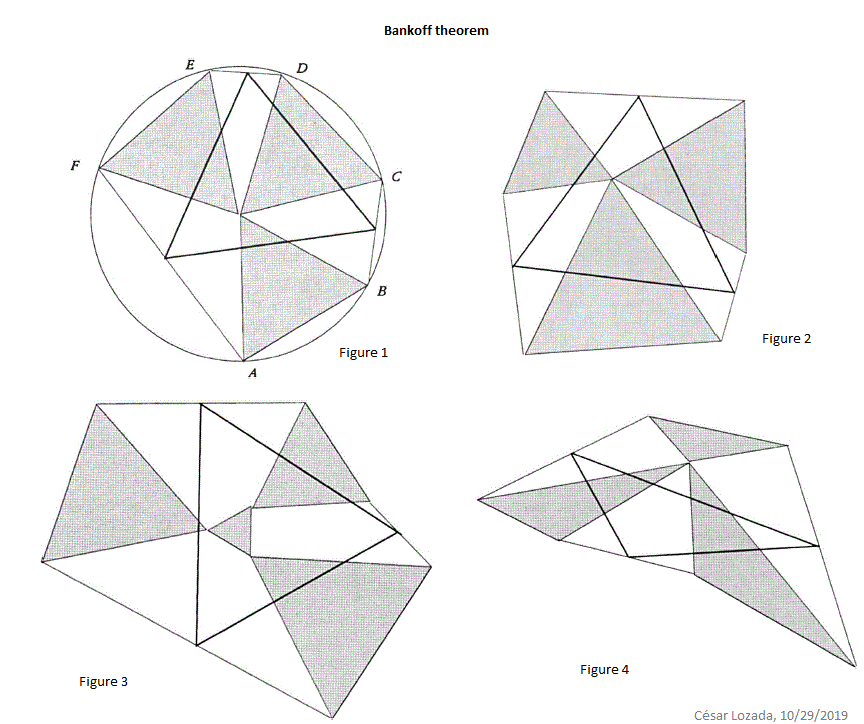
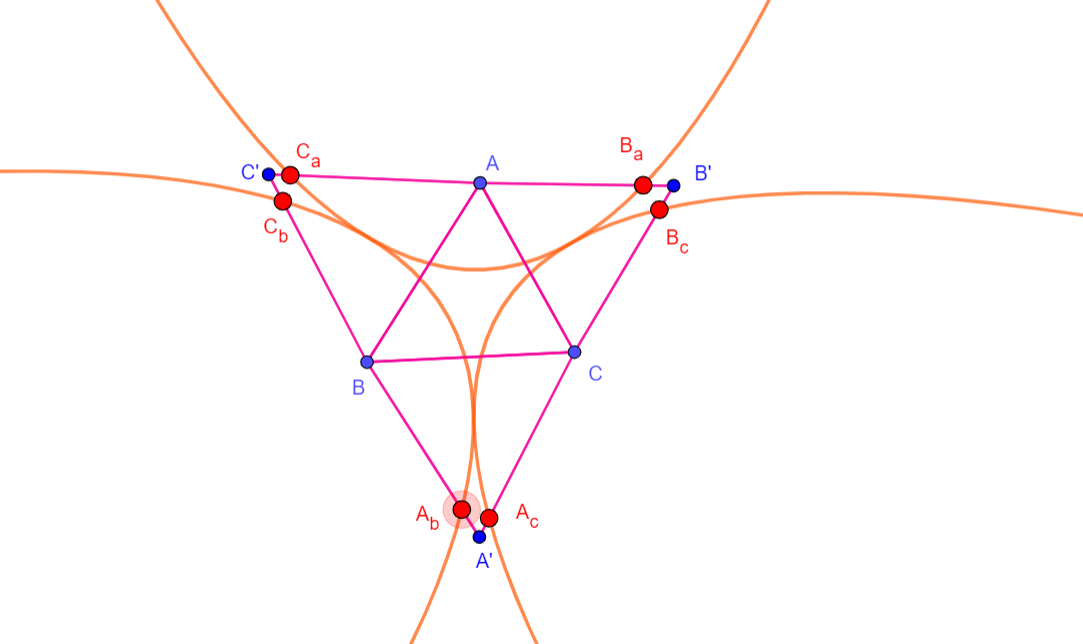
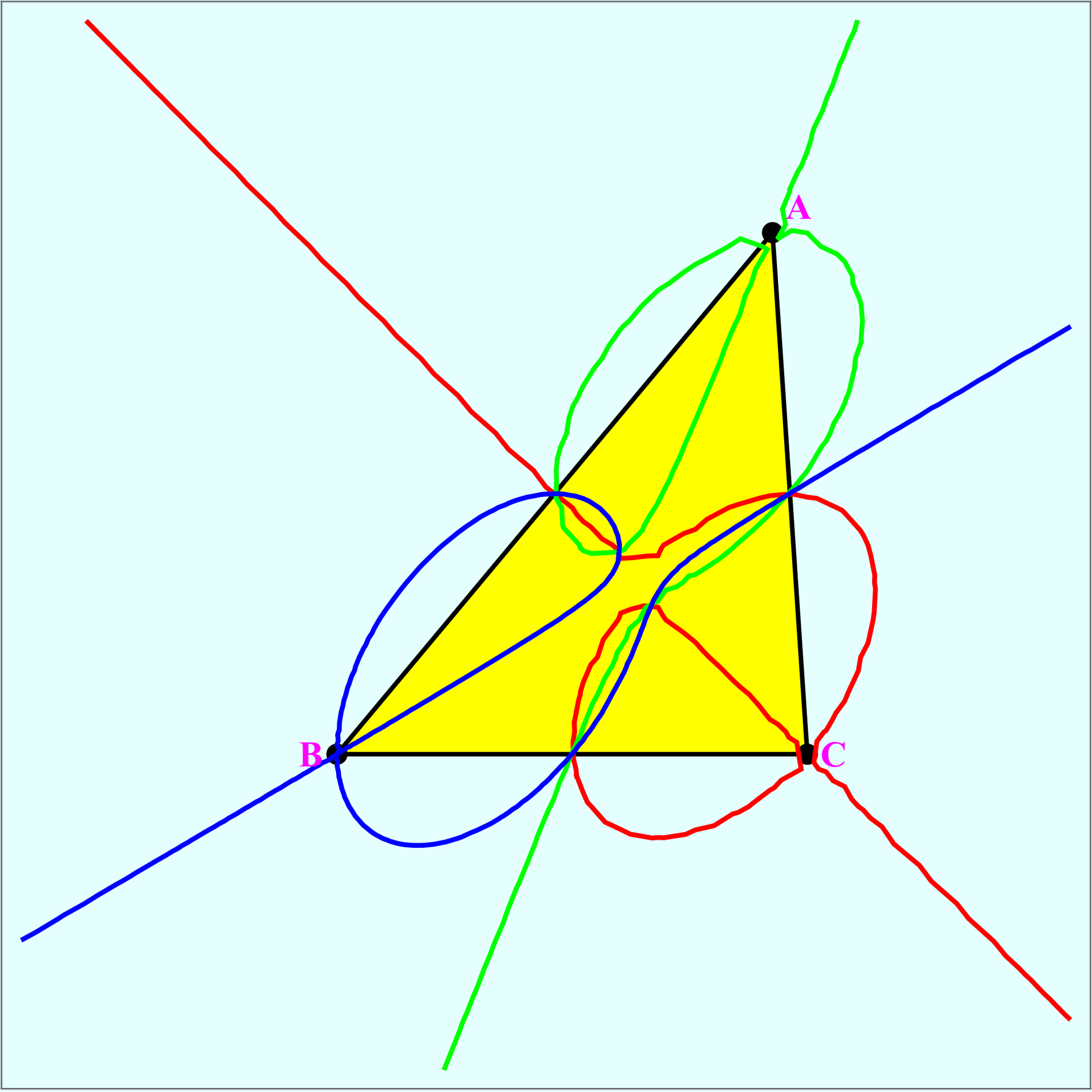
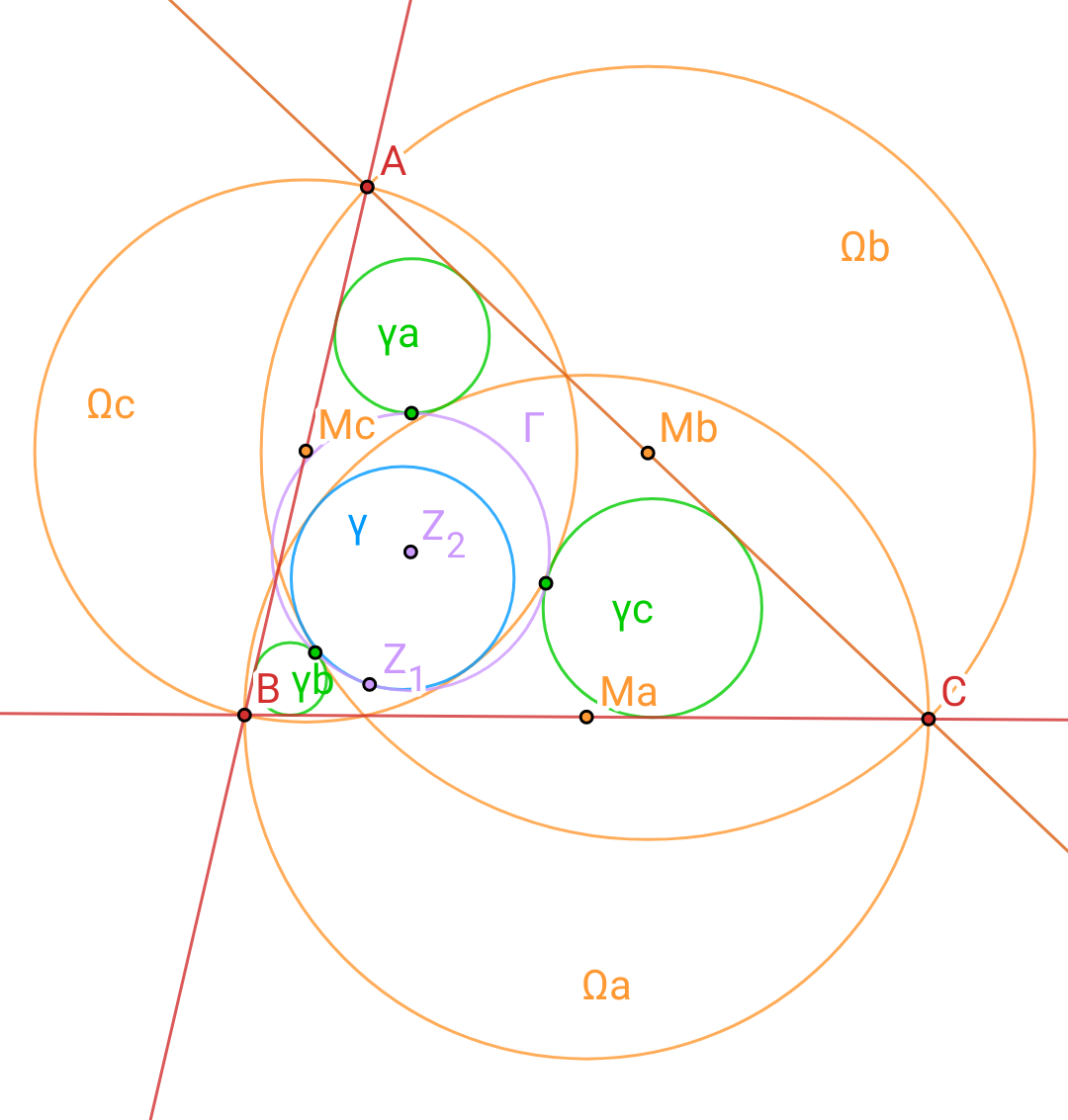
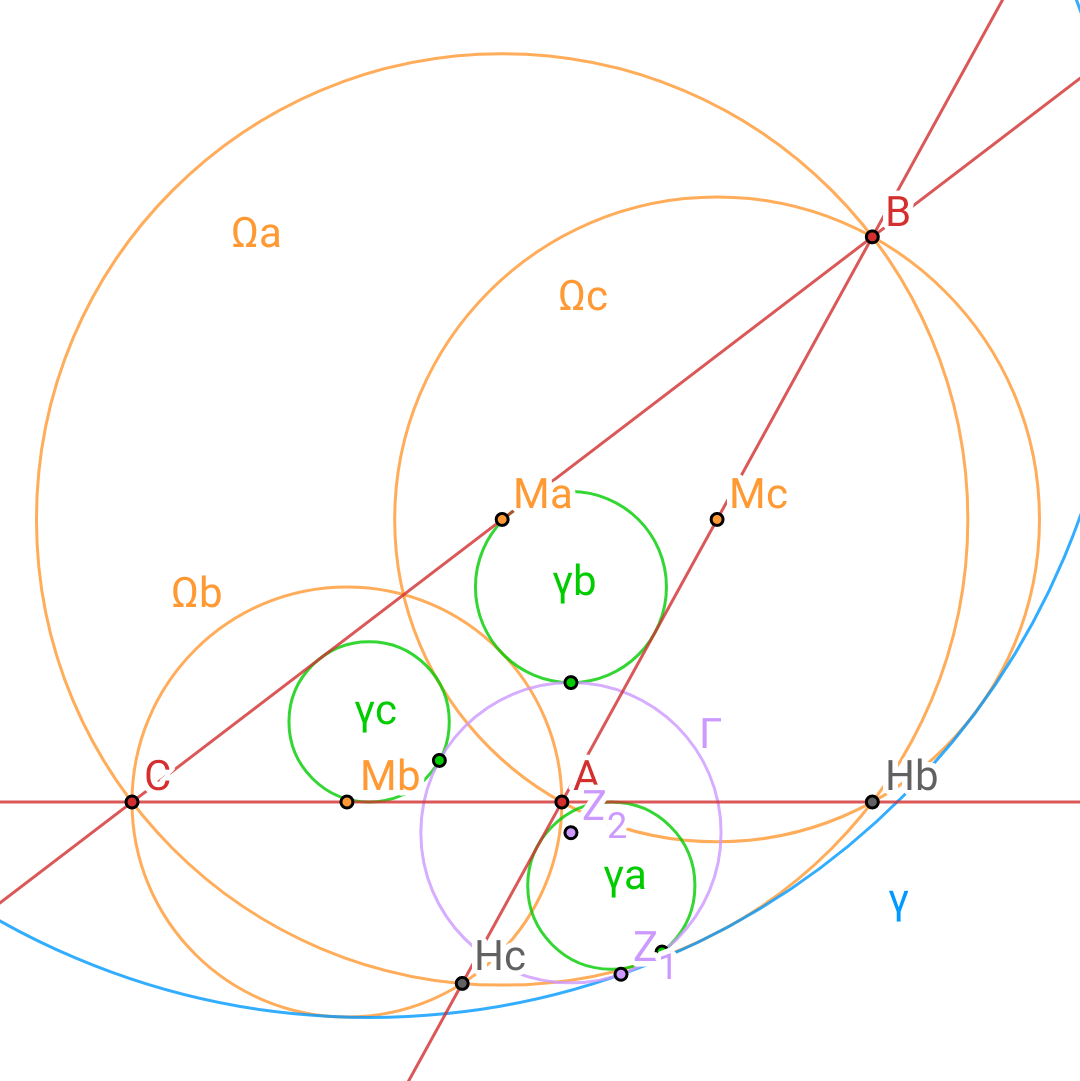
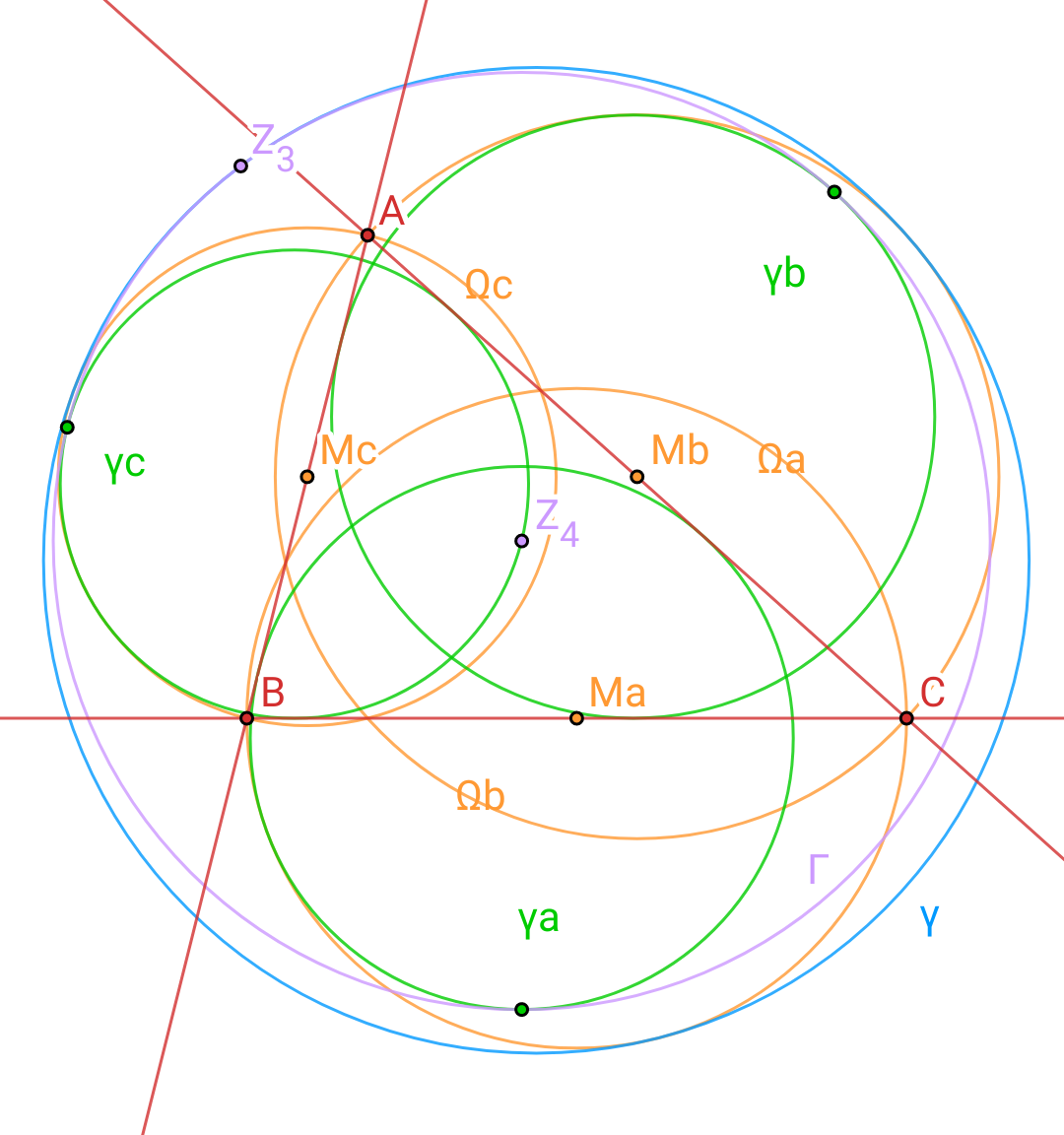
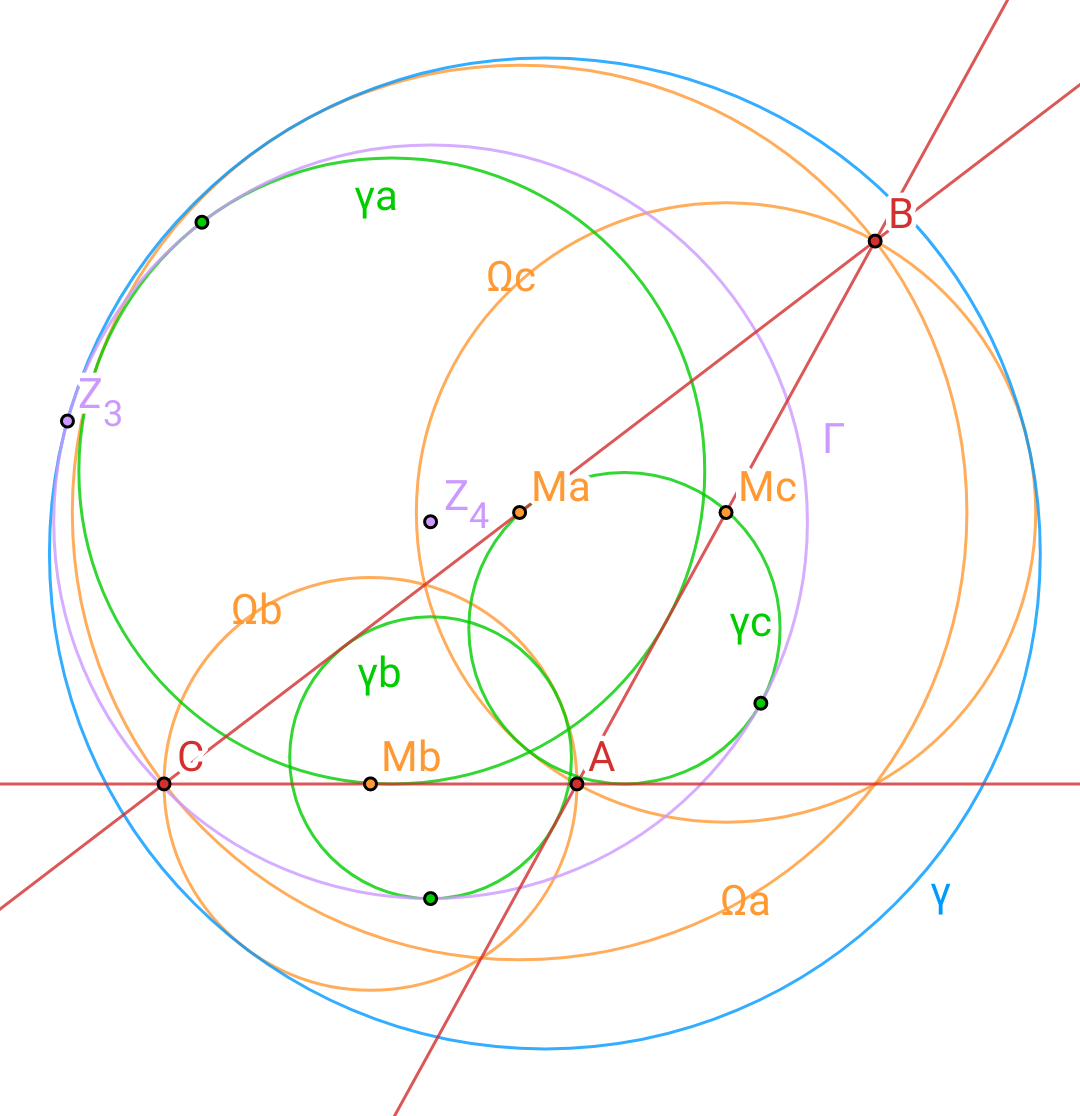
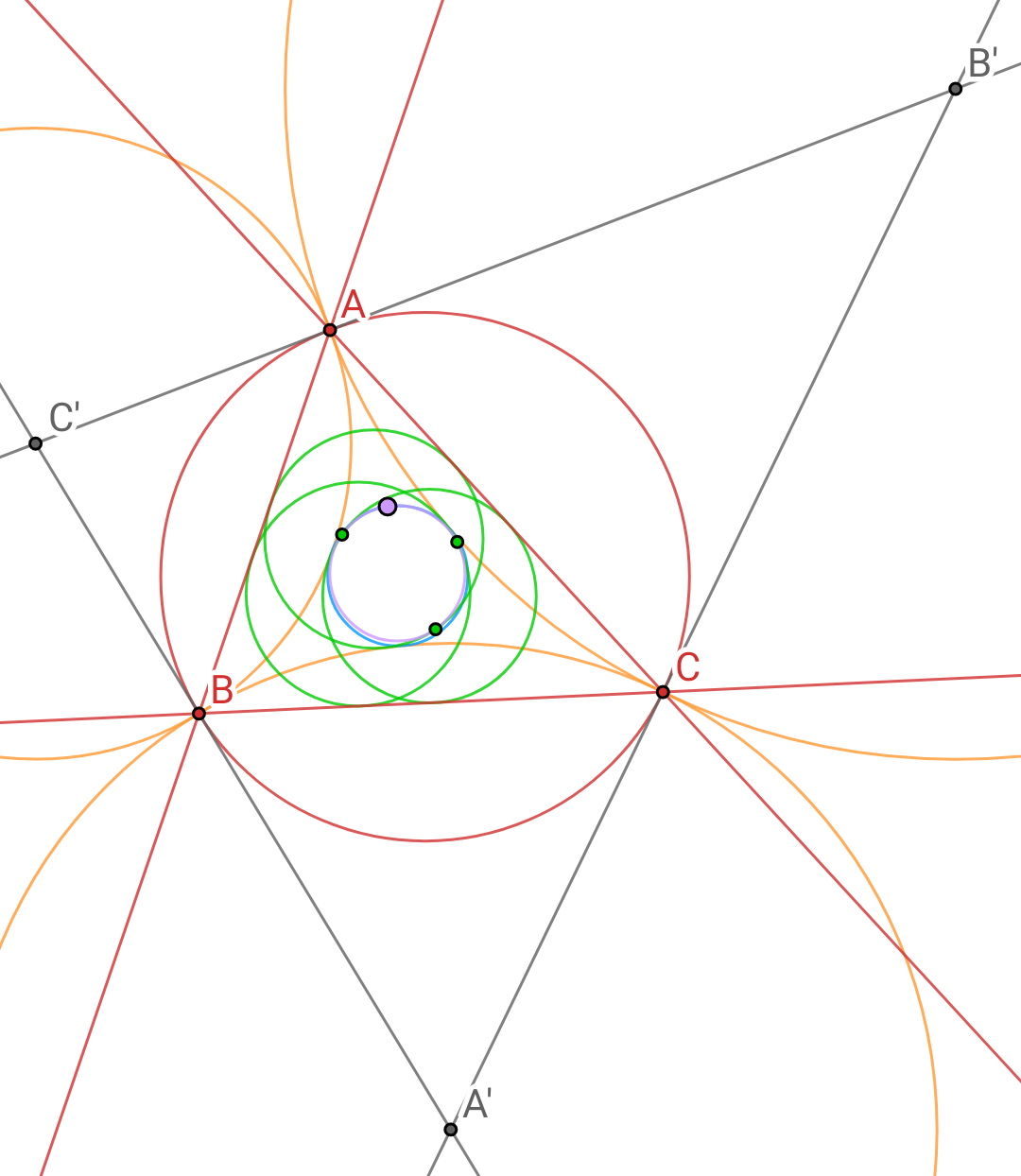
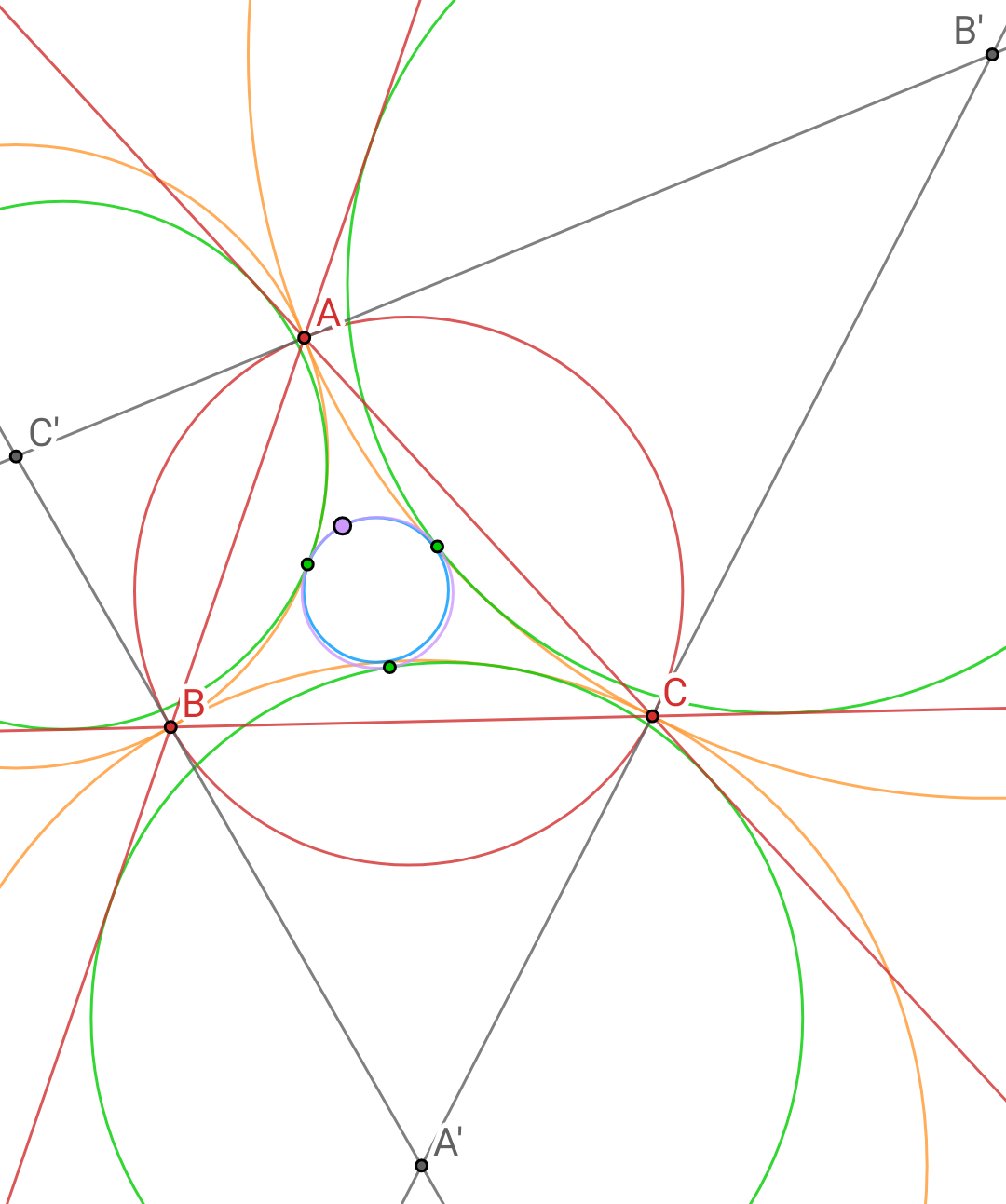
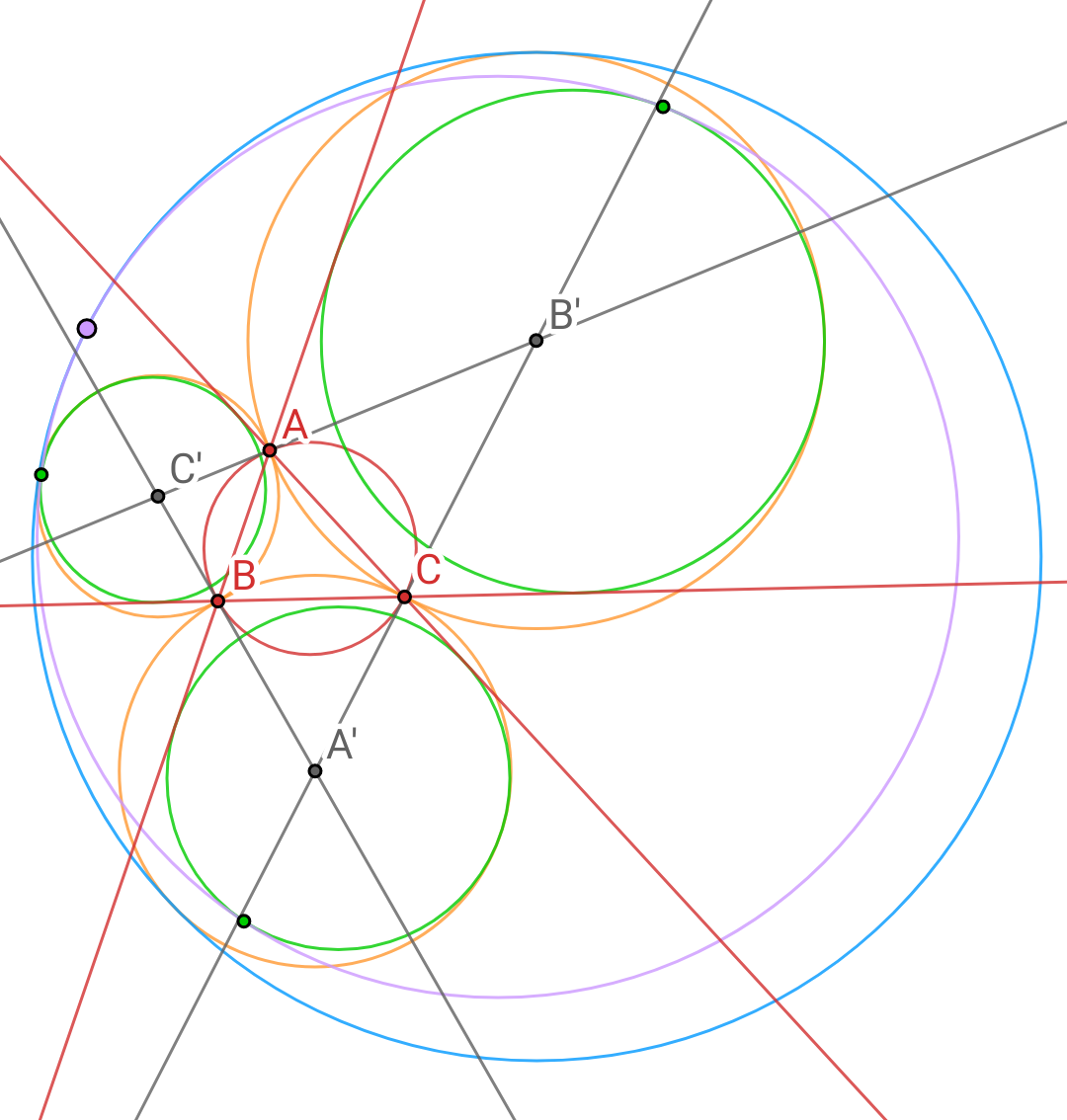
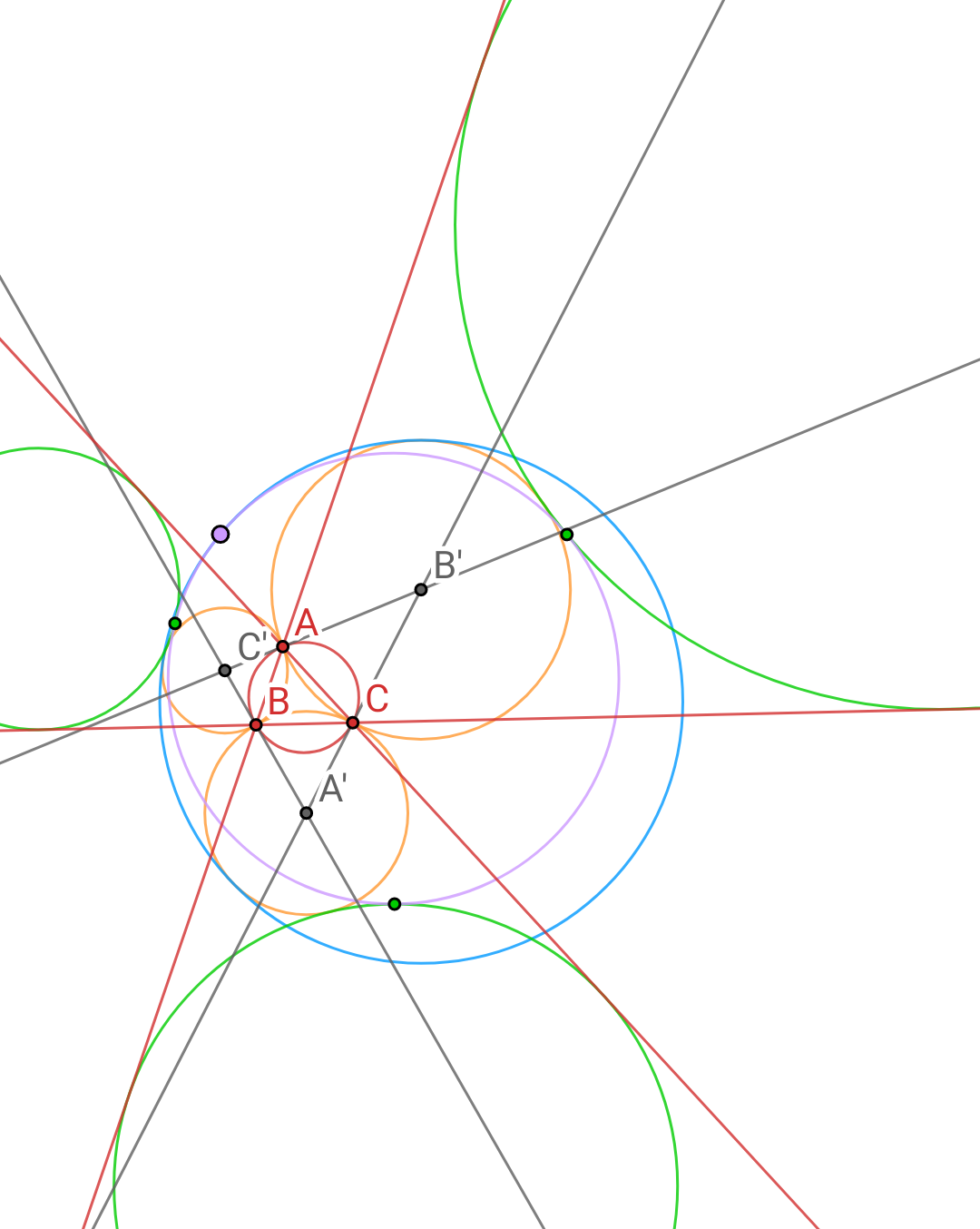
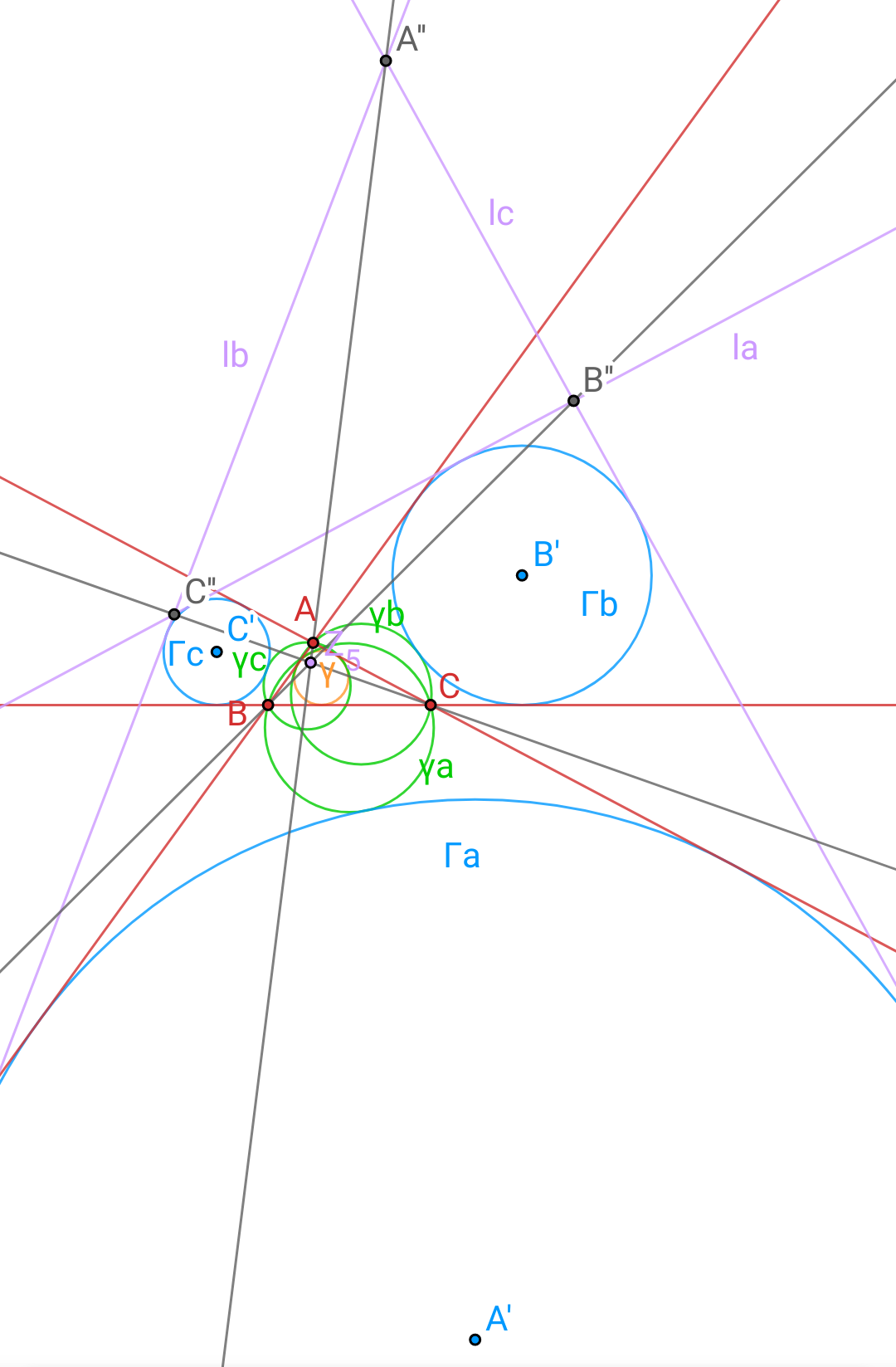
.jpg)