
Welcome to Tin City
Latest News:
UE Students have successfully unearthed a massive block of cement which has been speculated to have been once part of Tin City flooring.
What is Tin City?
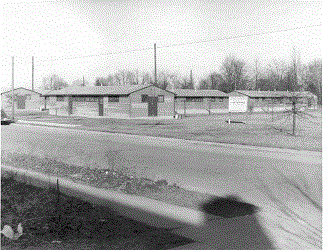
The Tin City excavation on the University of Evansville campus has been ongoing since 2003. Located near Neu Chapel, Moore Residence Hall, and Wheeler Concert Hall, the area between these buildings was once the site of 13 extra military barracks.
These barracks were purchased to accommodate the skyrocketing number of enrolling students and their families. Originally called Campus Court Apartments, in the 1950s it began to be called
“Tin City” by students, the nickname being acquired because of the shining aluminum siding. As they were meant to be more of a temporary residence, the University removed the barracks and replaced them with the aforementioned buildings in 1961.
These buildings, as result of their temporary nature, were lost in the folds of history. However, a member of the university’s archaeology department began to take an interest in the possibility of there being remains of “Tin City” on campus. Using old maps, surveying, and aerial photographs, the position of the buildings were discovered and the class, Archaeology 340 – Field Techniques, was founded.
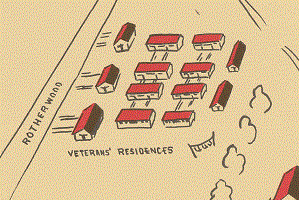
The goals of the project remain much as they were when the project started. The main purpose, besides giving students the perfect place to apply their archaeological knowledge, is to locate the 1950s era buildings. However, the archaeology department also wishes to gather information about the daily lives of those who lived in these apartments, as well as to test the historical integrity of these buildings. To put it in less academic terms: does the archaeological material match the eyewitness accounts, the written records, and the photographs of “Tin City”?
Despite the fact that the site was landscaped, the project has yielded wonderful results while also giving students an opportunity to practice archaeology. The project has produced bits of grey concrete, fragments of glass, porcelain shards, and many other artifacts indicative of a residential area and other evidence, such as aerial photographs, confirm this location to definitely be the site of “Tin City” (Kaiser).
Images
Image 1:Tin City Units, date uncertain
Image 2: Drawing of the Tin City Units from the inside cover of the LinC, 1948.
References:
Kaiser, A. (2005) Rediscovering Tin City. UE Magazine Winter. 4-5